Lending

Lending protocols form the backbone of the decentralized money market, allowing users to lend or borrow digital assets without intermediaries. Using smart contracts, platforms like Aave and Morpho automate interest rates based on supply and demand while requiring over-collateralization for security. The 2026 lending landscape features advanced permissionless vaults and institutional-grade credit lines. This tag covers the evolution of capital efficiency, liquidations, and the integration of diverse collateral types, including LSTs and tokenized RWAs.

15932 Articles
Created: 2026/02/02 18:52
Updated: 2026/02/02 18:52
Top Altcoins Whales Are Watching Closely Going Into Black Friday

Top Altcoins Whales Are Watching Closely Going Into Black Friday

The post Top Altcoins Whales Are Watching Closely Going Into Black Friday appeared on BitcoinEthereumNews.com. Key Insights: Top altcoins like SHIB, ENA, and MORPHO are drawing whale attention as prices sit far below earlier highs. Shiba Inu whale holdings rose 4.67% while the bull–bear power indicator flips toward strength. Morpho and Ethena show rising large-holder demand, but each still needs to clear key resistance levels to confirm a trend change. Top altcoins are getting attention as crypto whales look for good entries before Black Friday. These whales often buy when prices fall a lot, and many tokens are now far below their earlier highs. In this story, we look at three different types of altcoins: A well-known meme coin, a DeFi token linked to lending activity, and a popular project that has been active through this cycle. All three trade at discounts and show early signs that large holders are slowly returning. Shiba Inu (SHIB): One of the Top Altcoins on the List Shiba Inu is one of the top altcoins that still trades at a discount. It is down about 65% in one year and almost 90% below its all-time high. This large drop is why whales have started buying again. In the past 30 days, whales increased their SHIB holdings by 4.67%, and they now hold 86.89 billion SHIB. This shows they see the price as cheap compared to last year. SHIB Whales | Source: Nansen The price has also moved up by about 18% since Nov. 21. This happened after the bull–bear power turned green. Bull–bear power is a simple tool that shows if buyers or sellers are stronger. Green bars mean buyers lead. Red bars mean sellers lead. The last time this tool turned green in early November, SHIB made a short move up. It has turned back again now. SHIB needs to close above $0.0000088 to show a stronger recovery.…

Author: BitcoinEthereumNews
How Top-Rated Back Doctors Are Using Innovation to Redefine Spinal Health

How Top-Rated Back Doctors Are Using Innovation to Redefine Spinal Health

Back pain is one of the most common medical complaints worldwide—affecting nearly 8 out of 10 adults at some point in their lives. From long hours spent sitting at desks to age-related degeneration, our modern lifestyles often take a toll on the spine. Fortunately, new technologies and treatment techniques are changing the way back pain […] The post How Top-Rated Back Doctors Are Using Innovation to Redefine Spinal Health appeared first on TechBullion.

Author: Techbullion
Detailed Explanation of EigenLayer Cap: How to get retail investors to "lend" money to giant market makers without fear of them running away with the money?

Detailed Explanation of EigenLayer Cap: How to get retail investors to "lend" money to giant market makers without fear of them running away with the money?

Eigencloud is exploring the composability potential of Ethereum DeFi. Their recent Cap-based AVS is quite interesting, and they're trying to attract large institutions to participate. Previously, on-chain lending was seen as lacking sufficient security by some institutions, preventing them from engaging. Eigen's Cap-based approach might change that. This time, a major institution called Flow Traders has entered the fray. It's one of the world's largest market makers and a company listed on a European exchange. Market makers, known for their high liquidity, often need to borrow money to make market-making decisions and maximize profits. Now, they can borrow money directly on the Ethereum blockchain. The question is, who dares to lend to them? This is where Eigen's Cap comes into play, which can be simply understood as an "on-chain bank for Ethereum." The money users deposit into the pool (such as USDC) is often money from retail investors/funds/institutions/DeFi projects who want to earn more interest. Therefore, when the returns are in place and there is insurance, they are willing to lend it to Flow Traders. If Flow Traders' market makers provide returns for idle funds, and guarantors (such as YieldNest, which is also Eigen's operator) provide insurance, then YieldNest users are willing to pledge their own ETH as collateral. If Flow Traders default on their loans or misuse the funds (spending money recklessly/exceeding the collateral ratio), then lenders can forfeit the pledged ETH in YieldNest through the contract and receive compensation. So, what are the benefits for guarantors like YieldNest? Aren't they afraid of the risks? Guarantors can also make money, and the risks are relatively controllable. The fees mainly come from collecting guarantee fees (insurance fees). For example, if Flow Traders borrows 100 million USDC, it's willing to pay an extra "insurance/guarantee fee" to the guarantor (assuming the loan interest rate is 5%, now it's willing to pay 8%, the extra 3% is pure profit for guarantors like YieldNest). For YieldNest, by pledging its own ETH, it earns millions or even tens of millions of dollars in guarantee fees annually (depending on the loan size). This portion of ETH was already pledged on Eigenlayer; providing guarantee is equivalent to earning a substantial guarantee fee. Regarding risks, YieldNest will consider Flow Traders' qualifications (a regulated European listed company) and will lend a corresponding amount of collateral based on on-chain credit limits, without providing guarantees for all structures. Furthermore, in case of default, a warning will be issued first, and automatic forced liquidation will be triggered if the LTV exceeds the limit. Flow Traders uses a hard whitelist when lending money, prohibiting transfers to other account addresses (an alert will be triggered immediately if funds are transferred out); it requires borrowers to pledge their assets in the Cap protocol, and the collateral ratio cannot exceed the agreed LTV; and data must be reported as required.

Author: PANews
Korea is about to define DeFi’s next wave

Korea is about to define DeFi’s next wave

The post Korea is about to define DeFi’s next wave appeared on BitcoinEthereumNews.com. Disclosure: The views and opinions expressed here belong solely to the author and do not represent the views and opinions of crypto.news’ editorial. South Korea’s crypto scene has long stood out — defined by fearless traders, rapid market cycles, and the famous “Kimchi premium” that often pushed local prices far above global averages. This was never just a pricing anomaly; it was a reflection of something deeper: an unmatched retail appetite for risk and innovation. Summary Retail power drives innovation: Korea’s crypto market thrives on retail participation, with over a third of citizens trading and altcoins dominating volume — creating a high-risk, high-liquidity environment that fuels DeFi growth. Regulation brings maturity: The new Digital Asset Basic Act (DABA) unifies oversight, legitimizes DeFi, and encourages institutional participation through licensing, stablecoin initiatives, and venture support. Korea as DeFi’s launchpad: With active traders, clear regulation, and institutional engagement converging, South Korea is poised to lead the next phase of global DeFi development. Retail traders are the lifeblood of Korea’s crypto economy  Retail traders have always been the lifeblood of Korea’s crypto economy. Nearly one–third of the population now holds crypto accounts, and altcoins account for over 80% of total trading volume on domestic exchanges — a clear sign that Korean traders are constantly chasing new opportunities. Their risk-on mindset has often made Korea a bellwether for market trends, from speculative runs on microcaps to early experimentation with onchain products. While this intensity once came at the cost of stability, it also fueled innovation and liquidity. Rather than viewing volatility as a flaw, it’s time to see it as a feature — the very condition that allows DeFi to thrive. High trading frequency keeps DEXs liquid without relying solely on institutional capital, and Korea’s culture of active engagement makes it fertile ground for yield…

Author: BitcoinEthereumNews
Texas Allocates $5M into BlackRock’s $BTC ETF as Bitcoin Hyper Raises Over $28.5M

Texas Allocates $5M into BlackRock’s $BTC ETF as Bitcoin Hyper Raises Over $28.5M

Quick Facts: ➡️ Texas allocating $5M into a BlackRock Bitcoin ETF during a dip shows a growing state-level conviction in Bitcoin’s long-term upside. ➡️ Broader adoption of spot Bitcoin ETFs by institutions reinforces $BTC as macro collateral, even as on-chain scalability and programmability remain unresolved bottlenecks. ➡️ Bitcoin Hyper aims to address these with an […]

Author: Bitcoinist
UAE Sets Comprehensive Structure for Central Bank Authority Under New Decree-Law

UAE Sets Comprehensive Structure for Central Bank Authority Under New Decree-Law

The post UAE Sets Comprehensive Structure for Central Bank Authority Under New Decree-Law appeared on BitcoinEthereumNews.com. UAE’s new decree centralizes monetary authority and sharpens sector-wide oversight. Updated rules boost supervision, governance standards, and institutional accountability. Customer protection strengthens through stricter reporting, oversight, and intervention powers. The United Arab Emirates has introduced a wide regulatory overhaul that reshapes how the Central Bank functions across the national financial system. The new framework expands regulatory tools, sharpens institutional responsibilities, and links decision making with clearer accountability.  Consequently, the decree-law positions the Central Bank as the primary authority for monetary policy, sector supervision, and financial stability, while also clarifying how licensed institutions, insurers, and market infrastructure operators must meet national standards.  Besides, the updated model aims to create stronger oversight across banking, insurance, payments, and emerging financial technologies. Hence, the new structure supports a more predictable regulatory environment and helps institutions understand their obligations within the broader financial ecosystem. Clearer Powers and Institutional Responsibilities The decree-law confirms the Central Bank as a federal institution with full operational and financial independence. It reports directly to the President and operates under its own regulations.  Additionally, the framework separates the Bank from general public finance procedures, which allows greater flexibility in monetary operations. The law also defines which institutions fall under direct supervision.  Hence, banks, insurers, finance companies, and payment firms must comply with Central Bank rules. Financial free zones remain outside the scope because they follow separate legislation. Moreover, government-related entities must coordinate with the Central Bank when their work affects the national financial sector. Governance rules also receive major updates. The Board of Directors includes seven qualified members who serve renewable four-year terms. Each member must demonstrate financial or economic experience, hold UAE nationality, and avoid conflicts of interest.  The Central Bank also manages a defined capital structure that includes paid-up capital and reserve accounts. Additionally, annual audited statements support transparency…

Author: BitcoinEthereumNews
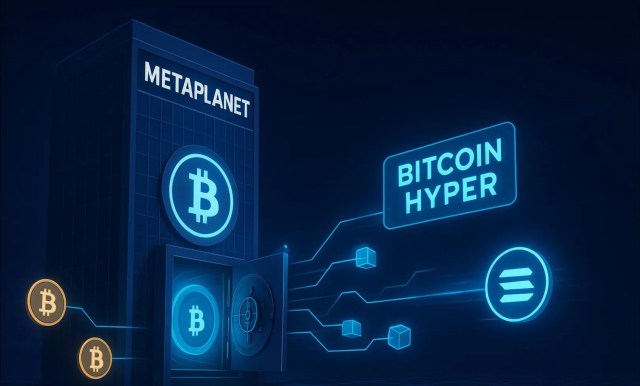
Metaplanet Leverages 30,823 $BTC for $130M Loan. Bitcoin Hyper Rides the Wave Into a $28.5M Presale

Metaplanet Leverages 30,823 $BTC for $130M Loan. Bitcoin Hyper Rides the Wave Into a $28.5M Presale

Quick Facts: ➡️ Metaplanet’s $130M Bitcoin-backed loan shows corporates increasingly treat $BTC as long-term collateral rather than a trading asset. ➡️ Metaplanet already owns 30,823 $BTC, worth over $2.7B, and has secured a $500M credit line to buy more. ➡️ Bitcoin Hyper ($HYPER) aims to marry Bitcoin settlement with SVM execution, targeting DeFi, payments, and […]

Author: Bitcoinist
Goblin launches GoAPT, the first enhanced LST on Aptos, building an infrastructure for annualized optimized yield.

Goblin launches GoAPT, the first enhanced LST on Aptos, building an infrastructure for annualized optimized yield.

PANews reported on November 26th that Goblin Finance, the native enhanced yield infrastructure of the Aptos ecosystem, officially launched its core product, GoAPT, today. GoAPT aims to build a yield infrastructure for Aptos centered on real strategy revenue sharing. Unlike traditional LSTs that only map the base staking APR, GoAPT not only retains approximately 6.5% of the network's base yield but also returns real yields from the strategy vault, GoVault, to the token price, resulting in an overall annualized yield of up to 1.3 times higher than before. Goblin stated that while Aptos has matured in its core modules such as DEX, lending, and stablecoins, its yield layer remains undeveloped. Goblin aims to create a "sustainable yield flywheel" through the GoAPT + GoVault combination: strategy yields are channeled into GoAPT price → attracting more APT staking → driving Vault yield growth → continuously benefiting users. GoVault has already deployed a diverse range of professional strategies, such as Automated Liquidity Management (ALM). It will also soon launch Delta-Neutral hedging and CeDeFi robust arbitrage strategies, with annualized returns ranging from 20% to 50%. Users only need to stake APT to participate in the strategy system and earn compound returns. Goblin will continue to expand its strategy matrix to promote GoAPT as a high-trust asset and liquidity standard in the Aptos ecosystem, empowering diverse scenarios such as lending and restaking, and further releasing the yield potential of the Aptos network.

Author: PANews
Hoskinson says the road to a Cardano revival is now underway

Hoskinson says the road to a Cardano revival is now underway

Analysis Of Hoskinson's Plan For A Cardano Revival, Detailing Midnight Glacier Drop, RealFi Loans, DeFi Push, And Base-Layer Scaling.

Author: The Cryptonomist
Stablecoins shed $6 billion in November, its largest monthly drop since 2022

Stablecoins shed $6 billion in November, its largest monthly drop since 2022

The stablecoin market has suffered its steepest monthly contraction since the collapse of Terra’s Luna and UST in…

Author: Technext