Lending

Lending protocols form the backbone of the decentralized money market, allowing users to lend or borrow digital assets without intermediaries. Using smart contracts, platforms like Aave and Morpho automate interest rates based on supply and demand while requiring over-collateralization for security. The 2026 lending landscape features advanced permissionless vaults and institutional-grade credit lines. This tag covers the evolution of capital efficiency, liquidations, and the integration of diverse collateral types, including LSTs and tokenized RWAs.

14755 Articles
Created: 2026/02/02 18:52
Updated: 2026/02/02 18:52
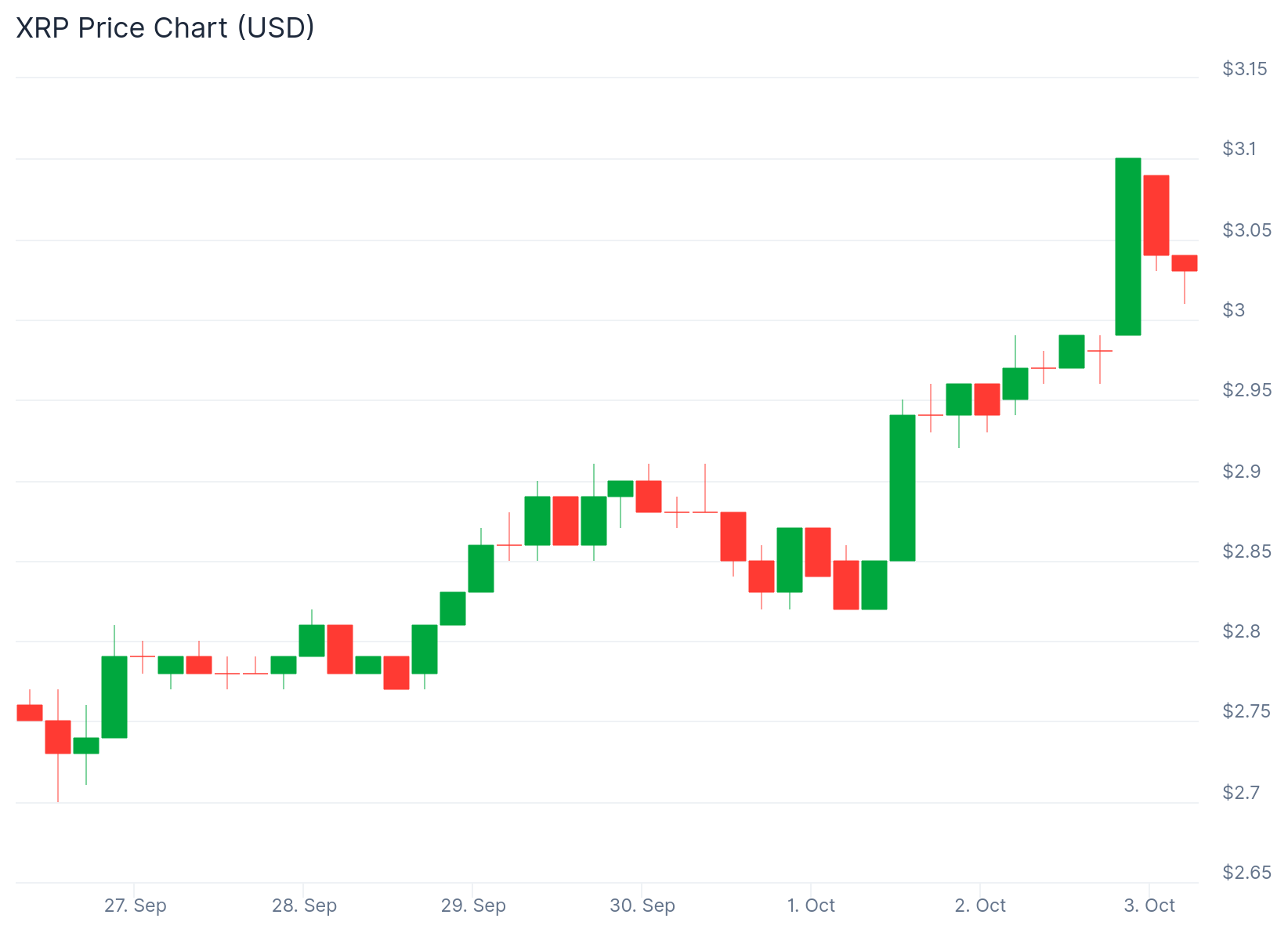
XRP Price: Token Hits $3 Following VivoPower Treasury Announcement

XRP Price: Token Hits $3 Following VivoPower Treasury Announcement

TLDR XRP rose above $3 on Oct 2, trading at $3.04 with a market cap of $181.8 billion and 24-hour volume exceeding $6.1 billion VivoPower International completed a $19 million equity raise at $6.05 per share to fund XRP treasury operations and debt repayment The Nasdaq-listed company repositioned itself as a digital treasury firm with [...] The post XRP Price: Token Hits $3 Following VivoPower Treasury Announcement appeared first on CoinCentral.

Author: Coincentral
Tether Debuts Gold-Backed Stablecoin XAUT on Arbitrum, Expanding Its Interoperability Solution

Tether Debuts Gold-Backed Stablecoin XAUT on Arbitrum, Expanding Its Interoperability Solution

With its launch on Arbitrum, XAUt0 aims to accelerate its usability and advance its accessibility across the wider decentralized finance world.

Author: Blockchainreporter
Hedging Tactics When the Market Turns Bearish

Hedging Tactics When the Market Turns Bearish

Image Every trader loves a bull market. Prices climb, optimism reigns, and it feels like every decision is the right one. But markets don’t rise forever. At some point, the tide turns. The charts bleed red, optimism fades, and fear takes over. That’s when hedging becomes not just a strategy, but a lifeline. Hedging isn’t about predicting the future or beating the market. It’s about survival. It’s the art of protecting your portfolio when sentiment shifts and uncertainty takes control. In crypto especially — where volatility is sharper and cycles move faster — having a hedging plan can mean the difference between riding out the storm and losing everything you’ve built. Why Hedge at All? The biggest mistake many traders make is assuming they can simply “wait out” the bear. But crypto winters are brutal and long. A coin that crashes 80 percent doesn’t just need to rise 80 percent to break even — it needs to rise 400 percent. That kind of recovery can take years, if it happens at all. Hedging isn’t about abandoning your conviction; it’s about buying yourself time and flexibility. By limiting downside, you protect capital, preserve emotional clarity, and keep dry powder for when the market finally turns again. Stablecoins: The First Line of Defense One of the simplest hedging tactics is rotating into stablecoins. Converting part of your holdings into USDT, USDC, or DAI shields you from price collapses while keeping you inside the crypto ecosystem. It also gives you liquidity. When panic-selling drives prices down, having stable reserves means you can re-enter at stronger levels instead of watching from the sidelines. The key here is proportion. Going 100 percent into stablecoins may feel safe, but it also means missing any surprise rebound. Many experienced traders hedge by shifting 20 to 50 percent of their portfolio, balancing stability with continued exposure. Short Positions: Profit from the Downside Another way to hedge is by taking short positions. This can be done through futures contracts, margin trading, or inverse ETFs where available. A short allows you to profit when prices fall, effectively offsetting losses in your spot holdings. For example, if you hold a significant amount of Ethereum, opening a small short position against ETH means that when the price drops, the gains from your short soften the blow to your portfolio. The challenge is that shorting carries its own risks — liquidation, funding fees, and the temptation to over-leverage. Used sparingly, though, it’s a powerful tool. Options: Insurance for Your Portfolio Options trading is another way to hedge, though less common among retail crypto traders. Buying a put option is like purchasing insurance — it gives you the right to sell an asset at a predetermined price. If the market drops, the option rises in value, offsetting some of your losses. The downside is cost: options premiums can add up, and if the market never falls, your “insurance” expires worthless. But just as homeowners pay for insurance they may never use, traders often find the peace of mind worth the price. Diversification: A Hedge Beyond Coins Hedging doesn’t always mean taking direct positions against your assets. Sometimes it means broadening exposure. A portfolio that holds only speculative altcoins is extremely vulnerable in a downturn. Adding Bitcoin or Ethereum, which tend to hold value better, provides relative stability. Going further, diversifying outside crypto — into equities, commodities, or even cash — creates a buffer against systemic risk. The FTX collapse in 2022 was a reminder that no matter how strong your token picks seem, a single event can shake the entire industry. A hedge across asset classes ensures your financial security isn’t entirely tied to crypto’s fate. Hedging with Yield and Passive Strategies Some traders choose to hedge through yield strategies. Staking Ethereum, lending stablecoins on DeFi platforms, or using liquidity pools can provide passive income even during downturns. While not immune to risks — smart contract exploits and platform failures are real threats — these methods create an income stream that cushions losses. Of course, the safer the bear hedge, the lower the return. Parking stablecoins in a reputable, insured yield platform might only offer a few percent annually, but in a bear market, preservation often matters more than profit. The Psychological Hedge Hedging isn’t just about money. It’s also about mindset. Bear markets test patience, discipline, and emotional resilience. By having a hedge in place — whether that’s stablecoins, shorts, or diversification — you free yourself from panic-driven decisions. You can watch the charts turn red without feeling like your entire future is at stake. That emotional buffer may be the most underrated hedge of all. Final Thoughts Bear markets are inevitable. The traders who survive aren’t the ones who try to time the exact bottom, but the ones who manage risk intelligently when the cycle turns against them. Hedging isn’t about eliminating losses — it’s about limiting them, preserving capital, and ensuring you’re still standing when the next bull run begins. So when the market turns bearish, ask yourself: are you exposed, or are you prepared? Because in crypto, the difference can be everything. If you found this breakdown helpful, don’t forget to clap, and follow me here on Medium for more deep dives into strategy, psychology, and risk management in the crypto markets. Hedging Tactics When the Market Turns Bearish was originally published in Coinmonks on Medium, where people are continuing the conversation by highlighting and responding to this story

Author: Medium
Bitcoin Tops $120,000 Amid US Government Shutdown

Bitcoin Tops $120,000 Amid US Government Shutdown

The post Bitcoin Tops $120,000 Amid US Government Shutdown appeared on BitcoinEthereumNews.com. Bitcoin surged past $120,000 on October 3 following the US federal government’s partial shutdown earlier this week. Investors sought safety in digital assets and gold, highlighting Bitcoin’s position as an alternative store of value when traditional systems falter. Just one day earlier, Cardano founder Charles Hoskinson predicted Bitcoin could reach $250,000 by mid-2026, citing geopolitical disruption as a catalyst. Sponsored Sponsored Government Shutdown Sparks Market Turbulence The shutdown began on October 1 after the Senate rejected a stopgap funding bill by a 55-45 vote, falling short of the 60 votes required. Without appropriations, federal agencies lost access to funding, placing roughly 150,000 government employees at risk of furlough. Market reactions were immediate. Futures tied to the S&P 500 dropped sharply in early trading hours, while gold rose 1.1% to $3,913.70 per ounce. Bitcoin jumped more than 2% overnight, reaching $116,400 before breaking through the $120,000 threshold the following day. Deutsche Bank strategist Jim Reid warned in a client note that the absence of official data releases, such as employment and inflation reports, left policymakers and investors in “complete blindness.” Bitcoin price chart Source: BeinCrypto Analysts see the shutdown as a direct contributor to market volatility. Matt Mena, a strategist at 21Shares, argued that delayed economic data may prompt the Federal Reserve to cut interest rates by 25 basis points in October, with another reduction likely in December. Lower real yields and a weaker dollar, he noted, historically provide favorable conditions for Bitcoin. Sponsored Sponsored The Bitcoin price action follows a recent Bloomberg interview in which Charles Hoskinson said he sees Bitcoin at around $250,000 by the middle of next year. Bitcoin’s Appeal in Geopolitical Fragmentation Hoskinson has repeatedly argued that geopolitical fragmentation strengthens the case for cryptocurrencies. Speaking to Bloomberg from TOKEN2049, Hoskinson noted the US government had publicly flagged Cardano…

Author: BitcoinEthereumNews
Bitcoin Tops $120,000 Amid US Government Shutdown, Echoing Hoskinson’s Forecast

Bitcoin Tops $120,000 Amid US Government Shutdown, Echoing Hoskinson’s Forecast

Bitcoin surged past $120,000 on October 3 following the US federal government’s partial shutdown earlier this week. Investors sought safety in digital assets and gold, highlighting Bitcoin’s position as an alternative store of value when traditional systems falter. Just one day earlier, Cardano founder Charles Hoskinson predicted Bitcoin could reach $250,000 by mid-2026, citing geopolitical disruption as a catalyst. Government Shutdown Sparks Market Turbulence The shutdown began on October 1 after the Senate rejected a stopgap funding bill by a 55-45 vote, falling short of the 60 votes required. Without appropriations, federal agencies lost access to funding, placing roughly 150,000 government employees at risk of furlough. Market reactions were immediate. Futures tied to the S&P 500 dropped sharply in early trading hours, while gold rose 1.1% to $3,913.70 per ounce. Bitcoin jumped more than 2% overnight, reaching $116,400 before breaking through the $120,000 threshold the following day. Deutsche Bank strategist Jim Reid warned in a client note that the absence of official data releases, such as employment and inflation reports, left policymakers and investors in “complete blindness.” Bitcoin price chart Source: BeinCrypto Analysts see the shutdown as a direct contributor to market volatility. Matt Mena, a strategist at 21Shares, argued that delayed economic data may prompt the Federal Reserve to cut interest rates by 25 basis points in October, with another reduction likely in December. Lower real yields and a weaker dollar, he noted, historically provide favorable conditions for Bitcoin. The Bitcoin price action follows a recent Bloomberg interview in which Charles Hoskinson said he sees Bitcoin at around $250,000 by the middle of next year. Bitcoin’s Appeal in Geopolitical Fragmentation Hoskinson has repeatedly argued that geopolitical fragmentation strengthens the case for cryptocurrencies. Speaking to Bloomberg from TOKEN2049, Hoskinson noted the US government had publicly flagged Cardano and added, “They tweeted about it. It’s going to the reserve,” a reference to earlier announcements about a proposed US crypto strategic reserve. With tensions between the US, Russia, and China complicating cross-border commerce, reliance on conventional banking systems becomes more politically constrained. Digital assets like Bitcoin, he suggested, offer a global settlement layer free from such restrictions. Amberdata’s derivatives director Greg Magadini described the shutdown as a “catalyst” that could either accelerate Bitcoin’s ascent or trigger sharp declines, depending on whether investors view it as a hedge against the dollar or as a risk asset. For now, the reaction is clear: Bitcoin rose nearly 4% within 24 hours, while Ethereum, XRP, Solana, and Dogecoin gained between 4% and 7%. The CoinDesk 20 Index climbed 5% to 4,217 points. The crisis also reflects Hoskinson’s earlier prediction that increased corporate involvement could solidify crypto’s credibility. Tech giants such as Apple and Microsoft have signaled growing interest, while Visa, Mastercard, and Stripe advance stablecoin integrations. This convergence between traditional finance and crypto is blurring industry lines, lending Bitcoin additional legitimacy during times of instability. Economic Risks and Policy Implications Economists warn that the longer the shutdown lasts, the more severe the consequences for US growth. Oxford Economics’ Ryan Sweet estimated that GDP could decline by 0.1 to 0.2 percentage points for each week of closure. A full-quarter disruption could reduce growth by as much as 2.4 percentage points. This potential contraction increases the likelihood of further monetary easing, creating conditions that may accelerate capital flows into digital assets. As traditional indicators remain unavailable, market participants face heightened uncertainty. “Bitcoin is among the few assets that thrive when the old playbook collapses,” according to analyst Mena. Hoskinson’s broader thesis, that crypto could dominate global finance within three to five years, appears increasingly relevant. “Crypto is 3–5 years away from taking over the world,” Hoskinson added. The US shutdown demonstrates how political dysfunction and economic uncertainty can undermine faith in traditional systems, while decentralized assets gain traction as alternatives. For investors, the episode underscores Bitcoin’s evolving role as both a hedge and a barometer of systemic fragility.

Author: Coinstats
Crypto.com taps Morpho DeFi lending

Crypto.com taps Morpho DeFi lending

The post Crypto.com taps Morpho DeFi lending appeared on BitcoinEthereumNews.com. Crypto.com, the Singapore-based cryptocurrency exchange, has informed its users that they will soon be able to borrow wrapped crypto assets and earn returns on stablecoins through Morpho, a decentralized finance (DeFi) lending protocol.  This update was made public after an announcement on Thursday, October 2, revealing that Morpho intends to establish stablecoin lending markets on the Cronos blockchain, with the launch of the first vaults anticipated later this year. With this combination, users can deposit wrapped Ether or Bitcoin into Morpho vaults and utilize them as collateral to borrow stablecoins and earn yield. The Morpho lending protocol acts as a game-changer in blockchain technology  Wrapped assets are tokens on one blockchain, such as Ethereum, that represent an asset from a different blockchain, like Bitcoin, at a 1:1 value. On Cronos, wrapped tokens like CDCETH and CDCBTC reflect ETH and BTC, enabling users to add value to the network and access DeFi lending markets without leaving the chain. Following these updates, Morpho’s co-founder and integration team lead, Merlin Egalite, said that they aim to provide a trusted user experience in the front, with DeFi infrastructure in the back. He further explained that the protocol will be directly combined into Crypto.com’s platforms, offering its lending features to all users. Morpho connects lenders and borrowers using platforms such as Aave and Compound. With its increased adoption, the protocol has been positioned as the second-largest DeFi lending protocol, with a total value locked of around $7.7 billion, according to reports from DefiLlama. For the accessibility of this protocol, Egalite mentioned that users based in the US will have the chance to access the protocol. He acknowledged that the Genesis Act hinders stablecoin issuers from directly paying reserve yields to holders. However, he stated that lending a stablecoin and earning yield is a different activity that…

Author: BitcoinEthereumNews
How Mutuum Finance (MUTM) Compares to Early Shiba Inu (SHIB)

How Mutuum Finance (MUTM) Compares to Early Shiba Inu (SHIB)

Shiba Inu (SHIB) stormed the world in 2021 with its viral community-backed momentum and meme-driven rally, turning small investments into life-changing gains. Now, the same level of hype and investor attention is forming around Mutuum Finance (MUTM), except this time there is far more to the fervor than speculation. While SHIB’s runaway success was built […]

Author: Cryptopolitan
Polkadot (DOT) in 2025: The Network of Networks Powering Interoperable Web3

Polkadot (DOT) in 2025: The Network of Networks Powering Interoperable Web3

📑 Table of Contents Polkadot: A Network of Networks The Vision Behind Polkadot’s Creation How Polkadot’s Modular Technology Works Governance and Community Power Polkadot in Action: Examples and Partners DOT Tokenomics Explained Polkadot’s Roadmap and Future Outlook FAQ: 10 Unanswered Questions About Polkadot 🌐 Polkadot: A Network of Networks Polkadot is one of the most [...]]]>

Author: Crypto News Flash
Bank of England Governor Proposes Stablecoins as Alternative to Banks

Bank of England Governor Proposes Stablecoins as Alternative to Banks

TLDR Bailey says stablecoins could separate money from credit, reducing reliance on commercial banks. The Bank of England plans to allow stablecoins access to central bank accounts. Bailey calls for scrutiny of stablecoins, emphasizing the need for risk-free backing assets. Industry groups criticize proposed stablecoin ownership limits, arguing it could harm innovation. Bank of England [...] The post Bank of England Governor Proposes Stablecoins as Alternative to Banks appeared first on CoinCentral.

Author: Coincentral
Crypto.com to integrate Morpho lending, bringing stablecoin yield to Cronos

Crypto.com to integrate Morpho lending, bringing stablecoin yield to Cronos

                                                                               Crypto.com is adding Morpho lending to Cronos, allowing users to earn stablecoin yields on wrapped BTC and ETH, mirroring Coinbase’s push into DeFi lending.                     Crypto.com users will soon be able to lend wrapped crypto assets and earn yield on stablecoins through Morpho, a decentralized finance (DeFi) lending protocol.According to a Thursday statement, Morpho will launch stablecoin lending markets on the Cronos blockchain, with the first vaults expected this year. The integration will allow users to deposit wrapped Ether (ETH) or Bitcoin (BTC) into Morpho vaults and borrow stablecoins against them to earn yield.Wrapped assets are tokens that represent another cryptocurrency on a different blockchain. On Cronos, wrapped tokens such as CDCETH and CDCBTC mirror ETH and BTC, allowing users to bring value into the network and access DeFi lending markets without leaving the chain.Read more

Author: Coinstats