CEX

CEXs are platforms managed by centralized organizations that facilitate the trading of cryptocurrencies, offering high liquidity and user-friendly fiat on-ramps. Leaders like Binance, OKX, and Coinbase serve as the primary gateways for institutional and retail entry. In 2026, the industry focus is on Proof of Reserves (PoR), enhanced regulatory compliance, and hybrid models that offer self-custody options. This tag provides updates on exchange security, listings, and global market trends.

4135 Articles
Created: 2026/02/02 18:52
Updated: 2026/02/02 18:52

$27 Billion WLFI Token Goes Live Listed on Top DEXs

$27 Billion WLFI Token Goes Live Listed on Top DEXs

Key Takeaways: WLFI token officially launches with a massive 27 billion supply now live on Ethereum, Solana, and BNB Chain DEXs. Trump family-backed project adds political weight and controversy, pushing The post $27 Billion WLFI Token Goes Live Listed on Top DEXs appeared first on CryptoNinjas.

Author: Crypto Ninjas
Mirror Chain ($MIRROR) Could Be Crypto’s Biggest Passive Income Revolution

Mirror Chain ($MIRROR) Could Be Crypto’s Biggest Passive Income Revolution

The post Mirror Chain ($MIRROR) Could Be Crypto’s Biggest Passive Income Revolution appeared on BitcoinEthereumNews.com. Crypto News Mirror Chain introduces a new passive income model in crypto. Built as a Layer 2 blockchain with Zero-Knowledge Rollups and Mirrored Virtual Machines, it ensures scalability, speed, and cross-chain compatibility. Through its unique Repetitive Earning Mechanism (R.E.M.), $MIRROR holders automatically earn multi-token rewards daily, creating a reliable income stream for life. How Mirror Chain is Changing the Passive Income Game Mirror Chain offers users automatic rewards without staking or farming. Every transaction across the ecosystem contributes to holders through a 1% redistribution fee. This fee is shared instantly and automatically, eliminating the need for third-party platforms or complex processes. Holders benefit from multi-token rewards, as all tokens transacting within the ecosystem participate in the reward system. Therefore, whether using $MIRROR directly or other integrated tokens, every holder gains consistent passive income. The low fees, high speed, and EVM compatibility enable seamless integration for developers and projects within the ecosystem. Moreover, the high-level audits and governance features ensure long-term security and transparency. $MIRROR Token Presale and Reward Potential The $MIRROR token has a total supply of 1,000,000,000. Its distribution is structured as follows: 10% Private Sale 10% Public Sale 20% Ecosystem & Staking Rewards 20% Marketing 18% Developer Fund 10% Liquidity & Exchange Support 4% Team (locked and vested) The presale price for Phase 1 is set at $0.0512. Already, $807K has been raised out of the $1M target. Investors can participate using Ethereum, USDC, USDT, or debit and credit cards. The next price adjustment will occur in less than two days. Early investors are projected to achieve up to 156% APY, positioning $MIRROR as one of the most attractive passive reward systems available. Why $MIRROR Token is the Key to Long-Term Crypto Success The Reflection Earning Mechanism ensures that 1% of every transaction across Mirror Chain flows back…

Author: BitcoinEthereumNews
Crypto Presale Alert: BlockchainFX Surges Ahead With $6.28M Raised as Algorand Price Predictions Lag

Crypto Presale Alert: BlockchainFX Surges Ahead With $6.28M Raised as Algorand Price Predictions Lag

BlockchainFX presale hits $6.28M with 90% APY and 35% bonus tokens, outshining Algorand price predictions as the best presale crypto 2025.

Author: Blockchainreporter
Pi Faces Pump & Dump After Pi Network Upgrades

Pi Faces Pump & Dump After Pi Network Upgrades

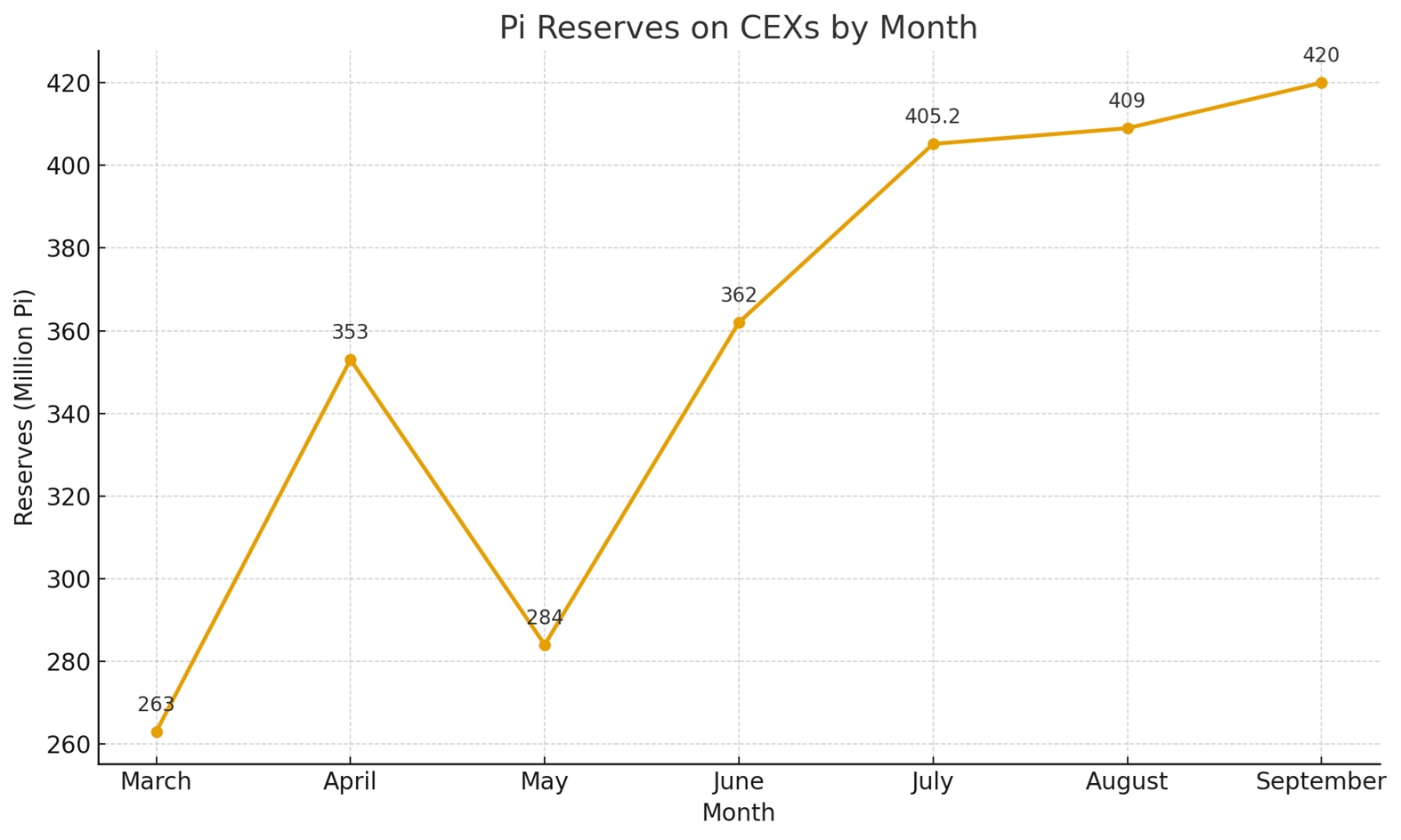
The post Pi Faces Pump & Dump After Pi Network Upgrades appeared on BitcoinEthereumNews.com. Key Notes Pi coin has dropped 10% to under $0.35, as rising exchange deposits and upcoming token unlocks point to further downside risk. Pi reserves on centralized exchanges have reached a record 420 million PI. More than 164 million Pi tokens are scheduled to unlock in September, creating potential selling pressure in a low-liquidity environment. Pi coin PI $0.34 24h volatility: 6.7% Market cap: $2.73 B Vol. 24h: $65.65 M , the native cryptocurrency of Pi Network, faced a classic pump and dump, and is down 10% today, slipping under $0.35. Following the Pi Network Linux Node update last week, the Pi token surged all the way to $0.40, where it faced huge selling pressure. Moving into September, exchange deposits and token unlocks will play a crucial role in deciding the further price trajectory. What Happens to Pi in September? As the Pi coin price sees a strong pullback to $0.35 after last week’s rejection, analysts are keen on what could happen in September. Historically, this has been the month of underperformance for the border crypto market. There are other factors that could influence the Pi coin trajectory moving ahead. The first warning sign comes as Pi coin reserves on centralized exchanges (CEXs) hit a record high, exceeding 420 million PI, according to Piscan data. In mid-August, the total exchange supply was at 409 million PI tokens. Pi coin supply on exchanges. | Source: Pi Scan This shows that over 11 million PI have moved to CEXs in just two weeks, suggesting rising selling pressure, while Pi’s daily trading volume remains under $100 million. The combination of rising supply and low liquidity sets the stage for potential further declines. More than 164 million PI tokens are scheduled to unlock in September, per Piscan’s monthly statistics. These releases, part of the…

Author: BitcoinEthereumNews
Only $0.0512 Today: Mirror Chain ($MIRROR) Could Be Crypto’s Biggest Passive Income Revolution

Only $0.0512 Today: Mirror Chain ($MIRROR) Could Be Crypto’s Biggest Passive Income Revolution

Through its unique Repetitive Earning Mechanism (R.E.M.), $MIRROR holders automatically earn multi-token rewards daily, creating a reliable income stream for […] The post Only $0.0512 Today: Mirror Chain ($MIRROR) Could Be Crypto’s Biggest Passive Income Revolution appeared first on Coindoo.

Author: Coindoo
Pi Coin Faces Classic Pump and Dump Despite Recent Pi Network Upgrade, ETP News

Pi Coin Faces Classic Pump and Dump Despite Recent Pi Network Upgrade, ETP News

Pi coin has come under strong selling pressure after a rejection at $0.40 following the recent Pi Network updates last week. The post Pi Coin Faces Classic Pump and Dump Despite Recent Pi Network Upgrade, ETP News appeared first on Coinspeaker.

Author: Coinspeaker
Meme coin nào sẽ 100x tiếp theo? PEPENODE có thể vượt Pepe vào năm 2025

Meme coin nào sẽ 100x tiếp theo? PEPENODE có thể vượt Pepe vào năm 2025

Không gian meme coin vẫn liên tục xuất hiện nhiều dự án mới, nhưng đa phần chỉ lặp lại mô hình quen thuộc: phát hành token, tạo sóng meme trên mạng xã hội và trông chờ hiệu ứng viral. PEPENODE đã phá vỡ khuôn mẫu này khi mang đến game đào ảo, cơ chế đốt […]

Author: Bitcoinist
Fluid: Redefining the capital efficiency benchmark for DeFi lending and trading

Fluid: Redefining the capital efficiency benchmark for DeFi lending and trading

Author: Castle Labs Compiled by AididiaoJP, Foresight News Money markets are at the heart of DeFi, allowing users to gain exposure to specific assets using a variety of strategies. Over time, this vertical has grown in both value locked (TVL) and functionality. With the introduction of new protocols like @MorphoLabs, @0xFluid, @eulerfinance, and @Dolomite_io, the range of functionality available through lending protocols has expanded. In this report, we focus on one of these protocols: Fluid. Fluid has launched several features, the most interesting of which are smart debt and smart collateral. It cannot be regarded as an ordinary lending protocol because it also combines its DEX functionality to provide users with more services. Fluid is showing significant growth in both DEX and lending verticals, with a total market size (in terms of total deposits) exceeding $2.8 billion. Fluid market size, source: Dune, @dknugo Fluid Market Size represents the total deposits in the protocol. This metric was chosen over TVL because debt is a productive asset in the protocol and contributes to exchange liquidity. Overview of Fluid components and how it works This section briefly outlines the components of the Fluid protocol and explains how it operates, with a focus on why it is a capital-efficient protocol. Fluid uses a unified liquidity model where multiple protocols can share liquidity, including the Fluid lending protocol, Fluid Vaults, and DEX. Fluid Lending allows users to provide assets and earn interest. The assets provided here are used throughout the Fluid ecosystem, improving their capital efficiency. It also opens up long-term yield opportunities as the protocol continuously adapts to changes in the borrower and lender market. Fluid Vaults are single-asset, single-liability vaults. These vaults are extremely capital-efficient because they allow for high LTVs (loan-to-value ratios), up to 95% of the collateral value. This number determines a user's borrowing capacity, as opposed to the deposited collateral. Fluid also employs a unique liquidation mechanism that reduces liquidation penalties to as low as 0.1%. The protocol only liquidates the amount necessary to restore a position to a healthy state. Fluid's liquidation process is inspired by the design of Uniswap V3. It categorizes positions by scale or range of their LTV and executes batch liquidations when the collateral value reaches the liquidation price. DEX aggregators then use these batches as liquidity: liquidation penalties translate into discounts for traders when they swap. Fluid DEX earns an additional layer of income for the liquidity layer through transaction fees generated by exchanges, further reducing borrowers' position interest while improving the capital efficiency of the entire protocol. Different DEX aggregators, such as KyberSwap and Paraswap, use Fluid DEX as a liquidity source to obtain deeper liquidity and increase trading volume. On Fluid, users can deposit their collateral into a DEX and earn both lending fees and trading fees, making it a Smart Collateral. If users wish to borrow against their collateral, they can borrow assets or open a Smart Debt Position, making their debt productive. For example, users can borrow from a pool of ETH and USDC/USDT. They can deposit ETH as collateral and borrow USDC/USDT. In exchange, they receive USDC and USDT in their wallets, which they can use as they wish, while the trading fees earned from this liquidity pool are used to reduce their outstanding debt. Fluid's latest progress and expansion Based on trading volume data over the past seven days, Fluid DEX ranks #4, behind only @Uniswap, @Pancakeswap, and @AerodromeFi. Fluid's partnership with Jupiter Lend has launched, a feature that has been in private beta since the beginning of the month, and Fluid DEX Lite has already launched. Additionally, Fluid DEX v2 will be available soon. DEXs ranked by 7-day trading volume. Source: Dune, @hagaetc In addition to this, the protocol also anticipates a token buyback as its annual revenue exceeds $10 million. Fluid recently published a post on its governance forum regarding this, which opened a discussion about the buyback and proposed three approaches. See the different proposed approaches here: https://x.com/0xnoveleader/status/1957867003194053114 Subject to governance approval (after discussion), the buyback will begin on October 1st, with a 6-month evaluation period. Jupiter Lend: Fluid Enters Solana Fluid’s expansion to Solana is in partnership with @JupiterExchange. Jupiter is the largest DEX aggregator on Solana, with a cumulative trading volume of over $970 billion. It is also the leading perpetual contract exchange and staking solution on Solana. The TVL of Solana lending now exceeds $3.5B, with @KaminoFinance being the primary contributor. The lending vertical on Solana offers significant growth potential for Fluid. @jup_lend recently launched its public beta after a few days of private testing. Its TVL has surpassed $250 million, making it the second-largest money market on the Solana blockchain, behind only Kamino. Jupiter Lend, launched in partnership with Fluid, offers similar functionality and efficiencies, with smart collateral and smart debt expected to launch on the platform later this year. Additionally, 50% of the platform's revenue will be allocated to Fluid. Fluid DEX iteration Fluid has already launched its DEX Lite and plans to launch V2 soon. This section will cover both and explain how these iterations will help Fluid grow further. Fluid DEX Lite Fluid DEX Lite launched in August and serves as a credit layer on Fluid, enabling borrowing directly from the Fluid liquidity layer. It has begun providing trading volume services for relevant trading pairs, starting with the USDC-USDT pair. This version of Fluid DEX is extremely gas efficient, reducing the cost of performing swaps by approximately 60% compared to other versions. It was created to capture a larger share of trading volume in the relevant trading pairs, where Fluid is already the dominant protocol. In its first week, Fluid Lite generated over $40 million in trading volume, with initial liquidity of $5 million borrowed from the liquidity layer. Fluid DEX Lite trading volume. Source: Dune, @dknugo Fluid DEX V2 Fluid DEX V1, launched in October 2024, surpassed $10 billion in cumulative trading volume on Ethereum in just 100 days, faster than any other decentralized exchange. To support this growth, Fluid is launching V2, designed with modularity and permissionless scalability in mind, allowing users to create multiple custom strategies. First, V2 will introduce four different types of DEXs within the protocol, two of which are inherited from V1. Fluid will support more DEX types than just these four, with more types being deployable through governance. The two new types introduced are Smart Collateral Range Orders and Smart Debt Range Orders, both of which allow borrowers to help improve their capital efficiency. Smart Collateral Range Orders function similarly to Uniswap V3, allowing users to provide liquidity by depositing collateral within a specific price range while also earning an annualized percentage rate (APR) on the borrowed funds. Smart Debt Range Orders work similarly, allowing users to create range orders by borrowing assets on the debt side and earn an annual percentage rate (APR) on the trade. Additionally, it introduces features like hooks (similar to Uniswap V4) for custom logic and automation, flash accounting to improve fee efficiency for CEX-DEX arbitrage, and on-chain yield accumulation limit orders, which means limit orders can earn annual lending rate (APR) while waiting to be filled. in conclusion Fluid continues to grow and improve by offering a unique set of features to become more capital efficient. Smart Collateral: Collateral deposited on the platform can be used to earn lending interest and transaction fees. Smart Debt: Smart Debt reduces debt by paying off part of it using transaction fees generated by the debt, making the debt borrowed by users productive. Unified Liquidity Layer: Fluid’s unified liquidity layer improves capital efficiency across the ecosystem by providing features such as higher LTV, advanced liquidation mechanisms, and automatic capping for better risk management. Its recent expansion into Solana through its partnership with Jupiter has broadened its market share in the lending category to non-EVM networks. Meanwhile, Fluid DEX Lite and DEX V2 aim to enhance user experience and increase transaction volume on EVM chains. Additionally, DEX V2 is expected to launch on Solana later this year, which will enable Fluid to enter Solana’s lending and exchange verticals.

Author: PANews
WLFI official multi-sig transfers 485 million market-making tokens to Jump Crypto

WLFI official multi-sig transfers 485 million market-making tokens to Jump Crypto

PANews reported on September 1 that according to Aunt Ai, the official WLFI multi-sig has just transferred a total of 485 million market-making tokens to two addresses of Jump Crypto, accounting for 0.485% of the total supply of WLFI and 16.2% of the 3 billion " CEX liquidity + DEX LP " .

Author: PANews
Meme Coin Presale Buzz: Why Analysts Are Watching these 5 Top Cryptos to Buy Now

Meme Coin Presale Buzz: Why Analysts Are Watching these 5 Top Cryptos to Buy Now

Arctic Pablo Coin’s presale is raising millions with staking rewards, referral incentives, and a CEX200 bonus, making it the top crypto to buy now in 2025.

Author: Blockchainreporter