New dataset transforms complex regulatory filings into standardized financial data accessible through high-performance APIs viaNexus, the high-performance financialNew dataset transforms complex regulatory filings into standardized financial data accessible through high-performance APIs viaNexus, the high-performance financial

viaNexus and SavaNet Launch Advanced U.S. Fundamentals Dataset Built for Modern Analytics and AI

For feedback or concerns regarding this content, please contact us at [email protected]

New dataset transforms complex regulatory filings into standardized financial data accessible through high-performance APIs

viaNexus, the high-performance financial data platform, announced the launch of the SavaNet-viaNexus U.S. Normalized Fundamentals dataset, developed in partnership with financial analytics firm SavaNet. The new dataset converts complex corporate filings into a deeply standardized financial framework designed for modern analytics, financial modeling, and AI-driven workflows.

Corporate financial statements remain essential for investment research and valuation, yet the underlying regulatory filings are often inconsistent, fragmented, and difficult to analyze at scale. The new dataset addresses this challenge by transforming XBRL filings into a standardized financial taxonomy that preserves reporting detail while enabling reliable comparison across companies.

The dataset is built on SavaNet’s Modeling and Analytics Information Classification System (MAICS™), a proprietary financial taxonomy developed over two decades by SavaNet founder Eric Linder, CFA, a former hedge fund portfolio manager and senior equity analyst at J.P. Morgan. The MAICS framework organizes more than 3,000 financial elements into a five-level hierarchy designed specifically for financial analysis.

Read More on Fintech : Global Fintech Interview with Kristin Kanders, Head of Marketing & Engagement, Plynk App

Combined with the viaNexus platform, the dataset is delivered through modern, high-performance APIs and agent-ready services, allowing developers, analysts, and fintech platforms to access normalized financial statement data without the heavy data engineering typically required to work with regulatory filings.

“The combination of the extreme as-reported detail of XBRL with the standardized hierarchical structure of the MAICS taxonomy delivers the best of both worlds,” said Eric Linder, CFA, Founder of SavaNet. “Working with viaNexus allows this data to be delivered in a modern infrastructure designed for both analysts and AI systems.”

“Financial filings contain an enormous amount of information, but unlocking their value requires both deep domain expertise and modern data infrastructure,” said Tim Baker, Co-Founder of viaNexus. “By combining SavaNet’s taxonomy with the viaNexus platform, we’re making high-quality normalized fundamentals immediately usable for research, fintech applications, and emerging AI-driven workflows.”

The initial release covers more than 3,000 U.S. companies, with five years of quarterly and annual historical data and more than 250 standardized financial fields across the income statement, balance sheet, cash flow statement, and derived financial ratios. This will expand to cover all Reg NMS stocks in the near term.  A deeper dataset containing the full MAICS taxonomy and additional analytical measures is also available.

The dataset supports a broad range of applications, including equity research, financial modeling, fintech platforms, and AI-driven analytical systems that require consistent, structured financial inputs.

Catch more Fintech Insights : Real-Time Payments and the Redefinition Of Global Liquidity

[To share your insights with us, please write to [email protected] ]

The post viaNexus and SavaNet Launch Advanced U.S. Fundamentals Dataset Built for Modern Analytics and AI appeared first on GlobalFinTechSeries.

Market Opportunity
Union Logo
Union Price(U)
$0.0008592
$0.0008592$0.0008592
-0.37%
USD
Union (U) Live Price Chart
Disclaimer: The articles reposted on this site are sourced from public platforms and are provided for informational purposes only. They do not necessarily reflect the views of MEXC. All rights remain with the original authors. If you believe any content infringes on third-party rights, please contact [email protected] for removal. MEXC makes no guarantees regarding the accuracy, completeness, or timeliness of the content and is not responsible for any actions taken based on the information provided. The content does not constitute financial, legal, or other professional advice, nor should it be considered a recommendation or endorsement by MEXC.

You May Also Like

Shocking OpenVPP Partnership Claim Draws Urgent Scrutiny

Shocking OpenVPP Partnership Claim Draws Urgent Scrutiny

The post Shocking OpenVPP Partnership Claim Draws Urgent Scrutiny appeared on BitcoinEthereumNews.com. The cryptocurrency world is buzzing with a recent controversy surrounding a bold OpenVPP partnership claim. This week, OpenVPP (OVPP) announced what it presented as a significant collaboration with the U.S. government in the innovative field of energy tokenization. However, this claim quickly drew the sharp eye of on-chain analyst ZachXBT, who highlighted a swift and official rebuttal that has sent ripples through the digital asset community. What Sparked the OpenVPP Partnership Claim Controversy? The core of the issue revolves around OpenVPP’s assertion of a U.S. government partnership. This kind of collaboration would typically be a monumental endorsement for any private cryptocurrency project, especially given the current regulatory climate. Such a partnership could signify a new era of mainstream adoption and legitimacy for energy tokenization initiatives. OpenVPP initially claimed cooperation with the U.S. government. This alleged partnership was said to be in the domain of energy tokenization. The announcement generated considerable interest and discussion online. ZachXBT, known for his diligent on-chain investigations, was quick to flag the development. He brought attention to the fact that U.S. Securities and Exchange Commission (SEC) Commissioner Hester Peirce had directly addressed the OpenVPP partnership claim. Her response, delivered within hours, was unequivocal and starkly contradicted OpenVPP’s narrative. How Did Regulatory Authorities Respond to the OpenVPP Partnership Claim? Commissioner Hester Peirce’s statement was a crucial turning point in this unfolding story. She clearly stated that the SEC, as an agency, does not engage in partnerships with private cryptocurrency projects. This response effectively dismantled the credibility of OpenVPP’s initial announcement regarding their supposed government collaboration. Peirce’s swift clarification underscores a fundamental principle of regulatory bodies: maintaining impartiality and avoiding endorsements of private entities. Her statement serves as a vital reminder to the crypto community about the official stance of government agencies concerning private ventures. Moreover, ZachXBT’s analysis…
Share
BitcoinEthereumNews2025/09/18 02:13
Solana Sees $10M Capital Rotation, Eyes $100 Breakout

Solana Sees $10M Capital Rotation, Eyes $100 Breakout

The post Solana Sees $10M Capital Rotation, Eyes $100 Breakout appeared on BitcoinEthereumNews.com. Capital rotation into Solana accelerated this week as traders
Share
BitcoinEthereumNews2026/03/18 00:18
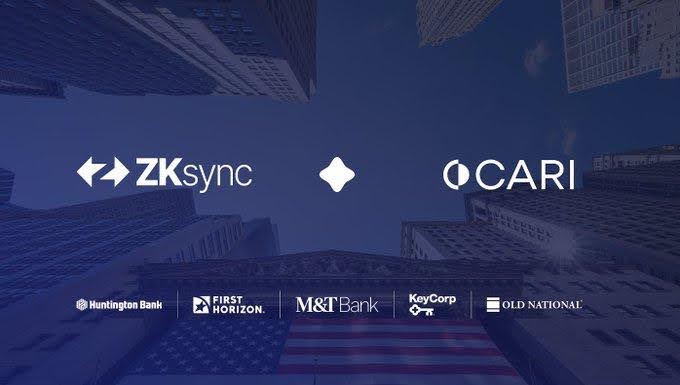
ZKsync Powers Tokenized Deposits in Major U.S. Bank Network

ZKsync Powers Tokenized Deposits in Major U.S. Bank Network

Key Takeaways: Five U.S. regional banks are building a tokenized deposit network on ZKsync. Deposits remain FDIC-insured bank liabilities, not stablecoins. The
Share
Crypto Ninjas2026/03/18 00:41