

Vitalik Buterin backs new update to simplify Ethereum node software
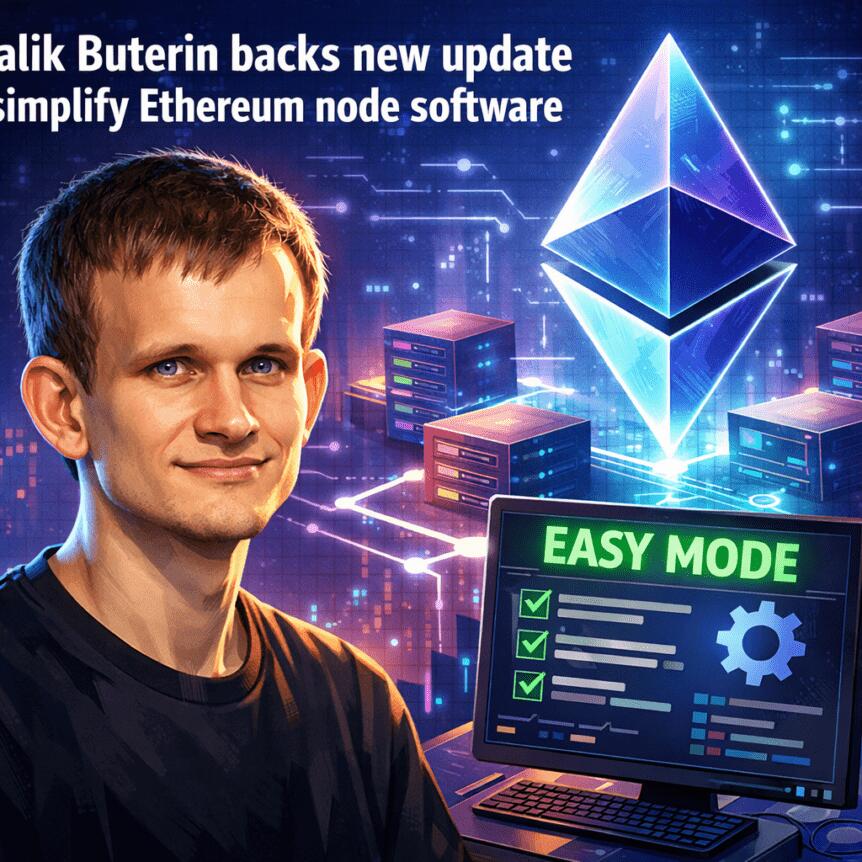
Vitalik Buterin, Ethereum’s co-founder, unveiled a proposal on Saturday to merge the backend programs that power Ethereum’s Beacon Chain consensus layer with the execution layer into a single codebase. The intention is to remove needless complexity from node operation and lower the barriers for individuals and households to participate as validators, not just large-scale operators or centralized service providers. The plan would reframe how a node is set up by unifying the two core software streams that currently run in parallel to coordinate consensus and transaction processing.
Today’s validators must manage two separate software stacks. The Beacon Chain governs consensus and staking, while the execution layer handles all transaction execution and smart contract logic. Each component requires careful synchronization to transmit data between layers, and any misalignment can complicate maintenance and uptime. That bifurcation has long been cited as a deterrent for hobbyists and smaller operators who want to contribute to Ethereum’s security and censorship resistance but lack the resources or time to manage a dual-stack environment. The proposed consolidation would, in theory, streamline operations and reduce the technical overhead for running a node, potentially expanding the pool of participants who can run their own infrastructure instead of leaning on RPC providers or managed services.
Buterin’s message, posted on X, stresses a broad aim: decentralization should not be a privilege of those who can hire specialists or buy advanced hardware. Even among those who can afford robust hardware for node operation, time remains a scarce resource. In the Ethereum ecosystem, the prospect of running a node has often been framed as an advanced undertaking, with the costs and complexity viewed as an impediment to a more inclusive network. This tension—between the ideal of widespread participation and the practical realities of hardware, bandwidth, and maintenance—has fed ongoing debates about centralization risks and resilience in the ecosystem.
To illustrate how the broader landscape influences these discussions, the proposal comes amid longstanding conversations about centralization risk tied to reliance on remote procedure call (RPC) providers. Critics argue that when a relatively small number of RPC services handle most node traffic, the network becomes vulnerable to deplatforming or censorship if those providers restrict access for geopolitical or policy reasons. Buterin has repeatedly warned that a healthy Ethereum network depends on a robust base of independent operators who can verify transactions and participate in governance without being at the mercy of a handful of external services. The emphasis on easier self-hosting reflects a preference for a more resilient, bottom-up network architecture, even as the ecosystem continues to balance performance, scalability, and privacy concerns.
In a related thread, Buterin revisited the topic of node economics with a proposal from May 2025 that envisions partially stateless nodes. This concept would allow nodes to operate without maintaining the full historical state of the blockchain, instead keeping only the data necessary for their specific tasks. Partial statelessness is intended to lower disk space and data storage requirements, which have historically been a major bottleneck for individuals running full nodes. By reducing the storage burden, more users could run nodes locally to participate in transaction validation and block verification, reinforcing the decentralized fabric of the network. An illustration from Ethereum Research explains how a local node might retain only delta-state information relevant to a user’s interactions, rather than the entire chain state, as part of a broader scaling and decentralization strategy.
Disk space and hardware requirements remain central considerations in the node equation. The consensus-driven direction of Ethereum and other smart contract blockchains has long highlighted the tension between decentralization and practical limitations. The hardware reality—driven in part by the ever-growing volume of on-chain data—creates a natural pull toward specialized setups, which can inadvertently concentrate validation power among those who can afford the right gear. Buterin has repeatedly called attention to this disparity, arguing that a market structure dominated by a small cadre of RPC providers or centralized validators exposes the network to risk and reduces its openness to broader participation. His stance is that a more approachable infrastructure—where individuals and households can run nodes with reasonable effort—would enhance resilience and reduce systemic vulnerability to external disruption.
In late January, Buterin disclosed a personal commitment to privacy-preserving technologies and open hardware. He set aside 16,384 Ether, roughly $45 million at the time, to support initiatives in privacy, open hardware, and verifiable software, with deployment planned gradually over the coming years as Ethereum Foundation leadership described a period of “mild austerity” while continuing to pursue a clear technical roadmap. The funds underscore a longer-term strategy to fortify the ecosystem’s core infrastructure and to align research and development with a more inclusive, privacy-conscious hardware and software ecosystem. This financial stance indicates the foundation’s willingness to invest in foundational capabilities that could propel broader participation, even as resources tighten in other areas.
As the discussion around node accessibility evolves, Ethereum supporters and observers are watching closely how these proposals might translate into concrete tooling, documentation, and developer guidance that lowers barriers without compromising security and decentralization. The conversation also intersects with ongoing governance work that clarifies the Ethereum Foundation’s mandate and priorities, as well as broader debates about how the network should balance openness with performance and user privacy. The connected discourse on statelessness, unified backends, and the role of independent operators continues to shape expectations for upcoming roadmap milestones and security hardening efforts.
For readers seeking a deeper dive into the related conversations, the topic of partially stateless nodes has been explored in depth by researchers and community members. Additional context and viewpoints are available in discussions and articles linked in this coverage, including perspectives on decentralization, hardware requirements, and the trade-offs involved in making node operation more approachable for non-professional operators. The broader takeaway is that Ethereum’s path toward greater accessibility and resilience is being pursued through a combination of architectural simplification, storage efficiency innovations, and an emphasis on individual participation as a fundamental good for the network’s long-term health.
Contextual notes and related materials can be explored through the linked references, including the ongoing dialogue about governance goals and implementation details that shape how developers and validators interact with Ethereum’s core protocols and tooling. The core premise remains: by reducing complexity and storage demands, the ecosystem could foster a healthier, more distributed validation layer, less susceptible to central points of control while preserving the security guarantees that underpin decentralized finance and smart contracts.
Why it matters
At stake is the balance between decentralization, usability, and security. If running a node becomes a task within reach of more individuals and households, Ethereum’s censorship-resistance and fault tolerance could improve as a broader base of independent operators contributes to block validation and stake participation. The proposed backend unification is a structural step toward removing needless friction from node operation, which, in turn, could dilute the influence of a small cadre of service providers who currently dominate occasional uptime guarantees or data availability. The move aligns with a long-standing aspiration among developers and researchers to democratize participation in Ethereum’s security model, ensuring that governance, validation, and staking remain distributed across a wide ecosystem rather than concentrated in a few hands.
From a protocol design perspective, consolidating the two layers into one coherent codebase could simplify maintenance, reduce the risk of misconfigurations, and accelerate the deployment of updates across the network. If the change reduces the complexity of running a node, it may encourage more users to validate and participate directly in consensus, potentially enhancing network security by diversifying the validator set. However, implementing such a fundamental architectural shift will require careful testing, broad community scrutiny, and a clear plan for interoperability with existing tooling and RPC ecosystems to avoid unintended fragmentation.
Beyond the technical implications, the discussions reflect a broader philosophy about Ethereum’s future: how to sustain a security-focused, permissionless system while remaining inclusive and accessible. The funding decisions tied to privacy-preserving technologies and open hardware signals an intent to invest in the long arc of infrastructure resilience, transparency, and verifiability. As the ecosystem weighs centralization risks against practical constraints, the conversation around node design, state management, and the deployment of stateless or partially stateless architectures will likely shape the next wave of core protocol enhancements and tooling improvements for years to come.
What to watch next
- Progress of the unified-backend pull request: status updates, reviews, and potential merge milestones.
- Clarifications from the Ethereum Foundation on roadmap implications and governance expectations.
- Adoption of partially stateless node concepts and any pilot deployments or testnet experiments.
- Updates to hardware guidance and storage requirements as the community tests new node configurations.
- Responses from RPC providers and ecosystem tooling developers regarding compatibility and risk mitigation.
Sources & verification
- Vitalik Buterin’s X post detailing the node operation concerns and the push for a unified backend.
- May 2025 discussions and proposals around partially stateless nodes and their implications for storage and hardware.
- Geth hardware requirements page outlining current storage and hardware considerations for node operators.
- Ethereum Foundation mandate and goals articles providing governance context for the technical roadmap.
- Cointelegraph coverage of Buterin’s privacy/open hardware funding and related centralization discussions.
Unified backends and the path to easier Ethereum node operation
Ethereum’s core design has always prioritized decentralization and security, yet the practical realities of running a full node have often required specialized expertise and resources. Buterin’s proposal to merge the beacon chain’s consensus backend with the execution layer into a single, coherent code structure is a bold attempt to lower the barrier to entry for validators and ordinary users alike. The central question is whether this consolidation can maintain the robustness of the consensus mechanism while simplifying the operational burden on node operators. If successful, the initiative could broaden the base of participants who validate blocks, attest to consensus, and participate in stake-related governance, thereby enhancing the network’s resilience to outages and censorship risks.
The conversation touches on the broader dynamics of Ethereum’s ecosystem, where debates about centralization, hardware requirements, and reliable data availability intersect with ongoing efforts to scale and secure the network. The push for more approachable node operation aligns with a vision of a highly distributed validation landscape that reduces dependence on a handful of external providers. Yet, the technical path to achieve this—through a unified back end and, potentially, partially stateless architectures—requires careful engineering, extensive testing, and careful evaluation of security implications. The YouTube explainer linked in coverage offers an additional layer of context for readers seeking a more approachable briefing on these architectural questions and the trade-offs involved in moving toward stateless or partially stateless nodes. Watch video
As with many foundational changes in the Ethereum roadmap, stakeholders will await further disclosures about timelines, testing plans, and how the update would interact with existing tooling, wallets, and RPC endpoints. The aim is to unlock more widespread participation without compromising the security and decentralization properties that are central to the network’s value proposition. If executed thoughtfully, this dual-layer consolidation could mark a meaningful step toward a more inclusive and resilient Ethereum ecosystem, where running a personal node becomes a realistic option for more users rather than a niche undertaking reserved for specialists.
This article was originally published as Vitalik Buterin backs new update to simplify Ethereum node software on Crypto Breaking News – your trusted source for crypto news, Bitcoin news, and blockchain updates.
You May Also Like

When the Middle East burns, the Filipino nanay feels the heat

The Hidden Costs of a Smart Home: How to Calculate Your Real Electricity Usage
