Solana’s validator count has dropped over 70% from its 2023 peak as rising costs and fee competition squeeze smaller operators out of the network. The post SolanaSolana’s validator count has dropped over 70% from its 2023 peak as rising costs and fee competition squeeze smaller operators out of the network. The post Solana

Solana Validator Count Drops 70%, Fueling Decentralisation Concerns

  • Solana’s active validator count has plummeted 68%, dropping from over 2,500 in 2023 to roughly 795 in early 2026.
  • Smaller operators are being priced out by intense competition from zero-fee institutional validators and annual voting costs that now exceed $49,000.
  • Network decentralisation is weakening, as evidenced by the Nakamoto Coefficient falling from 31 to 20, signaling that control is concentrating among fewer large-scale entities.

Solana’s validator network is shrinking fast due to economic reasons.

According to data from Solana Compass, the number of active validators has fallen from about 2,560 in early 2023 to roughly 795 today, a 68% drop. Validators are the machines that vote on blocks and keep the chain running. Fewer validators means fewer independent actors securing the network.
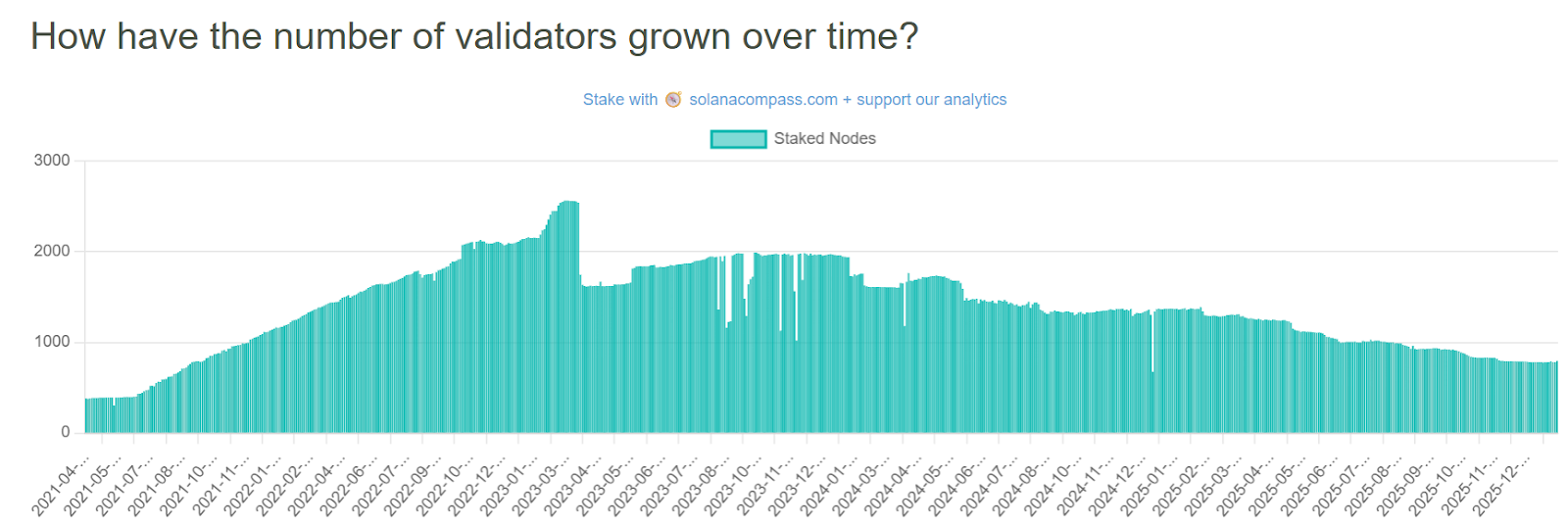
Source: Solana Compass

Some of this decline is harmless cleanup of inactive nodes. But operators say the real problem is that running a validator no longer pays for smaller players. 

Read more: Solana Mobile Launches SKR Token Airdrop for Seeker Smartphone Users

Low Fees Make Operations Less Viable

For instance, Moo, an independent Solana validator, said large validators now charge 0% fees to attract stake, leaving little revenue for independents. When rewards fall below costs, smaller validators shut down.

it is becoming increasingly impossible to operate a validator profitably (…) Many small validators are actively considering shutting down. Not due to lack of belief in Solana, but because the economics no longer work. At this point, the only justification left is altruism. Loving the network and caring about decentralization is not a sustainable business model.

Moo | Elemental – Solana Validator

That pressure also shows up clearly in decentralisation metrics, as the Solana Nakamoto Coefficient, or the minimum number of independent entities needed to control a critical share of the network, has dropped from 31 to 20. In simpler words, control over Solana’s stake is becoming more concentrated in fewer hands.

The cost structure goes something like this: 

  • A validator must stake SOL and continuously send vote transactions to participate in consensus. 
  • Voting alone can cost up to about 1.1 SOL per day. Over a year, that adds up to roughly 401 SOL just to stay online. 
  • At current prices, the first-year requirement excluding hardware and servers is around US$49,000 (AU$75,000). For many small operators, that math doesn’t work anymore.

This doesn’t mean Solana is failing or insecure today. Large validators are professional, well-capitalised, and technically capable, but it does mean decentralisation is drifting toward institutions and large staking providers rather than individuals.

Related: Analyst: Gold’s Surge Signals a Trust Crisis – and Crypto’s Moment

The post Solana Validator Count Drops 70%, Fueling Decentralisation Concerns appeared first on Crypto News Australia.

Disclaimer: The articles reposted on this site are sourced from public platforms and are provided for informational purposes only. They do not necessarily reflect the views of MEXC. All rights remain with the original authors. If you believe any content infringes on third-party rights, please contact [email protected] for removal. MEXC makes no guarantees regarding the accuracy, completeness, or timeliness of the content and is not responsible for any actions taken based on the information provided. The content does not constitute financial, legal, or other professional advice, nor should it be considered a recommendation or endorsement by MEXC.

You May Also Like

Top 5 News This Week: Senators vs. Chinese embassy; Rodrigo Duterte and ICC

Top 5 News This Week: Senators vs. Chinese embassy; Rodrigo Duterte and ICC

The Philippines' top news stories from January 25 to 31, 2026
Share
Rappler2026/01/31 20:00
Kalshi debuts ecosystem hub with Solana and Base

Kalshi debuts ecosystem hub with Solana and Base

The post Kalshi debuts ecosystem hub with Solana and Base appeared on BitcoinEthereumNews.com. Kalshi, the US-regulated prediction market exchange, rolled out a new program on Wednesday called KalshiEco Hub. The initiative, developed in partnership with Solana and Coinbase-backed Base, is designed to attract builders, traders, and content creators to a growing ecosystem around prediction markets. By combining its regulatory footing with crypto-native infrastructure, Kalshi said it is aiming to become a bridge between traditional finance and onchain innovation. The hub offers grants, technical assistance, and marketing support to selected projects. Kalshi also announced that it will support native deposits of Solana’s SOL token and USDC stablecoin, making it easier for users already active in crypto to participate directly. Early collaborators include Kalshinomics, a dashboard for market analytics, and Verso, which is building professional-grade tools for market discovery and execution. Other partners, such as Caddy, are exploring ways to expand retail-facing trading experiences. Kalshi’s move to embrace blockchain partnerships comes at a time when prediction markets are drawing fresh attention for their ability to capture sentiment around elections, economic policy, and cultural events. Competitor Polymarket recently acquired QCEX — a derivatives exchange with a CFTC license — to pave its way back into US operations under regulatory compliance. At the same time, platforms like PredictIt continue to push for a clearer regulatory footing. The legal terrain remains complex, with some states issuing cease-and-desist orders over whether these event contracts count as gambling, not finance. This is a developing story. This article was generated with the assistance of AI and reviewed by editor Jeffrey Albus before publication. Get the news in your inbox. Explore Blockworks newsletters: Source: https://blockworks.co/news/kalshi-ecosystem-hub-solana-base
Share
BitcoinEthereumNews2025/09/18 04:40
Cardano Latest News, Pi Network Price Prediction and The Best Meme Coin To Buy In 2025

Cardano Latest News, Pi Network Price Prediction and The Best Meme Coin To Buy In 2025

The post Cardano Latest News, Pi Network Price Prediction and The Best Meme Coin To Buy In 2025 appeared on BitcoinEthereumNews.com. Pi Network is rearing its head, and Cardano is trying to recover from a downtrend. But the go to option this fall is Layer Brett, a meme coin with utility baked into it. $LBRETT’s presale is not only attractive, but is magnetic due to high rewards and the chance to make over 100x gains. Layer Brett Is Loading: Join or You’re Wrecked The crypto crowd loves to talk big numbers, but here’s one that’s impossible to ignore: Layer 2 markets are projected to process more than $10 trillion per year by 2027. That tidal wave is building right now — and Layer Brett is already carving out space to ride it. The presale price? A tiny $0.0058. That’s launchpad level, the kind of entry point that fuels 100x gains if momentum kicks in. Latecomers will scroll through charts in regret while early entrants pocket the spoils. Layer Brett is more than another Layer 2 solution. It’s crypto tech wrapped in meme energy, and that mix is lethal in the best way. Blazing-fast transactions, negligible fees, and staking rewards that could make traditional finance blush. Stakers lock in a staggering 700% APY. But every new wallet that joins cuts into that yield, so hesitation is expensive. And let’s not forget the kicker — a massive $1 million giveaway fueling even more hype around the presale. Combine that with a decentralized design, and you’ve got something that stands out in a space overcrowded with promises. This isn’t some slow-burning project hoping to survive. Layer Brett is engineered to explode. It’s raw, it’s loud, it’s built for the degens who understand that timing is everything. At $0.0058, you’re either in early — or you’re out forever. Is PI the People’s Currency? Pi Network’s open mainnet unlocks massive potential, with millions of users completing…
Share
BitcoinEthereumNews2025/09/18 06:14