Introduction: Financial markets are exploring blockchain-enabled settlement as the NYSE advances a platform to trade tokenized stocks and ETFs. Backed by ICE, theIntroduction: Financial markets are exploring blockchain-enabled settlement as the NYSE advances a platform to trade tokenized stocks and ETFs. Backed by ICE, the

NYSE Debuts 24/7 Tokenized Stocks Platform
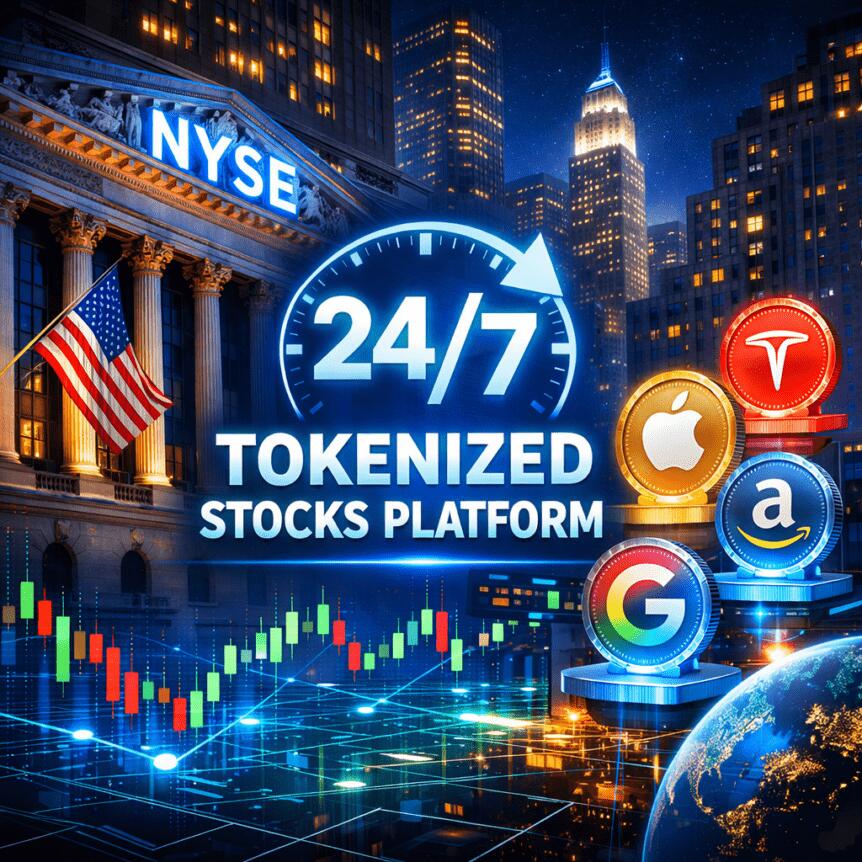
Nyse Debuts 24/7 Tokenized Stocks Platform

Introduction: Financial markets are exploring blockchain-enabled settlement as the NYSE advances a platform to trade tokenized stocks and ETFs. Backed by ICE, the project would fuse a 24/7 trading regime with near-instant settlement, marrying a traditional matching engine with blockchain-backed post-trade processing. If regulators sign off, the venue could enable real-time funding and settlement via stablecoins, expanding access to digital representations of conventional equities.

Key Takeaways

  • 24/7 trading and real-time settlement are central to the proposed platform, leveraging a hybrid of established matching engines and blockchain settlement layers.
  • Tokenized securities would be minted on-chain, offering fractional ownership and continuous market access beyond standard trading hours.
  • ICE’s digital strategy aims to modernize clearing and settlement infrastructure, with potential integration of tokenized collateral to support faster, on-chain workflows.
  • Collaborations with major banks are underway to enable tokenized deposits across clearinghouses, enabling capital movement outside traditional business hours.

Tickers mentioned: None

Sentiment: Neutral

Price impact: Neutral. The move centers on infrastructure and regulatory clearance rather than immediate price action.

Trading idea (Not Financial Advice): Hold. The project represents a strategic shift toward on-chain market infrastructure, but regulatory risk and implementation timelines will be decisive.

Market context: The push toward on-chain settlement aligns with broader institutional interest in tokenization and 24/7 access to digital representations of traditional assets amid rising demand for more flexible liquidity tools.

NYSE seeks “fully onchain” solutions for settlement, trading infrastructure

The tokenized securities platform is a pillar of ICE’s broader digital strategy, which envisions clearing infrastructure that supports continuous trading and the potential integration of tokenized collateral. In practical terms, the NYSE would operate a new trading venue for digital assets tied to traditional stocks and ETFs, underpinned by a blockchain-based post-trade ecosystem.

The project is designed to enable real-time settlement and funding, potentially using stablecoins, rather than the current one-day (T+1) settlement cycle characteristic of U.S. equity markets. Tokenized stocks are shares of ordinary company stocks minted on a blockchain ledger, granting investors round-the-clock access and the possibility of fractional ownership, thereby broadening participation and liquidity.

Beyond the technology itself, the NYSE has previously signaled a desire to extend trading hours. In late 2024, it indicated efforts to push the weekday window toward a longer trading day, up to 22 hours, to address global demand for U.S. equities. In October 2024, the exchange filed with the U.S. Securities and Exchange Commission to seek approval for extended hours, underscoring the ongoing regulatory considerations surrounding longer market access. Separately, Nasdaq has also floated plans for 24-hour trading on weekdays, reflecting a broader industry push toward around-the-clock trading.

The tokenized securities platform sits at the intersection of ICE’s wider digital ambitions. The plan envisions not only trading but also clearing and custody workflows that are native to an on-chain environment. By weaving together Pillar’s matching capabilities with blockchain-based post-trade processing, ICE aims to offer a seamless on-chain experience for market participants. The initiative would ideally accommodate cross-chain custody and settlement, providing the technical backbone for a more resilient, 24/7 ecosystem.

ICE’s stance is that tokenized markets could reduce settlement risk and increase operational resilience by anchoring settlement in blockchain-native infrastructure. The company is actively engaging banks to support tokenized deposits across its clearinghouses, allowing members to manage money outside standard banking hours and enhancing liquidity provisioning in a more flexible framework. In support of this effort, ICE notes that it operates six clearing houses around the world—including major energy clearing and credit derivative platforms—placing it in a unique position to pilot end-to-end on-chain settlement at scale.

“We are leading the industry toward fully on-chain solutions, grounded in the unmatched protections and high regulatory standards that position us to marry trust with state-of-the-art technology,” said Lynn Martin, president of NYSE Group. This vision is reinforced by executives who describe tokenized securities as a pivotal step in ICE’s strategy to build on-chain market infrastructure for trading, settlement, custody, and capital formation in a new era of global finance.

This article was originally published as NYSE Debuts 24/7 Tokenized Stocks Platform on Crypto Breaking News – your trusted source for crypto news, Bitcoin news, and blockchain updates.

Market Opportunity
Polytrade Logo
Polytrade Price(TRADE)
$0.04676
$0.04676$0.04676
+0.06%
USD
Polytrade (TRADE) Live Price Chart
Disclaimer: The articles reposted on this site are sourced from public platforms and are provided for informational purposes only. They do not necessarily reflect the views of MEXC. All rights remain with the original authors. If you believe any content infringes on third-party rights, please contact [email protected] for removal. MEXC makes no guarantees regarding the accuracy, completeness, or timeliness of the content and is not responsible for any actions taken based on the information provided. The content does not constitute financial, legal, or other professional advice, nor should it be considered a recommendation or endorsement by MEXC.

You May Also Like

The Channel Factories We’ve Been Waiting For

The Channel Factories We’ve Been Waiting For

The post The Channel Factories We’ve Been Waiting For appeared on BitcoinEthereumNews.com. Visions of future technology are often prescient about the broad strokes while flubbing the details. The tablets in “2001: A Space Odyssey” do indeed look like iPads, but you never see the astronauts paying for subscriptions or wasting hours on Candy Crush.  Channel factories are one vision that arose early in the history of the Lightning Network to address some challenges that Lightning has faced from the beginning. Despite having grown to become Bitcoin’s most successful layer-2 scaling solution, with instant and low-fee payments, Lightning’s scale is limited by its reliance on payment channels. Although Lightning shifts most transactions off-chain, each payment channel still requires an on-chain transaction to open and (usually) another to close. As adoption grows, pressure on the blockchain grows with it. The need for a more scalable approach to managing channels is clear. Channel factories were supposed to meet this need, but where are they? In 2025, subnetworks are emerging that revive the impetus of channel factories with some new details that vastly increase their potential. They are natively interoperable with Lightning and achieve greater scale by allowing a group of participants to open a shared multisig UTXO and create multiple bilateral channels, which reduces the number of on-chain transactions and improves capital efficiency. Achieving greater scale by reducing complexity, Ark and Spark perform the same function as traditional channel factories with new designs and additional capabilities based on shared UTXOs.  Channel Factories 101 Channel factories have been around since the inception of Lightning. A factory is a multiparty contract where multiple users (not just two, as in a Dryja-Poon channel) cooperatively lock funds in a single multisig UTXO. They can open, close and update channels off-chain without updating the blockchain for each operation. Only when participants leave or the factory dissolves is an on-chain transaction…
Share
BitcoinEthereumNews2025/09/18 00:09
Shanghai residents flock to sell gold as its price hit record highs

Shanghai residents flock to sell gold as its price hit record highs

The post Shanghai residents flock to sell gold as its price hit record highs appeared on BitcoinEthereumNews.com. Gold surged over the $5,500-per-ounce milestone
Share
BitcoinEthereumNews2026/01/31 01:48
Polygon Tops RWA Rankings With $1.1B in Tokenized Assets

Polygon Tops RWA Rankings With $1.1B in Tokenized Assets

The post Polygon Tops RWA Rankings With $1.1B in Tokenized Assets appeared on BitcoinEthereumNews.com. Key Notes A new report from Dune and RWA.xyz highlights Polygon’s role in the growing RWA sector. Polygon PoS currently holds $1.13 billion in RWA Total Value Locked (TVL) across 269 assets. The network holds a 62% market share of tokenized global bonds, driven by European money market funds. The Polygon POL $0.25 24h volatility: 1.4% Market cap: $2.64 B Vol. 24h: $106.17 M network is securing a significant position in the rapidly growing tokenization space, now holding over $1.13 billion in total value locked (TVL) from Real World Assets (RWAs). This development comes as the network continues to evolve, recently deploying its major “Rio” upgrade on the Amoy testnet to enhance future scaling capabilities. This information comes from a new joint report on the state of the RWA market published on Sept. 17 by blockchain analytics firm Dune and data platform RWA.xyz. The focus on RWAs is intensifying across the industry, coinciding with events like the ongoing Real-World Asset Summit in New York. Sandeep Nailwal, CEO of the Polygon Foundation, highlighted the findings via a post on X, noting that the TVL is spread across 269 assets and 2,900 holders on the Polygon PoS chain. The Dune and https://t.co/W6WSFlHoQF report on RWA is out and it shows that RWA is happening on Polygon. Here are a few highlights: – Leading in Global Bonds: Polygon holds 62% share of tokenized global bonds (driven by Spiko’s euro MMF and Cashlink euro issues) – Spiko U.S.… — Sandeep | CEO, Polygon Foundation (※,※) (@sandeepnailwal) September 17, 2025 Key Trends From the 2025 RWA Report The joint publication, titled “RWA REPORT 2025,” offers a comprehensive look into the tokenized asset landscape, which it states has grown 224% since the start of 2024. The report identifies several key trends driving this expansion. According to…
Share
BitcoinEthereumNews2025/09/18 00:40