This 17th installation of Shake, Rattle, & Roll delivers good ol’ jumpscares (I screamed twice) and passable plots, but sputters towards the end.This 17th installation of Shake, Rattle, & Roll delivers good ol’ jumpscares (I screamed twice) and passable plots, but sputters towards the end.

Metro Manila Film Festival 2025: Slick but shallow

By Joseph L. Garcia, Senior Reporter

Movie Review
Shake, Rattle & Roll: Evil Origins
Directed by Shugo Praico, Joey de Guzman, and Ian Loreños
Produced by Regal Entertainment
MTRCB Rating: R-13
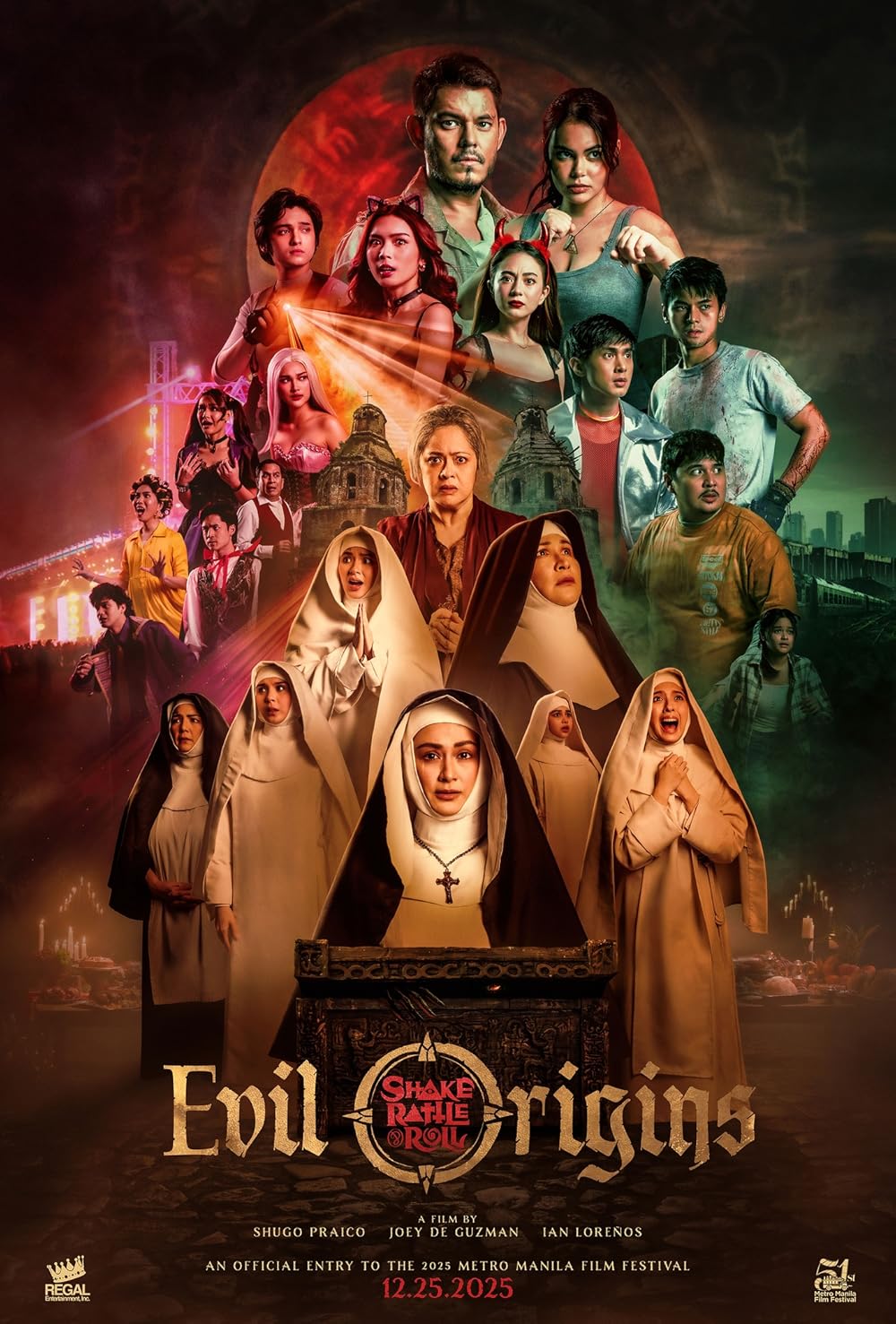
This 17th installation of Shake, Rattle, & Roll delivers good ol’ jumpscares (I screamed twice) and passable plots, but sputters towards the end.

The first two stories of the anthology (which have a plot point in common) titled “1775” and “2025,” prove immediately why the horror franchise has become a staple in Philippine cinema’s Christmas diet. As for the third: eh.

The first, “1775,” opens with some very beautiful nuns. We don’t exaggerate: the cast includes the Ortega sisters Ysabel and Ashley. The nuns’ wimples and veils charmingly frame the faces of Carla Abellana, Janice de Belen (she’s a star for a reason; her face can still fight against much younger actresses), and even sexy star Ara Mina (from Mano Po’s butt-crack dress to a complete nun’s habit, she’s still something to watch on the big screen. Kudos!).

A mysterious chest arrives at the convent, which the nuns theorize in Spanish as coming from Mexico (the period film is set during the height of the Galleon Trade). Meanwhile, Ms. Abellana’s character is locked away in the cellar for her nightly fits and visions. The chest tempts the nuns one by one, while Ms. De Belen’s character rules over the nuns with frightening tyranny.

We commend this segment for the wonderful set and production design, not to mention the gorgeous costumes (yes, they are nuns’ habits, but they’re made with such care). The plot leaves so much room to make this segment into its own movie (the chest’s manipulations leave room for so much more), and the actresses play their roles so well. The gothic setting in a convent is a bit too easy, but it works in bringing suspense. We suppose our only gripes about this segment are the cheap jump-scares and one or two too-easy deaths.

The “2025” segment is for a certain generation: younger millennials and Gen Z. It’s an old-fashioned slasher (teens are stalked by masked creeps during a rave) but my, oh my: it looks and sounds VERY good. The fact that it’s set in a rave means they have paid extra care to the music, and we’re already looking forward to the soundtrack to play at our next party. The cinematography is, as the kids once said, “lit,” and it is shot as smoothly as a music video. The experience is hypnotic, and visually delightful: never mind that half the segment is a gore-fest, but so wonderfully choreographed.

The third segment, “2050” follows the same slick production values of the first two, and offers an evocative view of a post-apocalyptic Philippines. We’re not super onboard with the plot though: the entity in the damned chest from the first segment, which made an appearance in the second, has gained strength and has won — taking over the country. Richard Gutierrez and his merry band have to defeat the entity and the thing inside the box. It’s shot more like a first-person video game than a movie, and shares the same fast pace.

(Spoilers!)

The third segment shows the film’s big baddie as a cheap copy of Harry Potter villain, Voldemort. Imagine our distress after the build-up from the first two segments, because in our heads: maybe the enemy is corruption. Think about it: in “1775” it arrives in the Philippines through colonialism, thrives in the church, tempts with comfort. In its death throes, it brings down the church with it (literally). In the second segment, “2025,” it is worshipped and protected and fed blood by a select few, while thriving inside a playground of the rich. In “2050,” it has finally won, leaving the country a desolate place; its people left to pick refuse.

The first two segments are a must-watch for horror fans, and even give a wink by casting Shake, Rattle, & Roll vets Ms. De Belen and Manilyn Reynes. The film taken as a whole is good for a scream or three, and overall a visual feast. Just don’t overthink it like I did.

Market Opportunity
Open Loot Logo
Open Loot Price(OL)
$0.01569
$0.01569$0.01569
-0.69%
USD
Open Loot (OL) Live Price Chart
Disclaimer: The articles reposted on this site are sourced from public platforms and are provided for informational purposes only. They do not necessarily reflect the views of MEXC. All rights remain with the original authors. If you believe any content infringes on third-party rights, please contact [email protected] for removal. MEXC makes no guarantees regarding the accuracy, completeness, or timeliness of the content and is not responsible for any actions taken based on the information provided. The content does not constitute financial, legal, or other professional advice, nor should it be considered a recommendation or endorsement by MEXC.

You May Also Like

The Channel Factories We’ve Been Waiting For

The Channel Factories We’ve Been Waiting For

The post The Channel Factories We’ve Been Waiting For appeared on BitcoinEthereumNews.com. Visions of future technology are often prescient about the broad strokes while flubbing the details. The tablets in “2001: A Space Odyssey” do indeed look like iPads, but you never see the astronauts paying for subscriptions or wasting hours on Candy Crush.  Channel factories are one vision that arose early in the history of the Lightning Network to address some challenges that Lightning has faced from the beginning. Despite having grown to become Bitcoin’s most successful layer-2 scaling solution, with instant and low-fee payments, Lightning’s scale is limited by its reliance on payment channels. Although Lightning shifts most transactions off-chain, each payment channel still requires an on-chain transaction to open and (usually) another to close. As adoption grows, pressure on the blockchain grows with it. The need for a more scalable approach to managing channels is clear. Channel factories were supposed to meet this need, but where are they? In 2025, subnetworks are emerging that revive the impetus of channel factories with some new details that vastly increase their potential. They are natively interoperable with Lightning and achieve greater scale by allowing a group of participants to open a shared multisig UTXO and create multiple bilateral channels, which reduces the number of on-chain transactions and improves capital efficiency. Achieving greater scale by reducing complexity, Ark and Spark perform the same function as traditional channel factories with new designs and additional capabilities based on shared UTXOs.  Channel Factories 101 Channel factories have been around since the inception of Lightning. A factory is a multiparty contract where multiple users (not just two, as in a Dryja-Poon channel) cooperatively lock funds in a single multisig UTXO. They can open, close and update channels off-chain without updating the blockchain for each operation. Only when participants leave or the factory dissolves is an on-chain transaction…
Share
BitcoinEthereumNews2025/09/18 00:09
Shanghai residents flock to sell gold as its price hit record highs

Shanghai residents flock to sell gold as its price hit record highs

The post Shanghai residents flock to sell gold as its price hit record highs appeared on BitcoinEthereumNews.com. Gold surged over the $5,500-per-ounce milestone
Share
BitcoinEthereumNews2026/01/31 01:48
Polygon Tops RWA Rankings With $1.1B in Tokenized Assets

Polygon Tops RWA Rankings With $1.1B in Tokenized Assets

The post Polygon Tops RWA Rankings With $1.1B in Tokenized Assets appeared on BitcoinEthereumNews.com. Key Notes A new report from Dune and RWA.xyz highlights Polygon’s role in the growing RWA sector. Polygon PoS currently holds $1.13 billion in RWA Total Value Locked (TVL) across 269 assets. The network holds a 62% market share of tokenized global bonds, driven by European money market funds. The Polygon POL $0.25 24h volatility: 1.4% Market cap: $2.64 B Vol. 24h: $106.17 M network is securing a significant position in the rapidly growing tokenization space, now holding over $1.13 billion in total value locked (TVL) from Real World Assets (RWAs). This development comes as the network continues to evolve, recently deploying its major “Rio” upgrade on the Amoy testnet to enhance future scaling capabilities. This information comes from a new joint report on the state of the RWA market published on Sept. 17 by blockchain analytics firm Dune and data platform RWA.xyz. The focus on RWAs is intensifying across the industry, coinciding with events like the ongoing Real-World Asset Summit in New York. Sandeep Nailwal, CEO of the Polygon Foundation, highlighted the findings via a post on X, noting that the TVL is spread across 269 assets and 2,900 holders on the Polygon PoS chain. The Dune and https://t.co/W6WSFlHoQF report on RWA is out and it shows that RWA is happening on Polygon. Here are a few highlights: – Leading in Global Bonds: Polygon holds 62% share of tokenized global bonds (driven by Spiko’s euro MMF and Cashlink euro issues) – Spiko U.S.… — Sandeep | CEO, Polygon Foundation (※,※) (@sandeepnailwal) September 17, 2025 Key Trends From the 2025 RWA Report The joint publication, titled “RWA REPORT 2025,” offers a comprehensive look into the tokenized asset landscape, which it states has grown 224% since the start of 2024. The report identifies several key trends driving this expansion. According to…
Share
BitcoinEthereumNews2025/09/18 00:40