


- Scotiabank
- National Bank
- RBC
- CIBC
- BMO
- TD
From RBC to TD, Canada’s major banks posted fourth-quarter earnings this week, highlighting shifting profits, credit trends, and signals for investors. The post Stock news for investors: Fourth-quarter earnings roll in from Canada’s big banks appeared first on MoneySense.From RBC to TD, Canada’s major banks posted fourth-quarter earnings this week, highlighting shifting profits, credit trends, and signals for investors. The post Stock news for investors: Fourth-quarter earnings roll in from Canada’s big banks appeared first on MoneySense.
Stock news for investors: Fourth-quarter earnings roll in from Canada’s big banks
Featured RRSP Accounts
featured
EQ Bank
Build your retirement savings with 1.50% interest, tax-deferred contributions and zero fees.
go to site
featured
Registered GIC rate
Earn a guaranteed 2.75% in your RRSP when you lock in for 1 year.
go to site
Best RRSP rates
See our ranking of the best RRSP accounts and rates available in Canada.
read now
MoneySense is an award-winning magazine, helping Canadians navigate money matters since 1999. Our editorial team of trained journalists works closely with leading personal finance experts in Canada. To help you find the best financial products, we compare the offerings from over 12 major institutions, including banks, credit unions and card issuers. Learn more about our advertising and trusted partners.
Scotiabank reports $2.21B Q4 profit up from $1.69B a year ago
Scotiabank (TSX:BNS)
Numbers for its fourth quarter:
- Profit: $2.21 billion (up from $1.69 billion a year ago)
- Revenue: $9.80 billion (up from $8.53 billion)
Scotiabank says it earned $2.21 billion in net income for its fourth quarter, up from $1.69 billion in the same quarter last year, helped by strength in its wealth management and capital markets businesses. The bank said Tuesday the profit amounted to $1.65 per diluted share for the quarter ended Oct. 31, up from $1.22 per diluted share in the same period a year ago.
Revenue totalled $9.80 billion, up from $8.53 billion in the same quarter last year. The bank’s provision for credit losses amounted to $1.11 billion for the quarter, up from $1.03 billion a year ago.
On an adjusted basis, Scotiabank says it earned $1.93 per diluted share in its latest quarter, up from an adjusted profit of $1.57 per diluted share a year ago. Analysts on average had expected an adjusted profit of $1.84, according to estimates compiled by LSEG Data & Analytics.
Scotiabank chief executive Scott Thomson said 2025 was a very positive year for the bank. “We delivered improving results through the year as we strengthened our balance sheet, improved our loan-to-deposit ratio, and increased return on equity,” Thomson said in a statement. “This quarter all our business lines reported year-over-year earnings growth with particular strength in global wealth management and global banking and markets and improving results in Canadian banking.”
The bank’s global wealth management business earned $447 million in net income attributable to equity holders, up from $380 million in the same quarter last year, while its global banking and markets business earned $519 million for the quarter, up from $347 million a year ago.
Scotiabank’s Canadian banking operations earned $941 million in its latest quarter, up from $934 million in the same quarter last year. Meanwhile, Scotiabank’s international banking arm earned $634 million in net income attributable to equity holders of the bank for the quarter, up from $600 million a year ago.
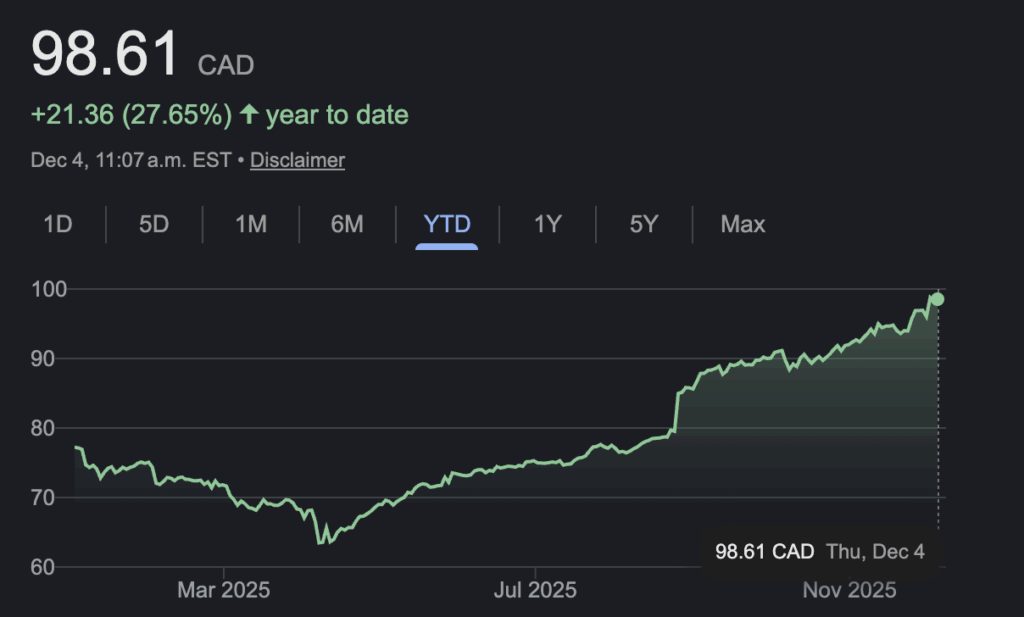 Source Google
National Bank reports $1.06B fourth-quarter profit, raises dividend
National Bank of Canada (TSX:NA)
Numbers for its fourth quarter:
- Profit: $1.06 billion (up from $955 million a year ago)
- Revenue: $3.70 billion (up from $2.94 billion)
National Bank of Canada raised its dividend as it reported a fourth-quarter profit of $1.06 billion. The bank said Wednesday it will now pay a quarterly dividend of $1.24 per share, an increase of six cents.
National Bank, which announced Tuesday that it was buying Laurentian Bank’s retail and small business segments, says its fourth-quarter profit amounted to $2.57 per diluted share, compared with net income of $955 million or $2.66 per diluted share a year ago when it had fewer shares outstanding.
Revenue for the quarter ended Oct. 31 totalled $3.70 billion, up from $2.94 billion a year earlier.
The bank’s provisions for credit losses amounted to $244 million, up from $162 million in the same quarter last year. On an adjusted basis, National Bank says it earned $2.82 per diluted share in its latest quarter, up from an adjusted profit of $2.58 per diluted share in the same quarter last year. Analysts on average had expected an adjusted profit of $2.62 per share, according to estimates compiled by LSEG Data & Analytics.
“With our strengthened national presence, diversified business mix, strong capital ratios and prudent credit profile, we are well-positioned to generate continued growth and superior returns, in what will remain a complex macro-environment,” National Bank chief executive Laurent Ferreira said in a statement.
The bank said its personal and commercial banking group earned $319 million in its latest quarter, down from $327 million a year ago, as it was hit by costs related to the acquisition of Canadian Western Bank.
National Bank’s wealth management business earned $258 million, up from $219 million, while its capital markets arm earned $432 million, up from $306 million.
National Bank’s U.S. specialty finance and international operations earned $174 million, up from $157 million in the same quarter last year.
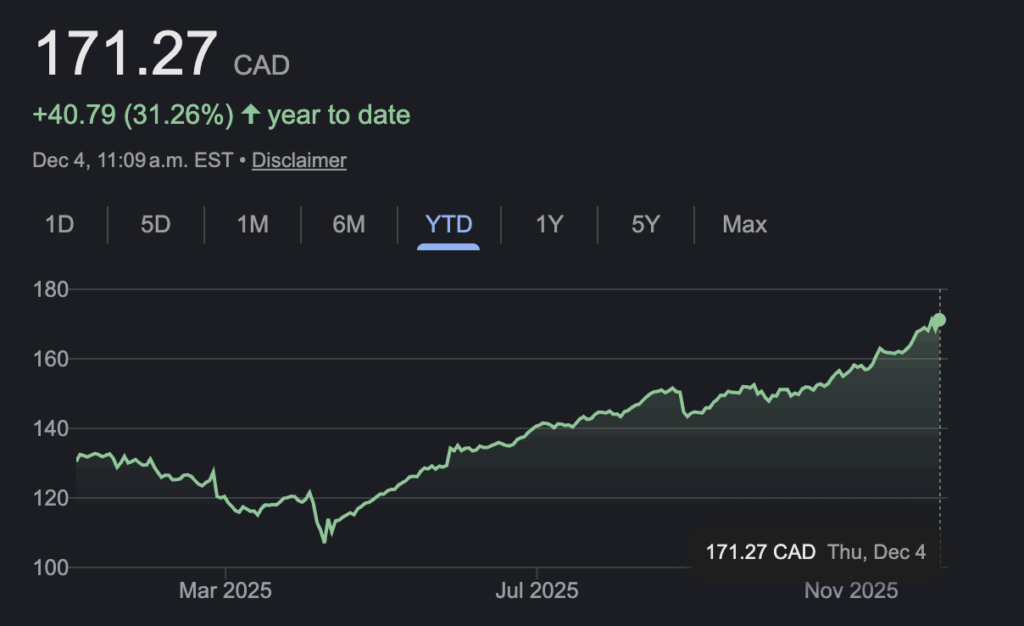 Source Google
RBC posts record Q4 profit but CEO raises concerns about uneven economic recovery
Royal Bank of Canada (TSX:RY)
Numbers for its fourth quarter:
- Profit: $5.43 billion (up from $4.22 billion a year ago)
- Revenue: $17.21 billion (up from $15.07 billion)
Royal Bank of Canada handily beat analyst expectations as it reported record fourth-quarter results that showed rising profits across most divisions.
The bank said Wednesday it made a profit of $5.43 billion in the quarter ending Oct. 31, up from a profit of $4.22 billion a year ago, as capital markets, wealth management and personal and commercial banking all saw higher returns, offset by lower results in insurance. The results helped lead RBC to increase its quarterly dividend to $1.64 per share, up from $1.54 per share.
The bank sees continued strength ahead, raising its return-on-equity target to 17 per cent, up from 16 per cent.
RBC’s results and outlook come despite continued trade and economic uncertainty, but chief executive Dave McKay expressed cautious optimism on the wider picture. “While the operating environment remains fluid and complex, and there is a lot of hard work yet to be done by governments and the private sector, I am cautiously optimistic on the outlook for Canada,” he said on an earnings call with analysts Wednesday.
McKay noted that overall Canada’s effective tariff rate remains low and has done little to impact exports to the U.S., while the ongoing shift to a service-oriented economy should also offset some trade-related headwinds. He did, however, express concern with the split economic recovery, which is leading to increased inequality.
“The impact of the K-shaped economy is increasingly polarizing, with more affluent consumers investing disposable income and growing markets, while less affluent consumers struggle with affordability.” The trend can be seen in RBC’s own results, with its capital markets and wealth management divisions driving much of the earnings beat.
Meanwhile, many borrowers continue to struggle, with the bank increasing its provisions for potentially bad loans in the quarter to $1.01 billion, up from $840 million a year ago.
Chief risk officer Graeme Hepworth said the overall Canadian economy has demonstrated strong resilience this past year with household spending strong, but the bank has maintained a prudent approach to provisions given trade issues are largely unresolved and pockets of concern remain.
“Rising unemployment in Ontario and the Greater Toronto Area, coupled with higher payments at mortgage renewal, have contributed to rising consumer impairments in these regions,” said Hepworth. “We expect retail losses to remain elevated in 2026 as we work through the lag effect of higher unemployment, consumer insolvencies, and ongoing payment shocks for mortgage renewals in Canada.”
The areas of concern did little to hold back overall results, with adjusted earnings of $3.85 per diluted share in the quarter, up from an adjusted profit of $3.07 per diluted share in the same quarter last year.
Analysts on average had expected an adjusted profit of $3.53 per share, according to estimates compiled by LSEG Data & Analytics.
Scotiabank analyst Mike Rizvanovic said that while credit losses were elevated, they remained manageable as other areas like capital markets and wealth shined. “A strong quarter overall for (Royal Bank) at first look, driven by outsized growth in the top line that benefited once again from solid gains in market-sensitive businesses, which comfortably offset a modest miss across other business lines,” he said in a note.
Revenue totalled $17.21 billion, up from $15.07 billion in the same quarter last year.
RBC’s wealth management arm earned $1.28 billion, up from $969 million a year ago, while the bank’s capital markets business earned $1.43 billion, up from $985 million in the same quarter last year. Personal banking earned $1.89 billion in the bank’s latest quarter, up from $1.58 billion a year ago. Commercial banking operations earned $810 million, up from $774 million. RBC’s insurance business earned $98 million, down from $162 million a year ago.
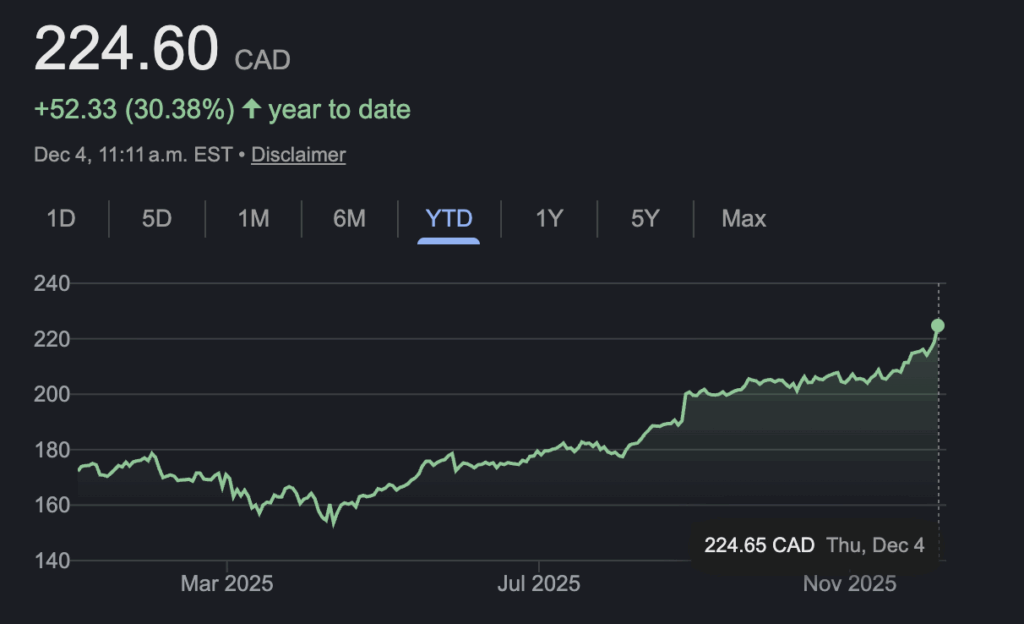 Source Google
CIBC reports fourth-quarter profit up from year ago, raises dividend
CIBC (TSX:CM)
Numbers for its fourth quarter:
- Profit: $2.18 billion (up from $1.88 billion a year ago)
- Revenue: $7.58 billion (up from $6.62 billion)
CIBC raised its dividend as it reported a fourth-quarter profit of $2.18 billion, up from $1.88 billion a year ago. The bank said Thursday it will now pay a quarterly dividend of $1.07 per share, up from 97 cents per share. CIBC says its profit for the quarter ended Oct. 31 amounted to $2.20 per diluted share, up from $1.90 per diluted share a year ago.
Revenue for the quarter totalled $7.58 billion, up from $6.62 billion, while the bank’s provision for credit losses amounted to $605 million, up from $419 million a year ago. On an adjusted basis, CIBC says it earned $2.21 per diluted share, up from an adjusted profit of $1.91 per diluted share in the same quarter last year.
Analysts on average had expected an adjusted profit of $2.08 per share, according to estimates compiled by LSEG Data & Analytics.
“In a dynamic operating environment, our proactive and disciplined approach to managing our business, our resilient capital position and our deep client relationships supported robust growth while maintaining strong credit quality,” CIBC chief executive Harry Culham said in a statement.
CIBC said the growth came as its Canadian personal and business banking business earned $796 million in its latest quarter, up from $792 million a year ago as higher revenue was partially offset by a higher provision for credit losses and higher expenses.
The bank’s Canadian commercial banking and wealth management group earned $603 million, up from $551 million a year ago, while its U.S. commercial banking and wealth management business earned $275 million, up from $200 million a year ago.
CIBC’s capital markets business earned $548 million, up from $346 million in the same quarter last year.
CIBC also announced several senior executive changes Thursday that will be effective Jan. 1. The bank said Sandy Sharman, senior executive vice-president and group head, people, culture and brand, will transition to the role of special adviser before retiring at the end of 2026. CIBC also said Christina Kramer, senior executive vice-president and chief administrative officer, will add responsibility for enterprise real estate, enterprise capabilities and organizational agility, brand, community investment, client experience, communications, and corporate events. Richard Jardim will be appointed senior executive vice-president and chief technology and information officer, global technology, data and AI, while Yvonne Dimitroff will become executive vice-president and chief human resources officer, people, culture and talent.
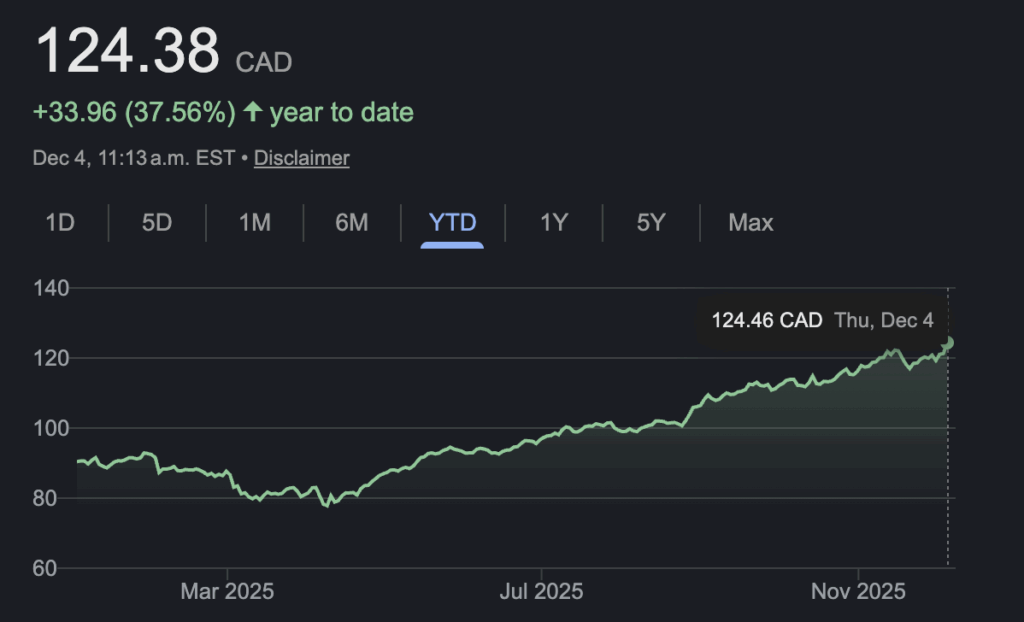 Source Google
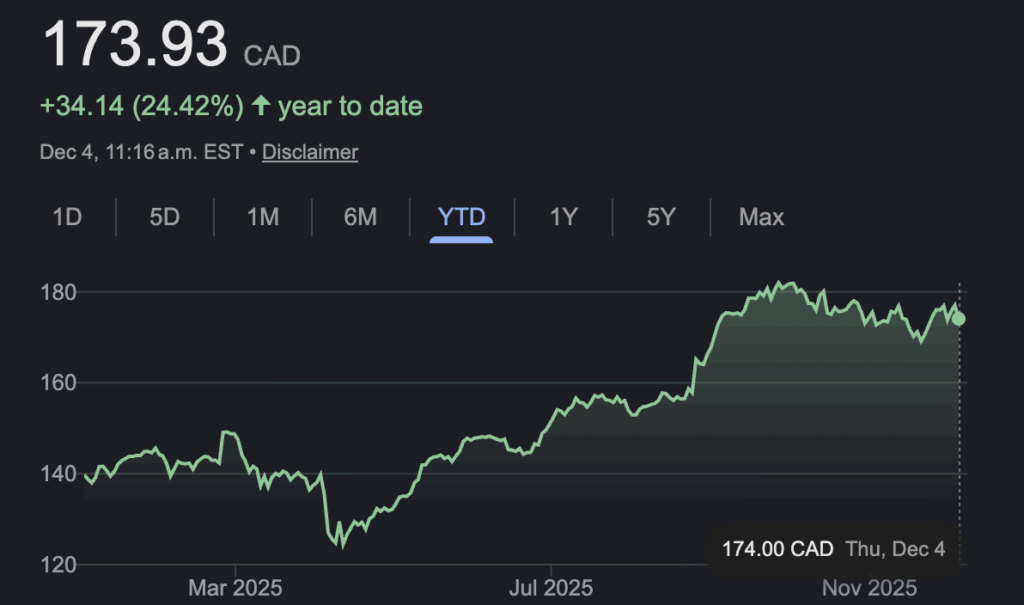
BMO Financial Group reports $2.3B fourth-quarter profit, raises dividend
BMO Financial Group (TSX:BMO)
Numbers for its fourth quarter:
- Profit: $2.30 billion (compared to $2.30 billion a year ago)
- Revenue: $9.34 billion (up from $8.96 billion)
BMO Financial Group raised its dividend as it reported a fourth-quarter profit of $2.30 billion. The bank said Thursday it will now pay a quarterly dividend of $1.67 per share, an increase of four cents per share. BMO says its profit amounted to $2.97 per diluted share for the quarter ended Oct. 31 compared with a profit of $2.30 billion or $2.94 per diluted share a year ago when it had more shares outstanding.
Revenue for the quarter totalled $9.34 billion, up from $8.96 billion last year, while the bank’s provision for credit losses totalled $755 million, down from $1.52 billion a year ago. On an adjusted basis, BMO says it earned $3.28 per diluted share, up from an adjusted profit of $1.90 per diluted in the same quarter last year.
Analysts on average had expected an adjusted profit of $3.03 per share, according to estimates compiled by LSEG Data & Analytics.
“Fiscal 2025 was a strong year for BMO, with consistent execution and growing momentum to achieve our commitments to shareholders,” BMO chief executive Darryl White said. “We enter 2026 in a position of financial strength, with a focused strategy and a winning culture that continues to grow and attract talent across the bank.”
BMO said its Canadian personal and commercial banking business earned $752 million, up from $750 million a year ago, while its U.S. banking business earned $807 million, up from $281 million in the same quarter last year.
The bank’s wealth management arm earned $383 million, up from $301 million a year ago.
BMO’s capital markets business earned $521 million, up from $251 million in the same quarter last year.
The bank also announced Thursday the appointment of Tammy Brown to its board of directors.
Brown previously served as deputy chair of KPMG Canada’s board of directors and was a partner and national industry leader for industrial markets at the firm.
 Source Google
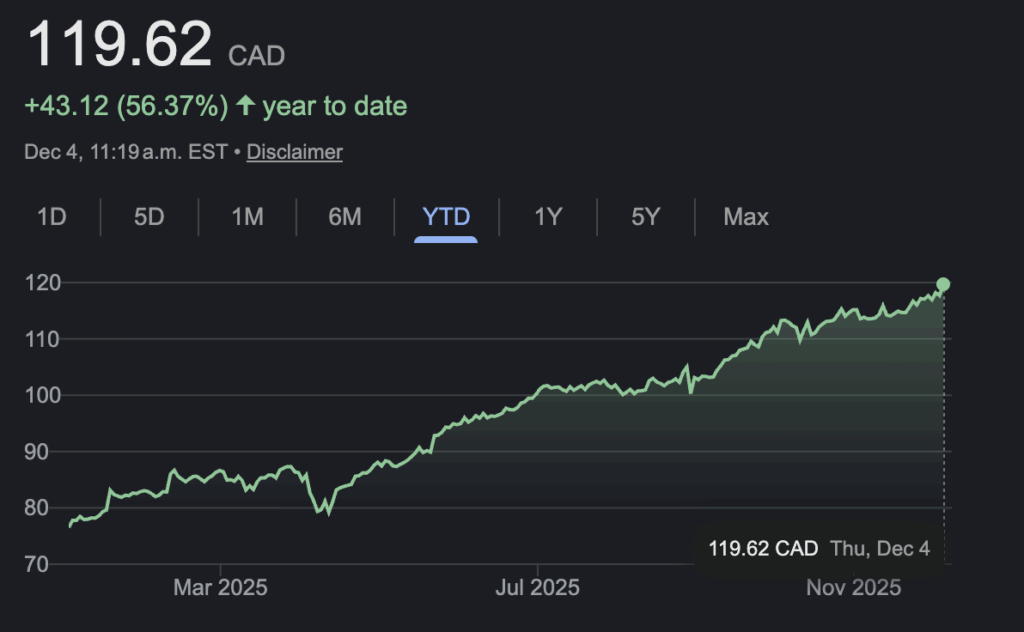
TD Bank reports $3.28B fourth-quarter profit, raises dividend
TD Bank Group (TSX:TD)
Numbers for its fourth quarter:
- Profit: $3.28 billion (down from $3.64 billion a year ago)
- Revenue: $15.49 billion (down from $15.51 billion)
TD Bank Group raised its dividend as it reported its fourth-quarter profit fell compared with a year ago, weighed down by one-time restructuring charges. The bank said Thursday it will pay a quarterly dividend of $1.08 per share, up from $1.05 per share.
TD says its profit amounted to $3.28 billion or $1.82 per diluted share for the quarter ended Oct. 31, compared with a profit of $3.64 billion or $1.97 per diluted share a year ago. On an adjusted basis, TD says it earned $2.18 per diluted share for its latest quarter, up from an adjusted profit of $1.72 per diluted share in the same quarter last year.
Revenue for the quarter totalled $15.49 billion, down from $15.51 billion a year ago, while the bank’s provision for credit losses amounted to $982 million, down from $1.11 billion in the same quarter last year.
Analysts on average had expected an adjusted profit of $2.03 per share, according to estimates compiled by LSEG Data & Analytics.
“TD had a strong fourth quarter, delivering robust fee and trading income in our markets-driven businesses as well as volume growth year-over-year in Canadian personal and commercial banking, capping a year of strong performance,” TD chief executive Raymond Chun said in a statement.
TD said its Canadian personal and commercial banking business earned $1.87 billion in its latest quarter, up from $1.82 billion a year ago as higher revenue was partially offset by higher provisions for credit losses and non-interest expenses.
The bank’s U.S. retail banking operations earned $719 million, up from $702 million in the same quarter last year.
TD’s wealth management business earned $699 million in the quarter, up from $349 million a year ago, while the bank’s wholesale baking group earned $494 million, up from $235 million in the same quarter last year.
 Source Google
Tools
MoneySense’s ETF Screener Tool
use tool
Read more news:
- News for investors: Barrick settles Mali dispute and Couche-Tard profit climbs
- Canadians aren’t as generous as they used to be
- Credit counselling calls surge as Canadians struggle with rising costs
- How cash ETFs keep your money working
The post Stock news for investors: Fourth-quarter earnings roll in from Canada’s big banks appeared first on MoneySense.
Sorumluluk Reddi: Bu sitede yeniden yayınlanan makaleler, halka açık platformlardan alınmıştır ve yalnızca bilgilendirme amaçlıdır. MEXC'nin görüşlerini yansıtmayabilir. Tüm hakları telif sahiplerine aittir. Herhangi bir içeriğin üçüncü taraf haklarını ihlal ettiğini düşünüyorsanız, kaldırılması için lütfen [email protected] ile iletişime geçin. MEXC, içeriğin doğruluğu, eksiksizliği veya güncelliği konusunda hiçbir garanti vermez ve sağlanan bilgilere dayalı olarak alınan herhangi bir eylemden sorumlu değildir. İçerik, finansal, yasal veya diğer profesyonel tavsiye niteliğinde değildir ve MEXC tarafından bir tavsiye veya onay olarak değerlendirilmemelidir.
Ayrıca Şunları da Beğenebilirsiniz

Tether's value surges over 40-fold, with a $500 billion valuation hinting at both capital and narrative ambitions.
By Nancy, PANews News that Tether is in talks to raise funds at a $500 billion valuation has propelled it to new heights. If the deal goes through, its valuation would leap to the highest of any global crypto company, rivaling even Silicon Valley unicorns like OpenAI and SpaceX. Tether, with its strong capital base, boasts profit levels that have driven its price-to-earnings ratio beyond the reach of both crypto and traditional institutions. Yet, its pursuit of a new round of capital injection at a high valuation serves not only as a powerful testament to its profitability but also as a means of shaping the market narrative through capital operations, building momentum for future business and market expansion. Net worth soared more than 40 times in a year, and well-known core investors are being evaluated. On September 24, Bloomberg reported that stablecoin giant Tether is planning to sell approximately 3% of its shares at a valuation of $15 billion to $20 billion. If the deal goes through, Tether's valuation could reach approximately $500 billion, making it one of the world's most valuable private companies and potentially setting a record for the largest single financing in the history of the crypto industry. By comparison, in November 2024, Cantor Fitzgerald, a prominent US financial services firm, acquired approximately 5% of Tether for $600 million, valuing the company at approximately $12 billion. This means Tether's value has increased more than 40-fold in less than a year. However, since Cantor Fitzgerald's former CEO, Howard Lutnick, is currently the US Secretary of Commerce, the deal was interpreted as a "friendship price" that could potentially garner more political support for Tether. Tether's rapid rise in value is largely due to its dominant market share, impressive profit margins, and solid financial position. According to Coingecko data, as of September 24th, USDT's market capitalization exceeded $172 billion, setting a new record and accounting for over 60% of the market share. Furthermore, Tether CEO Paolo Ardoino recently admitted that Tether's profit margin is as high as 99%. The second-quarter financial report further demonstrates Tether's robust financial position, with $162.5 billion in reserve assets exceeding $157.1 billion in liabilities. "Tether has about $5.5 billion in cash, Bitcoin and equity assets on its balance sheet. If calculated based on the approximately $173 billion USDT in circulation and a 4% compound yield, and if it raises funds at a valuation of $500 billion, it means that its enterprise value to annualized return (PE) multiple is about 68 times," Dragonfly investor Omar pointed out. Sources familiar with the matter revealed that the disclosed valuation represents the upper end of the target range, and the final transaction value could be significantly lower. Negotiations are at an early stage, and investment details are subject to change. The transaction involves the issuance of new shares, not the sale of shares by existing investors. Paolo Ardoino later confirmed that the company is actively evaluating the possibility of raising capital from a number of prominent core investors. Behind the high valuation of external financing, the focus is on business expansion and compliance layout Tether has always been known to be "rich." The stablecoin giant is expected to generate $13.7 billion in net profit in 2024, thanks to interest income from U.S. Treasury bonds and cash assets. For any technology or financial company, this profit level is more than enough to support continued expansion. However, Tether is now launching a highly valued external financing plan. This is not only a capital operation strategy, but also relates to business expansion and regulatory compliance. According to Paolo Ardoino, Tether plans to raise funds to expand the company's strategic scale in existing and new business lines (stablecoins, distribution coverage, artificial intelligence, commodity trading, energy, communications, and media) by several orders of magnitude. He disclosed in July this year that Tether has invested in over 120 companies to date, and this number is expected to grow significantly in the coming months and years, with a focus on key areas such as payment infrastructure, renewable energy, Bitcoin, agriculture, artificial intelligence, and tokenization. In other words, Tether is trying to transform passive income that depends on the interest rate environment into active growth in cross-industry investments. But pressure is mounting. With the increasing number of competitors and the Federal Reserve resuming its interest rate cut cycle, Tether's main source of profit faces downward risks. The company has previously emphasized that its external investments are entirely sourced from its own profits. A decline in earnings expectations would mean a shrinking pool of funds available for expansion. However, the injection of substantial financing would provide Tether with ample liquidity for its investment portfolio. What truly necessitates Tether's capital and resources is expansion into the US market. With the implementation of the US GENIUS Act, stablecoin issuance enters a new compliance framework. This presents both a challenge and an opportunity for Tether. This is especially true after competitor Circle's successful IPO and capital market recognition, with its valuation soaring to $30 billion, further magnifying Tether's compliance shortcomings. On the one hand, USDT has long been on the gray edge, walking on the edge of regulation. Tether has successfully attracted public attention through extremely small equity transactions and huge valuations, and has also used this to enhance the market narrative, thereby breaking the negative perception of the outside world and significantly enhancing its own influence. On the other hand, unlike Circle's IPO, Tether has chosen a different path to gain mainstream market acceptance. In September of this year, Tether announced that it would launch a US-native stablecoin, USAT, by the end of the year. Unlike the widely circulated USDT, USAT is designed specifically for businesses and institutions operating under US regulations. It is issued by Anchorage Digital, a licensed digital asset bank, and operates on Tether's global distribution network. This allows Tether to retain control over its core profits while meeting regulatory compliance requirements. The personnel arrangements also make this new card intriguing. USAT's CEO is Bo Hines (see also: 29-Year-Old Crypto Upstart Bo Hines: From White House Crypto Liaison to Rapid Assignment to Tether's US Stablecoin ). In August of this year, Tether appointed him as its Digital Asset and US Strategy Advisor, responsible for developing and executing Tether's US market development strategy and strengthening communication with policymakers. As previously reported by PANews, Hines previously served as the White House Digital Asset Policy Advisor, where he was responsible for promoting crypto policy and facilitating the passage of the GENIUS Act, a US stablecoin, and has accumulated extensive connections in the political and business circles. This provides USAT with an additional layer of protection when entering the US market. Cantor Fitzgerald, the advisor to this financing round, is also noteworthy. As one of the Federal Reserve's designated principal dealers, Cantor boasts extensive experience in investment banking and private equity, building close ties to Wall Street's political and business networks. Furthermore, Cantor is the primary custodian of Tether's reserve assets, providing firsthand insight into the latter's fund operations. For external investors, Cantor's involvement not only adds credibility to Tether's financing valuation but also provides added certainty for the launch of USAT in the US market.
Paylaş
PANews2025/09/24 15:52

Tokenized Assets Hit All-Time High of $330B Market Cap, Spanning Stablecoins and Stocks
Tokenized assets have surged to an all-time high market capitalization of $330 billion, encompassing a diverse range including stablecoins, tokenized funds, commodities, and stocks, according to data from analytics platform Token Terminal. This milestone reflects the growing mainstream adoption of blockchain technology for real-world asset (RWA) tokenization, bridging traditional finance with decentralized systems.
Paylaş
MEXC NEWS2025/12/15 11:18

Vitalik Buterin Sells 1,400 UNI for 16,796 USDC, Also Moves 10,000 KNC and 400 Trillion DINU
The post Vitalik Buterin Sells 1,400 UNI for 16,796 USDC, Also Moves 10,000 KNC and 400 Trillion DINU appeared on BitcoinEthereumNews.com. COINOTAG News, citing
Paylaş
BitcoinEthereumNews2025/12/15 09:32