

Iran Demands Payments for Strait of Hormuz Passage in Bitcoin
Key Insights
- Iran wants ships using the Strait of Hormuz to pay toll in Bitcoin.
- The country is also accepting payments in Yuan, which appears to be a move to avoid US sanctions.
- Bitcoin rises to $73,000 after the ceasefire announcement but remains down 20% in 2026.
Iran is asking oil tankers that want to pass through the Strait of Hormuz to pay a $1-per-barrel fee in Bitcoin. This is according to a recent Financial Times report. They cited the spokesperson for the country’s Oil, Gas, and Petrochemical Products Exporters Union.
The move follows a recent two‑week ceasefire agreed between the US, Israel, and Iran. It brings a temporary pause to hostilities among the countries.
Iran Charging Passage Toll in Bitcoin to Avoid Sanctions
According to spokesperson Hamid Hosseini, charging ships that pass through the strait aims to regulate their cargo. He stressed that the measure is designed to control what vessels transport.
He emphasized that the measure is intended to control cargo movement. Iran first instituted the toll system following the US and Israel missile strikes in February 2026.
However, it later closed the Strait as the conflict escalated, a decision that sent oil prices above $100. However, it has now begun reopening the strait with a ceasefire in place, but access for non-hostile vessels remains limited.
Ships that want to pass are required to declare their cargo and submit other documents via email to the Iranian authorities. Once the cargo has been duly assessed, authorities charge based on the cargo, with oil vessels paying $1 per barrel.
Beyond Bitcoin, the country is also accepting payments in Chinese Yuan and USD-pegged stablecoins such as USDC and USDT. Ships are reportedly given Bitcoin wallets that they must pay to within seconds.
Hosseni told Financial Times:
It is unclear how much revenue the country will generate from the venture. The closure of the strait and ongoing hostilities have caused a massive drop in traffic. Still, the strait could become a major source of revenue for Iran if traffic returns to prewar levels.
President Trump even mentioned the idea of setting up a toll in the Strait. He stated that the US is considering setting up a joint venture with Iran to secure the shipping lane.
Interestingly, Iran has now closed the Strait again upon reports of ceasefire violations after Israel launched strikes on Lebanon.
Bitcoin Crosses $70,000 Again
Meanwhile, news of a ceasefire has sent Bitcoin’s price to over $70,000. The flagship asset traded around $68,000 before the ceasefire news. It then shot up to $73,000 in the hours after.
The news that Iran was collecting tolls in Bitcoin might also have impacted the price. BTC has now corrected to $71,000. Most major cap assets also posted gains of over 4% in the last 24 hours.
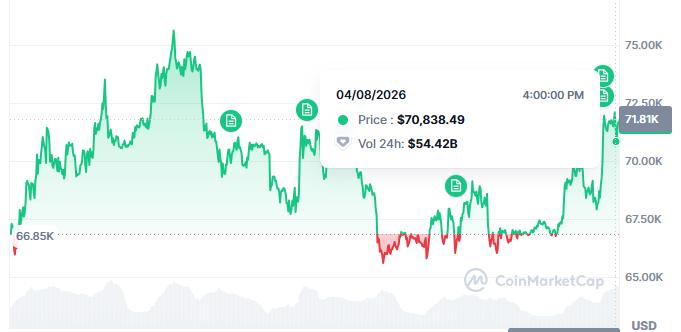
Despite the gains, cryptocurrencies remain down significantly this year. The signs of any permanent rebound remain slim even as exchange supply continues to decline, according to CryptoQuant data.
Nevertheless, the Iranian authorities’ adoption shows how cryptocurrencies remain a tool for evading sanctions. Crypto volume into the country has particularly soared since the war began, according to data from Chainalysis.
The post Iran Demands Payments for Strait of Hormuz Passage in Bitcoin appeared first on The Market Periodical.


Ayrıca Şunları da Beğenebilirsiniz

XRP Volume Hits Rare Lows, Signals Possible Breakout Ahead

Wall Street and Hollywood Veterans to Launch NEXTRock and SVCV Global in Japan




