

US Senator Warren probes China-based Bitmain on security concerns
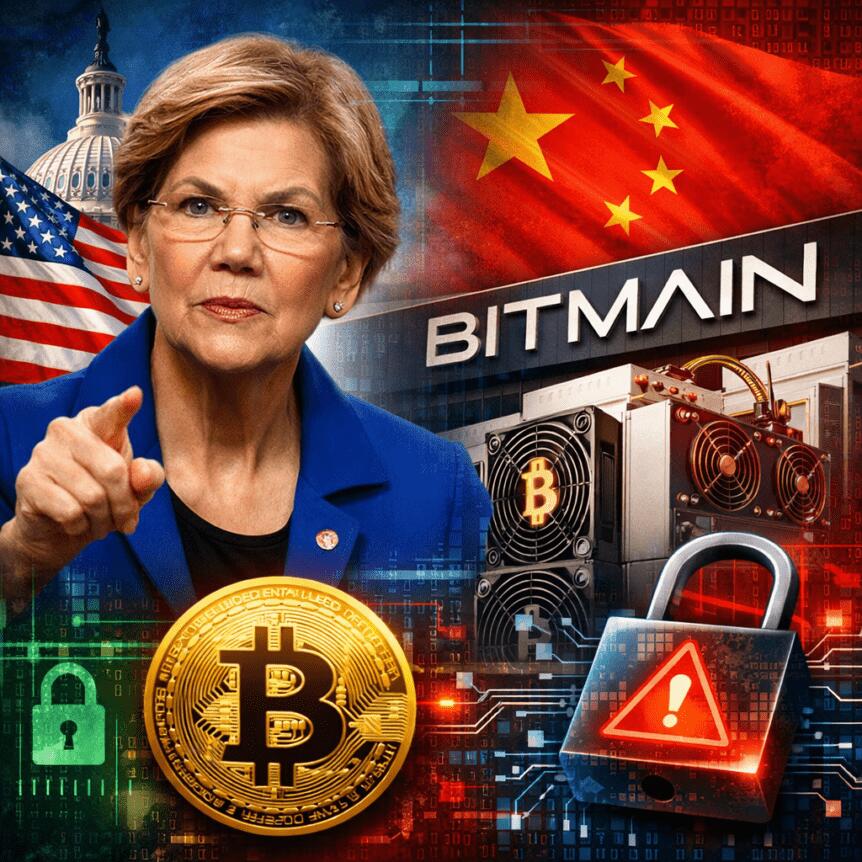
Senator Elizabeth Warren has asked the U.S. Commerce Department to explain how it is assessing potential national-security risks linked to Bitmain Technologies, the Chinese-founded maker of a substantial share of the world’s Bitcoin mining hardware. The request follows prior reporting that Bitmain is under federal scrutiny, with a focus on whether its ASICS could pose espionage risks or threaten critical infrastructure.
In a letter dated Thursday, Warren urged Commerce Secretary Howard Lutnick to provide documents and communications related to Bitmain, citing a Bloomberg report on the matter. The inquiry signals a broader government interest in the national-security dimensions of foreign-manufactured mining equipment, as the sector becomes increasingly strategic for energy grids and cyber defense.
Key takeaways
- Senator Warren requested detailed documentation from the Commerce Department on Bitmain, citing a Bloomberg report about national-security concerns.
- The inquiry intersects with a long-running federal probe into Bitmain and potential risks to U.S. critical infrastructure, codenamed Operation Red Sunset and led by Homeland Security.
- Bitmain is pursuing a major expansion in the United States, planning to open its first U.S. ASIC manufacturing facility with production slated to begin in early 2026 and scale by the end of the year.
- U.S. authorities have previously halted shipments of Bitmain devices and scrutinized related Chinese chip firms for alleged ties to sanctioned entities, highlighting a broader regulatory tightening around mining hardware.
- In a separate development, a Trump-backed American Bitcoin Corp. has pursued large-scale Bitmain purchases, illustrating ongoing sector adoption amid geopolitical tensions.
Regulatory spotlight deepens around Bitmain
The Commerce Department is being pressed to shed light on how national-security considerations are weighed in evaluating Bitmain, which supplies a large portion of the global Bitcoin mining hardware ecosystem. The development comes amid a cluster of ongoing regulatory and anti-foreign-influence actions that have kept Bitmain in the crosshairs of U.S. policymakers.
The Bloomberg reporting framing Warren’s inquiry underscores how lawmakers are threading concerns about foreign tech supply chains with national-security risk governance. While the Commerce Department has not publicly released its conclusions, the request indicates growing congressional scrutiny of mining hardware suppliers from outside the United States, particularly those with ties to strategic sectors like semiconductors and telecommunications.
Unresolved probe and what it could mean for the sector
The Bitmain review, described in reports as Operation Red Sunset and led by Homeland Security, reportedly examined whether Bitmain’s ASIC machines could be exploited for espionage or to disrupt the U.S. power grid. Bloomberg noted that the probe’s current status is unclear and that national-security investigations of this type can extend for years without public resolution. The lack of a formal public outcome does not necessarily signal exoneration; it often reflects a prolonged, sensitive process where details remain classified or undisclosed.
Industry observers have pointed to the broader risk dynamics for miners and equipment suppliers who depend on global supply chains and are subject to shifting regulatory overlays. The uncertainty surrounding the Bitmain probe adds another layer of caution for investors and operators evaluating hardware procurement in a climate where security concerns increasingly influence partnerships and deployment decisions.
Bitmain’s U.S. manufacturing ambitions under the microscope
Amid the scrutiny, Bitmain has signaled its ambition to establish a significant U.S. manufacturing footprint. Bloomberg reported in mid-2023 that Bitmain planned to open its first U.S.-based ASIC production facility, with initial chip manufacturing anticipated to begin in early 2026 and scale later in the year. The move would mark a notable shift in the hardware supply chain, potentially reducing dependence on overseas fabrication while inviting heightened regulatory attention from U.S. authorities.
Cointelegraph reached out to Warren and Bitmain for comment, but neither had provided a response by publication. The timing of a U.S. facility aligns with a period of renewed interest in domestic mining infrastructure, even as the regulatory environment remains unsettled for equipment sourced from abroad.
Market dynamics, adoption, and the political backdrop
Bitmain’s mining hardware remains widely deployed among U.S. and global operators. The company’s machines appear in operations across the sector, including instances where high-profile investors are involved in mining ventures. In one notable case, American Bitcoin Corp.—a Trump-aligned project—reported a large-scale procurement of Bitmain rigs, agreeing to acquire 16,000 Bitmain ASICs in a deal valued at about $314 million. The arrangement illustrates ongoing demand for Bitmain’s hardware even as the company faces heightened regulatory attention and potential geopolitical risk factors.
The broader market context is also shaped by competitiveness among ASIC manufacturers. A Cambridge University–backed industry report shows a concentrated market share among a small set of large producers, highlighting how hardware supply shifts can influence mining economics, efficiency, and resilience in the face of policy changes. As regulators weigh security considerations against economic incentives for domestic manufacturing, investors and operators are watching how supply chains will adapt to potential restraints, export controls, or licensing requirements.
The regulatory backdrop also includes prior actions—such as halted shipments of Bitmain devices and investigations into related Chinese chip firms over alleged links to sanctioned entities—as well as a 2024 federal review flagging concerns about deploying Bitmain machines near U.S. military installations. These elements collectively frame a sector where security, diplomacy, and economics are increasingly interwoven into everyday mining decisions.
Overall, the trajectory for Bitmain in 2026 and beyond will hinge on how Commerce and homeland-security authorities balance innovation, national-security safeguards, and the evolving geostrategic calculus of semiconductor and crypto infrastructure supply chains. As the government’s position becomes clearer, miners and investors will need to adjust their risk models to incorporate regulatory developments, potential licensing regimes, and the possibility of shifts in supplier dynamics.
Readers should monitor whether the Commerce Department provides formal responses to Senator Warren’s requests and how the Red Sunset probe evolves, as any developments could influence Bitmain’s U.S. plans, the availability of mining hardware, and the broader regulatory environment governing crypto infrastructure in the United States.
This article was originally published as US Senator Warren probes China-based Bitmain on security concerns on Crypto Breaking News – your trusted source for crypto news, Bitcoin news, and blockchain updates.
You May Also Like

Bitcoin Price Prediction: Expert Warns of Potential Plunge to $60K Support Level

Expert to XRP Holders: This Is Not a Joke. Prepare Now


