Bulls Keep the Upper Hand as Solana Price Tests the Crucial $95 Resistance Zone

Market conditions remain cautious, yet the Solana price is still grinding higher and pressing into a key resistance area that could decide the next directional leg.
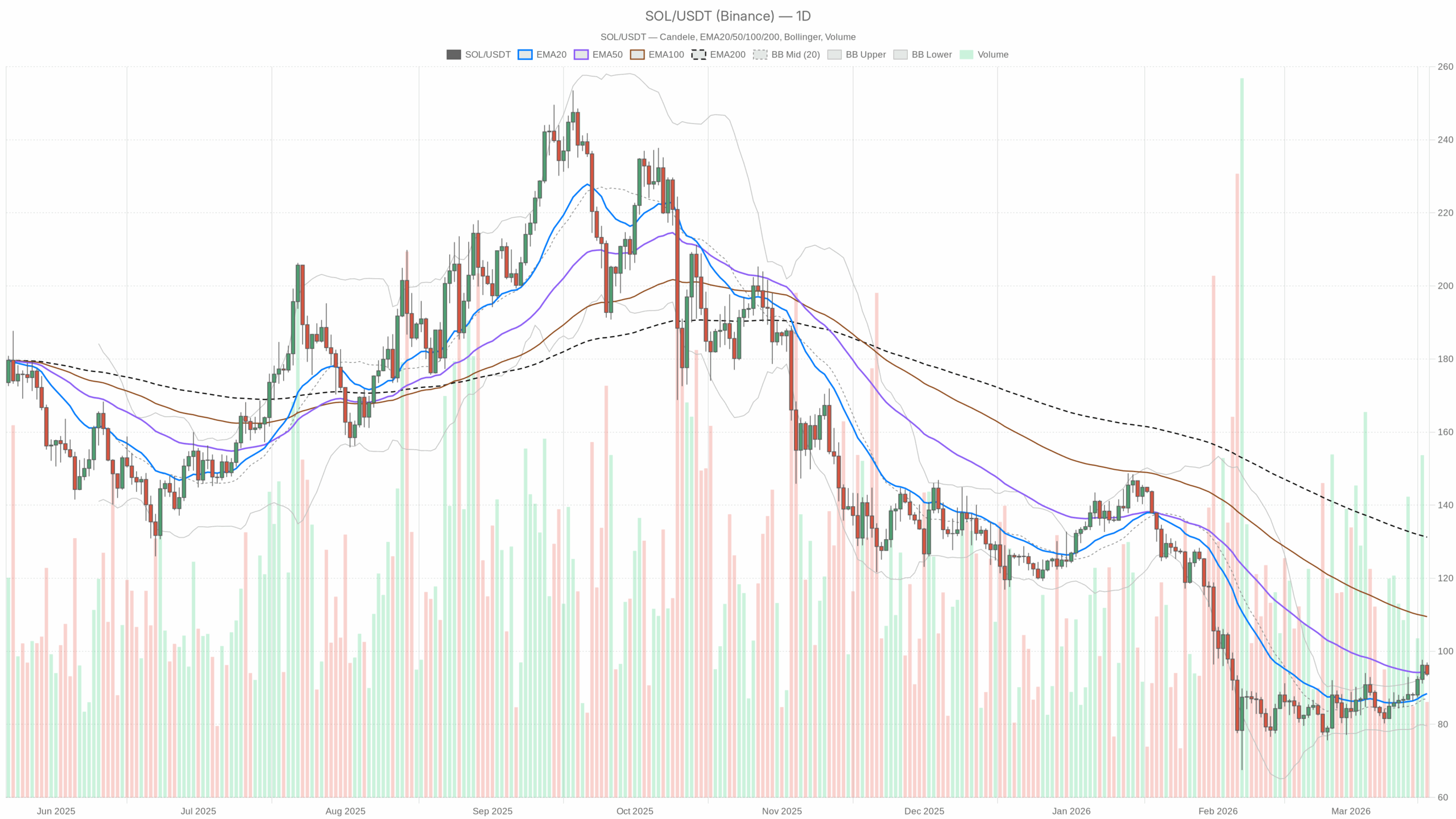 SOL/USDT — daily chart with candlesticks, EMA20/EMA50 and volume.
Daily Chart (D1): Primary Bias – Constructive Bullish
The daily timeframe defines the main scenario, and here the bias is mildly bullish with some overhead damage still to repair.
Daily EMAs: Early-Stage Repair, Not a Clean Trend
- Price: $93.71
- EMA 20: $88.42
- EMA 50: $94.26
- EMA 200: $131.24
Solana trades above the 20-day EMA but slightly below the 50-day EMA, with the 200-day far overhead. That is a textbook repair phase after a larger down leg: short-term strength, medium-term still capped, long-term trend still bearish.
What it implies: Bulls are regaining control in the short run, but this is happening within a broader downtrend from much higher levels. Moreover, traders should expect resistance pressure as price approaches and tests the 50-day EMA around $94–95. If it can reclaim and hold above the 50-day, the narrative upgrades from a bounce to a genuine trend rebuild.
Daily RSI: Healthy, Not Overstretched
- RSI 14: 57.65
RSI in the high 50s means momentum is positive but not euphoric.
What it implies: There is room for Solana price to extend higher before running into traditional overbought conditions. This supports the idea of further upside as long as buyers keep defending pullbacks.
Daily MACD: Bullish Inflection
- MACD line: 0.63
- Signal line: -1.00
- Histogram: 1.63
The MACD line is above the signal and the histogram is positive and sizable.
What it implies: Momentum has recently turned up from a previous bearish phase. We are in the middle of a bullish impulse on the daily chart, not at the start, but certainly not exhausted yet. This aligns with RSI: constructive upside momentum with no blow-off signs.
Daily Bollinger Bands: Trading Near the Upper Edge
- Middle band (20SMA): $87.06
- Upper band: $94.53
- Lower band: $79.59
- Price: $93.71 (near upper band)
Price is riding close to the upper band, while the mid-band sits well below current levels.
What it implies: Buyers are in control on the daily timeframe, pressing price toward the higher volatility envelope. This is how trend legs normally develop. However, hugging the upper band near a known resistance zone ($94–95) also raises the risk of short-term mean reversion if buyers hesitate.
Daily ATR: Elevated but Not Extreme Volatility
- ATR 14: $4.82
With ATR around $4.8, Solana has been swinging roughly 5% per day in recent sessions.
What it implies: Moves of $4–5 in either direction are normal right now. For traders, that means risk and stop placement need to factor in multi-dollar intraday noise; tight stops near obvious levels are likely to get run.
Daily Pivots: Local Battlefield Around $94
- Pivot point (PP): $94.62
- Resistance 1 (R1): $96.04
- Support 1 (S1): $92.29
Current price at $93.71 sits just below the daily pivot and under R1.
What it implies: The $94–96 region is a key intraday supply zone on the daily map. A clean push above the PP and through R1 would confirm buyers absorbing overhead offers. Conversely, repeated failures here would reinforce the area as a short-term ceiling and invite a pullback toward S1 or the mid-Bollinger band.
Intraday Picture: Short-Term Momentum Cooling
While the daily chart leans bullish, the lower timeframes are more mixed. This is important for timing and risk.
1-Hour Chart (H1): Neutral Drift After a Push
- Price: $93.73
- EMA 20: $94.15
- EMA 50: $92.84
- EMA 200: $89.47
- RSI 14: 48.12
- MACD line: 0.24
- Signal line: 0.55
- Histogram: -0.31
- Bollinger mid: $94.70 (bands $92.83–96.57)
- ATR 14: $1.06
- Pivot: $93.67 (R1 $93.93, S1 $93.46)
On H1, price is slightly below the 20-EMA but above the 50- and 200-EMA. The short-term trend is pausing inside a broader intraday uptrend.
What it implies: The intraday bull run is taking a breather. RSI is almost dead center, and MACD has crossed into a mild bearish configuration (line under signal, negative histogram). This looks more like consolidation or digestion than an aggressive selloff. Above the 50-EMA and 200-EMA, dips still look like they belong to buyers in the context of the daily bullish bias, but intraday momentum is not strong right now.
15-Minute Chart (M15): Micro Pressure to the Downside
- Price: $93.62
- EMA 20: $94.07
- EMA 50: $94.36
- EMA 200: $92.80
- RSI 14: 40.42
- MACD line: -0.23
- Signal line: -0.17
- Histogram: -0.06
- Bollinger mid: $94.17 (bands $93.34–95.01)
- ATR 14: $0.48
- Pivot: $93.70 (R1 $93.79, S1 $93.53)
On the 15-minute chart, price is trading below both the 20- and 50-EMA but still above the 200-EMA. RSI is in the low 40s and MACD is slightly bearish.
What it implies: Very short-term flows are skewed to the downside, but not capitulatory. This is the typical intraday back-and-fill that often precedes either a continuation higher (if daily buyers step back in) or a larger intraday pullback (if selling pressure accelerates). For execution, it means chasing strength on this micro timeframe is riskier; better entries usually come closer to the 200-EMA or prior support.
Market Context: Strong Asset in a Nervous Market
Bitcoin dominance at about 56.7% and a fear reading of 28 show the broader market is in a cautious, Bitcoin-heavy mode. Yet Solana still commands about 2.05% of total crypto market cap, with robust DeFi activity across major Solana DEXs such as Raydium, Orca, and HumidiFi, many of which show sharp 1-day fee spikes.
What it implies: Capital remains interested in Solana‘s ecosystem even as macro sentiment leans defensive. That underpins the daily bullish bias. However, Solana is not trading in a vacuum; heavy BTC corrections or broader risk-off waves can still drag it down quickly.
Bullish Scenario for Solana Price
The bullish case is built on the daily chart continuing to dominate the story.
Key conditions for upside:
As long as Solana holds above the daily 20-EMA ($88.4) and keeps grinding near the upper Bollinger band, the path of least resistance is higher. The first technical objective is a clean reclaim of the daily 50-EMA and pivot region:
- A sustained push above $95–96 (daily pivot plus R1 and slightly above the 50-EMA)
- H1 momentum turning back up, with MACD histogram flipping positive and RSI pushing into the 55–60 zone
If that happens, shorts above the 50-day start to feel pressure, and a continuation move toward the next psychological and technical zones around $100–102 becomes plausible. Given the current ATR, a move of that size could happen over a handful of trading sessions rather than weeks.
What would invalidate the bullish scenario?
The bullish thesis weakens meaningfully if Solana loses its short-term momentum structure:
- A daily close back below the 20-day EMA (~$88), turning that level from support back into resistance
- RSI dropping back toward the low 40s on the daily, showing that buying pressure has faded
- MACD histogram rolling over into negative territory again on D1
If those conditions line up, the current leg looks more like a failed bounce inside a larger downtrend, opening the door for a deeper retrace toward the lower Bollinger band and prior supports in the low $80s.
Bearish Scenario for Solana Price
Bears currently have the higher timeframes working against them, but they have two angles: fade resistance now, or wait for a break of structure.
Fade at resistance:
Right here, $94–96 combines the daily pivot, R1, and the 50-day EMA. Micro timeframes (M15 and partially H1) are already leaning slightly bearish. This is a logical spot for short-term traders to lean against:
- Failure to reclaim and hold above $95–96
- Rejection wicks on the 1H or 4H around that zone, with RSI unable to break out
- Follow-through lower, breaking the local intraday supports around $92–93
Under that path, a pullback toward the daily mid-Bollinger band at about $87 and the 20-day EMA becomes the target area.
Breakdown scenario:
For a more structural bearish shift:
- Daily closes below the $88–87 zone, where the 20-day EMA and mid-band converge
- MACD bear cross on the daily with a sustained negative histogram
- RSI sliding under 45 on D1, indicating loss of bullish momentum
That combination would open space for Solana to retest the lower Bollinger band in the high $70s to low $80s. Given the current ATR, that move could materialize in a week or two if selling accelerates and macro sentiment deteriorates.
What would invalidate the bearish scenario?
If price accepts above $96 and turns that area into intraday support, the fade-at-resistance idea is wrong. From there, bears would need to back off unless they are explicitly playing a longer-term mean reversion from much higher levels. A rising daily RSI above 60 and a firmly positive MACD histogram would reinforce that bears have lost the initiative.
Positioning, Risk, and Uncertainty
Solana’s daily structure justifies a constructive bias, but it is not a one-way market. The macro is still in fear, volatility remains elevated with 5% daily ranges, and price is trading right into a dense cluster of resistance.
For directional traders, this backdrop favors two broad attitudes:
- Pro-bull but selective: Respect the daily upturn, but avoid chasing green candles right into $95–96. Patience around pullbacks closer to the 20-day EMA or intraday supports can matter more than precision tops and bottoms when ATR is this high.
- Short-term contrarian: If you lean bearish, your edge is very short-term: fading into the $94–96 zone with tight risk defined above resistance, not assuming a full trend reversal unless daily structure actually breaks down.
The key point: the Solana price currently favors the bulls on the daily chart, but intraday momentum is in cooling mode. The next decisive move will likely come from how price behaves around $95 and whether the market is willing to pay up above the 50-day EMA in a fearful macro environment. Until that resolves, treating both upside and downside moves as volatile but tradable swings rather than locked-in trends remains the more realistic view.
You May Also Like

Steel Dynamics (STLD) Stock Dips Following Disappointing Q1 Earnings Forecast

EUR/CHF slides as Euro struggles post-inflation data