

USD/JPY Price Forecast: Resilient Pair Holds Critical Gains Near 157.00 Monthly Peak
BitcoinWorld
USD/JPY Price Forecast: Resilient Pair Holds Critical Gains Near 157.00 Monthly Peak
TOKYO, May 2025 – The USD/JPY currency pair demonstrates remarkable resilience in Asian trading sessions, maintaining its position near monthly highs above the psychologically significant 157.00 level. This sustained strength follows a period of heightened volatility driven by divergent monetary policies between the Federal Reserve and Bank of Japan. Market participants now closely monitor technical indicators and fundamental developments that could determine the pair’s next directional move. The current consolidation near monthly peaks suggests potential for further appreciation, though several critical resistance levels loom overhead.
USD/JPY Technical Chart Analysis and Key Levels
Technical analysis reveals the USD/JPY pair has established a firm foothold above the 157.00 handle, a level that previously served as both support and resistance throughout April 2025. The daily chart shows the pair trading approximately 1.2% above its 50-day moving average, indicating sustained bullish momentum. Furthermore, the Relative Strength Index (RSI) currently reads 62, placing it in bullish territory while remaining below overbought conditions. This technical positioning suggests room for additional upside movement before encountering significant selling pressure.
Several critical technical levels now define the trading landscape. Immediate resistance appears at 157.50, followed by the more substantial 158.00 psychological barrier. On the downside, support clusters emerge at 156.80, 156.30, and the crucial 155.50 level. The 155.50 mark represents the pair’s 100-day moving average and has provided reliable support during previous pullbacks. Market analysts note that a decisive break above 158.00 could trigger accelerated buying, potentially targeting the 160.00 handle last tested in late 2024.
Chart Pattern Recognition and Volume Analysis
Recent price action reveals the formation of an ascending triangle pattern on the four-hour chart, typically considered a continuation pattern in technical analysis. This pattern features a flat upper resistance near 157.50 and rising lower trendline support. Trading volume has remained consistent during this consolidation phase, suggesting genuine accumulation rather than speculative positioning. The measured move target from this pattern’s completion projects toward the 159.00-159.50 region, aligning with previous areas of historical resistance.
Fundamental Drivers Behind USD/JPY Strength
The fundamental backdrop continues to favor US dollar strength against the Japanese yen, primarily driven by widening interest rate differentials. The Federal Reserve maintains its benchmark rate within the 5.25%-5.50% range as of May 2025, while the Bank of Japan has only cautiously normalized its negative interest rate policy. This substantial rate gap, exceeding 500 basis points, creates powerful carry trade incentives that naturally support USD/JPY appreciation. Institutional investors frequently borrow in low-yielding yen to purchase higher-yielding dollar assets, generating consistent demand for the currency pair.
Recent economic data releases have further reinforced this dynamic. United States inflation metrics, particularly core PCE, remain persistently above the Fed’s 2% target, suggesting continued restrictive monetary policy. Conversely, Japan’s core inflation has moderated to approximately 2.2% year-over-year, reducing pressure on the Bank of Japan to implement aggressive tightening measures. This policy divergence represents the primary fundamental driver behind the pair’s sustained upward trajectory since 2022.
Central Bank Policy Trajectories and Market Expectations
Market expectations regarding future central bank actions significantly influence USD/JPY price dynamics. According to CME FedWatch Tool data, traders currently price in approximately 50 basis points of Federal Reserve rate cuts through December 2025. Meanwhile, expectations for additional Bank of Japan rate hikes remain modest, with most analysts projecting only 10-25 basis points of tightening during the same period. This anticipated policy path suggests interest rate differentials will remain historically wide, continuing to support USD/JPY strength throughout 2025.
The Bank of Japan faces particular challenges in normalizing policy without triggering excessive yen appreciation that could harm export competitiveness. Governor Kazuo Ueda has repeatedly emphasized a data-dependent approach with gradual adjustments. This cautious stance contrasts with the Federal Reserve’s continued focus on inflation containment, creating what analysts describe as a “perfect storm” for USD/JPY appreciation. The table below summarizes key policy differences:
| Central Bank | Current Policy Rate | 2025 Projected Changes | Primary Policy Focus |
|---|---|---|---|
| Federal Reserve | 5.25%-5.50% | 50 bps cuts expected | Inflation containment |
| Bank of Japan | 0.00%-0.10% | 10-25 bps hikes expected | Gradual normalization |
Market Structure and Participant Positioning
Commitment of Traders (COT) reports from the Commodity Futures Trading Commission reveal substantial net short positioning in Japanese yen futures, reaching near-extreme levels not seen since 2022. This positioning data indicates that professional traders maintain overwhelmingly bearish views on the yen relative to the US dollar. However, some analysts caution that such extreme positioning often precedes sharp reversals when sentiment eventually shifts. The current structure suggests that any dovish Federal Reserve signals or unexpectedly hawkish Bank of Japan communications could trigger rapid yen appreciation as traders unwind crowded positions.
Meanwhile, options market data shows increased demand for USD/JPY call options at strike prices of 158.00 and 159.00, suggesting institutional expectations for further near-term appreciation. The one-month risk reversal, which measures the premium of calls over puts, remains positive at +0.85%, confirming continued bullish bias among options traders. This derivatives market activity provides valuable insight into professional expectations beyond simple spot price movements.
Geopolitical Considerations and Safe-Haven Flows
Geopolitical developments frequently influence USD/JPY dynamics through safe-haven flows. The Japanese yen traditionally strengthens during periods of market stress or geopolitical uncertainty, while the US dollar benefits from its status as the global reserve currency. Recent tensions in the Asia-Pacific region have created competing influences on the currency pair. On one hand, regional instability typically supports yen strength. On the other hand, dollar demand increases during global uncertainty. The net effect has been relatively balanced, allowing interest rate differentials to remain the dominant driver of USD/JPY price action.
Historical Context and Long-Term Trends
The USD/JPY pair has experienced significant appreciation since 2021, rising from approximately 103.00 to current levels near 157.00—a remarkable 52% increase over four years. This sustained uptrend represents the pair’s most substantial rally since the Plaza Accord era of the mid-1980s. Historical analysis reveals that USD/JPY typically experiences multi-year trending periods followed by extended consolidation phases. The current rally has now exceeded the duration of the 2012-2015 uptrend, suggesting increased potential for either acceleration or correction in coming months.
Previous periods of extreme USD/JPY valuation have often prompted coordinated intervention by Japanese monetary authorities. The Ministry of Finance last intervened in currency markets during September and October 2022 when USD/JPY approached 152.00. With the pair now trading approximately 500 pips above those intervention levels, market participants carefully monitor official communications for any hints of renewed currency stabilization efforts. Japanese Finance Minister Shunichi Suzuki recently stated that authorities would take “appropriate action against excessive moves” without specifying particular levels.
Comparative Analysis with Other Major Currency Pairs
The USD/JPY’s performance significantly outperforms other major dollar pairs in 2025. While EUR/USD has declined approximately 4% year-to-date and GBP/USD has fallen roughly 3%, USD/JPY has appreciated nearly 8% during the same period. This relative strength highlights the unique dynamics between US and Japanese monetary policies compared to other developed economies. The European Central Bank and Bank of England have implemented more aggressive tightening cycles than the Bank of Japan, resulting in narrower interest rate differentials with the Federal Reserve.
Key factors distinguishing USD/JPY from other major pairs include:
- Maximum policy divergence: The Fed-BoJ gap exceeds other central bank differentials
- Structural flows: Japan’s persistent current account surplus creates natural yen demand
- Intervention risk: Japanese authorities have historically been more active in FX markets
- Carry trade appeal: The yen remains a premier funding currency for global investors
Risk Factors and Potential Catalysts for Reversal
Despite the prevailing bullish trend, several risk factors could trigger USD/JPY correction or reversal. First, any acceleration in Bank of Japan policy normalization would immediately narrow interest rate differentials, reducing the pair’s fundamental support. Second, unexpected Federal Reserve dovishness, perhaps in response to weakening labor market data, could diminish dollar appeal. Third, coordinated G7 currency intervention remains a possibility if officials deem yen weakness excessive or disorderly. Fourth, deteriorating risk sentiment in global equity markets typically benefits the yen as a traditional safe-haven currency.
Technical analysts identify additional warning signs that could precede trend changes. A daily close below the 155.50 support level would break the 100-day moving average and potentially signal deeper correction toward 153.00. Furthermore, bearish divergence on momentum oscillators, where price makes higher highs while indicators make lower highs, would suggest weakening underlying strength. Market participants should monitor these technical developments alongside fundamental catalysts for comprehensive risk assessment.
Seasonal Patterns and Quarterly Flows
Historical analysis reveals distinct seasonal patterns in USD/JPY price action. The pair typically demonstrates strength during the first and fourth quarters, while experiencing more mixed performance during mid-year months. This pattern correlates with Japanese corporate repatriation flows ahead of fiscal year-end in March and semi-annual dividend payments in September. Additionally, the pair often exhibits increased volatility during Bank of Japan policy meetings, which occur eight times annually. The next scheduled meeting in June 2025 represents a potential catalyst for renewed directional movement depending on policy communications.
Conclusion
The USD/JPY price forecast remains cautiously bullish as the pair maintains gains near monthly highs above 157.00. Technical analysis suggests potential for further appreciation toward 158.00-159.00 resistance zones, though overextended positioning increases vulnerability to corrections. Fundamentally, persistent policy divergence between the Federal Reserve and Bank of Japan continues to provide structural support for dollar strength against the yen. Market participants should monitor upcoming economic data releases, central bank communications, and technical developments around key levels. The USD/JPY forecast ultimately depends on the evolving balance between interest rate differentials, risk sentiment, and potential currency intervention by Japanese authorities.
FAQs
Q1: What key technical levels should traders watch for USD/JPY?
A1: Immediate resistance appears at 157.50 and 158.00, while support clusters at 156.80, 156.30, and the crucial 155.50 level representing the 100-day moving average.
Q2: Why does USD/JPY remain strong despite potential Federal Reserve rate cuts?
A2: Interest rate differentials remain historically wide even with expected Fed cuts, as the Bank of Japan maintains ultra-accommodative policy with only gradual normalization anticipated.
Q3: What would trigger Japanese currency intervention in USD/JPY?
A3: Japanese authorities typically intervene when they perceive “excessive volatility” or “disorderly moves” rather than specific levels, though previous intervention occurred near 152.00 in 2022.
Q4: How do carry trades influence USD/JPY price action?
A4: Investors borrow low-yielding yen to purchase higher-yielding dollar assets, creating consistent demand for USD/JPY that strengthens during periods of market stability and risk appetite.
Q5: What economic indicators most impact USD/JPY direction?
A5: US inflation data (CPI, PCE), Federal Reserve communications, Japanese wage growth figures, and Bank of Japan policy decisions represent the most significant fundamental drivers.
This post USD/JPY Price Forecast: Resilient Pair Holds Critical Gains Near 157.00 Monthly Peak first appeared on BitcoinWorld.
You May Also Like
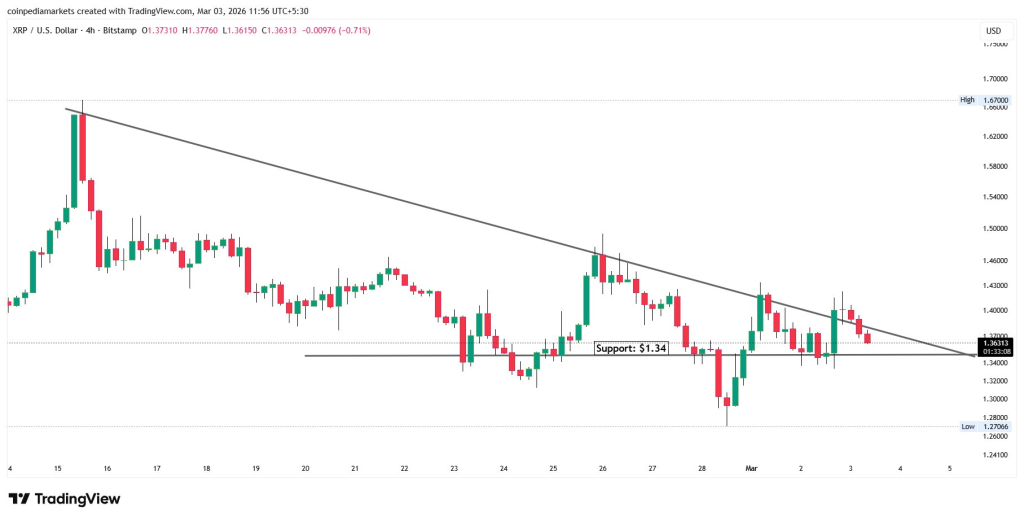
Warning Signs Flash for $XRP as $1.34 Support Gets Tested

PiDex Testnet Launch: What It Means for Pi Network and Picoin Value
