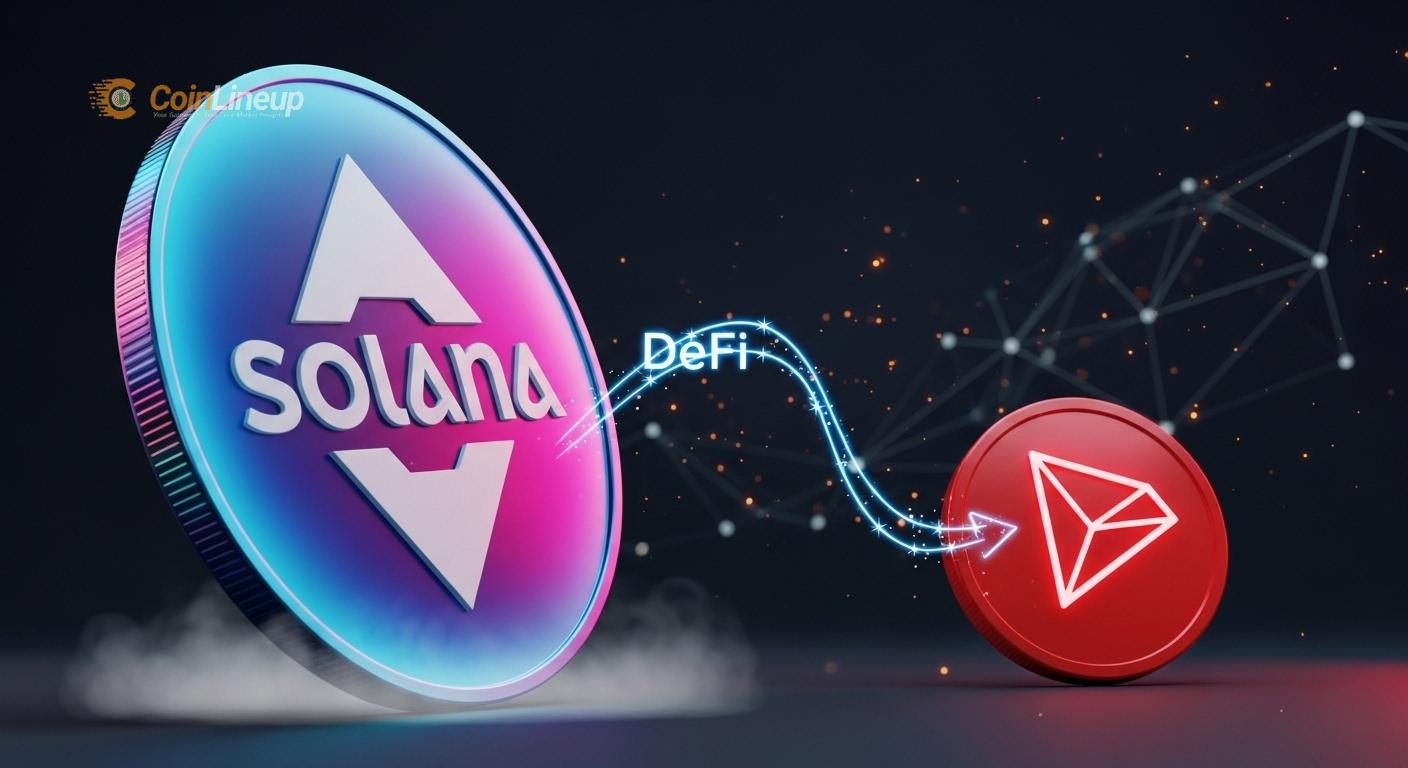
Data shows Solana led 24h fees on DeFi/MEV; TRC-20 USDT drove Tron on 7d/30d per data. Solana vs Tron fees, DeFiLlama fee revenue, USDT stablecoin transfersData shows Solana led 24h fees on DeFi/MEV; TRC-20 USDT drove Tron on 7d/30d per data. Solana vs Tron fees, DeFiLlama fee revenue, USDT stablecoin transfers

Solana edges past Tron in 24h fees on DeFi activity

2026/02/23 03:19
3 min read
For feedback or concerns regarding this content, please contact us at [email protected]
Solana edges past Tron in 24h fees on DeFi activity

Key Takeaways:

  • Solana briefly surpassed TRON in 24h network fees, conditionally and timeframe-dependent.
  • Interpret flips by confirming 24h vs 7d windows and Fees versus Revenue.
  • Fee drivers differ: TRON stablecoin transfers; Solana volatile DeFi and trading.

A reported 24-hour flip suggests Solana briefly surpassed TRON in network fees. The signal is timeframe-dependent and hinges on whether a dashboard is set to Fees or Revenue.

Immediate takeaways are methodological. Confirm the exact window (24h vs 7d vs 30d), ensure you are comparing identical metrics, and then assess the quality and durability of the activity producing those fees.

On TRON, fee generation is closely tied to TRC-20 USDT transfers and network design choices; a sector analysis noted that stablecoin transfer fees remained elevated versus Solana even after fee reductions aimed at boosting usage, based on data from PANewsLab. This implies high-frequency payments and remittance-style flows can dominate TRON’s fee profile.

On Solana, fee revenue is more volatile and often associated with DEX trading, liquid staking, and broader DeFi activity, as reported by AltCryptoTalk. This mix can amplify fee swings during bursts of liquidity, bot activity, or memecoin launches.

TRON’s governance has also cut gas costs, with subsequent short-term revenue compression for block producers before volume recovery, according to Cointelegraph. Such policy levers can reshape daily fee tallies without necessarily reflecting organic fee-paying demand.

A separate lens is fee concentration: one analysis attributed 95% of Solana fees to about 1.26% of users, said BTCC.com summarizing research by Michael Nadeau. Concentration can inflate headline fees while masking how broadly the cost burden is distributed across regular users.

Start at the DeFiLlama Fees/Revenue dashboard for chains. This interface is widely used for cross-chain fee comparisons and provides 24h, 7d, and 30d windows.

Set the view explicitly to Fees, not Revenue, and select the 24h filter. Revenue can include protocol-level take rates and may differ from raw fees paid.

Search for and select Solana and TRON to display side-by-side series. Confirm the chains are mapped correctly and that no custom filters are hiding either protocol.

Toggle across 7d and 30d to see whether the daily flip persists. If the lead reverses at longer horizons, the initial 24h observation was likely a transient spike.

This cross-check matters because single-day snapshots can conflict with other windows; as reported by U.Today, “Tron pulled in ~$676,000 in fees over a 24-hour span, beating Solana’s ~$599,197 for the same period.” Interpreting any flip requires anchoring the timeframe and metric.

For neutral market context at the time of this writing, CoinGecko data show roughly $2.08 billion in 24-hour trading activity with a day-over-day decline, while SOL trades in the mid-$80s. Context like this does not validate fees but helps frame overall market conditions.

Disclaimer: CoinLineup.com provides cryptocurrency and financial market information for educational and informational purposes only. The content on this site does not constitute financial, investment, or trading advice. Cryptocurrency and stock markets involve significant risk, and past performance is not indicative of future results. Always conduct your own research and consult a qualified financial advisor before making any investment decisions.

Disclaimer: The articles reposted on this site are sourced from public platforms and are provided for informational purposes only. They do not necessarily reflect the views of MEXC. All rights remain with the original authors. If you believe any content infringes on third-party rights, please contact [email protected] for removal. MEXC makes no guarantees regarding the accuracy, completeness, or timeliness of the content and is not responsible for any actions taken based on the information provided. The content does not constitute financial, legal, or other professional advice, nor should it be considered a recommendation or endorsement by MEXC.

You May Also Like

Landmark Court Ruling Rejects Terrorism Financing Claims

Landmark Court Ruling Rejects Terrorism Financing Claims

The post Landmark Court Ruling Rejects Terrorism Financing Claims appeared on BitcoinEthereumNews.com. Binance Lawsuit Dismissed: Landmark Court Ruling Rejects
Share
BitcoinEthereumNews2026/03/07 10:27
IP Hits $11.75, HYPE Climbs to $55, BlockDAG Surpasses Both with $407M Presale Surge!

IP Hits $11.75, HYPE Climbs to $55, BlockDAG Surpasses Both with $407M Presale Surge!

The post IP Hits $11.75, HYPE Climbs to $55, BlockDAG Surpasses Both with $407M Presale Surge! appeared on BitcoinEthereumNews.com. Crypto News 17 September 2025 | 18:00 Discover why BlockDAG’s upcoming Awakening Testnet launch makes it the best crypto to buy today as Story (IP) price jumps to $11.75 and Hyperliquid hits new highs. Recent crypto market numbers show strength but also some limits. The Story (IP) price jump has been sharp, fueled by big buybacks and speculation, yet critics point out that revenue still lags far behind its valuation. The Hyperliquid (HYPE) price looks solid around the mid-$50s after a new all-time high, but questions remain about sustainability once the hype around USDH proposals cools down. So the obvious question is: why chase coins that are either stretched thin or at risk of retracing when you could back a network that’s already proving itself on the ground? That’s where BlockDAG comes in. While other chains are stuck dealing with validator congestion or outages, BlockDAG’s upcoming Awakening Testnet will be stress-testing its EVM-compatible smart chain with real miners before listing. For anyone looking for the best crypto coin to buy, the choice between waiting on fixes or joining live progress feels like an easy one. BlockDAG: Smart Chain Running Before Launch Ethereum continues to wrestle with gas congestion, and Solana is still known for network freezes, yet BlockDAG is already showing a different picture. Its upcoming Awakening Testnet, set to launch on September 25, isn’t just a demo; it’s a live rollout where the chain’s base protocols are being stress-tested with miners connected globally. EVM compatibility is active, account abstraction is built in, and tools like updated vesting contracts and Stratum integration are already functional. Instead of waiting for fixes like other networks, BlockDAG is proving its infrastructure in real time. What makes this even more important is that the technology is operational before the coin even hits exchanges. That…
Share
BitcoinEthereumNews2025/09/18 00:32
The U.S. Commodity Futures Trading Commission unveiled a new logo, claiming it will usher in a "golden age" of innovation.

The U.S. Commodity Futures Trading Commission unveiled a new logo, claiming it will usher in a "golden age" of innovation.

PANews reported on March 7 that the U.S. Commodity Futures Trading Commission (CFTC) today unveiled a new logo, stating that it symbolizes the agency's commitment
Share
PANews2026/03/07 10:08