Bitcoin’s slide to $60,000 on Feb. 6 triggered a sharp surge of exchange inflows that on-chain analyst Darkfost called a capitulation event, with short-term holdersBitcoin’s slide to $60,000 on Feb. 6 triggered a sharp surge of exchange inflows that on-chain analyst Darkfost called a capitulation event, with short-term holders

Retail Dumps, Bitcoin Inflows Surge: On-Chain Data Flags Capitulation

2026/02/09 18:00
3 min read

Bitcoin’s slide to $60,000 on Feb. 6 triggered a sharp surge of exchange inflows that on-chain analyst Darkfost called a capitulation event, with short-term holders and small “shrimp” wallets leading the move. It wasn’t just retail panic either—flows jumped on venues that pros actually use.

Darkfost said the selloff “reignited investor anxiety” after BTC revisited a price level “not…since October 2024,” alongside a broader drawdown “exceeding 50% from the last all time high.” It wasn’t only where BTC traded. It was how fast it got there. “The acceleration of this correction created a clear fear driven dynamic,” he said. People rushed coins onto exchanges. That only added fuel to the liquidation fire. “Unsurprisingly, Short Term Holders were the first to react emotionally.”

Bitcoin Capitulation Event

What stood out: short-term holders were piling into Binance deposits first—the usual ‘quick to flinch’ group. On Feb. 6 alone, Binance inflows attributed to STHs on a 7-day sum basis “exceeded 100,000 BTC,” surpassing activity seen during the April 2025 correction, he said.
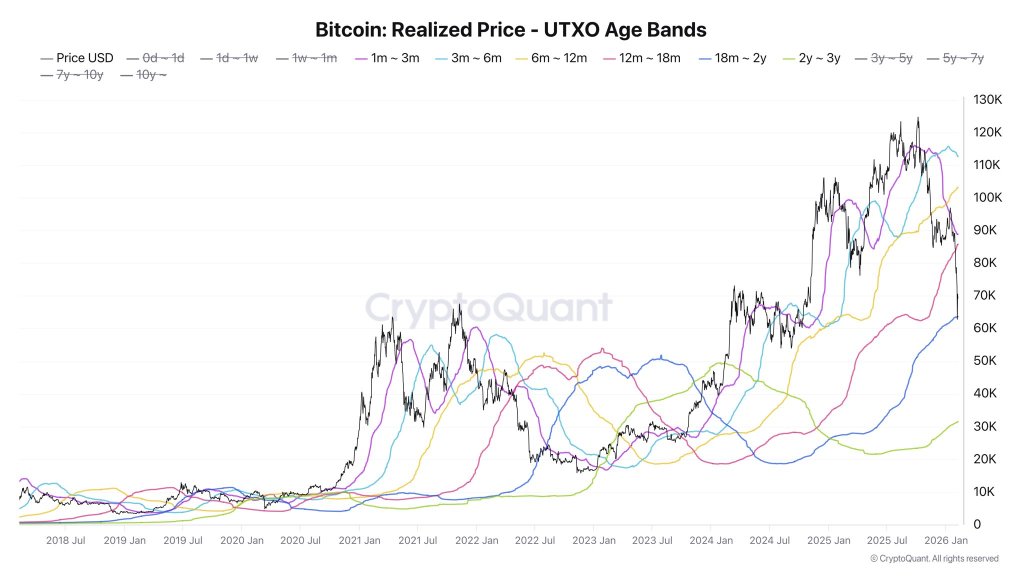
Bitcoin Realized Price (UTXO age bands)

Across venues, the scale was larger still. From Feb. 4 to Feb. 6, nearly “241,000 BTC were sent to various exchanges,” Darkfost wrote. It’s tough to interpret that as anything but selling pressure. In his view, the resulting wave of deposits compounded volatility already elevated by forced liquidations and de-risking.

While Binance tends to capture large swaths of retail-driven flow, Darkfost flagged a concurrent surge on Coinbase Advanced, which he described as widely used by institutions, active traders, and professional desks. On Feb. 6, BTC inflows there hit roughly “27,000 BTC.” That’s a real spike.

That’s the part that messes with the easy “retail panic” story. When you see it on both Binance and Coinbase, it’s probably not just one crowd freaking out. Darkfost put it bluntly: “nervousness…not limited to retail investors.”

In a separate post focused on small holders, Darkfost argued that retail participation had been unusually muted for much of the cycle, then abruptly reappeared during the drop. He looked at Binance deposits from wallets under 1 BTC—the “shrimps,” usually the most jumpy.

On Feb. 5, shrimp inflows to Binance exceeded “1,000 BTC in a single day,” versus a monthly average “closer to 365 BTC,” according to Darkfost. He noted the last comparable spike was in July 2025, but in a very different market regime, when Bitcoin was still pushing toward new highs. Same kind of flow, totally different mood.
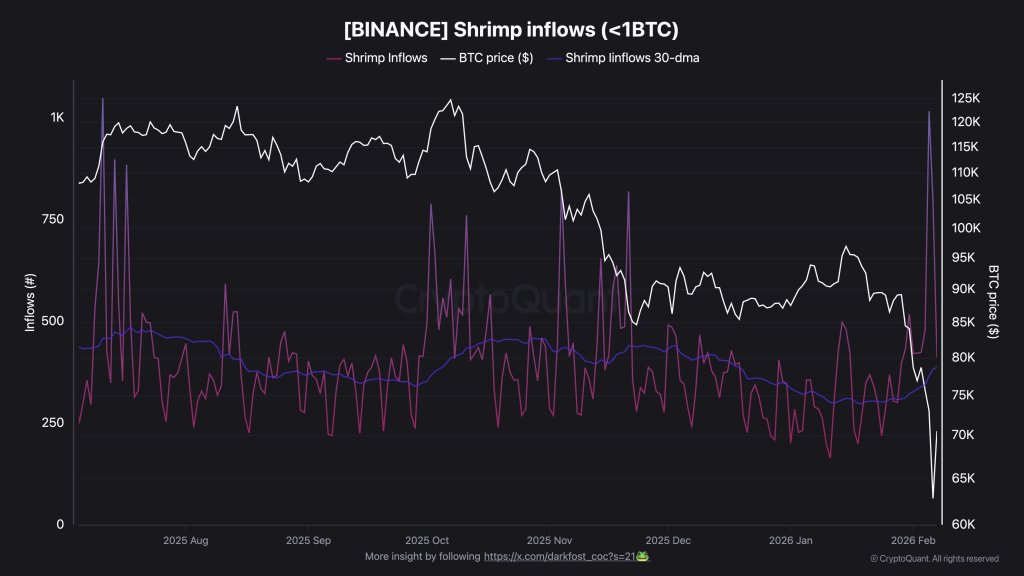
Binance Bitcoin shrimp inflows

Darkfost also tied the move to cost-basis dynamics that have increasingly squeezed holders as the correction deepened. He said Bitcoin “has put all STH under pressure and is now beginning to test LTH,” adding that the first long-term holder cohorts—6 to 12 months and 12 to 18 months—were already underwater with cost bases of “$103,188” and “$85,849.”

He pointed to a reaction after price reached the realized price of the 18-month to 2-year cohort at “$63,654,” calling it “likely an area of interest for these holders.” He also noted that their rising cost basis suggests higher-cost coins have aged into that bracket.

His take: this was an exhaustion flush, and it won’t reset overnight. “These capitulation moves have pushed BTC into an extreme oversold zone that the market will now need time to absorb and digest,” he wrote. After briefly slipping below $60,000, Bitcoin rebounded and was “trading again around $71,000.” Darkfost said that stabilization lined up with retail flows drifting back toward their average.

That takes one obvious source of sell pressure off the table. The bigger question is whether this was the low—or just a breather in a nasty, high-volatility regime.

At press time, BTC traded at $69,525.
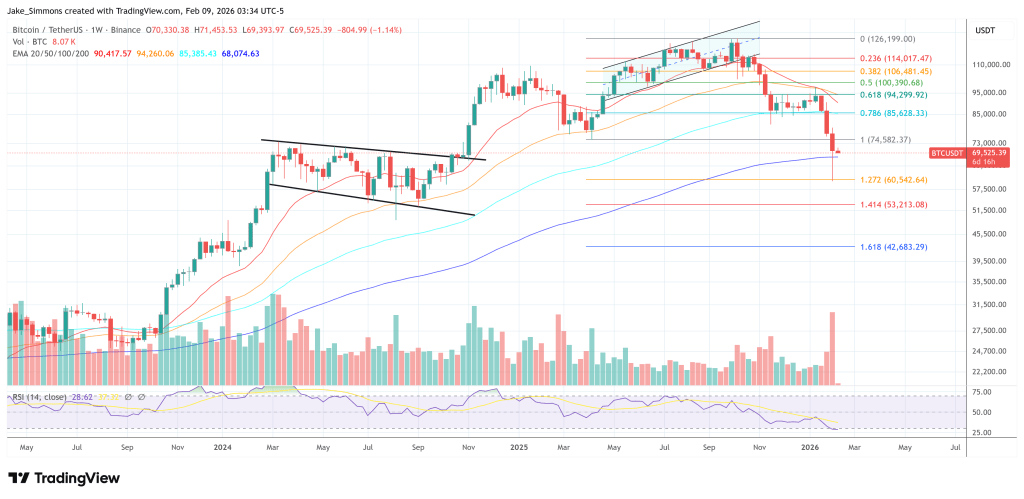
Bitcoin price chart
Market Opportunity
Bitcoin Logo
Bitcoin Price(BTC)
$69.051,97
$69.051,97$69.051,97
-%3,00
USD
Bitcoin (BTC) Live Price Chart
Disclaimer: The articles reposted on this site are sourced from public platforms and are provided for informational purposes only. They do not necessarily reflect the views of MEXC. All rights remain with the original authors. If you believe any content infringes on third-party rights, please contact [email protected] for removal. MEXC makes no guarantees regarding the accuracy, completeness, or timeliness of the content and is not responsible for any actions taken based on the information provided. The content does not constitute financial, legal, or other professional advice, nor should it be considered a recommendation or endorsement by MEXC.

You May Also Like

Crypto whale loses $6M to sneaky phishing scheme targeting staked Ethereum

Crypto whale loses $6M to sneaky phishing scheme targeting staked Ethereum

The post Crypto whale loses $6M to sneaky phishing scheme targeting staked Ethereum appeared on BitcoinEthereumNews.com. A crypto whale lost more than $6 million in staked Ethereum (stETH) and Aave-wrapped Bitcoin (aEthWBTC) after approving malicious signatures in a phishing scheme on Sept. 18, according to blockchain security firm Scam Sniffer. According to the firm, the attackers disguised their move as a routine wallet confirmation through “Permit” signatures, which tricked the victim into authorizing fund transfers without triggering obvious red flags. Yu Xian, founder of blockchain security company SlowMist, noted that the victim did not recognize the danger because the transaction required no gas fees. He wrote: “From the victim’s perspective, he just clicked a few times to confirm the wallet’s pop-up signature requests, didn’t spend a single penny of gas, and $6.28 million was gone.” How Permit exploits work Permit approvals were originally designed to simplify token transfers. Instead of submitting an on-chain approval and paying fees, a user can sign an off-chain message authorizing a spender. That efficiency, however, has created a new attack surface for malicious players. Once a user signs such a permit, attackers can combine two functions—Permit and TransferFrom—to drain assets directly. Because the authorization takes place off-chain, wallet dashboards show no unusual activity until the funds move. As a result, the assets are gone when the approval executes on-chain, and tokens are redirected to the attacker’s wallet. This loophole has made permit exploits increasingly attractive for malicious actors, who can siphon millions without needing complex hacks or high-cost gas wars. Phishing losses The latest theft highlights a wider trend of escalating phishing campaigns. Scam Sniffer reported that in August alone, attackers stole $12.17 million from more than 15,200 victims. That figure represented a 72% jump in losses compared with July. According to the firm, the most significant share of August’s damages came from three large accounts that accounted for nearly half…
Share
BitcoinEthereumNews2025/09/19 02:31
Why is the Trump-backed WLFI Token Price Up Today?

Why is the Trump-backed WLFI Token Price Up Today?

The post Why is the Trump-backed WLFI Token Price Up Today? appeared first on Coinpedia Fintech News World Liberty Financial’s native token WLFI, backed by the
Share
CoinPedia2026/02/09 18:54
Unlock 24/7 Crypto Blackjack Customer Support Now

Unlock 24/7 Crypto Blackjack Customer Support Now

Cryptsy - Latest Cryptocurrency News and Predictions Cryptsy - Latest Cryptocurrency News and Predictions - Experts in Crypto Casinos Did you know BC.Game supports
Share
Cryptsy2026/02/09 19:33