Virtuals Protocol Debuts 60-Day Trial for Founders, VIRTUAL Shows Signs of Life
Virtuals Protocol VIRTUAL $0.64 24h volatility: 2.2% Market cap: $421.06 M Vol. 24h: $79.67 M has introduced a new launch framework called “60 Days,” giving early-stage founders a reversible way to test products, tokens, and market demand.
Instead of forcing immediate and permanent commitment, founders build publicly for 60 days while capital forms through trading activity and optional growth pools.
At the end of the window, founders choose whether to commit. If they commit, funds unlock over time and the project continues.
If they don’t, the token winds down and all eligible funds are returned to holders. The framework removes the usual one-way risk tied to early token launches.
How the 60 Days Mechanism Works
Each project launches a token on the Base network using a standard bonding curve. Tokens trade during the 60-day trial while founders ship updates, engage users, publish metrics, and collect feedback.
Projects begin in private pools. Once cumulative volume reaches 42,000 VIRTUAL, liquidity migrates to a Uniswap V2 pool for open trading.
All trades carry a 1% fee and 30% goes to the protocol while 70% is allocated to the founder but remains locked during the trial.
If the founder commits, those funds unlock. If not, they are redirected into the refund pool.
Capital Formation and Founder Support
Virtuals uses Automated Capital Formation (ACF) to allocate funds to founders based on trading activity.
Released ACF funds support operations and early scaling. Unreleased allocations stay locked and are excluded from refunds until formally released.
Founders may also open a Growth Allocation pool by selling up to 5% of team tokens at a fixed valuation.
These funds are held in escrow and fully refunded if the founder does not commit. If the founder commits, Growth Allocation tokens vest linearly over six months.
To cover living and operating costs, founders receive stipends every 30 days. The stipend equals 10% of collected funds from founder trading fees and released ACF, capped at $5,000 USDC per payout.
It is important to note founders can commit early or wait until Day 60. A commitment unlocks founder trading fees, releases ACF funds, and starts Growth Allocation vesting.
If the founder does not commit, liquidity is drained, token issuance stops, and refunds trigger automatically.
VIRTUAL Attempts a Comeback
VIRTUAL token is up almost 3% in the past 24 hours, currently trading at $0.6374. However, the token has dropped more than 20% in the last 30 days alone.
The chart below shows prices below a descending trendline and the main demand zone sits near the $0.60 area.
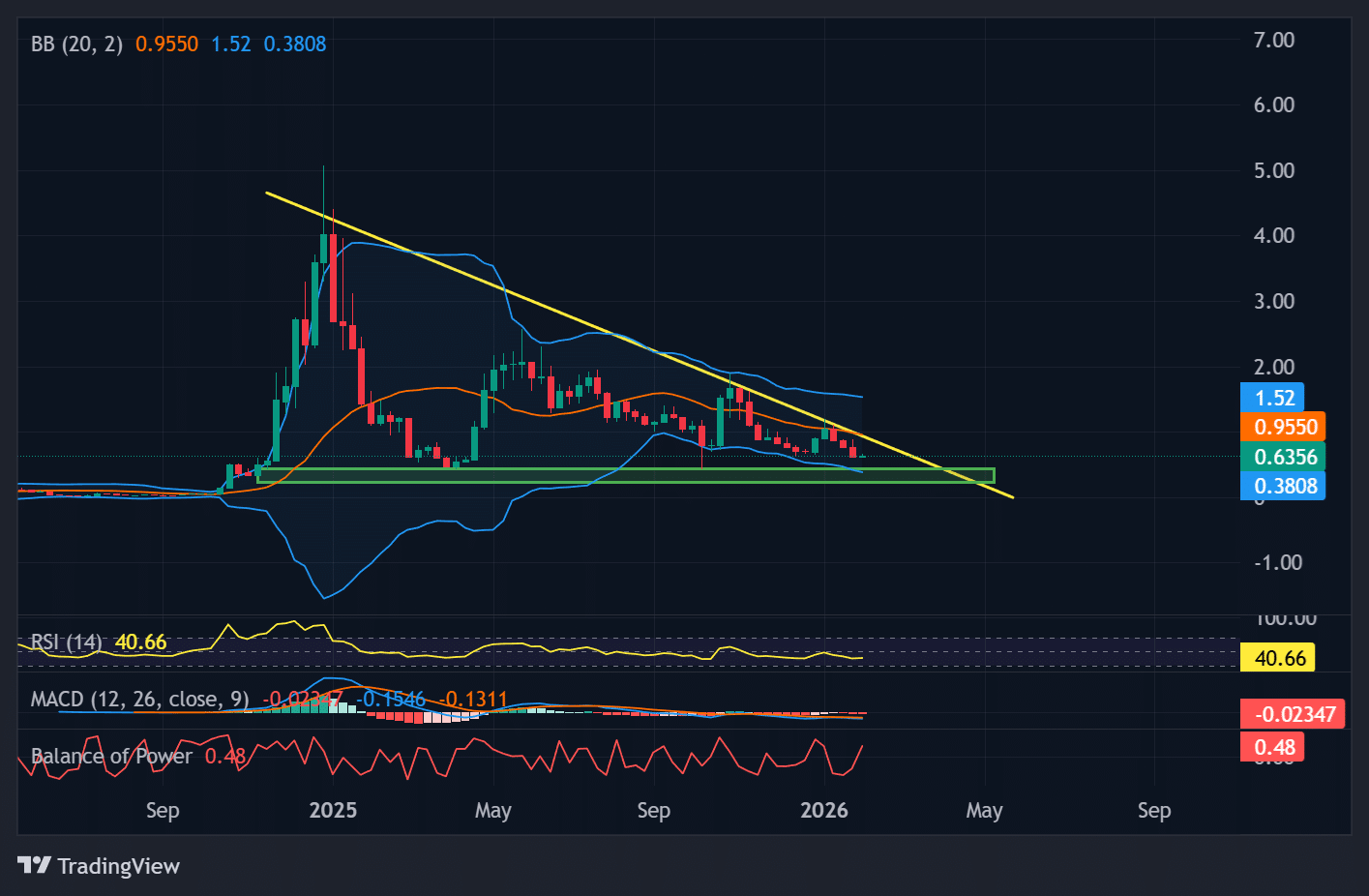
VIRTUAL price chart with momentum indicators. | Source: TradingView
If VIRTUAL holds the current support and breaks the descending trendline, a test of the $0.95 to $1.50 range is possible. However, A clean break below support would expose the $0.38 area.
nextThe post Virtuals Protocol Debuts 60-Day Trial for Founders, VIRTUAL Shows Signs of Life appeared first on Coinspeaker.
You May Also Like

Trump Says Family Handled $500M World Liberty Financial Stake Sale
WLD Price Prediction: Worldcoin Targets $0.62-$0.73 by February Despite Current Bearish Momentum