Bitcoin remains under pressure, struggling to reclaim the $88,000 level as uncertainty and persistent selling continue to dominate market sentiment. Price actionBitcoin remains under pressure, struggling to reclaim the $88,000 level as uncertainty and persistent selling continue to dominate market sentiment. Price action

Bitcoin Whales Flip From Distribution To Early Re-Accumulation – Details

4 min read

Bitcoin remains under pressure, struggling to reclaim the $88,000 level as uncertainty and persistent selling continue to dominate market sentiment. Price action reflects hesitation rather than panic, but the inability to attract sustained demand highlights a fragile short-term structure. According to a recent CryptoQuant analysis, on-chain data tracking large holders offers critical context for this weakness.

Data focusing on wallets holding between 1,000 and 10,000 BTC, excluding exchanges and mining pools, points to a clear behavioral shift among whales after an extended distribution phase in late 2025. Following a local peak around mid-2025, aggregate whale balances declined steadily while Bitcoin traded at elevated levels.

This pattern is consistent with distribution into strength, not forced liquidation, suggesting that large holders were reducing exposure opportunistically as price momentum matured.

The 30-day balance change metric reinforces this view. Throughout the third quarter and into early Q4, whale balances repeatedly printed negative monthly changes, even as prices attempted to push higher. This divergence coincided with rising volatility and fading upside momentum, signaling that rallies were increasingly sustained by marginal buyers rather than committed institutional-scale accumulation.

Whale Behavior Signals Early Stabilization After Prolonged Distribution

However, the same report highlights an important shift beneath the surface. Recent on-chain data shows a clear inflection in whale behavior, with both short-term (7-day) and medium-term (30-day) balance changes turning positive. After months of persistent outflows, total whale holdings are no longer declining and have begun to stabilize, gradually recovering from their local lows. This change suggests that large holders are no longer actively distributing into rallies.

Bitcoin Total Balance and Balance Change of Large Holders | Source: CryptoQuant

Historically, transitions from net distribution to early accumulation tend to emerge during periods of price compression or after corrective phases, rather than near market peaks. The current environment fits that pattern. Bitcoin is trading in a tight range after a sharp drawdown, and volatility has compressed, creating conditions where strategic repositioning becomes more attractive for larger players.

From a broader macro on-chain perspective, the 1-year change in whale holdings remains relatively flat. This indicates that the market has not yet entered a full-scale accumulation regime typically associated with strong bull market expansions. Instead, the behavior observed so far is more consistent with tactical positioning and selective re-entry, rather than high-conviction, long-term buying.

Importantly, whale activity is no longer adding sustained sell-side pressure to Bitcoin’s supply. While this shift does not guarantee an immediate upside breakout, it materially reduces downside risk.

The market appears to be transitioning into a stabilization phase, where the next directional move will depend on whether accumulation meaningfully accelerates or fades at current levels.

Bitcoin Consolidates Around Weekly Demand Level

Bitcoin’s weekly chart shows price consolidating just below the $90,000 zone, highlighting a market caught between stabilization and unresolved downside risk. After the sharp correction from the $120K–$125K peak, BTC has entered a broad consolidation range, with recent candles clustering around the mid-to-high $80K area. This zone is increasingly acting as a critical demand region rather than a launchpad for immediate upside.
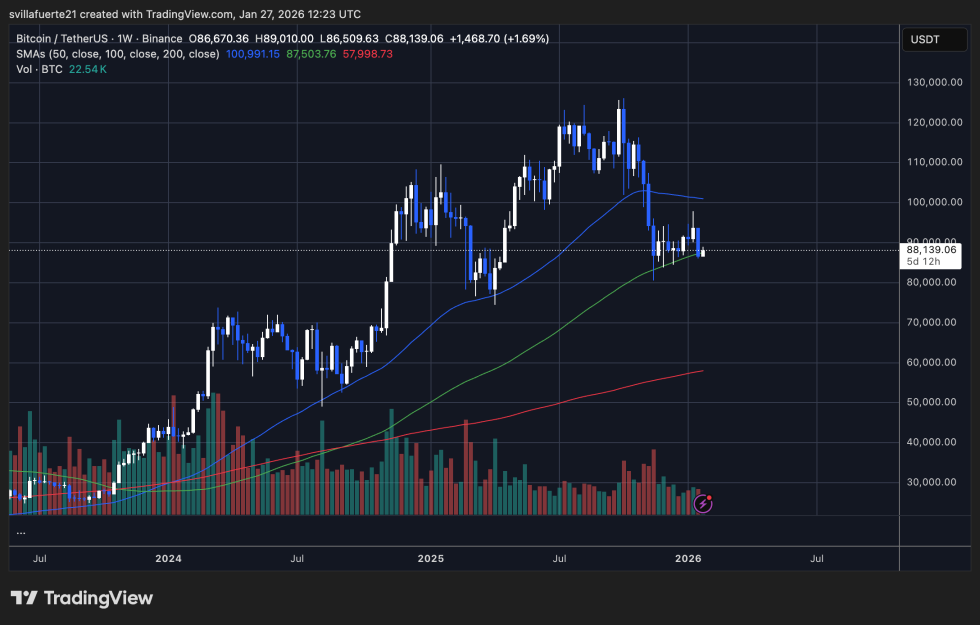
BTC testing weekly support level | Source: BTCUSDT chart on TradingView

From a trend perspective, the structure has clearly weakened. Price remains below the 50-period moving average (blue), which has rolled over and now acts as dynamic resistance near the low $90Ks. The 100-period moving average (green) continues to slope upward and currently provides medium-term support just below the current price, reinforcing the idea of compression rather than free fall.

Meanwhile, the 200-period moving average (red) remains well below the price and rising steadily, confirming that the broader long-term uptrend is still intact despite the correction.

Volume dynamics also support a stabilization narrative. Selling pressure has eased compared to the distribution phase seen near the highs, and recent weekly candles show reduced downside momentum. However, the lack of strong bullish follow-through suggests buyers are selective rather than aggressive.

Bitcoin is transitioning into a decision zone. Holding above the 100-week moving average keeps the market in a corrective but constructive phase. Failure to do so would open the door to deeper mean reversion, while a reclaim of the 50-week average would be an early signal of trend repair.

Featured image from ChatGPT, chart from TradingView.com 

Disclaimer: The articles reposted on this site are sourced from public platforms and are provided for informational purposes only. They do not necessarily reflect the views of MEXC. All rights remain with the original authors. If you believe any content infringes on third-party rights, please contact [email protected] for removal. MEXC makes no guarantees regarding the accuracy, completeness, or timeliness of the content and is not responsible for any actions taken based on the information provided. The content does not constitute financial, legal, or other professional advice, nor should it be considered a recommendation or endorsement by MEXC.

You May Also Like

Ethereum unveils roadmap focusing on scaling, interoperability, and security at Japan Dev Conference

Ethereum unveils roadmap focusing on scaling, interoperability, and security at Japan Dev Conference

The post Ethereum unveils roadmap focusing on scaling, interoperability, and security at Japan Dev Conference appeared on BitcoinEthereumNews.com. Key Takeaways Ethereum’s new roadmap was presented by Vitalik Buterin at the Japan Dev Conference. Short-term priorities include Layer 1 scaling and raising gas limits to enhance transaction throughput. Vitalik Buterin presented Ethereum’s development roadmap at the Japan Dev Conference today, outlining the blockchain platform’s priorities across multiple timeframes. The short-term goals focus on scaling solutions and increasing Layer 1 gas limits to improve transaction capacity. Mid-term objectives target enhanced cross-Layer 2 interoperability and faster network responsiveness to create a more seamless user experience across different scaling solutions. The long-term vision emphasizes building a secure, simple, quantum-resistant, and formally verified minimalist Ethereum network. This approach aims to future-proof the platform against emerging technological threats while maintaining its core functionality. The roadmap presentation comes as Ethereum continues to compete with other blockchain platforms for market share in the smart contract and decentralized application space. Source: https://cryptobriefing.com/ethereum-roadmap-scaling-interoperability-security-japan/
Share
BitcoinEthereumNews2025/09/18 00:25
Here’s How Consumers May Benefit From Lower Interest Rates

Here’s How Consumers May Benefit From Lower Interest Rates

The post Here’s How Consumers May Benefit From Lower Interest Rates appeared on BitcoinEthereumNews.com. Topline The Federal Reserve on Wednesday opted to ease interest rates for the first time in months, leading the way for potentially lower mortgage rates, bond yields and a likely boost to cryptocurrency over the coming weeks. Average long-term mortgage rates dropped to their lowest levels in months ahead of the central bank’s policy shift. Copyright{2018} The Associated Press. All rights reserved. Key Facts The central bank’s policymaking panel voted this week to lower interest rates, which have sat between 4.25% and 4.5% since December, to a new range of 4% and 4.25%. How Will Lower Interest Rates Impact Mortgage Rates? Mortgage rates tend to fall before and during a period of interest rate cuts: The average 30-year fixed-rate mortgage dropped to 6.35% from 6.5% last week, the lowest level since October 2024, mortgage buyer Freddie Mac reported. Borrowing costs on 15-year fixed-rate mortgages also dropped to 5.5% from 5.6% as they neared the year-ago rate of 5.27%. When the Federal Reserve lowered the funds rate to between 0% and 0.25% during the pandemic, 30-year mortgage rates hit record lows between 2.7% and 3% by the end of 2020, according to data published by Freddie Mac. Consumers who refinanced their mortgages in 2020 saved about $5.3 billion annually as rates dropped, according to the Consumer Financial Protection Bureau. Similarly, mortgage rates spiked around 7% as interest rates were hiked in 2022 and 2023, though mortgage rates appeared to react within weeks of the Fed opting to cut or raise rates. How Do Treasury Bonds Respond To Lower Interest Rates? Long-term Treasury yields are more directly influenced by interest rates, as lower rates tend to result in lower yields. When the Fed pushed rates to near zero during the pandemic, 10-year Treasury yields fell to an all-time low of 0.5%. As…
Share
BitcoinEthereumNews2025/09/18 05:59
The Giants Are Stumbling: Why BlockDAG’s 20-Exchange Launch is the Market’s New Safe Haven

The Giants Are Stumbling: Why BlockDAG’s 20-Exchange Launch is the Market’s New Safe Haven

The cryptocurrency market seems to have caught headwinds entering February. Portfolios across the globe are flashing red as the flash crash of February 2nd wreaks
Share
Captainaltcoin2026/02/04 02:30