

How many rental properties to make $5000 a month? A practical guide
You will learn the cash-flow formula, how to estimate mortgage payments using current rate surveys or lender quotes, what expense ranges practitioners commonly use, and how to run conservative, moderate, and aggressive scenarios. Use this as a practical starting point, then verify local rents, rates, and tax rules for your situation.
Quick answer and what this article will help you do
Bottom line: reach $5,000 net per month by dividing the $5,000 target by a realistic net cash flow per unit, not by gross rent. Net cash flow per unit is what remains after you subtract mortgage payment, taxes, insurance, maintenance, vacancy allowance and property-management fees from the gross rent you collect, so that per-unit figure is what determines how many properties you need. For a reproducible method, follow the cash-flow formula below and test conservative, moderate, and aggressive scenarios.
This article gives a short bottom-line summary, a step-by-step cash-flow framework you can reproduce, worked scenario templates, and a short checklist to gather local data and consult professionals. It is written for people doing property investment for beginners and uses simple steps you can copy into a spreadsheet to model your market assumptions.
Read the cash-flow formula and the scenario sections next if you want to get straight to the numbers. If you want to check how financing changes the outcome, go to the mortgage section and the sensitivity checklist afterward. The explanations here point you to primary data sources to validate rents and prevailing rates.
Why per-unit cash flow matters more than number of units
Focus on net cash flow per unit because the number of units you need equals your income goal divided by that net number. In practice, net cash flow equals gross rent minus the major expense items, and this methodology reflects common industry practice for 2024 and 2025 reporting and modeling Zillow Research rent data.
Mortgage payments and debt service are usually the largest single monthly expense for leveraged buys. That means small changes in interest rates or loan sizing can change your per-unit cash flow more than small changes in management fees or maintenance percentages, so check current mortgage surveys or lender quotes when you model your plan Freddie Mac Primary Mortgage Market Survey.
tool to list required line items for a per-unit cash-flow calculation
Use local numbers for best results
Common misconceptions include using gross rent as the income number without subtracting debt service and recurring expenses. Gross rent is useful for market comparison, but it is not the cash you can spend. Also, tax deductions and depreciation affect taxable income and future tax bills but do not increase the cash in your bank account for the month received; keep tax modeling separate from monthly cash-flow modeling and consult IRS guidance for how deductions and depreciation apply.
Step-by-step cash-flow framework you can reproduce
Here is a simple, reproducible framework to get net monthly cash flow per unit and then calculate how many rentals you need. The general steps are: estimate local gross rent, calculate a mortgage payment for the likely loan size and rate, add taxes and insurance, estimate maintenance and vacancy allowances, include property-management fees, and subtract all those from gross rent to get net per unit.
Step 1: Estimate realistic gross rent using recent local data, property investment for beginners.
Step 2: Calculate the monthly mortgage payment from the purchase price, down payment, term, and a realistic interest rate. Use a lender quote or the current primary mortgage market survey as a check on typical rates in your area Freddie Mac Primary Mortgage Market Survey.

Step 3: Add estimated monthly amounts for property taxes, insurance, routine maintenance, a vacancy allowance, and a property-management fee. Typical practitioner ranges for these items are available from industry guidance and will help you pick starting points before you validate locally NAR research and guidance.
Step 4: Subtract the mortgage payment and the summed expense allowances from gross rent to get net monthly cash flow per unit. Once you have that per-unit number, divide 5,000 by it to estimate how many units you need; you can verify the arithmetic with a rental cash flow calculator. Document every assumption so you can rerun the math under different scenarios.
How to estimate mortgage payment and why rates matter
To estimate the monthly mortgage payment, you need a loan amount, a term (for example 30 years), and an interest rate. Use a lender quote or a current primary mortgage market survey as your starting point for the interest rate because market surveys reflect prevailing conditions that strongly influence monthly debt service Freddie Mac Primary Mortgage Market Survey.
Many calculators use the standard annuity formula to convert rate, term, and principal into a monthly principal and interest payment. You can enter the purchase price and down payment into a mortgage calculator or spreadsheet payment formula to get the monthly cost without doing the formula by hand.
Divide your $5,000 monthly target by the net monthly cash flow you expect per unit after mortgage, taxes, insurance, maintenance, vacancy, and management fees; then run conservative and aggressive scenarios to see a planning range.
Remember that interest expense usually dominates monthly outflows on a leveraged rental. When rates are higher, the mortgage portion of the expense can reduce or eliminate monthly positive cash flow for a given rent level, so test several rate levels when you model your plan.
Expense assumptions to include and typical ranges
Common expense lines you must include are property-management fees, a vacancy allowance, routine maintenance, insurance, and property taxes. Practitioners commonly use ranges to start: property-management roughly 8 to 10 percent of gross rent, vacancy 5 to 10 percent, and maintenance 5 to 10 percent, but local variation can change these materially so verify with local sources Realtor.com property management fee guidance.
Property taxes and insurance often vary by jurisdiction and property type. Use recent tax assessor records or listings for similar properties and get an insurance quote or agent estimate to avoid underestimating those costs. When in doubt, lean conservative on tax and insurance estimates until you have quotes.
Keep a reserves line for unexpected repairs. Routine maintenance is a predictable ongoing cost, but turnover repairs and one-off capital items can be lumpy. Modeling a modest reserve or capex allowance helps avoid surprise negative months.
Vacancy, turnover and how to model downtime
Vacancy allowance is an estimate for the income lost when a unit is empty. Turnover costs are the repairs, cleaning, and advertising that occur when a tenant moves out. Both reduce monthly available cash if you average them across a year.
Local vacancy trends and recent rent growth affect how long units sit empty and how quickly you can raise rents. Observed rent indices show nominal rents rose through 2024 but growth moderated in 2025, so use recent local trend data rather than national averages when choosing vacancy and rent pace assumptions Census HVS historical vacancy trends.
As a rule, use conservative vacancy assumptions for weaker markets or when you are building a new portfolio, and moderate assumptions where demand has been steady. If you plan to hire a property manager to reduce downtime, include the management fee in your monthly expense line and reduce your time commitment accordingly.
Tax, deductions, and depreciation: what affects taxable income versus cash flow
Many rental expenses are deductible and depreciation reduces taxable income over time, but those tax items do not directly increase monthly cash flow. For details on which expenses are deductible and how depreciation works, consult IRS guidance on residential rental property IRS Publication 527.
Depreciation can reduce taxable income and your tax bill in a reporting year, yet it is a noncash accounting deduction. Treat tax planning and monthly cash-flow modeling separately: model the cash that hits your bank account, and then model tax impacts on the profitability reports and your expected tax payments.
Three scenarios to model: conservative, moderate, aggressive
Model at least three scenarios so you see a plausible range of outcomes. A conservative scenario assumes lower rents, higher vacancy, and higher maintenance; a moderate scenario uses reasonable market averages; an aggressive scenario assumes stronger rent growth and lower downtime. The conservative case commonly shows you need significantly more units than the aggressive case because per-unit net cash flow is lower.
For each scenario, document the assumptions for gross rent, vacancy rate, management fee, maintenance percent, and the mortgage rate. Comparing the scenario outputs helps you understand whether acquisition pace, property type, or market choice matters more than small changes in fees.
Sensitivity checklist: how changes in rent, vacancy, or rates change required units
Run a simple sensitivity test by increasing or decreasing one input while holding others constant. For example, recalculate net per-unit cash flow with a 1 percentage point higher mortgage rate, or with a 5 percent lower gross rent, and observe how the required number of units shifts. This shows which inputs matter most in your market assumptions.
Mortgage rates and rent levels are usually the most sensitive drivers of required units because they directly affect the largest expense and the revenue line. Document the range of units from your sensitivity tests and use that range for planning rather than a single point estimate.
Worked examples and how to adapt them to your market
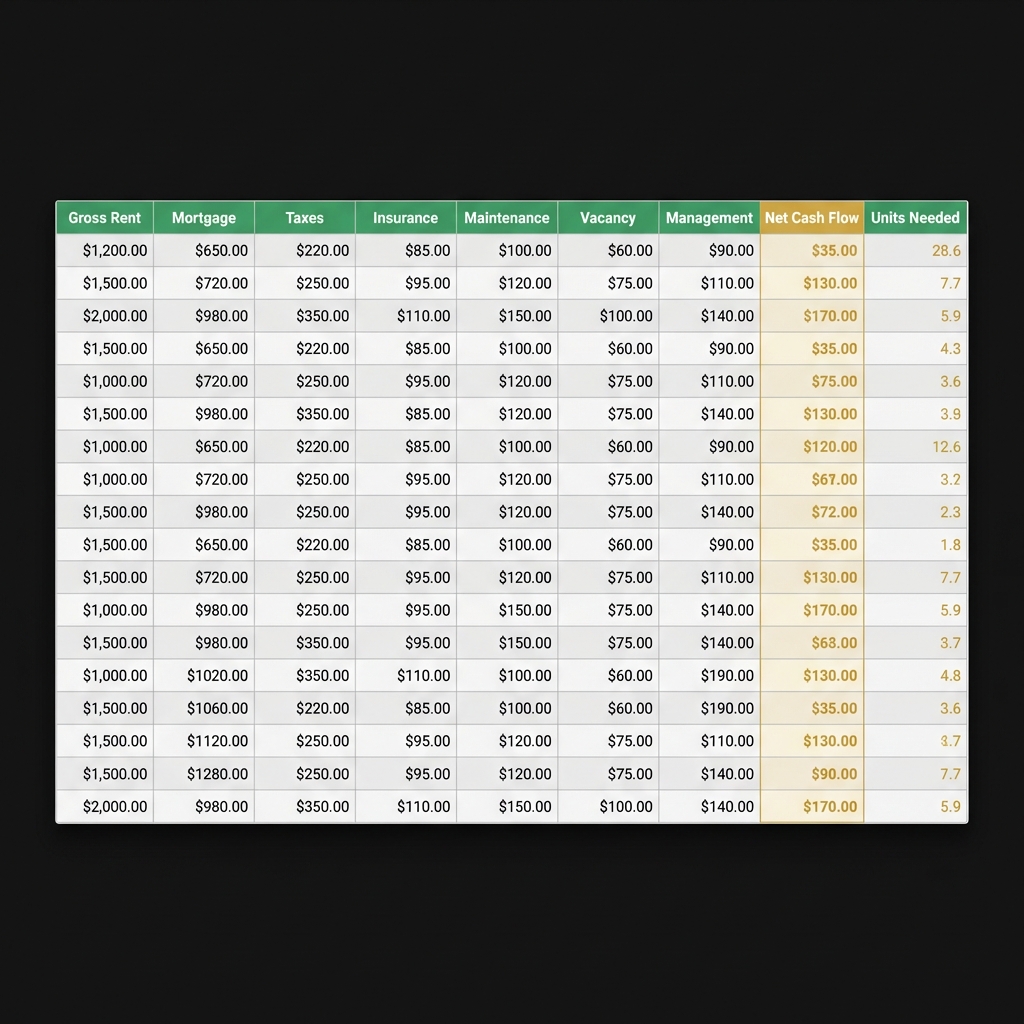
Build a simple spreadsheet with columns for gross rent, mortgage payment, taxes, insurance, maintenance, vacancy allowance, management fee, net cash flow per unit, and units needed to reach $5,000. That layout makes it easy to substitute your local rent numbers and lender quotes and to see the arithmetic clearly.
Replace example percentages in any template with your local numbers. Source rents from recent listings and local rent indices and get lender rate quotes for realistic mortgage payments. Do not copy example numbers without validating them against local data and lender quotes. You can also use a rental property calculator.
Decision factors: buy-and-hold, financing and scale considerations
Beyond the math, consider financing constraints like down payment needs, loan limits, and how quickly you can add units. These constraints affect the timeline to reach $5,000 per month and may make a staged plan more realistic.
Operational scale matters too. Managing many single-family units can require hiring a property manager, which raises fees but frees your time. Think about reserve requirements, diversification across neighborhoods, and exit options before committing to a buy-and-hold scale-up.
Common mistakes and how to avoid them
Typical errors include using gross rent without subtracting mortgage and expenses, copying national averages without checking local rents and taxes, and underestimating vacancy and maintenance. These mistakes make required unit counts look smaller than they should.
Corrective steps are straightforward: run the net cash-flow calculation with conservative assumptions, get lender quotes and local tax data, and perform stress tests with higher vacancy or rates. Keep a cash reserve to manage unexpected repair or vacancy months.
Short checklist and next steps to model your path to $5,000/month
Data to gather: recent local rents for comparable units, at least one lender rate quote, local property tax estimates, insurance quotes, typical management fees, and local vacancy data. Use these inputs in a spreadsheet or mortgage calculator to compute net rental income and units needed.
Who to consult: a lender for realistic financing terms, a local property manager to confirm fee and vacancy expectations, and a tax professional to understand tax timing and depreciation effects on your returns. Run at least three scenarios and document assumptions for later review.
Wrap-up: realistic expectations and how to proceed safely
The number of rental properties you need to net $5,000 per month depends on per-unit net cash flow, and the main levers are mortgage rates, local rents, and expense assumptions. Start with a careful per-unit calculation, validate local rent and tax data, and use scenario analysis to set a realistic planning range Zillow Research rent data.
FinancePolice offers plain language guidance to help you run these basic models and identify the inputs you need to verify. Use the checklist and scenario templates here, and consult lenders and tax professionals before you commit to acquisitions.
Subtract monthly mortgage payment, property taxes, insurance, maintenance, vacancy allowance, and management fees from gross rent to get net cash flow per unit.
No, deductions and depreciation affect taxable income and tax payments but do not directly increase the cash you receive each month.
Start with mortgage rate and local gross rent assumptions, then test vacancy and maintenance ranges and property-management fees in sensitivity scenarios.
Approach acquisitions one step at a time, document each assumption, and use scenario results to set a paced plan rather than a single hard target.
References
- https://www.zillow.com/research/data/
- https://www.freddiemac.com/pmms
- https://www.nar.realtor/research-and-statistics
- https://www.realtor.com/advice/rent/property-management-fees/
- https://www.census.gov/housing/hvs/data/historical.html
- https://financepolice.com/advertise/
- https://www.irs.gov/publications/p527
- https://www.turbotenant.com/landlord-toolbox/rental-cashflow-calculator/
- https://www.mortgagecalculator.org/calcs/residential-income.php
- https://www.calculator.net/rental-property-calculator.html
- https://financepolice.com/how-to-finance-a-business-purchase/
- https://financepolice.com/real-estate-side-hustles/
- https://financepolice.com/
You May Also Like

Is Doge Losing Steam As Traders Choose Pepeto For The Best Crypto Investment?

Thousands of users protest loss of companion as OpenAI retires GPT-4o
