Tailored incentives for deeptech startups, predictable tax and incentive frameworks, as well as continued investment in core infrastructure, are some of the demandsTailored incentives for deeptech startups, predictable tax and incentive frameworks, as well as continued investment in core infrastructure, are some of the demands

Indian VCs call for policies to encourage deeper pools of domestic capital ahead of Union Budget

India—the third-largest startup ecosystem—stands on the shoulders of venture capital (VC) firms that make bold investments and back passionate founders to ring in the next startup success story. 

While the country has been reeling from a funding winter, which lasted from 2023 to 2024, the VC ecosystem has corrected its course and is in a phase of disciplined maturity. Last year, Indian startups raised $11 billion—the lowest since 2020—with VCs writing fewer but larger checks, signalling a cautious and selective approach. 

In 2025, many VCs also raised new funds, albeit calling for greater participation from domestic institutional investors. “India has strong founder talent and operating depth, but long-term domestic pools like insurance and pension capital remain underrepresented at later stages. Enabling this participation through calibrated frameworks would strengthen capital continuity and reduce over-reliance on any single source of funding,” noted Navin Honagudi, Managing Partner at Elev8 Venture Partners.

Echoing a similar sentiment, Kunal Khattar, Founder at mobility-focused fund, AdvantEdge, noted that policies should be rolled out to reduce reliance on foreign VCs, and that the government should create stronger incentives for insurance and pension funds to invest in SEBI-registered Alternative Investment Funds (AIFs). 

Firms are also looking for greater predictability and longevity for tax and incentive frameworks, especially VC firms that have been investing in deeptech companies. “Startups building foundational or deeptech capabilities typically operate on 7-10 year horizons, where clarity and stability matter as much as headline incentives. Multi-year visibility on eligibility, tax treatment, and scheme continuity would encourage more patient capital and reduce friction in investment decisions,” said Manu Iyer, Co-founder and General Partner at Bluehill.VC.

Also Read
Continued customs duty support, subsidy parity: EV ecosystem pens down wishlist ahead of Union Budget

Additionally, VCs are also calling for policies to encourage localisation of components and exemptions on critical raw materials for startups. 

The Union Budget should also come up with policies or capital allocation to encourage continued investment in core infrastructure, which will help startups scale up faster and in a more capital-efficient manner, Honagudi noted. 

VC firms have also noted that the Indian startup ecosystem has reached a stage where the foundations built over the last decade have given rise to consistent and predictable institutional support. The focus should be on creating an environment, where India can create globally competitive companies through patient capital and predictable policies. 

To foster global competitiveness, Khattar noted that policies can move from simple “tax holidays” to a mission-mode funding model. “The Rs 1 lakh crore Research, Development, and Innovation (RDI) Fund can also be deployed as non-dilutive, outcome-linked grants for startups achieving specific milestones in battery density, recycling, or AI-driven predictive maintenance.” 

Additionally, he also noted that for Indian startups to go global, the country needs simpler FEMA (Foreign Exchange Management Act) reporting. “Reducing the compliance burden for early-stage founders to ‘self-certify’ for the first 5–10 years would allow them to focus on product-market fit rather than administrative overhead,” Khattar said.


Edited by Suman Singh

Disclaimer: The articles reposted on this site are sourced from public platforms and are provided for informational purposes only. They do not necessarily reflect the views of MEXC. All rights remain with the original authors. If you believe any content infringes on third-party rights, please contact [email protected] for removal. MEXC makes no guarantees regarding the accuracy, completeness, or timeliness of the content and is not responsible for any actions taken based on the information provided. The content does not constitute financial, legal, or other professional advice, nor should it be considered a recommendation or endorsement by MEXC.

You May Also Like

Botanix launches stBTC to deliver Bitcoin-native yield

Botanix launches stBTC to deliver Bitcoin-native yield

The post Botanix launches stBTC to deliver Bitcoin-native yield appeared on BitcoinEthereumNews.com. Botanix Labs has launched stBTC, a liquid staking token designed to turn Bitcoin into a yield-bearing asset by redistributing network gas fees directly to users. The protocol will begin yield accrual later this week, with its Genesis Vault scheduled to open on Sept. 25, capped at 50 BTC. The initiative marks one of the first attempts to generate Bitcoin-native yield without relying on inflationary token models or centralized custodians. stBTC works by allowing users to deposit Bitcoin into Botanix’s permissionless smart contract, receiving stBTC tokens that represent their share of the staking vault. As transactions occur, 50% of Botanix network gas fees, paid in BTC, flow back to stBTC holders. Over time, the value of stBTC increases relative to BTC, enabling users to redeem their original deposit plus yield. Botanix estimates early returns could reach 20–50% annually before stabilizing around 6–8%, a level similar to Ethereum staking but fully denominated in Bitcoin. Botanix says that security audits have been completed by Spearbit and Sigma Prime, and the protocol is built on the EIP-4626 vault standard, which also underpins Ethereum-based staking products. The company’s Spiderchain architecture, operated by 16 independent entities including Galaxy, Alchemy, and Fireblocks, secures the network. If adoption grows, Botanix argues the system could make Bitcoin a productive, composable asset for decentralized finance, while reinforcing network consensus. This is a developing story. This article was generated with the assistance of AI and reviewed by editor Jeffrey Albus before publication. Get the news in your inbox. Explore Blockworks newsletters: Source: https://blockworks.co/news/botanix-launches-stbtc
Share
BitcoinEthereumNews2025/09/18 02:37
XLM Price Prediction: Targets $0.25-$0.27 by February 2026
XLM Price Prediction: Targets $0.25-$0.27 by February 2026

The post XLM Price Prediction: Targets $0.25-$0.27 by February 2026 appeared on BitcoinEthereumNews.com. Ted Hisokawa Jan 23, 2026 05:42 Stellar (XLM) consolidates
Share
BitcoinEthereumNews2026/01/23 23:04
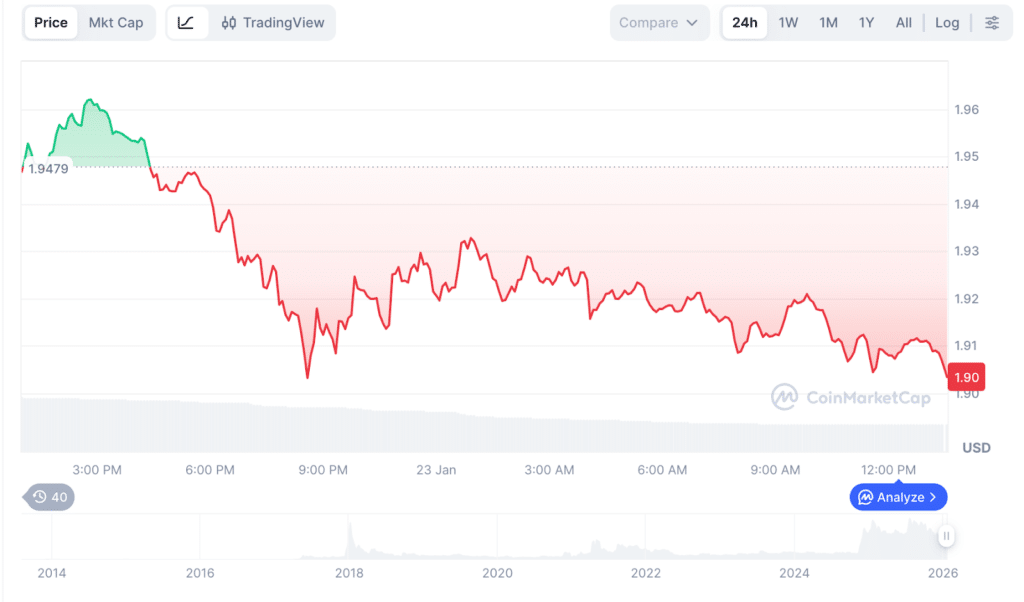
Will XRP Price Break Above $2 or Fall Below $1.80?

Will XRP Price Break Above $2 or Fall Below $1.80?

This article was first published on The Bit Journal. XRP price analysis.“XRP around at $1.91: Will It Explode or Implode?” XRP is teetering on the edge, approximately
Share
Coinstats2026/01/23 23:00