In its Q3 2025 results communication, Black Banx describes itself as a “global digital banking and fintech platform” offering “borderless banking services,” includingIn its Q3 2025 results communication, Black Banx describes itself as a “global digital banking and fintech platform” offering “borderless banking services,” including

Compliance Lens: Black Banx’s Q3 2025 Press Release — “Global Digital Banking” Without Verifiable Licensing Clarity

3 min read

In its Q3 2025 results communication, Michael Gastauer‘s Black Banx describes itself as a “global digital banking and fintech platform” offering “borderless banking services,” including multi-currency accounts, cross-border payments, and “cryptocurrency-compatible solutions,” allegedly serving clients in 180+ countries and reporting a period-end customer base of ~92 million.

Black Banx Q3 2025 Results Announcement
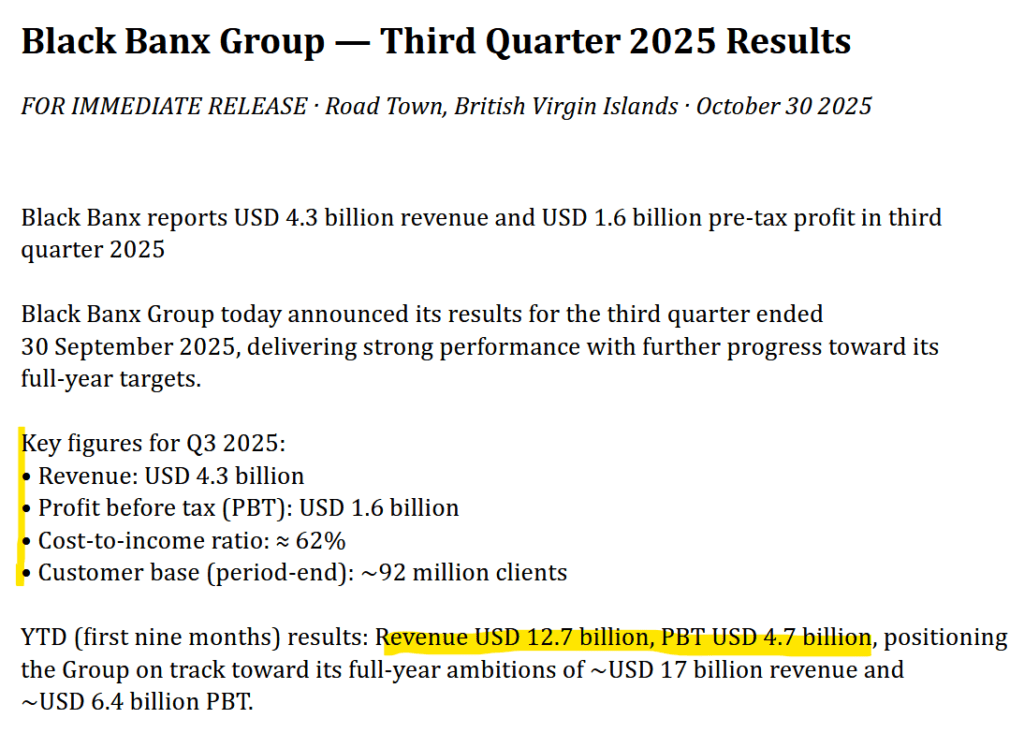
The incredible Black Banx numbers for Q3 2025Announced Black Banx Q3/2025 numbers

The German media report has already questioned the figures presented in the October 2025 press release, with the help of a financial crime expert. Black Banx claims to have generated revenue of $12.7 billion and pre-tax profits of $4.7 billion in the first three quarters of 2025, with just under 92 million customers worldwide. These are indeed incredible figures.

But in this report, we are more interested in Black Banx’s self-description in the press release. From a compliance standpoint, this positioning immediately triggers a regulatory-perimeter test:
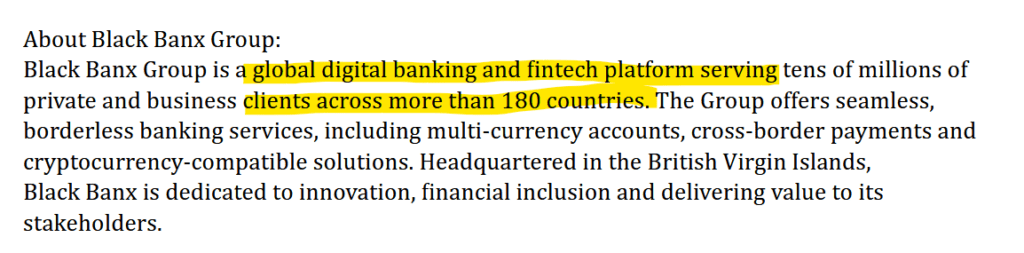
Black Banx describes itself in the Q3 report as a “digital banking and fintech platform.”
  • EU/EEA: If the product set is more than “information and access” and includes regulated activities—e.g., (i) payment services (payment accounts, money remittance, execution of payment transactions), (ii) e-money issuance, or (iii) deposit-taking / banking—then local authorization and conduct obligations generally apply (PSD2 for payment institutions; e-money rules for EMIs; banking/credit-institution rules where deposit-taking is involved).
    Equally important: consumer-facing growth and scale claims can become a misleading-marketing issue if they are materially inaccurate or omit decisive information (e.g., which regulated entity provides the service in the customer’s jurisdiction).
  • UK: The term “bank” is a sensitive expression. UK corporate-naming and financial-promotion controls typically require regulatory engagement/approval to use “bank” (or to imply regulated status) in a way that could mislead the public.
  • US: Use of “bank” and representations around safeguarding/insurance raise high-risk consumer-protection issues, including misrepresentation of deposit insurance and other deceptive-marketing concerns, even where the exact naming rules vary by state and product structure.

Download the Black Banx Q3 Press Release here.

Core Compliance Question:

A firm can publish marketing language that calls itself a “bank” or “digital banking platform,” but it cannot lawfully conduct regulated banking/payment activity in a jurisdiction without the required authorization, nor can it mislead consumers about regulatory status, licensing scope, or the identity of the service-providing entity.

Where a group claims 92 million clients across 180+ countries, the compliance expectation is straightforward: clear, jurisdiction-specific entity disclosure (legal entity + regulator + license type/number + passporting basis), audited/attested financials, and transparent product classification. Absent that, the press-release narrative becomes a material red-flag for counterparties, partners, and consumers.

Call for Information (Whistle42)

If you are a customer, former employee, banking partner, payment processor, regulator-facing compliance professional, or service provider with documentary evidence on (i) which Black Banx entity contracted with you, (ii) where it is licensed and for what activities, (iii) correspondent/settlement banking relationships, (iv) AML/transaction-monitoring setup, or (v) customer-number/audit substantiation, please submit information securely via Whistle42.com.

Share Information via Whistle42
Disclaimer: The articles reposted on this site are sourced from public platforms and are provided for informational purposes only. They do not necessarily reflect the views of MEXC. All rights remain with the original authors. If you believe any content infringes on third-party rights, please contact [email protected] for removal. MEXC makes no guarantees regarding the accuracy, completeness, or timeliness of the content and is not responsible for any actions taken based on the information provided. The content does not constitute financial, legal, or other professional advice, nor should it be considered a recommendation or endorsement by MEXC.
Tags:

You May Also Like

Cashing In On University Patents Means Giving Up On Our Innovation Future

Cashing In On University Patents Means Giving Up On Our Innovation Future

The post Cashing In On University Patents Means Giving Up On Our Innovation Future appeared on BitcoinEthereumNews.com. “It’s a raid on American innovation that would deliver pennies to the Treasury while kneecapping the very engine of our economic and medical progress,” writes Pipes. Getty Images Washington is addicted to taxing success. Now, Commerce Secretary Howard Lutnick is floating a plan to skim half the patent earnings from inventions developed at universities with federal funding. It’s being sold as a way to shore up programs like Social Security. In reality, it’s a raid on American innovation that would deliver pennies to the Treasury while kneecapping the very engine of our economic and medical progress. Yes, taxpayer dollars support early-stage research. But the real payoff comes later—in the jobs created, cures discovered, and industries launched when universities and private industry turn those discoveries into real products. By comparison, the sums at stake in patent licensing are trivial. Universities collectively earn only about $3.6 billion annually in patent income—less than the federal government spends on Social Security in a single day. Even confiscating half would barely register against a $6 trillion federal budget. And yet the damage from such a policy would be anything but trivial. The true return on taxpayer investment isn’t in licensing checks sent to Washington, but in the downstream economic activity that federally supported research unleashes. Thanks to the bipartisan Bayh-Dole Act of 1980, universities and private industry have powerful incentives to translate early-stage discoveries into real-world products. Before Bayh-Dole, the government hoarded patents from federally funded research, and fewer than 5% were ever licensed. Once universities could own and license their own inventions, innovation exploded. The result has been one of the best returns on investment in government history. Since 1996, university research has added nearly $2 trillion to U.S. industrial output, supported 6.5 million jobs, and launched more than 19,000 startups. Those companies pay…
Share
BitcoinEthereumNews2025/09/18 03:26
VectorUSA Achieves Fortinet’s Engage Preferred Services Partner Designation

VectorUSA Achieves Fortinet’s Engage Preferred Services Partner Designation

TORRANCE, Calif., Feb. 3, 2026 /PRNewswire/ — VectorUSA, a trusted technology solutions provider, specializes in delivering integrated IT, security, and infrastructure
Share
AI Journal2026/02/05 00:02
Top Solana Treasury Firm Forward Industries Unveils $4 Billion Capital Raise To Buy More SOL ⋆ ZyCrypto

Top Solana Treasury Firm Forward Industries Unveils $4 Billion Capital Raise To Buy More SOL ⋆ ZyCrypto

The post Top Solana Treasury Firm Forward Industries Unveils $4 Billion Capital Raise To Buy More SOL ⋆ ZyCrypto appeared on BitcoinEthereumNews.com. Advertisement &nbsp &nbsp Forward Industries, the largest publicly traded Solana treasury company, has filed a $4 billion at-the-market (ATM) equity offering program with the U.S. SEC  to raise more capital for additional SOL accumulation. Forward Strategies Doubles Down On Solana Strategy In a Wednesday press release, Forward Industries revealed that the 4 billion ATM equity offering program will allow the company to issue and sell common stock via Cantor Fitzgerald under a sales agreement dated Sept. 16, 2025. Forward said proceeds will go toward “general corporate purposes,” including the pursuit of its Solana balance sheet and purchases of income-generating assets. The sales of the shares are covered by an automatic shelf registration statement filed with the US Securities and Exchange Commission that is already effective – meaning the shares will be tradable once they’re sold. An automatic shelf registration allows certain publicly listed companies to raise capital with flexibility swiftly.  Kyle Samani, Forward’s chairman, astutely described the ATM offering as “a flexible and efficient mechanism” to raise and deploy capital for the company’s Solana strategy and bolster its balance sheet.  Advertisement &nbsp Though the maximum amount is listed as $4 billion, the firm indicated that sales may or may not occur depending on existing market conditions. “The ATM Program enhances our ability to continue scaling that position, strengthen our balance sheet, and pursue growth initiatives in alignment with our long-term vision,” Samani said. Forward Industries kicked off its Solana treasury strategy on Sept. 8. The Wednesday S-3 form follows Forward’s $1.65 billion private investment in public equity that closed last week, led by crypto heavyweights like Galaxy Digital, Jump Crypto, and Multicoin Capital. The company started deploying that capital this week, announcing it snatched up 6.8 million SOL for approximately $1.58 billion at an average price of $232…
Share
BitcoinEthereumNews2025/09/18 03:42