Bitcoin is down 36% from its recent peak, and the “bear market” label is already circulating across crypto X. But in a thread on Sunday, trader Cristian Chifoi Bitcoin is down 36% from its recent peak, and the “bear market” label is already circulating across crypto X. But in a thread on Sunday, trader Cristian Chifoi

Is Bitcoin Really In A Bear Market? Why January 20 Matters

2026/01/20 13:00

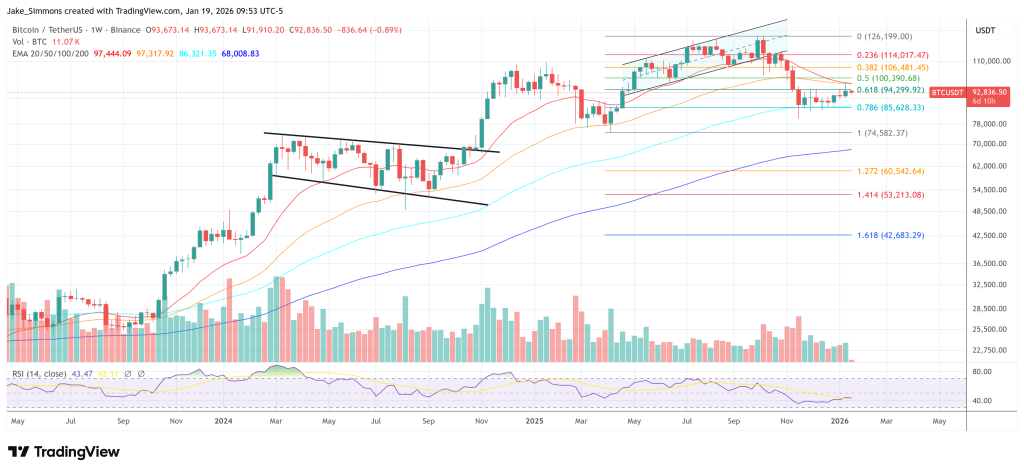
Bitcoin is down 36% from its recent peak, and the “bear market” label is already circulating across crypto X. But in a thread on Sunday, trader Cristian Chifoi argues that calling a regime shift on the drawdown alone misses the more tradable signal: what happens after the first meaningful rebound, and how price behaves around a tight set of time-based “seasonality windows.”

Chifoi’s core claim is that many commentators default to reactive narratives after volatility has already printed. “The simplest way to determine if the Bitcoin bear market has started is not after we had a 36% correction, as all of crypto analysts online suggest,” he wrote. “The same analysts that suggested a supercycle in November 2021 on, while the price was pumping 100%+.” In his framing, the bear-market question is less about the magnitude of the drop and more about whether any bounce that follows looks like strength or a structurally weak countertrend move that fails over time.

Is Bitcoin In A Bear Market?

Chifoi’s first lens is a cross-check between Bitcoin and USDT dominance (USDT.D), which he describes as an “inverted BTC chart” used as a confluence signal. He also emphasizes timing as the primary indicator, arguing the drawdown has already met a minimum duration he tracks across cycles.

“If you are a trader or not, I also suggest you use time as your first indicator, and price as the second,” he wrote. “We had a 77 day correction from top to bottom already. The price couldn’t get lower. That is the signal, rest is noise.”

From there, his bear-market confirmation playbook hinges on how far Bitcoin can bounce and how long it can sustain momentum. He outlines USDT.D targets: first around 5.5%, then lower levels like 4.7% and maps them to potential BTC levels. A push “lil’ over 100k,” he said, could still qualify as a “dead cat bounce” if it persists for weeks without follow-through. In that case, the bounce itself becomes evidence of weakness rather than a green light for a renewed uptrend.

His second scenario is more uncomfortable for both “cycle is dead” skeptics and early-bear callers: Bitcoin makes a higher high, potentially into the $115,000–$120,000 range, but then stalls out over a multi-week window. Even that, in Chifoi’s view, could be consistent with a bear-market transition if time passes and price cannot “deliver more gains,” turning a nominal breakout into a distribution-like top.

“It is the same game!” he added, arguing that traders should be watching for the same failure mode at different price levels rather than anchoring to a single number.

Chifoi’s second framework is seasonality, centered on a window around January 20 (plus or minus a few days) extending into late March or early April. He says he has been tracking this as a primary decision point since the start of 2026, and frames it as a fork between two paths: either Bitcoin rallies into that date to set a pivot high and roll over, or it forms a pivot low around that date and then pushes higher into the next time pivot.

“A pump into the January 20, over $100-$110k would mean a pivot high and the continuation down into next time pivot,” he wrote. The alternative, he said, is “January 20 pivot low, and then continuation up to next time pivot,” adding he is watching this week’s price action “until Friday” for confirmation.

At the time of writing, Chifoi leans toward the latter interpretation. “For now it seems pretty clear that we are developing a pivot low, and the next move is the opposite one versus what we had from October 6th until now,” he said.

Chifoi positions most market participants into two “camps”: those calling for a supercycle or declaring the cycle framework broken, and those asserting a bear market began in October and ends in October 2026 “just like 2022.” He argues both could get forced into poor positioning if Bitcoin prints a new high in the coming weeks before selling off after April.

His own risk case is broader and more time-focused: a new high followed by a sustained decline into late 2026 or early 2027, which he calls his “next important time pivot.” In that context, the operational takeaway is less about predicting a bear market today and more about letting the next rebound and the January-to-spring window define whether this is a reset inside a broader uptrend or the start of a longer distribution-to-downtrend transition.

“Pay attention these next few weeks,” Chifoi wrote. “I do not know what will happen, but the plan is already set up and will adapt my positioning accordingly, whichever scenario plays out, because I already know what to do in either of the cases.”

At press time, BTC traded at $92,836.
Bitcoin price chart
Market Opportunity
Bitcoin Logo
Bitcoin Price(BTC)
$90,608.56
$90,608.56$90,608.56
-2.64%
USD
Bitcoin (BTC) Live Price Chart
Disclaimer: The articles reposted on this site are sourced from public platforms and are provided for informational purposes only. They do not necessarily reflect the views of MEXC. All rights remain with the original authors. If you believe any content infringes on third-party rights, please contact [email protected] for removal. MEXC makes no guarantees regarding the accuracy, completeness, or timeliness of the content and is not responsible for any actions taken based on the information provided. The content does not constitute financial, legal, or other professional advice, nor should it be considered a recommendation or endorsement by MEXC.

You May Also Like

Why Bitcoin’s Bear Case Is Suddenly Back on the Table

Why Bitcoin’s Bear Case Is Suddenly Back on the Table

Fear, Liquidity, and Market Structure Collide at a Critical Moment Bitcoin has spent most of January 2026 trading under pressure, slipping below key psycho
Share
Medium2026/01/20 20:55
USD/JPY drops to near 157.80 as US-EU disputes batter US Dollar

USD/JPY drops to near 157.80 as US-EU disputes batter US Dollar

The post USD/JPY drops to near 157.80 as US-EU disputes batter US Dollar appeared on BitcoinEthereumNews.com. The USD/JPY pair is down 0.2% to near 157.80 during
Share
BitcoinEthereumNews2026/01/20 21:27
MetaMask Token: Exciting Launch Could Be Sooner Than Expected

MetaMask Token: Exciting Launch Could Be Sooner Than Expected

BitcoinWorld MetaMask Token: Exciting Launch Could Be Sooner Than Expected The cryptocurrency community is buzzing with exciting news: a native MetaMask token might arrive sooner than many anticipated. This development could reshape how users interact with the popular Web3 wallet and the broader decentralized ecosystem. It signals a significant step forward for one of the most widely used tools in the blockchain space. What’s Fueling the MetaMask Token Buzz? Joseph Lubin, the CEO of ConsenSys, the company behind MetaMask, recently shared insights that ignited this excitement. According to reports from The Block, Lubin indicated that a MetaMask token could launch ahead of previous expectations. This isn’t the first time the idea has surfaced; Dan Finlay, one of MetaMask’s founders, had previously mentioned the possibility of issuing such a token. ConsenSys has been a pivotal player in the Ethereum ecosystem, developing essential infrastructure and applications. MetaMask, their flagship wallet, serves millions of users, providing a gateway to decentralized applications (dApps), NFTs, and various blockchain networks. Therefore, any move to introduce a native token is a major event for the entire Web3 community. Why is a MetaMask Token So Anticipated? The prospect of a MetaMask token generates immense interest because it could introduce new layers of utility and community governance. Users often speculate about the benefits such a token could offer. Here are some key reasons for the high anticipation: Governance Rights: A token could empower users to participate in the future direction and development of MetaMask. This means voting on new features, upgrades, or even changes to the platform’s policies. Ecosystem Rewards: Tokens might be distributed as rewards for active participation, using certain features, or contributing to the MetaMask community. This incentivizes engagement and loyalty. Enhanced Utility: The token could unlock premium features, reduce transaction fees, or provide exclusive access to services within the MetaMask ecosystem or partnered dApps. Decentralization: Introducing a token often aligns with the broader Web3 ethos of decentralization, distributing control and ownership among its users rather than centralizing it within ConsenSys. Consequently, a token launch is seen as a way to deepen user involvement and foster a more robust, community-driven ecosystem around the wallet. Exploring the Potential Impact of a MetaMask Token The introduction of a MetaMask token could have far-reaching implications for the decentralized finance (DeFi) and Web3 landscape. Firstly, it could set a new standard for how popular infrastructure tools engage with their user base. By providing a tangible stake, MetaMask might strengthen its position as a community-governed platform. Moreover, a token could significantly boost the wallet’s visibility and adoption, attracting new users eager to participate in its governance or benefit from its utility. This could also lead to innovative integrations with other blockchain projects, creating a more interconnected and efficient Web3 experience. Ultimately, the success of such a token will depend on its design, utility, and how effectively it engages the global MetaMask community. What Challenges Could a MetaMask Token Face? While the excitement is palpable, launching a MetaMask token also presents several challenges that ConsenSys must navigate carefully. One primary concern is regulatory scrutiny. The classification of cryptocurrency tokens varies across jurisdictions, and ensuring compliance is crucial for long-term success. Furthermore, designing a fair and equitable distribution model is paramount. Ensuring that the token provides genuine utility beyond mere speculation will be another hurdle. A token must integrate seamlessly into the MetaMask experience and offer clear value to its holders. Additionally, managing community expectations and preventing market manipulation will require robust strategies. Addressing these challenges effectively will be key to the token’s sustainable growth and positive reception. What’s Next for the MetaMask Ecosystem? The prospect of a MetaMask token signals an evolving strategy for ConsenSys and the future of Web3 wallets. It reflects a growing trend where foundational tools seek to empower their communities through tokenization. Users are keenly watching for official announcements regarding the token’s mechanics, distribution, and launch timeline. This development could solidify MetaMask’s role not just as a wallet, but as a central pillar of decentralized identity and interaction. The potential for a sooner-than-expected launch adds an element of urgency and excitement, encouraging users to stay informed about every new detail. It represents a significant milestone for a platform that has become synonymous with accessing the decentralized web. Conclusion The hints from ConsenSys CEO Joseph Lubin regarding an earlier launch for the MetaMask token have undoubtedly captured the attention of the entire crypto world. This potential development promises to bring enhanced governance, utility, and community engagement to millions of MetaMask users. While challenges exist, the underlying potential for a more decentralized and user-driven ecosystem is immense. The coming months will likely reveal more about this highly anticipated token, marking a new chapter for one of Web3’s most vital tools. Frequently Asked Questions (FAQs) Q1: What is a MetaMask token? A MetaMask token would be a native cryptocurrency issued by ConsenSys, the company behind the MetaMask wallet. It is expected to offer various utilities, including governance rights, rewards, and access to special features within the MetaMask ecosystem. Q2: Why is ConsenSys considering launching a MetaMask token? ConsenSys is likely exploring a token launch to further decentralize the MetaMask platform, empower its user community with governance rights, incentivize active participation, and potentially unlock new forms of utility and growth for the ecosystem. Q3: What benefits could users gain from a MetaMask token? Users could gain several benefits, such as the ability to vote on MetaMask’s future developments, earn rewards for using the wallet, access exclusive features, or potentially reduce transaction fees. It also provides a direct stake in the platform’s success. Q4: When is the MetaMask token expected to launch? While no official launch date has been confirmed, ConsenSys CEO Joseph Lubin has indicated that the launch could happen sooner than previously expected. The exact timeline remains subject to official announcements from ConsenSys. Q5: How would a MetaMask token impact the broader Web3 ecosystem? A MetaMask token could significantly impact Web3 by setting a precedent for user-owned and governed infrastructure tools. It could drive further decentralization, foster innovation, and strengthen the connection between users and the platforms they rely on, ultimately contributing to a more robust and participatory decentralized internet. To learn more about the latest crypto market trends, explore our article on key developments shaping Ethereum institutional adoption. This post MetaMask Token: Exciting Launch Could Be Sooner Than Expected first appeared on BitcoinWorld.
Share
Coinstats2025/09/19 15:40