Analyze the performance of SDP and Moment-SOS relaxations on synthetic hyperbolic datasets.Analyze the performance of SDP and Moment-SOS relaxations on synthetic hyperbolic datasets.

Optimization Performance on Synthetic Gaussian and Tree Embeddings

Abstract and 1. Introduction

  1. Related Works

  2. Convex Relaxation Techniques for Hyperbolic SVMs

    3.1 Preliminaries

    3.2 Original Formulation of the HSVM

    3.3 Semidefinite Formulation

    3.4 Moment-Sum-of-Squares Relaxation

  3. Experiments

    4.1 Synthetic Dataset

    4.2 Real Dataset

  4. Discussions, Acknowledgements, and References

    \

A. Proofs

B. Solution Extraction in Relaxed Formulation

C. On Moment Sum-of-Squares Relaxation Hierarchy

D. Platt Scaling [31]

E. Detailed Experimental Results

F. Robust Hyperbolic Support Vector Machine

4.1 Synthetic Dataset

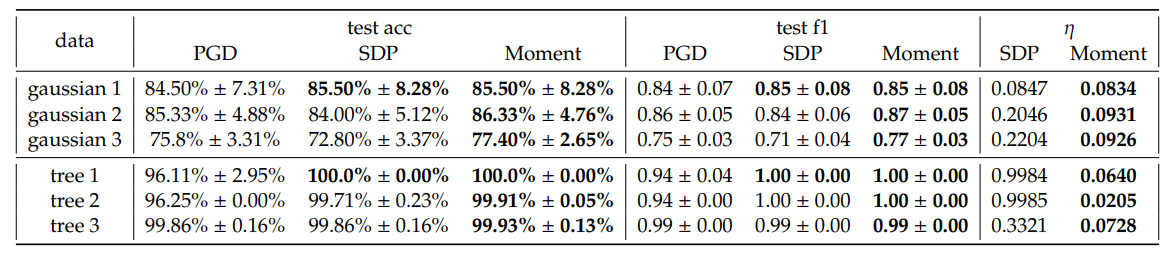
\ In general, we observe a small gain in average test accuracy and weighted F1 score from SDP and Moment relative to PGD. Notably, we observe that Moment often shows more consistent improvements compared to SDP, across most of the configurations. In addition, Moment gives smaller optimality gaps 𝜂 than SDP. This matches our expectation that Moment is tighter than the SDP.

\ Although in some case, for example when đŸ = 5, Moment achieves significantly smaller losses compared to both PGD and SDP, it is generally not the case. We emphasize that these losses are not direct measurements of the max-margin hyperbolic separators’ generalizability; rather, they are combinations of margin maximization and penalization for misclassification that scales with đ¶. Hence, the observation that the performance in test accuracy and weighted F1 score is better, even though the loss computed using extracted solutions from SDP and Moment is sometimes higher than that from PGD, might be due to the complicated loss landscape. More specifically, the observed increases in loss can be attributed to the intricacies of the landscape rather than the effectiveness of the optimization methods. Based on the accuracy and F1 score results, empirically SDP and Moment methods identify solutions that generalize better than those obtained by running gradient descent alone. We provide a more detailed analysis on the effect of hyperparameters in Appendix E.2 and runtime in Table 4. Decision boundary for Gaussian 1 is visualized in Figure 5.

\ Figure 3: Three Synthetic Gaussian (top row) and Three Tree Embeddings (bottom row). All features are in H2 but visualized through stereographic projection on B2. Different colors represent different classes. For tree dataset, the graph connections are also visualized but not used in training. The selected tree embeddings come directly from Mishne et al. [6].

\ Synthetic Tree Embedding. As hyperbolic spaces are good for embedding trees, we generate random tree graphs and embed them to H2 following Mishne et al. [6]. Specifically, we label nodes as positive if they are children of a specified node and negative otherwise. Our models are then evaluated for subtree classification, aiming to identify a boundary that includes all the children nodes within the same subtree. Such task has various practical applications. For example, if the tree represents a set of tokens, the decision boundary can highlight semantic regions in the hyperbolic space that correspond to the subtrees of the data graph. We emphasize that a common feature in such subtree classification task is data imbalance, which usually lead to poor generalizability. Hence, we aim to use this task to assess our methods’ performances under this challenging setting. Three embeddings are selected and visualized in Figure 3 and performance is summarized in Table 1. The runtime of the selected trees can be found in Table 4. Decision boundary of tree 2 is visualized in Figure 6.

\ Similar to the results of synthetic Gaussian datsets, we observe better performance from SDP and Moment compared to PGD, and due to data imbalance that GD methods typically struggle with, we have a larger gain in weighted F1 score in this case. In addition, we observe large optimality gaps for SDP but very tight gap for Moment, certifying the optimality of Moment even when class-imbalance is severe.

\ Table 1: Performance on synthetic Gaussian and tree dataset for đ¶ = 10.0: 5-fold test accuracy and weighted F1 score plus and minus 1 standard deviation, and the average relative optimality gap 𝜂 for SDP and Moment.
\

:::info Authors:

(1) Sheng Yang, John A. Paulson School of Engineering and Applied Sciences, Harvard University, Cambridge, MA ([email protected]);

(2) Peihan Liu, John A. Paulson School of Engineering and Applied Sciences, Harvard University, Cambridge, MA ([email protected]);

(3) Cengiz Pehlevan, John A. Paulson School of Engineering and Applied Sciences, Harvard University, Cambridge, MA, Center for Brain Science, Harvard University, Cambridge, MA, and Kempner Institute for the Study of Natural and Artificial Intelligence, Harvard University, Cambridge, MA ([email protected]).

:::


:::info This paper is available on arxiv under CC by-SA 4.0 Deed (Attribution-Sharealike 4.0 International) license.

:::

\

Market Opportunity
Treehouse Logo
Treehouse Price(TREE)
$0.0968
$0.0968$0.0968
-2.32%
USD
Treehouse (TREE) Live Price Chart
Disclaimer: The articles reposted on this site are sourced from public platforms and are provided for informational purposes only. They do not necessarily reflect the views of MEXC. All rights remain with the original authors. If you believe any content infringes on third-party rights, please contact [email protected] for removal. MEXC makes no guarantees regarding the accuracy, completeness, or timeliness of the content and is not responsible for any actions taken based on the information provided. The content does not constitute financial, legal, or other professional advice, nor should it be considered a recommendation or endorsement by MEXC.

You May Also Like

Why Bitcoin’s Bear Case Is Suddenly Back on the Table

Why Bitcoin’s Bear Case Is Suddenly Back on the Table

Fear, Liquidity, and Market Structure Collide at a Critical Moment Bitcoin has spent most of January 2026 trading under pressure, slipping below key psycho
Share
Medium2026/01/20 20:55
USD/JPY drops to near 157.80 as US-EU disputes batter US Dollar

USD/JPY drops to near 157.80 as US-EU disputes batter US Dollar

The post USD/JPY drops to near 157.80 as US-EU disputes batter US Dollar appeared on BitcoinEthereumNews.com. The USD/JPY pair is down 0.2% to near 157.80 during
Share
BitcoinEthereumNews2026/01/20 21:27
MetaMask Token: Exciting Launch Could Be Sooner Than Expected

MetaMask Token: Exciting Launch Could Be Sooner Than Expected

BitcoinWorld MetaMask Token: Exciting Launch Could Be Sooner Than Expected The cryptocurrency community is buzzing with exciting news: a native MetaMask token might arrive sooner than many anticipated. This development could reshape how users interact with the popular Web3 wallet and the broader decentralized ecosystem. It signals a significant step forward for one of the most widely used tools in the blockchain space. What’s Fueling the MetaMask Token Buzz? Joseph Lubin, the CEO of ConsenSys, the company behind MetaMask, recently shared insights that ignited this excitement. According to reports from The Block, Lubin indicated that a MetaMask token could launch ahead of previous expectations. This isn’t the first time the idea has surfaced; Dan Finlay, one of MetaMask’s founders, had previously mentioned the possibility of issuing such a token. ConsenSys has been a pivotal player in the Ethereum ecosystem, developing essential infrastructure and applications. MetaMask, their flagship wallet, serves millions of users, providing a gateway to decentralized applications (dApps), NFTs, and various blockchain networks. Therefore, any move to introduce a native token is a major event for the entire Web3 community. Why is a MetaMask Token So Anticipated? The prospect of a MetaMask token generates immense interest because it could introduce new layers of utility and community governance. Users often speculate about the benefits such a token could offer. Here are some key reasons for the high anticipation: Governance Rights: A token could empower users to participate in the future direction and development of MetaMask. This means voting on new features, upgrades, or even changes to the platform’s policies. Ecosystem Rewards: Tokens might be distributed as rewards for active participation, using certain features, or contributing to the MetaMask community. This incentivizes engagement and loyalty. Enhanced Utility: The token could unlock premium features, reduce transaction fees, or provide exclusive access to services within the MetaMask ecosystem or partnered dApps. Decentralization: Introducing a token often aligns with the broader Web3 ethos of decentralization, distributing control and ownership among its users rather than centralizing it within ConsenSys. Consequently, a token launch is seen as a way to deepen user involvement and foster a more robust, community-driven ecosystem around the wallet. Exploring the Potential Impact of a MetaMask Token The introduction of a MetaMask token could have far-reaching implications for the decentralized finance (DeFi) and Web3 landscape. Firstly, it could set a new standard for how popular infrastructure tools engage with their user base. By providing a tangible stake, MetaMask might strengthen its position as a community-governed platform. Moreover, a token could significantly boost the wallet’s visibility and adoption, attracting new users eager to participate in its governance or benefit from its utility. This could also lead to innovative integrations with other blockchain projects, creating a more interconnected and efficient Web3 experience. Ultimately, the success of such a token will depend on its design, utility, and how effectively it engages the global MetaMask community. What Challenges Could a MetaMask Token Face? While the excitement is palpable, launching a MetaMask token also presents several challenges that ConsenSys must navigate carefully. One primary concern is regulatory scrutiny. The classification of cryptocurrency tokens varies across jurisdictions, and ensuring compliance is crucial for long-term success. Furthermore, designing a fair and equitable distribution model is paramount. Ensuring that the token provides genuine utility beyond mere speculation will be another hurdle. A token must integrate seamlessly into the MetaMask experience and offer clear value to its holders. Additionally, managing community expectations and preventing market manipulation will require robust strategies. Addressing these challenges effectively will be key to the token’s sustainable growth and positive reception. What’s Next for the MetaMask Ecosystem? The prospect of a MetaMask token signals an evolving strategy for ConsenSys and the future of Web3 wallets. It reflects a growing trend where foundational tools seek to empower their communities through tokenization. Users are keenly watching for official announcements regarding the token’s mechanics, distribution, and launch timeline. This development could solidify MetaMask’s role not just as a wallet, but as a central pillar of decentralized identity and interaction. The potential for a sooner-than-expected launch adds an element of urgency and excitement, encouraging users to stay informed about every new detail. It represents a significant milestone for a platform that has become synonymous with accessing the decentralized web. Conclusion The hints from ConsenSys CEO Joseph Lubin regarding an earlier launch for the MetaMask token have undoubtedly captured the attention of the entire crypto world. This potential development promises to bring enhanced governance, utility, and community engagement to millions of MetaMask users. While challenges exist, the underlying potential for a more decentralized and user-driven ecosystem is immense. The coming months will likely reveal more about this highly anticipated token, marking a new chapter for one of Web3’s most vital tools. Frequently Asked Questions (FAQs) Q1: What is a MetaMask token? A MetaMask token would be a native cryptocurrency issued by ConsenSys, the company behind the MetaMask wallet. It is expected to offer various utilities, including governance rights, rewards, and access to special features within the MetaMask ecosystem. Q2: Why is ConsenSys considering launching a MetaMask token? ConsenSys is likely exploring a token launch to further decentralize the MetaMask platform, empower its user community with governance rights, incentivize active participation, and potentially unlock new forms of utility and growth for the ecosystem. Q3: What benefits could users gain from a MetaMask token? Users could gain several benefits, such as the ability to vote on MetaMask’s future developments, earn rewards for using the wallet, access exclusive features, or potentially reduce transaction fees. It also provides a direct stake in the platform’s success. Q4: When is the MetaMask token expected to launch? While no official launch date has been confirmed, ConsenSys CEO Joseph Lubin has indicated that the launch could happen sooner than previously expected. The exact timeline remains subject to official announcements from ConsenSys. Q5: How would a MetaMask token impact the broader Web3 ecosystem? A MetaMask token could significantly impact Web3 by setting a precedent for user-owned and governed infrastructure tools. It could drive further decentralization, foster innovation, and strengthen the connection between users and the platforms they rely on, ultimately contributing to a more robust and participatory decentralized internet. To learn more about the latest crypto market trends, explore our article on key developments shaping Ethereum institutional adoption. This post MetaMask Token: Exciting Launch Could Be Sooner Than Expected first appeared on BitcoinWorld.
Share
Coinstats2025/09/19 15:40