Stablecoin USX Experiences Brief Price Disruption on Solana Network USX, a dollar-pegged stablecoin native to the Solana blockchain, encountered a temporary deviationStablecoin USX Experiences Brief Price Disruption on Solana Network USX, a dollar-pegged stablecoin native to the Solana blockchain, encountered a temporary deviation

USX Stablecoin Recovers After Short Depeg Caused by DEX Selling Pressure
Usx Stablecoin Recovers After Short Depeg Caused By Dex Selling Pressure

Stablecoin USX Experiences Brief Price Disruption on Solana Network

USX, a dollar-pegged stablecoin native to the Solana blockchain, encountered a temporary deviation from its peg on decentralized exchanges early Friday. Heavy selling pressure and limited liquidity on platforms like Orca and Raydium caused USX to dip significantly before Solstice Finance stepped in with liquidity injections to stabilize the token.

According to a recent alert on X, PeckShieldAlert reported USX briefly trading as low as $0.10 in secondary markets amid the event. The sharp decline was linked to isolated trades executed amidst extraordinarily thin liquidity conditions, highlighting potential vulnerabilities of stablecoins during market stress.

Source: PeckShieldAlert

Data from GeckoTerminal revealed a more moderate decline, with the USX/USD trading pair plunging to approximately $0.80 within a 15-minute window on Orca’s pool. However, as liquidity improved, USX rebounded and stabilized near its intended peg of $1, highlighting the resilience of the market amidst the brief turmoil.
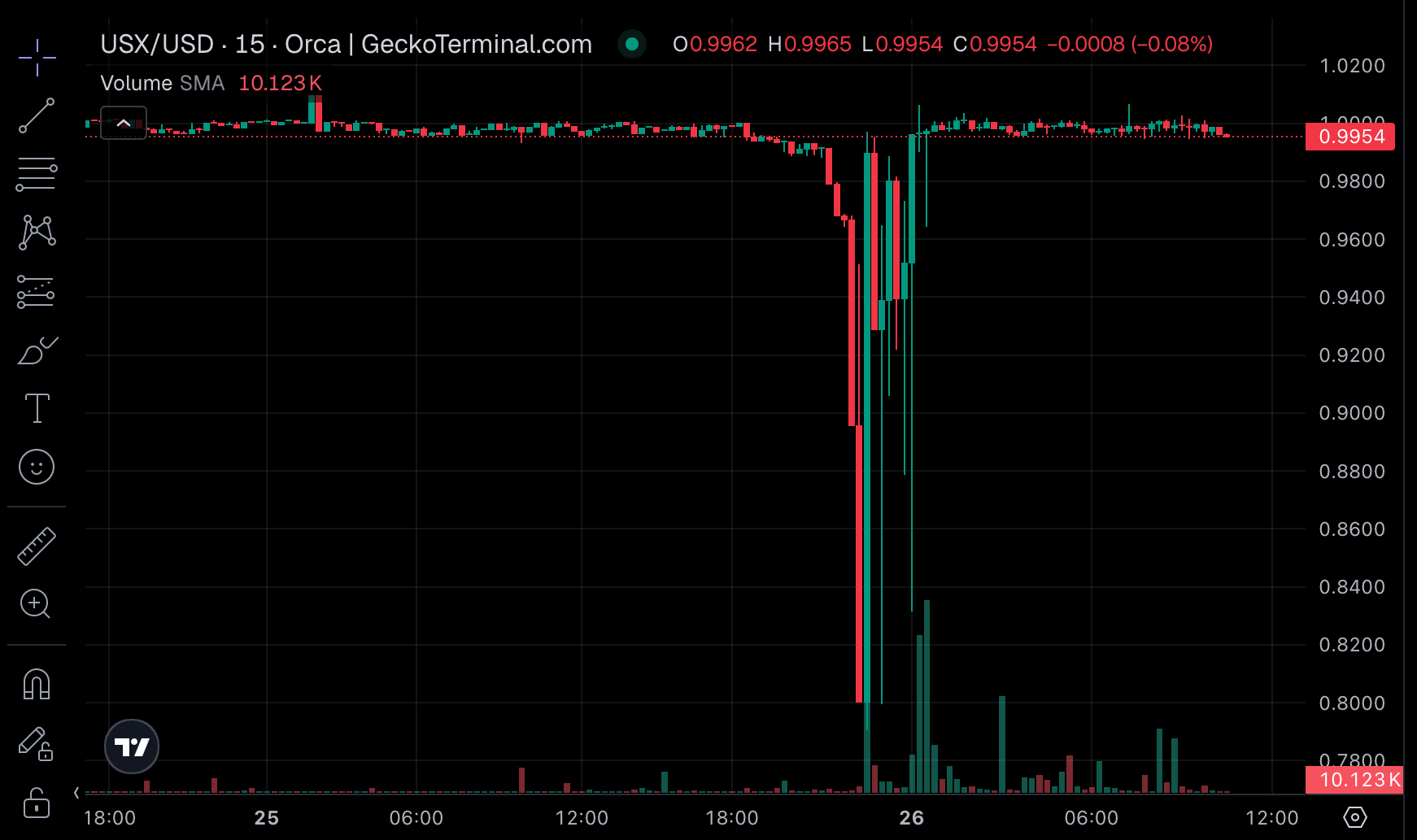
USX 15-min chartSource: GeckoTerminal.com

Solstice Finance reported initiating liquidity injections around 04:30 UTC, which contributed to the price recovery. The issuer reassured market participants that USX’s reserves are overcollateralized and that primary redemptions remain unaffected. The company has also engaged a third-party to verify its collateral levels and expressed commitment to supporting secondary markets to prevent similar episodes in the future.

Additionally, Solstice clarified that it continues to facilitate 1:1 redemptions for institutional partners with permissioned access, and it is actively working with partner entities to deepen secondary market liquidity. The implementation of these measures aims to mitigate the risk of abrupt peg deviations and bolster confidence in USX as a stable currency within the Solana ecosystem.

USX currently maintains a market capitalization of approximately $284 million, according to data from CoinMarketCap, reflecting its established presence and utility on the Solana blockchain. Despite the recent liquidity event, the stablecoin’s fundamentals remain sound, with resilience demonstrated through swift recovery efforts.

The Growing Concerns Over Stablecoin Stability

The incident underscores ongoing concerns about stablecoin stability amidst rapid industry expansion. Since the passage of the U.S. GENIUS Act in July, which provides a regulatory framework for dollar-pegged tokens, the stablecoin market has expanded sharply, with total market capitalization reaching around $308.5 billion, according to DefiLlama. This growth has attracted major financial institutions, payment providers, and crypto-native firms eager to participate in the evolving landscape.

However, regulators and industry experts warn that this rapid expansion increases systemic risks. The European Central Bank’s Dutch central bank governor, Olaf Sleijpen, recently highlighted potential macroeconomic shocks from stablecoin volatility, suggesting that authorities might need to treat stablecoins as sources of systemic risk rather than mere regulatory concerns. Sleijpen emphasized that any instability could prompt rapid sales of reserve assets, heightening market stress and affecting broader economic conditions.

In a comprehensive IMF report, global financial regulators examined the complexities and risks associated with stablecoins, citing fragmented regulations across jurisdictions and challenges in cross-chain interoperability as critical concerns. The report highlights the importance of coherent international standards to safeguard financial stability amid increasing stablecoin adoption. As the market continues to evolve, the resilience of stablecoins under stress will be tested, emphasizing the need for robust oversight and risk management frameworks.

This article was originally published as USX Stablecoin Recovers After Short Depeg Caused by DEX Selling Pressure on Crypto Breaking News – your trusted source for crypto news, Bitcoin news, and blockchain updates.

Market Opportunity
Wink Logo
Wink Price(LIKE)
$0.003327
$0.003327$0.003327
+1.58%
USD
Wink (LIKE) Live Price Chart
Disclaimer: The articles reposted on this site are sourced from public platforms and are provided for informational purposes only. They do not necessarily reflect the views of MEXC. All rights remain with the original authors. If you believe any content infringes on third-party rights, please contact [email protected] for removal. MEXC makes no guarantees regarding the accuracy, completeness, or timeliness of the content and is not responsible for any actions taken based on the information provided. The content does not constitute financial, legal, or other professional advice, nor should it be considered a recommendation or endorsement by MEXC.

You May Also Like

The Channel Factories We’ve Been Waiting For

The Channel Factories We’ve Been Waiting For

The post The Channel Factories We’ve Been Waiting For appeared on BitcoinEthereumNews.com. Visions of future technology are often prescient about the broad strokes while flubbing the details. The tablets in “2001: A Space Odyssey” do indeed look like iPads, but you never see the astronauts paying for subscriptions or wasting hours on Candy Crush.  Channel factories are one vision that arose early in the history of the Lightning Network to address some challenges that Lightning has faced from the beginning. Despite having grown to become Bitcoin’s most successful layer-2 scaling solution, with instant and low-fee payments, Lightning’s scale is limited by its reliance on payment channels. Although Lightning shifts most transactions off-chain, each payment channel still requires an on-chain transaction to open and (usually) another to close. As adoption grows, pressure on the blockchain grows with it. The need for a more scalable approach to managing channels is clear. Channel factories were supposed to meet this need, but where are they? In 2025, subnetworks are emerging that revive the impetus of channel factories with some new details that vastly increase their potential. They are natively interoperable with Lightning and achieve greater scale by allowing a group of participants to open a shared multisig UTXO and create multiple bilateral channels, which reduces the number of on-chain transactions and improves capital efficiency. Achieving greater scale by reducing complexity, Ark and Spark perform the same function as traditional channel factories with new designs and additional capabilities based on shared UTXOs.  Channel Factories 101 Channel factories have been around since the inception of Lightning. A factory is a multiparty contract where multiple users (not just two, as in a Dryja-Poon channel) cooperatively lock funds in a single multisig UTXO. They can open, close and update channels off-chain without updating the blockchain for each operation. Only when participants leave or the factory dissolves is an on-chain transaction…
Share
BitcoinEthereumNews2025/09/18 00:09
Will XRP Price Increase In September 2025?

Will XRP Price Increase In September 2025?

Ripple XRP is a cryptocurrency that primarily focuses on building a decentralised payments network to facilitate low-cost and cross-border transactions. It’s a native digital currency of the Ripple network, which works as a blockchain called the XRP Ledger (XRPL). It utilised a shared, distributed ledger to track account balances and transactions. What Do XRP Charts Reveal? […]
Share
Tronweekly2025/09/18 00:00
China Blocks Nvidia’s RTX Pro 6000D as Local Chips Rise

China Blocks Nvidia’s RTX Pro 6000D as Local Chips Rise

The post China Blocks Nvidia’s RTX Pro 6000D as Local Chips Rise appeared on BitcoinEthereumNews.com. China Blocks Nvidia’s RTX Pro 6000D as Local Chips Rise China’s internet regulator has ordered the country’s biggest technology firms, including Alibaba and ByteDance, to stop purchasing Nvidia’s RTX Pro 6000D GPUs. According to the Financial Times, the move shuts down the last major channel for mass supplies of American chips to the Chinese market. Why Beijing Halted Nvidia Purchases Chinese companies had planned to buy tens of thousands of RTX Pro 6000D accelerators and had already begun testing them in servers. But regulators intervened, halting the purchases and signaling stricter controls than earlier measures placed on Nvidia’s H20 chip. Image: Nvidia An audit compared Huawei and Cambricon processors, along with chips developed by Alibaba and Baidu, against Nvidia’s export-approved products. Regulators concluded that Chinese chips had reached performance levels comparable to the restricted U.S. models. This assessment pushed authorities to advise firms to rely more heavily on domestic processors, further tightening Nvidia’s already limited position in China. China’s Drive Toward Tech Independence The decision highlights Beijing’s focus on import substitution — developing self-sufficient chip production to reduce reliance on U.S. supplies. “The signal is now clear: all attention is focused on building a domestic ecosystem,” said a representative of a leading Chinese tech company. Nvidia had unveiled the RTX Pro 6000D in July 2025 during CEO Jensen Huang’s visit to Beijing, in an attempt to keep a foothold in China after Washington restricted exports of its most advanced chips. But momentum is shifting. Industry sources told the Financial Times that Chinese manufacturers plan to triple AI chip production next year to meet growing demand. They believe “domestic supply will now be sufficient without Nvidia.” What It Means for the Future With Huawei, Cambricon, Alibaba, and Baidu stepping up, China is positioning itself for long-term technological independence. Nvidia, meanwhile, faces…
Share
BitcoinEthereumNews2025/09/18 01:37