The post XRP Lending Goes Live: Ripple Enables Institutional Borrowing appeared on BitcoinEthereumNews.com. Ripple’s Native XRP Lending Could Redefine InstitutionalThe post XRP Lending Goes Live: Ripple Enables Institutional Borrowing appeared on BitcoinEthereumNews.com. Ripple’s Native XRP Lending Could Redefine Institutional

XRP Lending Goes Live: Ripple Enables Institutional Borrowing

Ripple’s Native XRP Lending Could Redefine Institutional Finance on the XRP Ledger

According to market analyst Diana, Ripple is preparing a major XRP Ledger upgrade that could redefine institutional use of XRP. The planned native lending feature would allow institutions to borrow XRP directly on-chain, mirroring traditional money market functionality.

This isn’t another experimental DeFi layer or third-party lending app. Ripple’s proposal embeds lending directly into the XRP Ledger core, allowing XRP to be lent, locked, deployed, and repaid entirely on-ledger. For institutions that demand regulated, predictable infrastructure, this distinction is decisive. 

Protocol-level rules replace counterparty exposure and smart-contract uncertainty with built-in transparency and enforcement. Each loan is fully isolated, meaning a default is contained to that single position, eliminating systemic, cascading risk. 

This modular, ring-fenced design mirrors traditional financial risk management and delivers a major trust upgrade for banks, payment firms, and large institutions assessing blockchain adoption.

A standout feature is fixed-term locking: borrowed XRP is secured for predefined periods, mirroring traditional credit agreements. While in use, it’s removed from circulation, creating a dual effect, enabling productive deployment while tightening liquid supply, a dynamic often overlooked, as Diana highlights.

In market terms, this shift is significant. When demand rises while available supply is constrained, upward price pressure naturally builds. Native lending strengthens this dynamic by anchoring XRP’s value to real financial utility, credit creation, liquidity provisioning, and institutional settlement, rather than speculative holding.

More importantly, native lending fundamentally repositions XRP in global finance. It elevates XRP from a payment bridge to collateral-grade financial infrastructure. Institutions would not simply transact with XRP; they could deploy it across balance-sheet operations, treasury strategies, and liquidity management frameworks.

For banks and payment firms, this is a decisive upgrade. Native lending introduces familiar credit mechanics, stronger risk controls, and clearer regulatory alignment, without sacrificing blockchain efficiency. As Diana notes, this is how digital assets become real money: not through hype, but through structure, trust, and measurable utility.

If executed as planned, Ripple’s native lending could be a pivotal inflection point, elevating XRP from a simple transaction bridge to a collateral-grade financial asset embedded within institutional credit markets.

Conclusion

Ripple’s decision to integrate native lending directly into the XRP Ledger is more than a technical enhancement, it marks a strategic shift toward institutional-grade financial infrastructure. 

By enabling isolated, fixed-term XRP loans at the protocol level, Ripple brings blockchain functionality in line with the risk controls, predictability, and transparency that traditional financial institutions demand. 

This approach strengthens trust while turning XRP into a productive, collateral-ready asset that can be borrowed, deployed, and repaid within a regulated framework. As active loans temporarily lock supply and demand is driven by real financial use, XRP’s role evolves from speculative utility to structural relevance. If widely adopted, native lending could elevate XRP into a core asset within institutional credit markets, bridging blockchain innovation with real-world finance.

Source: https://coinpaper.com/13254/xrp-lending-goes-live-ripple-lets-institutions-borrow-like-cash


Market Opportunity
XRP Logo
XRP Price(XRP)
$1.353
$1.353$1.353
-1.29%
USD
XRP (XRP) Live Price Chart
Disclaimer: The articles reposted on this site are sourced from public platforms and are provided for informational purposes only. They do not necessarily reflect the views of MEXC. All rights remain with the original authors. If you believe any content infringes on third-party rights, please contact [email protected] for removal. MEXC makes no guarantees regarding the accuracy, completeness, or timeliness of the content and is not responsible for any actions taken based on the information provided. The content does not constitute financial, legal, or other professional advice, nor should it be considered a recommendation or endorsement by MEXC.

You May Also Like

Crypto News: Donald Trump-Aligned Fed Governor To Speed Up Fed Rate Cuts?

Crypto News: Donald Trump-Aligned Fed Governor To Speed Up Fed Rate Cuts?

The post Crypto News: Donald Trump-Aligned Fed Governor To Speed Up Fed Rate Cuts? appeared on BitcoinEthereumNews.com. In recent crypto news, Stephen Miran swore in as the latest Federal Reserve governor on September 16, 2025, slipping into the board’s last open spot right before the Federal Open Market Committee kicks off its two-day rate discussion. Traders are betting heavily on a 25-basis-point trim, which would bring the federal funds rate down to 4.00%-4.25%, based on CME FedWatch Tool figures from September 15, 2025. Miran, who’s been Trump’s top economic advisor and a supporter of his trade ideas, joins a seven-member board where just three governors come from Democratic picks, according to the Fed’s records updated that same day. Crypto News: Miran’s Background and Quick Path to Confirmation The Senate greenlit Miran on September 15, 2025, with a tight 48-47 vote, following his nomination on September 2, 2025, as per a recent crypto news update. His stint runs only until January 31, 2026, stepping in for Adriana D. Kugler, who stepped down in August 2025 for reasons not made public. Miran earned his economics Ph.D. from Harvard and worked at the Treasury back in Trump’s first go-around. Afterward, he moved to Hudson Bay Capital Management as an economist, then looped back to the White House in December 2024 to head the Council of Economic Advisers. There, he helped craft Trump’s “reciprocal tariffs” approach, aimed at fixing trade gaps with China and the EU. He wouldn’t quit his White House gig, which irked Senator Elizabeth Warren at the September 7, 2025, confirmation hearings. That limited time frame means Miran gets to cast a vote straight away at the FOMC session starting September 16, 2025. The full board now features Chair Jerome H. Powell (Trump pick, term ends 2026), Vice Chair Philip N. Jefferson (Biden, to 2036), and folks like Lisa D. Cook (Biden, to 2028) and Michael S. Barr…
Share
BitcoinEthereumNews2025/09/18 03:14
Trump crypto company says ‘coordinated attack‘ on stablecoin failed

Trump crypto company says ‘coordinated attack‘ on stablecoin failed

The price of World Liberty Financial's token dipped about 7% early on Monday, later reported to be the result of a social media and short-seller attack.World Liberty
Share
Coinstats2026/02/24 01:56
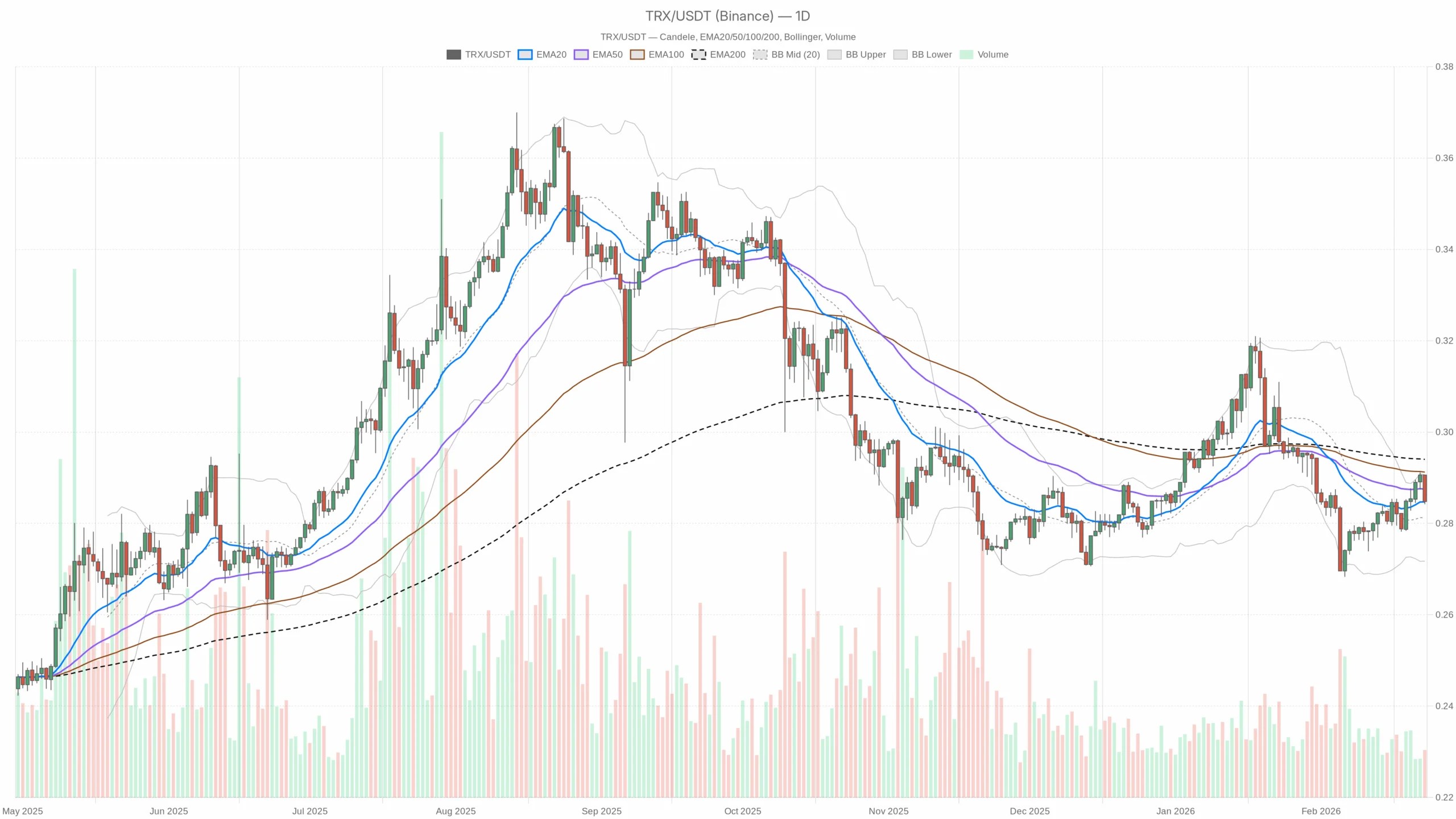
Tron crypto Analysis: 3 Scenarios for TRXUSDT

Tron crypto Analysis: 3 Scenarios for TRXUSDT

The post Tron crypto Analysis: 3 Scenarios for TRXUSDT appeared on BitcoinEthereumNews.com. While the broader crypto market leans risk‑off, Tron crypto (TRXUSDT
Share
BitcoinEthereumNews2026/02/24 02:33