The post Fed Meeting Outcome Today: FOMC Expectations and Forecast appeared first on Coinpedia Fintech News The U.S. economy stands at a critical juncture as investors await the Federal Reserve’s December 10 FOMC meeting, with markets widely expecting a 25 basis point interest rate cut.  Recent data, including the September Personal Consumption Expenditures (PCE) report showing inflation at 2.8% year-over-year, the fastest pace since spring 2024, has reinforced expectations of policy …The post Fed Meeting Outcome Today: FOMC Expectations and Forecast appeared first on Coinpedia Fintech News The U.S. economy stands at a critical juncture as investors await the Federal Reserve’s December 10 FOMC meeting, with markets widely expecting a 25 basis point interest rate cut.  Recent data, including the September Personal Consumption Expenditures (PCE) report showing inflation at 2.8% year-over-year, the fastest pace since spring 2024, has reinforced expectations of policy …

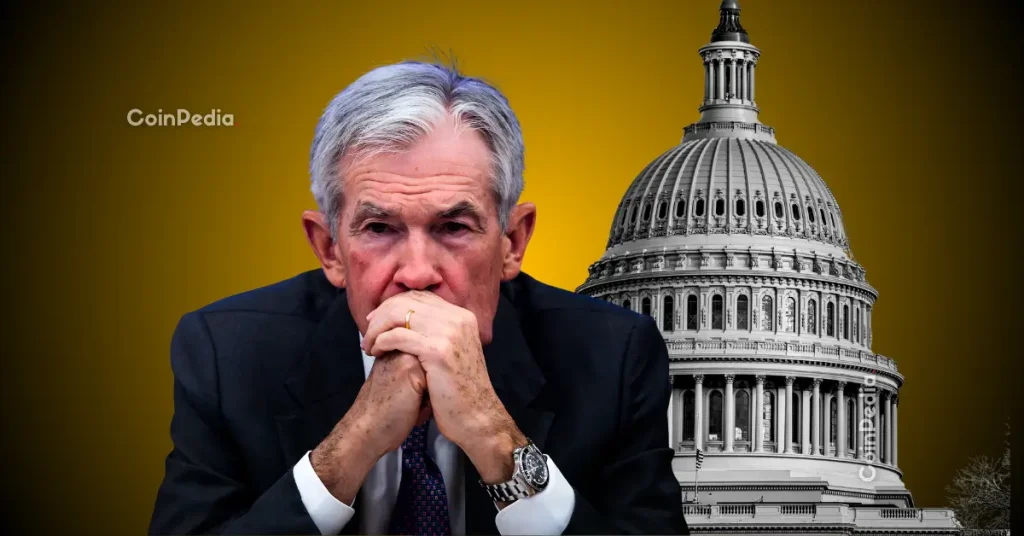
Fed Meeting Outcome Today: FOMC Expectations and Forecast
2025/12/10 17:06
FOMC Meeting Today

The post Fed Meeting Outcome Today: FOMC Expectations and Forecast appeared first on Coinpedia Fintech News

The U.S. economy stands at a critical juncture as investors await the Federal Reserve’s December 10 FOMC meeting, with markets widely expecting a 25 basis point interest rate cut. 

Recent data, including the September Personal Consumption Expenditures (PCE) report showing inflation at 2.8% year-over-year, the fastest pace since spring 2024, has reinforced expectations of policy easing despite inflation remaining above target.

FOMC Rate Cut Expectations

According to UBS strategist Jonathan Pink, there appears to be broad agreement within the committee to deliver a rate cut, though significant policy revisions are unlikely.

While a quarter-rate cut is largely priced in, investors will closely watch for signals on 2026 policy direction. Pink expects two rate cuts next year but emphasized that the next Fed chair could shape monetary policy debates. 

He also flagged balance-sheet activity as a growing focus, anticipating Treasury bill purchases of $40–60 billion per month to manage liquidity and stabilize repo markets.

FED Rate Cuts May Not Immediately Boost Markets

Crypto analyst LA𝕏MAN told Coinpedia that monetary easing alone may not reverse bearish trends if market structure remains weak.

U.S Inflation Outlook Leaves Fed Room to Move

Ed Ardenni, President of Denny Research, believes current inflation pressures are temporary and that the Fed has room to act, though risks remain.

Ardenni also warned that easing policy could introduce instability in equity markets, even as growth stays intact. He said Bitcoin is influenced heavily by Fed policy and regulatory developments rather than a pure store of value.

  • Also Read :
  •   FOMC Meeting Today: Why Jerome Powell Speech Matters More Than FED Rate Cut
  •   ,

Lower interest rates typically favor risk assets such as Bitcoin and Ethereum by improving liquidity and lowering opportunity costs. However, declining TradFi yields are expected to reduce stablecoin and on-chain dollar yields over time.

Leon Waidmann told coinpedia that

Waidmann pointed to long-term catalysts beyond rate cuts, including tokenized assets, expanding stablecoin adoption, and potential regulatory breakthroughs such as the Clarity Act.

FED Rate Cut Forecast

Despite optimism, market reactions following FOMC meetings have often been volatile. Jim Cramer’s recent claim that markets would “explode” if rates fall reflects traditional theory, but recent sell-offs show traders respond more to the Fed’s tone and immediate guidance than to rate cuts alone.

With expectations already priced in, the December FOMC decision may ultimately hinge less on the size of the cut and more on how convincingly Chair Powell maps the Fed’s path forward into 2026.

Never Miss a Beat in the Crypto World!

Stay ahead with breaking news, expert analysis, and real-time updates on the latest trends in Bitcoin, altcoins, DeFi, NFTs, and more.

bell icon Subscribe to News
Disclaimer: The articles reposted on this site are sourced from public platforms and are provided for informational purposes only. They do not necessarily reflect the views of MEXC. All rights remain with the original authors. If you believe any content infringes on third-party rights, please contact [email protected] for removal. MEXC makes no guarantees regarding the accuracy, completeness, or timeliness of the content and is not responsible for any actions taken based on the information provided. The content does not constitute financial, legal, or other professional advice, nor should it be considered a recommendation or endorsement by MEXC.

You May Also Like

Bitcoin devs cheer block reconstruction stats, ignore security budget concerns

Bitcoin devs cheer block reconstruction stats, ignore security budget concerns

The post Bitcoin devs cheer block reconstruction stats, ignore security budget concerns appeared on BitcoinEthereumNews.com. This morning, Bitcoin Core developers celebrated improved block reconstruction statistics for node operators while conveniently ignoring the reason for these statistics — the downward trend in fees for Bitcoin’s security budget. Reacting with heart emojis and thumbs up to a green chart showing over 80% “successful compact block reconstructions without any requested transactions,” they conveniently omitted red trend lines of the fees that Bitcoin users pay for mining security which powered those green statistics. Block reconstructions occur when a node requests additional information about transactions within a compact block. Although compact blocks allow nodes to quickly relay valid bundles of transactions across the internet, the more frequently that nodes can reconstruct without extra, cumbersome transaction requests from their peers is a positive trend. Because so many nodes switched over in August to relay transactions bidding 0.1 sat/vB across their mempools, nodes now have to request less transaction data to reconstruct blocks containing sub-1 sat/vB transactions. After nodes switched over in August to accept and relay pending transactions bidding less than 1 sat/vB, disparate mempools became harmonized as most nodes had a better view of which transactions would likely join upcoming blocks. As a result, block reconstruction times improved, as nodes needed less information about these sub-1 sat/vB transactions. In July, several miners admitted that user demand for Bitcoin blockspace had persisted at such a low that they were willing to accept transaction fees of just 0.1 satoshi per virtual byte — 90% lower than their prior 1 sat/vB minimum. With so many blocks partially empty, they succumbed to the temptation to accept at least something — even 1 billionth of one bitcoin (BTC) — rather than $0 to fill up some of the excess blockspace. Read more: Bitcoin’s transaction fees have fallen to a multi-year low Green stats for block reconstruction after transaction fees crash After…
Share
BitcoinEthereumNews2025/09/18 04:07
OpenAI and Partners Launch the Agentic AI Foundation for Open-Source AI Development

OpenAI and Partners Launch the Agentic AI Foundation for Open-Source AI Development

The post OpenAI and Partners Launch the Agentic AI Foundation for Open-Source AI Development appeared on BitcoinEthereumNews.com. Peter Zhang Dec 09, 2025 17:56 OpenAI, Anthropic, and Block, supported by tech giants, establish the Agentic AI Foundation under the Linux Foundation to advance open-source agentic AI infrastructure. In a significant move for the artificial intelligence community, OpenAI, in collaboration with Anthropic and Block, has co-founded the Agentic AI Foundation (AAIF) under the auspices of the Linux Foundation. This initiative, supported by industry leaders such as Google, Microsoft, AWS, Bloomberg, and Cloudflare, aims to develop open-source standards for agentic AI systems as they transition from experimental phases to real-world applications, according to OpenAI. The Role of Open Standards The foundation’s mission is to create a neutral ground for developing interoperable infrastructure for AI agents. As AI technology becomes increasingly integrated into business and consumer environments, the need for standardized protocols grows. Open standards are crucial for ensuring that AI systems can operate safely, efficiently, and across various platforms without the risk of fragmentation. OpenAI’s contribution to the AAIF includes the AGENTS.md, a straightforward open format providing agents with project-specific instructions. This effort is designed to facilitate long-term support and widespread adoption across the AI community. Building the Open Ecosystem Over the past year, OpenAI has been instrumental in developing open-source agentic infrastructure. Contributions include the Agents SDK, Apps SDK, and the Agentic Commerce Protocol, alongside open-source initiatives like the gpt-oss models and Codex CLI. These resources have significantly impacted the development community, demonstrated by their adoption in over two million public pull requests on GitHub. OpenAI’s efforts have laid the groundwork for AAIF by showcasing the potential of open, interoperable infrastructure. The foundation is envisioned as a collaborative space where developers and enterprises can build upon shared standards, ensuring technological advancements benefit the broader community. Donating AGENTS.md The AGENTS.md format, initially…
Share
BitcoinEthereumNews2025/12/10 19:30