The post Crypto Investor Loses $27M in Malware Attack Amid Upbit Solana Hack Concerns appeared on BitcoinEthereumNews.com. In a major crypto malware attack, an individual known as Babur lost approximately $27 million in cryptocurrency assets across various blockchain networks due to sophisticated malware that compromised private keys and automated theft from wallets and backups. This incident highlights the growing risks of advanced cyber threats in the crypto space. The malware targeted computers by disguising malicious links as legitimate sites, leading to automatic downloads of executable files that scanned for private keys. Keyloggers were used to capture passwords and sensitive data, enabling hackers to drain funds seamlessly without user awareness. Similar to recent exchange hacks like the Upbit incident, where $30 million was stolen, these attacks often exploit vulnerabilities in wallet systems and private key management. Discover how a devastating crypto malware attack drained $27 million from one user’s wallets. Learn prevention tips and recent industry breaches to safeguard your assets in 2025. Stay secure—read now! What Is a Crypto Malware Attack and How Does It Compromise Wallets? Crypto malware attacks involve malicious software designed to infiltrate devices and steal cryptocurrency by targeting private keys, seed phrases, and wallet credentials. In the recent case involving user Babur, the malware was deployed via a disguised website link that triggered an automatic download, allowing hackers to access and empty wallets holding about $27 million across multiple blockchains. These attacks underscore the need for robust security practices, as they can operate silently in the background, evading traditional antivirus detection. How Did the Recent $27 Million Crypto Malware Attack Unfold? The incident began when Babur, as identified by blockchain security firm SlowMist, clicked on a seemingly innocuous link that led to a malicious site. This action initiated the download of an executable file containing advanced malware, which immediately began scanning the victim’s computer for crypto-related files. According to analysis from SlowMist founder… The post Crypto Investor Loses $27M in Malware Attack Amid Upbit Solana Hack Concerns appeared on BitcoinEthereumNews.com. In a major crypto malware attack, an individual known as Babur lost approximately $27 million in cryptocurrency assets across various blockchain networks due to sophisticated malware that compromised private keys and automated theft from wallets and backups. This incident highlights the growing risks of advanced cyber threats in the crypto space. The malware targeted computers by disguising malicious links as legitimate sites, leading to automatic downloads of executable files that scanned for private keys. Keyloggers were used to capture passwords and sensitive data, enabling hackers to drain funds seamlessly without user awareness. Similar to recent exchange hacks like the Upbit incident, where $30 million was stolen, these attacks often exploit vulnerabilities in wallet systems and private key management. Discover how a devastating crypto malware attack drained $27 million from one user’s wallets. Learn prevention tips and recent industry breaches to safeguard your assets in 2025. Stay secure—read now! What Is a Crypto Malware Attack and How Does It Compromise Wallets? Crypto malware attacks involve malicious software designed to infiltrate devices and steal cryptocurrency by targeting private keys, seed phrases, and wallet credentials. In the recent case involving user Babur, the malware was deployed via a disguised website link that triggered an automatic download, allowing hackers to access and empty wallets holding about $27 million across multiple blockchains. These attacks underscore the need for robust security practices, as they can operate silently in the background, evading traditional antivirus detection. How Did the Recent $27 Million Crypto Malware Attack Unfold? The incident began when Babur, as identified by blockchain security firm SlowMist, clicked on a seemingly innocuous link that led to a malicious site. This action initiated the download of an executable file containing advanced malware, which immediately began scanning the victim’s computer for crypto-related files. According to analysis from SlowMist founder…

Crypto Investor Loses $27M in Malware Attack Amid Upbit Solana Hack Concerns

2025/12/06 10:30
  • The malware targeted computers by disguising malicious links as legitimate sites, leading to automatic downloads of executable files that scanned for private keys.

  • Keyloggers were used to capture passwords and sensitive data, enabling hackers to drain funds seamlessly without user awareness.

  • Similar to recent exchange hacks like the Upbit incident, where $30 million was stolen, these attacks often exploit vulnerabilities in wallet systems and private key management.

Discover how a devastating crypto malware attack drained $27 million from one user’s wallets. Learn prevention tips and recent industry breaches to safeguard your assets in 2025. Stay secure—read now!

What Is a Crypto Malware Attack and How Does It Compromise Wallets?

Crypto malware attacks involve malicious software designed to infiltrate devices and steal cryptocurrency by targeting private keys, seed phrases, and wallet credentials. In the recent case involving user Babur, the malware was deployed via a disguised website link that triggered an automatic download, allowing hackers to access and empty wallets holding about $27 million across multiple blockchains. These attacks underscore the need for robust security practices, as they can operate silently in the background, evading traditional antivirus detection.

How Did the Recent $27 Million Crypto Malware Attack Unfold?

The incident began when Babur, as identified by blockchain security firm SlowMist, clicked on a seemingly innocuous link that led to a malicious site. This action initiated the download of an executable file containing advanced malware, which immediately began scanning the victim’s computer for crypto-related files. According to analysis from SlowMist founder @evilcosuser on X, the software employed keyloggers to record keystrokes, capturing passwords and private keys in real-time. Once obtained, the malware automated the transfer of this sensitive information to the attackers’ servers, facilitating the swift drainage of funds from various wallets.

Experts from SlowMist noted that such poisoning tactics are particularly effective against desktop computers where users store private keys directly, rather than mobile devices like iPhones with built-in safeguards. The attack’s sophistication lay in its automation; after compromising the system, it didn’t require further user interaction to execute thefts. While investigations continue, preliminary findings suggest the malware was not overly complex but relied on social engineering to gain initial access. This event aligns with broader trends in 2024 and early 2025, where malware incidents have risen by over 30% in the crypto sector, per reports from cybersecurity organizations like Chainalysis.

To prevent similar breaches, security professionals recommend using hardware wallets, enabling multi-factor authentication, and avoiding downloads from unverified sources. Babur’s case serves as a stark reminder that even seasoned crypto holders can fall victim to evolving threats.

Frequently Asked Questions

What Should Crypto Users Do After a Suspected Malware Attack?

If you suspect a crypto malware attack, immediately disconnect your device from the internet, scan it with reputable antivirus software, and transfer any remaining assets to a new, secure wallet using a clean device. Change all associated passwords and monitor blockchain transactions for unauthorized activity. Consulting firms like SlowMist for forensic analysis can help trace stolen funds, though recovery is often challenging in decentralized networks.

Are Crypto Exchanges Safe from Malware and Similar Hacks in 2025?

Crypto exchanges in 2025 continue to bolster defenses against malware and hacks through advanced encryption and regular audits, but vulnerabilities persist, as seen in recent incidents. Users should choose platforms with proven security records, enable two-factor authentication, and diversify holdings across cold storage solutions to minimize risks from both individual attacks and exchange breaches.

Key Takeaways

  • Avoid clicking suspicious links: The Babur incident shows how a single malicious download can lead to total wallet compromise; always verify sources before interacting.
  • Implement layered security: Use hardware wallets and keyloggers-resistant practices to protect private keys, reducing the success rate of automated thefts by up to 80% according to cybersecurity data.
  • Stay informed on industry breaches: Events like the Upbit hack emphasize ongoing vigilance; regularly update software and follow guidance from firms like SlowMist to anticipate threats.

Conclusion

The $27 million loss in this crypto malware attack, combined with the Upbit exchange breach involving $30 million in stolen assets, illustrates the persistent vulnerabilities in cryptocurrency security despite advancements in 2025. By prioritizing secure storage practices and awareness of tactics like private key poisoning, users can better defend against such threats. As the industry evolves, staying proactive with tools from trusted security experts will be essential to safeguarding digital assets—consider auditing your setup today for peace of mind.

Blockchain security remains a cornerstone of the cryptocurrency ecosystem, and incidents like the one affecting Babur highlight the importance of vigilance. The malware’s ability to automate private key extraction and fund transfers across networks such as Ethereum and Solana demonstrates how attackers exploit human error combined with technical weaknesses. SlowMist’s investigation revealed that the attack vector was not novel but effective due to its stealthy execution, scanning for wallet files like MetaMask extensions and backup seed phrases.

Further details from the analysis indicate that the stolen assets included a mix of established tokens and altcoins, funneled through mixers to obscure trails. This case parallels other 2024 exploits, where malware accounted for nearly 25% of reported crypto thefts, totaling over $1.7 billion globally as per Chainalysis annual reports. Financial experts emphasize that while blockchain transparency aids in tracking, the pseudonymous nature of transactions complicates full recovery.

In response to rising threats, many in the community advocate for educational campaigns. For instance, @evilcosuser’s post reassured that these attacks, though alarming, are preventable with basic hygiene like offline key storage. The Upbit incident, occurring on November 27, 2024, further amplified concerns when hackers exploited a Solana wallet vulnerability, siphoning tokens including USD Coin and BONK. Upbit’s CEO, Oh Kyung-seok, publicly addressed the lapse, stating that customer funds were insulated through segregated reserves, and the exchange has since overhauled its infrastructure.

This restructuring involved generating fresh deposit addresses for all users and assets, a move monitored by South Korea’s Financial Supervisory Service. Such regulatory oversight is increasingly common, ensuring exchanges adhere to heightened standards. For individual holders like Babur, the lesson is clear: diversify storage methods and employ air-gapped devices for high-value transactions.

Looking ahead, the crypto sector’s resilience is evident in its rapid adaptations, from improved wallet protocols to AI-driven threat detection. Yet, as malware evolves, so must user habits. By integrating these insights, crypto enthusiasts can navigate 2025 with greater confidence, minimizing exposure to the next big breach.

Source: https://en.coinotag.com/crypto-investor-loses-27m-in-malware-attack-amid-upbit-solana-hack-concerns

Disclaimer: The articles reposted on this site are sourced from public platforms and are provided for informational purposes only. They do not necessarily reflect the views of MEXC. All rights remain with the original authors. If you believe any content infringes on third-party rights, please contact [email protected] for removal. MEXC makes no guarantees regarding the accuracy, completeness, or timeliness of the content and is not responsible for any actions taken based on the information provided. The content does not constitute financial, legal, or other professional advice, nor should it be considered a recommendation or endorsement by MEXC.

You May Also Like

XRP Near $2 as ETFs Smash $1B AUM — Institutional Money Quietly Takes Over

XRP Near $2 as ETFs Smash $1B AUM — Institutional Money Quietly Takes Over

XRP trades near $2.04 after climbing more than 12% in the last month, yet the token struggles to reclaim strong momentum. The asset slipped through the past week and lost close to 8% while traders weighed a rare combination of institutional strength and short-term weakness. With a market capitalization near $125 billion and daily volume above $3.3 billion, XRP keeps its position as one of the most liquid crypto assets. The market now watches the psychological $2 support level as heavy inflows clash ih rising short exposure and fading retail conviction.Sentiment Breakdown Creates a Contrarian SetupMarket sentiment around XRP sits inside one of the deepest fear zones since October. Santiment reports that sentiment prints the same level of panic that preceded a sharp twenty-two percent rebound on November 21. RSI sits near 45 and the SAR indicator keeps flipping into bearish territory. Source: XTraders feel trapped between disbelief and fatigue after a two-month decline of thirty-one percent. The present slide shows structural weakness rather than blind panic, which means any reversal must appear through rising volume and inflow recovery rather than pure emotion. Traders hunt for signs that shorts may reach exhaustion as they did during past rebounds.Institutions Accumulate While Retail Steps BackInstitutional appetite continues to grow even as retail traders exit. U.S. spot XRP ETFs attracted $906 million in net inflows since launch, with not a single day of outflows. The flagship XRPC ETF now holds $336 million, which places it above every competing fund.Franklin Templeton now lists XRP as a top-four holding in its regulated multi-asset crypto product. These flows form a clear divergence: Institutional portfolios build long-horizon positions while retail traders short the asset. The setup shows a market where deep pockets accumulate quietly below the surface, waiting for fear to drain out of the system.Ripple’s $4B Expansion Reshapes Global FinanceRipple pushed aggressively into global finance through a $4 billion acquisition wave across GTreasury, Rail, Palisade, and Ripple Prime. The company now holds strategic control over treasury management, liquidity services, payments, and institutional crypto infrastructure. Regulatory traction strengthens the expansion. Approvals in Singapore and the UAE, plus FSRA authorization of the RLUSD stablecoin, anchor Ripple inside the regulated payments ecosystem. Ripple also reached a major U.S. milestone when Bitnomial launched the first CFTC-approved XRP spot product. This move places XRP beside commodities such as Treasuries on a federally regulated exchange. Markets have not priced this transformation yet, leaving a wide gap between Ripple’s operational dominance and XRP’s market performance.On-Chain Data Reveals a Structural SplitThe XRP Ledger shows its highest transaction velocity of the year at 0.0324, marking strong network usage. Open interest climbed to $3.85 billion while funding rates stayed negative, which confirms heavy short positioning. A regional concentration also emerges: Upbit holds more than six billion XRP, far above Binance at 2.6 billion. The imbalance introduces the risk of region-based liquidation waves during volatility spikes. Liquidity remains deep and participation strong, yet direction stays capped by pressure from leveraged traders.Long-Term Holders Rotate as Whales Step InLong-term holder dormancy dropped ninety-one percent since mid-November, signaling that older coins rarely move. At the same time, cohorts that held XRP for six months to three years trimmed positions and locked in profits. Institutions absorbed much of that volume through ETF demand, which removed nearly half a percent of total supply from circulation as ETFs crossed one billion dollars in assets under management. Whales keep buying while early holders reduce exposure. This rotation delays any strong recovery but builds the foundation for a future supply squeeze once distribution slows.XRP now enters a rare moment where institutional strength outweighs retail fear, setting the stage for a potential shift once the market resolves its internal pressure.
Share
Coinstats2025/12/06 21:24
XRP Price Prediction for December 7: Sellers Continue to Dominate as Weak Momentum Persists

XRP Price Prediction for December 7: Sellers Continue to Dominate as Weak Momentum Persists

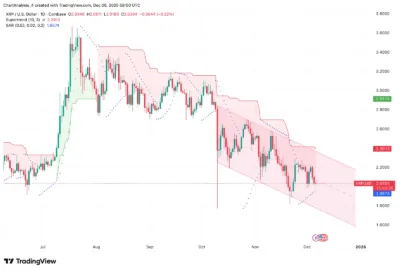
XRP struggles below $2.05, with bearish sentiment dominating market momentum. Weak spot inflows signal cautious sentiment as traders avoid aggressive positions. $2.00 support zone crucial; failure risks further declines towards $1.72. XRP’s price outlook for December 7 reveals ongoing weakness, as the cryptocurrency hovers near $2.03, continuing its downward trend since September. The failure to maintain any meaningful upward movement, coupled with consistent rejections at higher levels, has shifted the market bias firmly in favor of sellers. The token is now testing the critical $2.00 support zone, and if it fails to hold, further downside could be imminent. Also Read: Ethereum Price Prediction for November 9: Sellers Dominate as Weak Flows Persist Price Action and Key Technical Indicators XRP’s price action remains confined to a descending channel, with every rebound met with rejection at lower levels. The Supertrend indicator remains red, signaling ongoing bearish pressure, and the Parabolic SAR dots continue to sit above the price, reinforcing the dominance of sellers. Currently, the $2.00 level is a key support zone, but the inability to sustain a recovery above this level could lead to further losses, targeting $1.83 and $1.72. Source: Tradingview On the one-hour chart, XRP broke below a short-term ascending trendline, which had previously supported a minor recovery attempt. This has caused the price to consolidate beneath the trendline, keeping the bearish bias intact for the short term. Additionally, XRP remains within the lower half of the Bollinger Bands, indicating that downward pressure persists, with little sign of a sustained reversal. Market Sentiment and Data Reinforce Bearish Outlook Recent spot market data reveals weak flows, as $4.36 million in inflows were recorded in the latest session. However, these inflows seem more reactive than proactive, signaling a lack of strong accumulation interest and a market still wary of significant upside potential. Traders appear more focused on stabilizing the price rather than seeking aggressive bullish positions, indicating that sentiment remains fragile. Source: Coinglass In the derivatives market, open interest stands at $3.64 billion, showing a decline from recent highs. This drop, along with an 18% decrease in futures volume and a 60% collapse in options volume, underscores a lack of conviction in the market. Top traders remain predominantly net-long, but their reduced exposure further suggests a cautious approach in the current environment. XRP Price Forecast Looking ahead to December 7, the outlook remains largely bearish unless XRP can reclaim key resistance levels. A break above $2.15 and $2.39 would signal a potential shift in momentum, opening the door to higher targets such as $2.62 and $2.91. However, if the $2.00 support fails to hold, XRP is at risk of further declines towards $1.83 and $1.72. The technical indicators, spot flows, and derivatives data all point to continued bearish momentum for XRP. Sellers remain in control, and any recovery attempts are likely to face strong resistance. The next few sessions will be critical in determining whether the price can stabilize or if further downside is ahead. Also Read: Ethereum Classic (ETC) Price Prediction 2025–2029: Can ETC Hit $20 Soon? The post XRP Price Prediction for December 7: Sellers Continue to Dominate as Weak Momentum Persists appeared first on 36Crypto.
Share
Coinstats2025/12/06 21:06