The post Polymarket Wants to Be the House — Critics Say That’s a Problem appeared on BitcoinEthereumNews.com. Prediction market Polymarket is in the process of hiring an internal market-making team that will trade directly against customers — a shift that could blur the lines between a prediction market and a traditional sportsbook. The company has recently spoken to traders and sports bettors about building the new desk, according to Bloomberg, citing people familiar with the matter. The move follows a similar step by rival Kalshi, which has defended its own in-house trading team as a way to improve liquidity and the user experience. In practice, however, hiring external market makers is entirely possible, raising questions about Polymarket’s true motivation. The decision appears focused less on product improvement and more on generating revenue. “They don’t charge fees. They don’t make money. They want to find a way to monetize,” Harry Crane, a statistics professor at Rutgers University, told CoinDesk. Crane said Polymarket plans to offer parlays through an RFQ protocol, with the in-house desk pricing and matching those bets. “These require significant capital to back and also offer a substantial edge for the house if executed correctly,” he said. “I think it’s short-sighted and ultimately a mistake, but time will tell.” A small revenue stream with outsized risks Crane also questioned the financial logic behind the strategy. “Given the huge valuations, it’s not a viable strategy to monetize, if that’s the objective,” he said. “Assuming the trading desk is profitable — which is far from a given — the amount it can profit is a pittance compared to its valuation.” More importantly, Crane warned, the company can’t afford for the desk to be too profitable. “The company should not want an in-house trading team to be too profitable, as that will create significant PR problems and possible legal issues,” he said. “Just look at the class-action against Kalshi… The post Polymarket Wants to Be the House — Critics Say That’s a Problem appeared on BitcoinEthereumNews.com. Prediction market Polymarket is in the process of hiring an internal market-making team that will trade directly against customers — a shift that could blur the lines between a prediction market and a traditional sportsbook. The company has recently spoken to traders and sports bettors about building the new desk, according to Bloomberg, citing people familiar with the matter. The move follows a similar step by rival Kalshi, which has defended its own in-house trading team as a way to improve liquidity and the user experience. In practice, however, hiring external market makers is entirely possible, raising questions about Polymarket’s true motivation. The decision appears focused less on product improvement and more on generating revenue. “They don’t charge fees. They don’t make money. They want to find a way to monetize,” Harry Crane, a statistics professor at Rutgers University, told CoinDesk. Crane said Polymarket plans to offer parlays through an RFQ protocol, with the in-house desk pricing and matching those bets. “These require significant capital to back and also offer a substantial edge for the house if executed correctly,” he said. “I think it’s short-sighted and ultimately a mistake, but time will tell.” A small revenue stream with outsized risks Crane also questioned the financial logic behind the strategy. “Given the huge valuations, it’s not a viable strategy to monetize, if that’s the objective,” he said. “Assuming the trading desk is profitable — which is far from a given — the amount it can profit is a pittance compared to its valuation.” More importantly, Crane warned, the company can’t afford for the desk to be too profitable. “The company should not want an in-house trading team to be too profitable, as that will create significant PR problems and possible legal issues,” he said. “Just look at the class-action against Kalshi…

Polymarket Wants to Be the House — Critics Say That’s a Problem

2025/12/06 05:16

Prediction market Polymarket is in the process of hiring an internal market-making team that will trade directly against customers — a shift that could blur the lines between a prediction market and a traditional sportsbook.

The company has recently spoken to traders and sports bettors about building the new desk, according to Bloomberg, citing people familiar with the matter. The move follows a similar step by rival Kalshi, which has defended its own in-house trading team as a way to improve liquidity and the user experience.

In practice, however, hiring external market makers is entirely possible, raising questions about Polymarket’s true motivation. The decision appears focused less on product improvement and more on generating revenue.

“They don’t charge fees. They don’t make money. They want to find a way to monetize,” Harry Crane, a statistics professor at Rutgers University, told CoinDesk.

Crane said Polymarket plans to offer parlays through an RFQ protocol, with the in-house desk pricing and matching those bets.

“These require significant capital to back and also offer a substantial edge for the house if executed correctly,” he said. “I think it’s short-sighted and ultimately a mistake, but time will tell.”

A small revenue stream with outsized risks

Crane also questioned the financial logic behind the strategy.

“Given the huge valuations, it’s not a viable strategy to monetize, if that’s the objective,” he said. “Assuming the trading desk is profitable — which is far from a given — the amount it can profit is a pittance compared to its valuation.”

More importantly, Crane warned, the company can’t afford for the desk to be too profitable.

“The company should not want an in-house trading team to be too profitable, as that will create significant PR problems and possible legal issues,” he said. “Just look at the class-action against Kalshi for doing the same. That lawsuit appears to be 100% frivolous, but the optics and PR are not positive.”

Beyond the legal risks, Crane argued the move undermines Polymarket’s strategic identity. “This diminishes Polymarket’s opportunity to differentiate itself from the competition, and it dedicates resources and focus to something that is definitively not what got the company to this point.”

A shift toward a sportsbook model

This change makes Polymarket resemble a sportsbook, where users effectively trade against the house rather than other bettors. At a sportsbook, in-house traders set prices and build in vigorish — typically giving the operator a 5%–10% edge.

Polymarket’s foray into this territory could create a conflict of interest and unsettle bettors who joined prediction markets precisely because they weren’t sportsbooks. Markets would no longer reflect the collective wisdom of traders but instead the pricing decisions of Polymarket’s internal desk.

It also risks eroding Polymarket’s reputation as a barometer of real-world probabilities. That reputation was a key engine of its rapid growth during the 2024 U.S. election cycle, when news outlets routinely cited Polymarket alongside polling data, boosting its mainstream legitimacy.

Blurring lines and raising questions

Crane said the sportsbook comparison understates the problem.

“Does it blur the line between a prediction market and a traditional sportsbook? Yes, but it’s worse than that,” he said. “At a sportsbook it is well understood that the book is the counterparty, and will use whatever information it can to get the edge over its customers. Exchanges are supposed to be different.”

“But as long as there are in-house or privileged participants on an exchange, there will always be suspicions that they are gaining an unfair advantage,” Crane added, pointing to a recent controversy at NoVig, which voided a number of winning bets because its in-house market maker was the losing counterparty.

The introduction of an internal desk also raises operational and ethical questions reminiscent of the FTX-Alameda dynamic. How much order-flow or deposit-timing data will the desk have access to? Could it trade ahead of customer flows? Or will it simply post liquidity and collect spread, as some exchanges claim?

A risk to brand and trust

While market making may create a new revenue stream, the shift threatens the perceived neutrality and trust that helped Polymarket rise to prominence. The company did not immediately respond to CoinDesk’s request for comment.

Setting aside questions of fairness, Crane believes the strategy is simply misguided.

“It’s a bad business decision that takes a platform that previously felt very new and different and instead makes it look and feel just like everyone else,” he said.

Source: https://www.coindesk.com/business/2025/12/05/polymarket-hiring-in-house-team-to-trade-against-customers-here-s-why-it-s-a-risk

Disclaimer: The articles reposted on this site are sourced from public platforms and are provided for informational purposes only. They do not necessarily reflect the views of MEXC. All rights remain with the original authors. If you believe any content infringes on third-party rights, please contact [email protected] for removal. MEXC makes no guarantees regarding the accuracy, completeness, or timeliness of the content and is not responsible for any actions taken based on the information provided. The content does not constitute financial, legal, or other professional advice, nor should it be considered a recommendation or endorsement by MEXC.

You May Also Like

XRP Near $2 as ETFs Smash $1B AUM — Institutional Money Quietly Takes Over

XRP Near $2 as ETFs Smash $1B AUM — Institutional Money Quietly Takes Over

XRP trades near $2.04 after climbing more than 12% in the last month, yet the token struggles to reclaim strong momentum. The asset slipped through the past week and lost close to 8% while traders weighed a rare combination of institutional strength and short-term weakness. With a market capitalization near $125 billion and daily volume above $3.3 billion, XRP keeps its position as one of the most liquid crypto assets. The market now watches the psychological $2 support level as heavy inflows clash ih rising short exposure and fading retail conviction.Sentiment Breakdown Creates a Contrarian SetupMarket sentiment around XRP sits inside one of the deepest fear zones since October. Santiment reports that sentiment prints the same level of panic that preceded a sharp twenty-two percent rebound on November 21. RSI sits near 45 and the SAR indicator keeps flipping into bearish territory. Source: XTraders feel trapped between disbelief and fatigue after a two-month decline of thirty-one percent. The present slide shows structural weakness rather than blind panic, which means any reversal must appear through rising volume and inflow recovery rather than pure emotion. Traders hunt for signs that shorts may reach exhaustion as they did during past rebounds.Institutions Accumulate While Retail Steps BackInstitutional appetite continues to grow even as retail traders exit. U.S. spot XRP ETFs attracted $906 million in net inflows since launch, with not a single day of outflows. The flagship XRPC ETF now holds $336 million, which places it above every competing fund.Franklin Templeton now lists XRP as a top-four holding in its regulated multi-asset crypto product. These flows form a clear divergence: Institutional portfolios build long-horizon positions while retail traders short the asset. The setup shows a market where deep pockets accumulate quietly below the surface, waiting for fear to drain out of the system.Ripple’s $4B Expansion Reshapes Global FinanceRipple pushed aggressively into global finance through a $4 billion acquisition wave across GTreasury, Rail, Palisade, and Ripple Prime. The company now holds strategic control over treasury management, liquidity services, payments, and institutional crypto infrastructure. Regulatory traction strengthens the expansion. Approvals in Singapore and the UAE, plus FSRA authorization of the RLUSD stablecoin, anchor Ripple inside the regulated payments ecosystem. Ripple also reached a major U.S. milestone when Bitnomial launched the first CFTC-approved XRP spot product. This move places XRP beside commodities such as Treasuries on a federally regulated exchange. Markets have not priced this transformation yet, leaving a wide gap between Ripple’s operational dominance and XRP’s market performance.On-Chain Data Reveals a Structural SplitThe XRP Ledger shows its highest transaction velocity of the year at 0.0324, marking strong network usage. Open interest climbed to $3.85 billion while funding rates stayed negative, which confirms heavy short positioning. A regional concentration also emerges: Upbit holds more than six billion XRP, far above Binance at 2.6 billion. The imbalance introduces the risk of region-based liquidation waves during volatility spikes. Liquidity remains deep and participation strong, yet direction stays capped by pressure from leveraged traders.Long-Term Holders Rotate as Whales Step InLong-term holder dormancy dropped ninety-one percent since mid-November, signaling that older coins rarely move. At the same time, cohorts that held XRP for six months to three years trimmed positions and locked in profits. Institutions absorbed much of that volume through ETF demand, which removed nearly half a percent of total supply from circulation as ETFs crossed one billion dollars in assets under management. Whales keep buying while early holders reduce exposure. This rotation delays any strong recovery but builds the foundation for a future supply squeeze once distribution slows.XRP now enters a rare moment where institutional strength outweighs retail fear, setting the stage for a potential shift once the market resolves its internal pressure.
Share
Coinstats2025/12/06 21:24
XRP Price Prediction for December 7: Sellers Continue to Dominate as Weak Momentum Persists

XRP Price Prediction for December 7: Sellers Continue to Dominate as Weak Momentum Persists

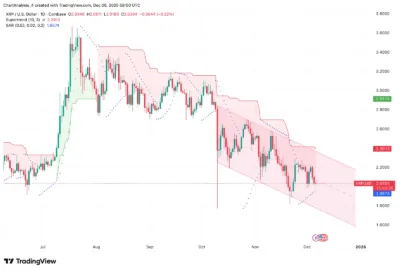
XRP struggles below $2.05, with bearish sentiment dominating market momentum. Weak spot inflows signal cautious sentiment as traders avoid aggressive positions. $2.00 support zone crucial; failure risks further declines towards $1.72. XRP’s price outlook for December 7 reveals ongoing weakness, as the cryptocurrency hovers near $2.03, continuing its downward trend since September. The failure to maintain any meaningful upward movement, coupled with consistent rejections at higher levels, has shifted the market bias firmly in favor of sellers. The token is now testing the critical $2.00 support zone, and if it fails to hold, further downside could be imminent. Also Read: Ethereum Price Prediction for November 9: Sellers Dominate as Weak Flows Persist Price Action and Key Technical Indicators XRP’s price action remains confined to a descending channel, with every rebound met with rejection at lower levels. The Supertrend indicator remains red, signaling ongoing bearish pressure, and the Parabolic SAR dots continue to sit above the price, reinforcing the dominance of sellers. Currently, the $2.00 level is a key support zone, but the inability to sustain a recovery above this level could lead to further losses, targeting $1.83 and $1.72. Source: Tradingview On the one-hour chart, XRP broke below a short-term ascending trendline, which had previously supported a minor recovery attempt. This has caused the price to consolidate beneath the trendline, keeping the bearish bias intact for the short term. Additionally, XRP remains within the lower half of the Bollinger Bands, indicating that downward pressure persists, with little sign of a sustained reversal. Market Sentiment and Data Reinforce Bearish Outlook Recent spot market data reveals weak flows, as $4.36 million in inflows were recorded in the latest session. However, these inflows seem more reactive than proactive, signaling a lack of strong accumulation interest and a market still wary of significant upside potential. Traders appear more focused on stabilizing the price rather than seeking aggressive bullish positions, indicating that sentiment remains fragile. Source: Coinglass In the derivatives market, open interest stands at $3.64 billion, showing a decline from recent highs. This drop, along with an 18% decrease in futures volume and a 60% collapse in options volume, underscores a lack of conviction in the market. Top traders remain predominantly net-long, but their reduced exposure further suggests a cautious approach in the current environment. XRP Price Forecast Looking ahead to December 7, the outlook remains largely bearish unless XRP can reclaim key resistance levels. A break above $2.15 and $2.39 would signal a potential shift in momentum, opening the door to higher targets such as $2.62 and $2.91. However, if the $2.00 support fails to hold, XRP is at risk of further declines towards $1.83 and $1.72. The technical indicators, spot flows, and derivatives data all point to continued bearish momentum for XRP. Sellers remain in control, and any recovery attempts are likely to face strong resistance. The next few sessions will be critical in determining whether the price can stabilize or if further downside is ahead. Also Read: Ethereum Classic (ETC) Price Prediction 2025–2029: Can ETC Hit $20 Soon? The post XRP Price Prediction for December 7: Sellers Continue to Dominate as Weak Momentum Persists appeared first on 36Crypto.
Share
Coinstats2025/12/06 21:06