The post Oracle’s CDS Prices Hit 2009 Peak Amid AI Debt Fears appeared on BitcoinEthereumNews.com. Oracle’s credit default swaps have surged to their highest level since 2009, reaching 1.28 percentage points amid AI debt fears. This spike reflects investor concerns over the company’s $105 billion debt pile and heavy AI infrastructure spending, positioning Oracle as a key hedge against potential tech sector downturns. Spike in CDS pricing: Oracle’s default protection cost jumped 0.03 points in one day, tripling from June levels. Heavy bond issuance: The company sold $18 billion in bonds in September to fund AI expansions. Investor hedging: CDS trading volume exploded to $5 billion in recent weeks, up from $200 million last year, per Barclays analysis. Oracle’s AI debt fears drive CDS to 2009 highs. Explore surging protection costs, massive bond sales, and tech sector risks in this in-depth analysis. Stay informed on market impacts. What are Oracle’s credit default swaps telling us about AI debt fears? Oracle’s credit default swaps (CDS) have climbed sharply, signaling heightened investor anxiety over the company’s escalating debt tied to AI investments. The cost to insure against Oracle’s default hit 1.28 percentage points on Tuesday, the highest since March 2009, according to ICE Data Services. This surge underscores broader concerns in the tech sector about the gap between massive AI spending and uncertain returns. Why is Oracle’s bond issuance fueling market unease? Oracle’s aggressive push into AI infrastructure has led to a flood of bond sales, amplifying debt levels and investor jitters. In September, the company issued $18 billion in U.S. high-grade corporate bonds to support data center expansions, the largest such deal in the market. This follows tens of billions in recent issuances, with total debt reaching $105 billion as of August, per Bloomberg data. As the lowest-rated major hyperscaler, Oracle’s moves stand out against peers with stronger credit profiles. Expert Hans Mikkelsen from TD Securities… The post Oracle’s CDS Prices Hit 2009 Peak Amid AI Debt Fears appeared on BitcoinEthereumNews.com. Oracle’s credit default swaps have surged to their highest level since 2009, reaching 1.28 percentage points amid AI debt fears. This spike reflects investor concerns over the company’s $105 billion debt pile and heavy AI infrastructure spending, positioning Oracle as a key hedge against potential tech sector downturns. Spike in CDS pricing: Oracle’s default protection cost jumped 0.03 points in one day, tripling from June levels. Heavy bond issuance: The company sold $18 billion in bonds in September to fund AI expansions. Investor hedging: CDS trading volume exploded to $5 billion in recent weeks, up from $200 million last year, per Barclays analysis. Oracle’s AI debt fears drive CDS to 2009 highs. Explore surging protection costs, massive bond sales, and tech sector risks in this in-depth analysis. Stay informed on market impacts. What are Oracle’s credit default swaps telling us about AI debt fears? Oracle’s credit default swaps (CDS) have climbed sharply, signaling heightened investor anxiety over the company’s escalating debt tied to AI investments. The cost to insure against Oracle’s default hit 1.28 percentage points on Tuesday, the highest since March 2009, according to ICE Data Services. This surge underscores broader concerns in the tech sector about the gap between massive AI spending and uncertain returns. Why is Oracle’s bond issuance fueling market unease? Oracle’s aggressive push into AI infrastructure has led to a flood of bond sales, amplifying debt levels and investor jitters. In September, the company issued $18 billion in U.S. high-grade corporate bonds to support data center expansions, the largest such deal in the market. This follows tens of billions in recent issuances, with total debt reaching $105 billion as of August, per Bloomberg data. As the lowest-rated major hyperscaler, Oracle’s moves stand out against peers with stronger credit profiles. Expert Hans Mikkelsen from TD Securities…

Oracle’s CDS Prices Hit 2009 Peak Amid AI Debt Fears

5 min read
  • Spike in CDS pricing: Oracle’s default protection cost jumped 0.03 points in one day, tripling from June levels.

  • Heavy bond issuance: The company sold $18 billion in bonds in September to fund AI expansions.

  • Investor hedging: CDS trading volume exploded to $5 billion in recent weeks, up from $200 million last year, per Barclays analysis.

Oracle’s AI debt fears drive CDS to 2009 highs. Explore surging protection costs, massive bond sales, and tech sector risks in this in-depth analysis. Stay informed on market impacts.

What are Oracle’s credit default swaps telling us about AI debt fears?

Oracle’s credit default swaps (CDS) have climbed sharply, signaling heightened investor anxiety over the company’s escalating debt tied to AI investments. The cost to insure against Oracle’s default hit 1.28 percentage points on Tuesday, the highest since March 2009, according to ICE Data Services. This surge underscores broader concerns in the tech sector about the gap between massive AI spending and uncertain returns.

Why is Oracle’s bond issuance fueling market unease?

Oracle’s aggressive push into AI infrastructure has led to a flood of bond sales, amplifying debt levels and investor jitters. In September, the company issued $18 billion in U.S. high-grade corporate bonds to support data center expansions, the largest such deal in the market. This follows tens of billions in recent issuances, with total debt reaching $105 billion as of August, per Bloomberg data. As the lowest-rated major hyperscaler, Oracle’s moves stand out against peers with stronger credit profiles. Expert Hans Mikkelsen from TD Securities notes parallels to historical bubbles, stating in an interview, “We’ve had these kinds of cycles before,” reminiscent of the dot-com era. Morgan Stanley’s late November warning highlighted potential CDS rises to 2 percentage points, nearing 2008 peaks, as debt pressures mount from AI partnerships like the one with OpenAI, projected to generate hundreds of billions in revenue.

The CDS spike isn’t isolated; it mirrors a broader tech bond surge. Oracle’s $95 billion in U.S. bonds makes it the top non-bank issuer in the Bloomberg U.S. Corporate Index. Trading in Oracle’s CDS has ballooned, with volume hitting $5 billion in the seven weeks ended November 14, according to Barclays credit strategist Jigar Patel’s analysis of trade data— a stark contrast to $200 million the prior year. This hedging frenzy positions Oracle as a barometer for AI market stability, where investors seek protection against a possible crash in productivity gains.

Underlying the unease is the disconnect between AI hype and tangible outcomes. While cash flows into AI have been enormous, real productivity boosts and profits remain elusive. Oracle’s expansion, including vast data center projects backed by AI deals, has stretched its balance sheet. As of the latest figures, the company’s debt includes significant leases, pushing the total load to unsustainable levels for some analysts if returns falter.

Frequently Asked Questions

What caused the recent jump in Oracle’s CDS pricing?

Oracle’s CDS pricing surged to 1.28 percentage points due to a combination of heavy bond sales and AI investment risks. The one-day increase of 0.03 points followed broader tech sector debt waves, with the gauge tripling from 0.36 in June, based on ICE Data Services data.

How does Oracle’s debt compare to other tech giants?

Oracle carries about $105 billion in total debt, the highest among major hyperscalers relative to its credit rating. While rivals boast stronger profiles, Oracle’s $95 billion in indexed bonds positions it as a prime target for default protection amid AI spending pressures, as noted in Bloomberg compilations.

Is the AI buildout expected to continue driving debt higher?

Yes, AI infrastructure spending is projected to accelerate into 2026, with U.S. investment-grade bond issuance potentially reaching a record $2.1 trillion, according to TD Securities. This could widen credit spreads to 100-110 basis points, up from 75-85 in 2025, straining issuers like Oracle.

Voice search optimization: If you’re wondering about the ongoing AI debt concerns for companies like Oracle, the key is monitoring how infrastructure investments translate into profits—delays could heighten default risks across the sector.

Key Takeaways

  • CDS Surge Signals Alarm: Oracle’s default protection costs hit 1.28 points, the highest since 2009, driven by AI fears and a tripling from June levels.
  • Bond Issuance Boom: Recent $18 billion sales fund massive data centers, but add to a $105 billion debt pile, making Oracle vulnerable compared to peers.
  • Investor Hedging Intensifies: CDS trading volume jumped to $5 billion recently; watch for further spreads widening if AI returns lag.

Conclusion

In summary, Oracle’s AI debt fears have propelled its credit default swaps to levels unseen since the financial crisis, highlighting the risks of unchecked tech spending. With bond issuance records looming and credit spreads poised to expand, investors must navigate this volatile landscape carefully. As AI infrastructure demands grow, staying vigilant on debt metrics will be crucial—consider diversifying portfolios to mitigate potential sector shocks from Oracle and similar players.

Source: https://en.coinotag.com/oracles-cds-prices-hit-2009-peak-amid-ai-debt-fears

Market Opportunity
null Logo
null Price(null)
--
----
USD
null (null) Live Price Chart
Disclaimer: The articles reposted on this site are sourced from public platforms and are provided for informational purposes only. They do not necessarily reflect the views of MEXC. All rights remain with the original authors. If you believe any content infringes on third-party rights, please contact [email protected] for removal. MEXC makes no guarantees regarding the accuracy, completeness, or timeliness of the content and is not responsible for any actions taken based on the information provided. The content does not constitute financial, legal, or other professional advice, nor should it be considered a recommendation or endorsement by MEXC.

You May Also Like

Best Crypto to Buy as Saylor & Crypto Execs Meet in US Treasury Council

Best Crypto to Buy as Saylor & Crypto Execs Meet in US Treasury Council

The post Best Crypto to Buy as Saylor & Crypto Execs Meet in US Treasury Council appeared on BitcoinEthereumNews.com. Michael Saylor and a group of crypto executives met in Washington, D.C. yesterday to push for the Strategic Bitcoin Reserve Bill (the BITCOIN Act), which would see the U.S. acquire up to 1M $BTC over five years. With Bitcoin being positioned yet again as a cornerstone of national monetary policy, many investors are turning their eyes to projects that lean into this narrative – altcoins, meme coins, and presales that could ride on the same wave. Read on for three of the best crypto projects that seem especially well‐suited to benefit from this macro shift:  Bitcoin Hyper, Best Wallet Token, and Remittix. These projects stand out for having a strong use case and high adoption potential, especially given the push for a U.S. Bitcoin reserve.   Why the Bitcoin Reserve Bill Matters for Crypto Markets The strategic Bitcoin Reserve Bill could mark a turning point for the U.S. approach to digital assets. The proposal would see America build a long-term Bitcoin reserve by acquiring up to one million $BTC over five years. To make this happen, lawmakers are exploring creative funding methods such as revaluing old gold certificates. The plan also leans on confiscated Bitcoin already held by the government, worth an estimated $15–20B. This isn’t just a headline for policy wonks. It signals that Bitcoin is moving from the margins into the core of financial strategy. Industry figures like Michael Saylor, Senator Cynthia Lummis, and Marathon Digital’s Fred Thiel are all backing the bill. They see Bitcoin not just as an investment, but as a hedge against systemic risks. For the wider crypto market, this opens the door for projects tied to Bitcoin and the infrastructure that supports it. 1. Bitcoin Hyper ($HYPER) – Turning Bitcoin Into More Than Just Digital Gold The U.S. may soon treat Bitcoin as…
Share
BitcoinEthereumNews2025/09/18 00:27
Breaking: CME Group Unveils Solana and XRP Options

Breaking: CME Group Unveils Solana and XRP Options

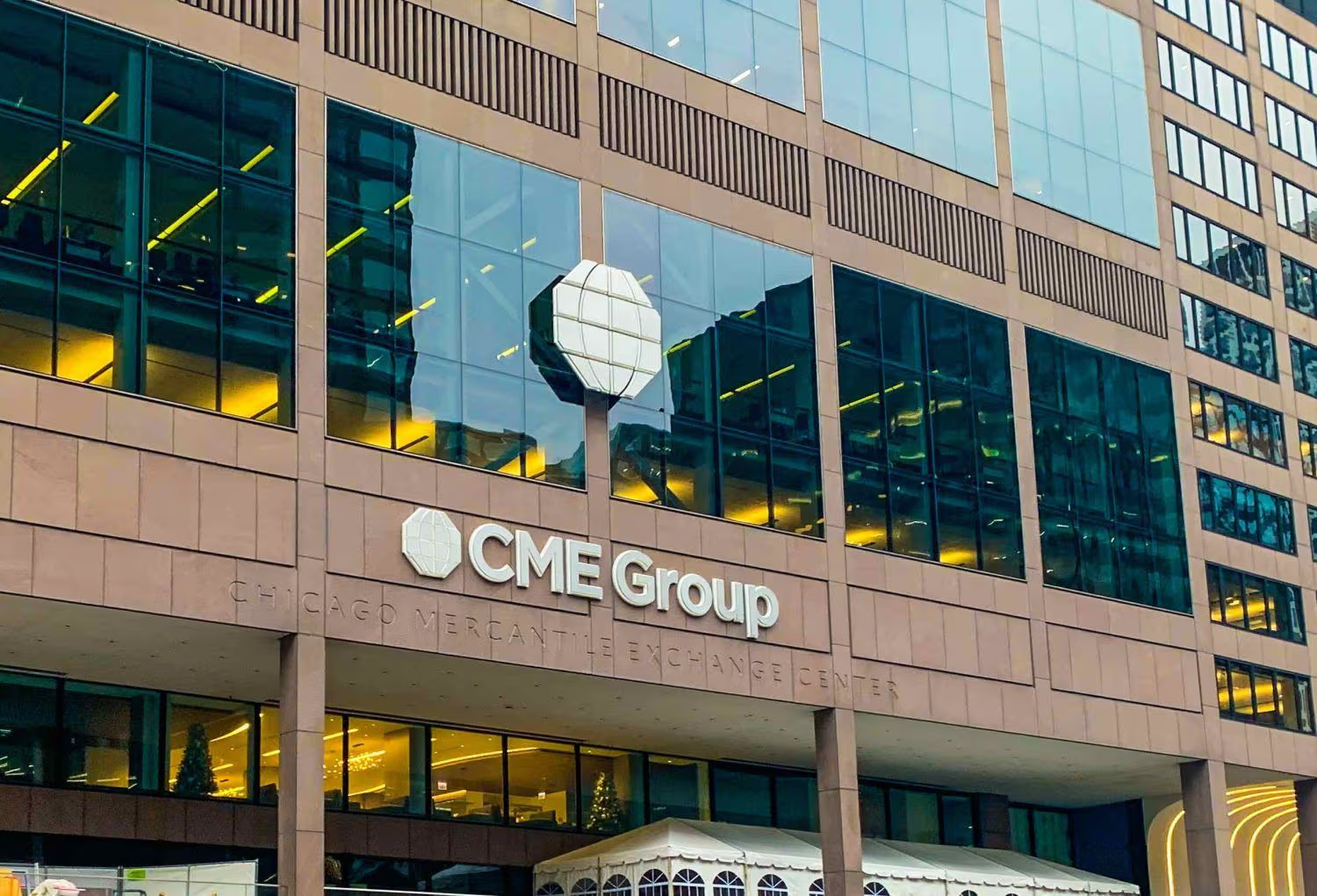
CME Group launches Solana and XRP options, expanding crypto offerings. SEC delays Solana and XRP ETF approvals, market awaits clarity. Strong institutional demand drives CME’s launch of crypto options contracts. In a bold move to broaden its cryptocurrency offerings, CME Group has officially launched options on Solana (SOL) and XRP futures. Available since October 13, 2025, these options will allow traders to hedge and manage exposure to two of the most widely traded digital assets in the market. The new contracts come in both full-size and micro-size formats, with expiration options available daily, monthly, and quarterly, providing flexibility for a diverse range of market participants. This expansion aligns with the rising demand for innovative products in the crypto space. Giovanni Vicioso, CME Group’s Global Head of Cryptocurrency Products, noted that the new options offer increased flexibility for traders, from institutions to active individual investors. The growing liquidity in Solana and XRP futures has made the introduction of these options a timely move to meet the needs of an expanding market. Also Read: Vitalik Buterin Reveals Ethereum’s Bold Plan to Stay Quantum-Secure and Simple! Rapid Growth in Solana and XRP Futures Trading CME Group’s decision to roll out options on Solana and XRP futures follows the substantial growth in these futures products. Since the launch of Solana futures in March 2025, more than 540,000 contracts, totaling $22.3 billion in notional value, have been traded. In August 2025, Solana futures set new records, with an average daily volume (ADV) of 9,000 contracts valued at $437.4 million. The average daily open interest (ADOI) hit 12,500 contracts, worth $895 million. Similarly, XRP futures, which launched in May 2025, have seen significant adoption, with over 370,000 contracts traded, totaling $16.2 billion. XRP futures also set records in August 2025, with an ADV of 6,600 contracts valued at $385 million and a record ADOI of 9,300 contracts, worth $942 million. Institutional Demand for Advanced Hedging Tools CME Group’s expansion into options is a direct response to growing institutional interest in sophisticated cryptocurrency products. Roman Makarov from Cumberland Options Trading at DRW highlighted the market demand for more varied crypto products, enabling more advanced risk management strategies. Joshua Lim from FalconX also noted that the new options products meet the increasing need for institutional hedging tools for assets like Solana and XRP, further cementing their role in the digital asset space. The launch of options on Solana and XRP futures marks another step toward the maturation of the cryptocurrency market, providing a broader range of tools for managing digital asset exposure. SEC’s Delay on Solana and XRP ETF Approvals While CME Group expands its offerings, the broader market is also watching the progress of Solana and XRP exchange-traded funds (ETFs). The U.S. Securities and Exchange Commission (SEC) has delayed its decisions on multiple crypto-related ETF filings, including those for Solana and XRP. Despite the delay, analysts anticipate approval may be on the horizon. This week, REX Shares and Osprey Funds are expected to launch an XRP ETF that will hold XRP directly and allocate at least 40% of its assets to other XRP-related ETFs. Despite the delays, some analysts believe that approval could come soon, fueling further interest in these assets. The delay by the SEC has left many crypto investors awaiting clarity, but approval of these ETFs could fuel further momentum in the Solana and XRP futures markets. Also Read: Tether CEO Breaks Silence on $117,000 Bitcoin Price – Market Reacts! The post Breaking: CME Group Unveils Solana and XRP Options appeared first on 36Crypto.
Share
Coinstats2025/09/18 02:35
Optimizely Named a Leader in the 2026 Gartner® Magic Quadrant™ for Personalization Engines

Optimizely Named a Leader in the 2026 Gartner® Magic Quadrant™ for Personalization Engines

Company recognized as a Leader for the second consecutive year NEW YORK, Feb. 5, 2026 /PRNewswire/ — Optimizely, the leading digital experience platform (DXP) provider
Share
AI Journal2026/02/06 00:47