Macro investor Michael Green, who is known as the Cassandra of Passive Investing, has sharpened his critique of Bitcoin, arguing that its design makes it economically brittle and socially corrosive, setting up a winner-takes-all outcome “like a Monopoly game.” In an interview with journalist Phil Rosen, Green said “the most important thing to understand is […]Macro investor Michael Green, who is known as the Cassandra of Passive Investing, has sharpened his critique of Bitcoin, arguing that its design makes it economically brittle and socially corrosive, setting up a winner-takes-all outcome “like a Monopoly game.” In an interview with journalist Phil Rosen, Green said “the most important thing to understand is […]

Bitcoin Could End ‘Like A Monopoly Game,’ Claims Wall Street Cassandra Michael Green

2025/11/26 11:00

Macro investor Michael Green, who is known as the Cassandra of Passive Investing, has sharpened his critique of Bitcoin, arguing that its design makes it economically brittle and socially corrosive, setting up a winner-takes-all outcome “like a Monopoly game.”

In an interview with journalist Phil Rosen, Green said “the most important thing to understand is that Bitcoin has marketed itself as multiple different things to try to appeal to investors at various points in time,” but has failed on its original brief. Under the Satoshi white paper, he noted, BTC was meant to be “a peer-to-peer payment system” that removed the dependence of payment rails on banks. “By moving to a distributed ledger and a peer-to-peer system, we’d be able to get banks out of the system.”

“That’s been a total failure,” he argued. “There are almost no real transactions that are occurring in Bitcoin. We have tons of transaction activity in speculative markets trading Bitcoin, but the actual quantity of retail transactions or peer-to-peer payments that occur over the Bitcoin network are remarkably small.”

Green distinguished between emergency government “money printing” and day-to-day bank credit. “There’s money printing that comes from the government, in which they largely are trying to smooth over mistakes that have been made,” he said, describing stimulus as a way to “basically create a do-over by printing money.”

More frequent, he added, is the expansion of money when banks lend: when a bank grants a $1,000 loan, “they simply created a new account for you called your checking account that has $1,000 in it… That expansion is totally normal and it has a credit function associated with it.”

“Bitcoin destroys the ability to do that because it was intentionally designed to skip the banking system,” Green contended. Rather than a full credit system, “it is effectively just a monetary system where what you’re really seeing is Bitcoin is effectively the tokens that are paid to the accounting firms that keep the blockchain in order… every Bitcoin that’s out there is basically a payment to Deloitte & Touche.”

Why Bitcoin Is Supposedly A ‘Monopoly Game’

Because its supply is capped and banks cannot create new BTC via lending, “no new money can be created. There is no capacity for mistake forgiveness in that type of framework,” he said. That makes the system “very limiting. Interest rates and credit spreads are just too high for a real economy framework.” Despite dramatic price gains, he concluded, Bitcoin “hasn’t emerged as a payment system” or “in any meaningful economic context.”

Green’s harshest criticism was distributional. “Because we have a finite quantity of it, ultimately, that means everybody who is born after the Bitcoin has been released finds themselves in deficit,” he said. He compared this to “a serf living off land in the 14th century that didn’t belong to you,” where “there was no other land that would ever become available to you.” That, he argued, “creates a deeply unequal society.”

Although he said he “was an early adopter of Bitcoin” and initially thought it was “a really interesting idea” of private money, he now believes “if you run through the simulation, Bitcoin, because there is a finite quantity of tokens, means that it basically plays like a Monopoly game.”

In that game, “you can’t add additional players as the game is being played… because they’re just going to lose very quickly. They don’t have any other properties. They don’t have any other money.” “How does every game of Monopoly end?” he asked. “Someone wins. With a single winner.”

“That’s exactly what we’ve seen within Bitcoin,” Green maintained, citing “increased concentration” and a Gini coefficient “beyond anything we’ve ever seen in the real world.” Instead of democratizing access, he argued, Bitcoin builds “a system that ultimately collapses upon itself and locks people out. Far from democratizing access, it does the exact opposite.”

At press time, BTC traded at $87,589.
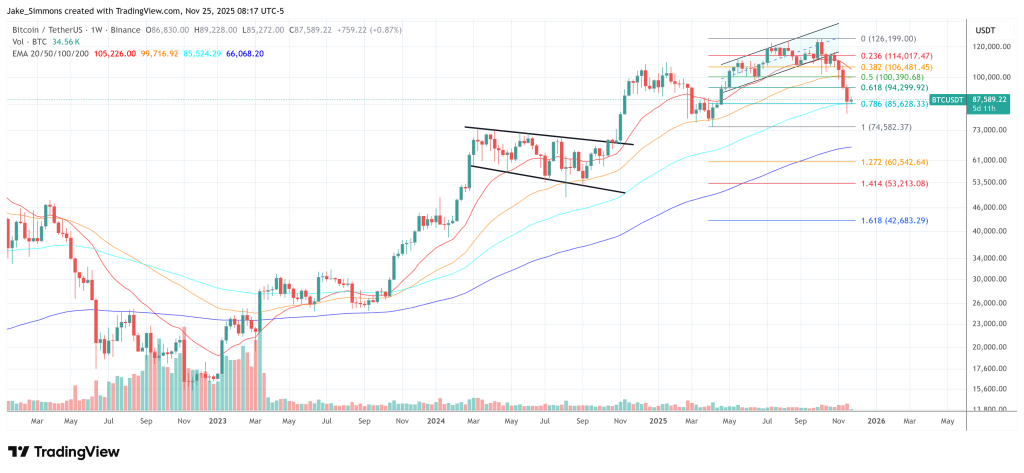
Bitcoin price
Disclaimer: The articles reposted on this site are sourced from public platforms and are provided for informational purposes only. They do not necessarily reflect the views of MEXC. All rights remain with the original authors. If you believe any content infringes on third-party rights, please contact [email protected] for removal. MEXC makes no guarantees regarding the accuracy, completeness, or timeliness of the content and is not responsible for any actions taken based on the information provided. The content does not constitute financial, legal, or other professional advice, nor should it be considered a recommendation or endorsement by MEXC.

You May Also Like

Japan-Based Bitcoin Treasury Company Metaplanet Completes $1.4 Billion IPO! Will It Buy Bitcoin? Here Are the Details

Japan-Based Bitcoin Treasury Company Metaplanet Completes $1.4 Billion IPO! Will It Buy Bitcoin? Here Are the Details

The post Japan-Based Bitcoin Treasury Company Metaplanet Completes $1.4 Billion IPO! Will It Buy Bitcoin? Here Are the Details appeared on BitcoinEthereumNews.com. Japan-based Bitcoin treasury company Metaplanet announced today that it has successfully completed its public offering process. Metaplanet Grows Bitcoin Treasury with $1.4 Billion IPO The company’s CEO, Simon Gerovich, stated in a post on the X platform that a large number of institutional investors participated in the process. Among the investors, mutual funds, sovereign wealth funds, and hedge funds were notable. According to Gerovich, approximately 100 institutional investors participated in roadshows held prior to the IPO. Ultimately, over 70 investors participated in Metaplanet’s capital raising. Previously disclosed information indicated that the company had raised approximately $1.4 billion through the IPO. This funding will accelerate Metaplanet’s growth plans and, in particular, allow the company to increase its balance sheet Bitcoin holdings. Gerovich emphasized that this step will propel Metaplanet to its next stage of development and strengthen the company’s global Bitcoin strategy. Metaplanet has recently become one of the leading companies in Japan in promoting digital asset adoption. The company has previously stated that it views Bitcoin as a long-term store of value. This large-scale IPO is considered a significant step in not only strengthening Metaplanet’s capital but also consolidating Japan’s role in the global crypto finance market. *This is not investment advice. Follow our Telegram and Twitter account now for exclusive news, analytics and on-chain data! Source: https://en.bitcoinsistemi.com/japan-based-bitcoin-treasury-company-metaplanet-completes-1-4-billion-ipo-will-it-buy-bitcoin-here-are-the-details/
Share
BitcoinEthereumNews2025/09/18 08:42
Single Currency-Pegged Tokens Surge Following MiCA Rollout.

Single Currency-Pegged Tokens Surge Following MiCA Rollout.

The post Single Currency-Pegged Tokens Surge Following MiCA Rollout. appeared on BitcoinEthereumNews.com. The euro stablecoin market has rebounded in the year since the European Union’s (EU) Markets in Crypto-Assets Regulation (MiCA) came into force, with market capitalization doubling after regulations governing the tokens rolled out in June 2024, according to a new report. The “Euro Stablecoin Trends Report 2025” from London-based payments processing company Decta points a potential shift for the tokens, whose value is pegged to the single European currency and which have historically struggled to gain traction against their U.S. dollar-pegged counterparts. The swing contrasts with the 48% contraction experienced the year before, according to the report. It also contrasts with a 26% advance in total stablecoin market cap. Euro coin market cap climbed to some $500 million by May 2025, the report said, mainly due to improved issuer obligations and standardized reserve requirements. It’s now $680 million, according to data tracked by CoinGecko. Even so, that’s just a tiny fraction of the $300 billion held in U.S. dollar-pegged tokens, a market dominated by Tether’s USDT with Circle Internet’s (CRCL) USDC in second place. Growth has been especially concentrated among a few standout tokens. EURS, issued by Malta-based Stasis, posted the most dramatic gains, soaring 644% million to $283.9 million by October 2025. Circle Internet’s EURC and EURCV, from Societe Generale’s SG-Forge, also recorded significant gains. Transaction activity surged in parallel. Monthly euro-stablecoin volume rose nearly ninefold after MiCA’s implementation US$3.83 billion. EURC and EURCV were among the biggest beneficiaries, with volume expanding 1,139% and 343% respectively, driven by increased usage in payments, fiat on-ramps and digital-asset trading. Consumer awareness also appears to be climbing. Decta found substantial spikes in search activity across the EU, including 400% growth in Finland and 313.3% in Italy, with smaller but steady increases in markets such as Cyprus and Slovakia. Source: https://www.coindesk.com/business/2025/12/06/hold-euro-stablecoin-market-cap-doubles-in-year-after-mica-decta-says
Share
BitcoinEthereumNews2025/12/06 21:25