The Bank of England has cautioned that loosening proposed stablecoin regulations could threaten financial stability and trigger a credit crunch, as officials seek to balance innovation with risk in the transition to digital money. Deputy Governor Sarah Breeden said the U.K. faces a “different set of risks” from the United States as it integrates stablecoins into its financial system. “We have to manage those carefully as we bring in this new form of money,” she told Reuters on Tuesday. The comments followed the bank’s release of a long-awaited consultation outlining a regulatory framework for systemic stablecoins, tokens expected to be widely used for payments. The plan includes temporary holding caps of £20,000 ($26,000) for individuals and £10 million ($13 million) for firms, alongside a requirement for issuers to keep 40% of their reserves at the central bank in non-interest-bearing accounts. Will the U.K.’s Stablecoin Limits Prevent a Credit Crunch — or Create One? Breeden said the measure is designed to reduce stress on banks from deposit outflows into stablecoins. “Look at what happened with SVB and Circle; those numbers are broadly in line with that,” she said, referring to USDC’s depeg in 2023 after $3.3 billion of its reserves were trapped at Silicon Valley Bank. Officials fear that large-scale transfers of deposits from commercial banks into stablecoins could weaken banks’ lending capacity, leading to a credit crunch that could raise borrowing costs and slow growth. Governor Andrew Bailey recently warned that such outflows could cause “a precipitous drop in credit for businesses and households.” The proposed limits mark a softer stance than the Bank’s 2023 plan, which would have required stablecoin issuers to hold all reserves at the BoE. Still, the crypto industry says the current version remains overly restrictive. Coinbase executive Tom Duff Gordon called the limits “bad for UK savers, bad for the City, and bad for sterling,” adding that “no other major jurisdiction has deemed caps necessary.” Industry groups also questioned how such limits could be enforced without real-time tracking or digital ID systems. Simon Jennings, head of the UK Cryptoasset Business Council, said, “Limits simply don’t work in practice.” The Bank’s consultation comes as the U.K. seeks to keep pace with U.S. developments. Earlier this year, President Donald Trump signed the GENIUS Act, establishing a federal stablecoin regime without ownership caps. Breeden said Britain is “moving just as quickly” and expects to finalize its framework in 2026. UK Eyes Global Stablecoin Leadership with New BoE-FCA Oversight Blueprint Under the U.K.’s dual-tier system, the BoE will oversee systemic payment stablecoins, while the Financial Conduct Authority (FCA) regulates non-systemic ones used mainly in trading. Issuers will be required to deposit part of their reserves with the central bank, earning returns on the remainder through short-term government securities. The initiative reflects growing government interest in blockchain modernization. In September, Chancellor Rachel Reeves and U.S. Treasury Secretary Scott Bessent agreed to deepen transatlantic cooperation on crypto oversight. London has also launched a Digital Securities Sandbox, where firms including HSBC, J.P. Morgan, and the London Stock Exchange Group plan to issue regulated stablecoins and digital gilts. However, disagreements persist between the Bank and Treasury over how strict the rules should be. Reform UK leader Nigel Farage called the BoE’s proposed limits “frankly ridiculous,” pledging to cut crypto capital gains tax to 10% and establish a £5 billion Bitcoin reserve if elected. The global stablecoin market has now surpassed $312 billion, dominated by dollar-backed tokens from Tether and Circle, while sterling-based stablecoins remain under £600,000 in circulation.Source: DefiLlama Despite their limited footprint, officials say stablecoins could soon play a key role in domestic and cross-border payments as regulation takes shapeThe Bank of England has cautioned that loosening proposed stablecoin regulations could threaten financial stability and trigger a credit crunch, as officials seek to balance innovation with risk in the transition to digital money. Deputy Governor Sarah Breeden said the U.K. faces a “different set of risks” from the United States as it integrates stablecoins into its financial system. “We have to manage those carefully as we bring in this new form of money,” she told Reuters on Tuesday. The comments followed the bank’s release of a long-awaited consultation outlining a regulatory framework for systemic stablecoins, tokens expected to be widely used for payments. The plan includes temporary holding caps of £20,000 ($26,000) for individuals and £10 million ($13 million) for firms, alongside a requirement for issuers to keep 40% of their reserves at the central bank in non-interest-bearing accounts. Will the U.K.’s Stablecoin Limits Prevent a Credit Crunch — or Create One? Breeden said the measure is designed to reduce stress on banks from deposit outflows into stablecoins. “Look at what happened with SVB and Circle; those numbers are broadly in line with that,” she said, referring to USDC’s depeg in 2023 after $3.3 billion of its reserves were trapped at Silicon Valley Bank. Officials fear that large-scale transfers of deposits from commercial banks into stablecoins could weaken banks’ lending capacity, leading to a credit crunch that could raise borrowing costs and slow growth. Governor Andrew Bailey recently warned that such outflows could cause “a precipitous drop in credit for businesses and households.” The proposed limits mark a softer stance than the Bank’s 2023 plan, which would have required stablecoin issuers to hold all reserves at the BoE. Still, the crypto industry says the current version remains overly restrictive. Coinbase executive Tom Duff Gordon called the limits “bad for UK savers, bad for the City, and bad for sterling,” adding that “no other major jurisdiction has deemed caps necessary.” Industry groups also questioned how such limits could be enforced without real-time tracking or digital ID systems. Simon Jennings, head of the UK Cryptoasset Business Council, said, “Limits simply don’t work in practice.” The Bank’s consultation comes as the U.K. seeks to keep pace with U.S. developments. Earlier this year, President Donald Trump signed the GENIUS Act, establishing a federal stablecoin regime without ownership caps. Breeden said Britain is “moving just as quickly” and expects to finalize its framework in 2026. UK Eyes Global Stablecoin Leadership with New BoE-FCA Oversight Blueprint Under the U.K.’s dual-tier system, the BoE will oversee systemic payment stablecoins, while the Financial Conduct Authority (FCA) regulates non-systemic ones used mainly in trading. Issuers will be required to deposit part of their reserves with the central bank, earning returns on the remainder through short-term government securities. The initiative reflects growing government interest in blockchain modernization. In September, Chancellor Rachel Reeves and U.S. Treasury Secretary Scott Bessent agreed to deepen transatlantic cooperation on crypto oversight. London has also launched a Digital Securities Sandbox, where firms including HSBC, J.P. Morgan, and the London Stock Exchange Group plan to issue regulated stablecoins and digital gilts. However, disagreements persist between the Bank and Treasury over how strict the rules should be. Reform UK leader Nigel Farage called the BoE’s proposed limits “frankly ridiculous,” pledging to cut crypto capital gains tax to 10% and establish a £5 billion Bitcoin reserve if elected. The global stablecoin market has now surpassed $312 billion, dominated by dollar-backed tokens from Tether and Circle, while sterling-based stablecoins remain under £600,000 in circulation.Source: DefiLlama Despite their limited footprint, officials say stablecoins could soon play a key role in domestic and cross-border payments as regulation takes shape

Bank of England Warns Weak Stablecoin Rules Could Trigger a ‘Credit Crunch’

2025/11/12 19:43
4 min read

The Bank of England has cautioned that loosening proposed stablecoin regulations could threaten financial stability and trigger a credit crunch, as officials seek to balance innovation with risk in the transition to digital money.

Deputy Governor Sarah Breeden said the U.K. faces a “different set of risks” from the United States as it integrates stablecoins into its financial system. “We have to manage those carefully as we bring in this new form of money,” she told Reuters on Tuesday.

The comments followed the bank’s release of a long-awaited consultation outlining a regulatory framework for systemic stablecoins, tokens expected to be widely used for payments.

The plan includes temporary holding caps of £20,000 ($26,000) for individuals and £10 million ($13 million) for firms, alongside a requirement for issuers to keep 40% of their reserves at the central bank in non-interest-bearing accounts.

Will the U.K.’s Stablecoin Limits Prevent a Credit Crunch — or Create One?

Breeden said the measure is designed to reduce stress on banks from deposit outflows into stablecoins. “Look at what happened with SVB and Circle; those numbers are broadly in line with that,” she said, referring to USDC’s depeg in 2023 after $3.3 billion of its reserves were trapped at Silicon Valley Bank.

Officials fear that large-scale transfers of deposits from commercial banks into stablecoins could weaken banks’ lending capacity, leading to a credit crunch that could raise borrowing costs and slow growth.

Governor Andrew Bailey recently warned that such outflows could cause “a precipitous drop in credit for businesses and households.”

The proposed limits mark a softer stance than the Bank’s 2023 plan, which would have required stablecoin issuers to hold all reserves at the BoE. Still, the crypto industry says the current version remains overly restrictive.

Coinbase executive Tom Duff Gordon called the limits “bad for UK savers, bad for the City, and bad for sterling,” adding that “no other major jurisdiction has deemed caps necessary.”

Industry groups also questioned how such limits could be enforced without real-time tracking or digital ID systems. Simon Jennings, head of the UK Cryptoasset Business Council, said, “Limits simply don’t work in practice.”

The Bank’s consultation comes as the U.K. seeks to keep pace with U.S. developments. Earlier this year, President Donald Trump signed the GENIUS Act, establishing a federal stablecoin regime without ownership caps.

Breeden said Britain is “moving just as quickly” and expects to finalize its framework in 2026.

UK Eyes Global Stablecoin Leadership with New BoE-FCA Oversight Blueprint

Under the U.K.’s dual-tier system, the BoE will oversee systemic payment stablecoins, while the Financial Conduct Authority (FCA) regulates non-systemic ones used mainly in trading.

Issuers will be required to deposit part of their reserves with the central bank, earning returns on the remainder through short-term government securities.

The initiative reflects growing government interest in blockchain modernization. In September, Chancellor Rachel Reeves and U.S. Treasury Secretary Scott Bessent agreed to deepen transatlantic cooperation on crypto oversight.

London has also launched a Digital Securities Sandbox, where firms including HSBC, J.P. Morgan, and the London Stock Exchange Group plan to issue regulated stablecoins and digital gilts.

However, disagreements persist between the Bank and Treasury over how strict the rules should be.

Reform UK leader Nigel Farage called the BoE’s proposed limits “frankly ridiculous,” pledging to cut crypto capital gains tax to 10% and establish a £5 billion Bitcoin reserve if elected.

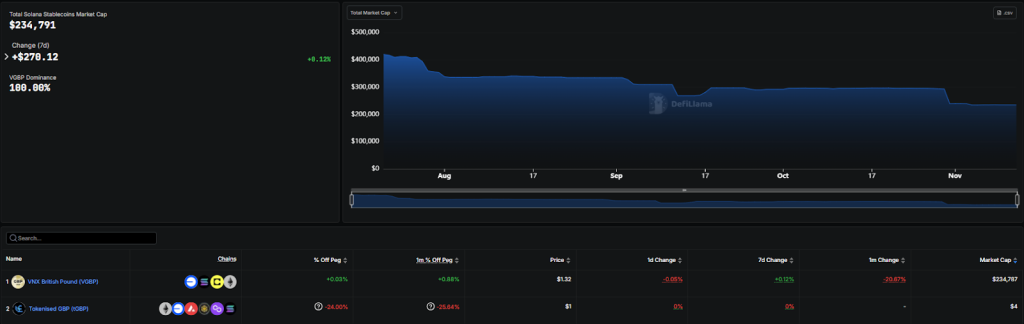
The global stablecoin market has now surpassed $312 billion, dominated by dollar-backed tokens from Tether and Circle, while sterling-based stablecoins remain under £600,000 in circulation.
Source: DefiLlama

Despite their limited footprint, officials say stablecoins could soon play a key role in domestic and cross-border payments as regulation takes shape.

Market Opportunity
Lorenzo Protocol Logo
Lorenzo Protocol Price(BANK)
$0.04016
$0.04016$0.04016
-6.21%
USD
Lorenzo Protocol (BANK) Live Price Chart
Disclaimer: The articles reposted on this site are sourced from public platforms and are provided for informational purposes only. They do not necessarily reflect the views of MEXC. All rights remain with the original authors. If you believe any content infringes on third-party rights, please contact [email protected] for removal. MEXC makes no guarantees regarding the accuracy, completeness, or timeliness of the content and is not responsible for any actions taken based on the information provided. The content does not constitute financial, legal, or other professional advice, nor should it be considered a recommendation or endorsement by MEXC.

You May Also Like

The Manchester City Donnarumma Doubters Have Missed Something Huge

The Manchester City Donnarumma Doubters Have Missed Something Huge

The post The Manchester City Donnarumma Doubters Have Missed Something Huge appeared on BitcoinEthereumNews.com. MANCHESTER, ENGLAND – SEPTEMBER 14: Gianluigi Donnarumma of Manchester City celebrates the second City goal during the Premier League match between Manchester City and Manchester United at Etihad Stadium on September 14, 2025 in Manchester, England. (Photo by Visionhaus/Getty Images) Visionhaus/Getty Images For a goalkeeper who’d played an influential role in the club’s first-ever Champions League triumph, it was strange to see Gianluigi Donnarumma so easily discarded. Soccer is a brutal game, but the sudden, drastic demotion of the Italian from Paris Saint-Germain’s lineup for the UEFA Super Cup clash against Tottenham Hotspur before he was sold to Manchester City was shockingly brutal. Coach Luis Enrique isn’t a man who minces his words, so he was blunt when asked about the decision on social media. “I am supported by my club and we are trying to find the best solution,” he told a news conference. “It is a difficult decision. I only have praise for Donnarumma. He is one of the very best goalkeepers out there and an even better man. “But we were looking for a different profile. It’s very difficult to take these types of decisions.” The last line has really stuck, especially since it became clear that Manchester City was Donnarumma’s next destination. Pep Guardiola, under whom the Italian will be playing this season, is known for brutally axing goalkeepers he didn’t feel fit his profile. The most notorious was Joe Hart, who was jettisoned many years ago for very similar reasons to Enrique. So how can it be that the Catalan coach is turning once again to a so-called old-school keeper? Well, the truth, as so often the case, is not quite that simple. As Italian soccer expert James Horncastle pointed out in The Athletic, Enrique’s focus on needing a “different profile” is overblown. Lucas Chevalier,…
Share
BitcoinEthereumNews2025/09/18 07:38
whale Garrett Jin deposited 261,000 ETH, worth $543 million, into Binance.

whale Garrett Jin deposited 261,000 ETH, worth $543 million, into Binance.

PANews reported on February 15 that, according to Lookonchain monitoring, Bitcoin whale Garrett Jin (BitcoinOG 1011short) deposited 261,024 ETH (worth $543 million
Share
PANews2026/02/15 09:34
Bitcoin faces DOJ as $200M PGI Ponzi draws 20-year term

Bitcoin faces DOJ as $200M PGI Ponzi draws 20-year term

The post Bitcoin faces DOJ as $200M PGI Ponzi draws 20-year term appeared on BitcoinEthereumNews.com. Ramil Ventura Palafox receives 20-year sentence for PGI Bitcoin
Share
BitcoinEthereumNews2026/02/15 09:07