Cardano’s on-chain governance entered uncharted territory this weekend after the meme-mascot account HOSKY declared that the network’s Constitutional Committee (CC) was “dropping below the required seven members,” calling it “our first official government shutdown.” The post followed a formal retirement notice from the Cardano Atlantic Council, a seated CC member, which said it will “retire […]Cardano’s on-chain governance entered uncharted territory this weekend after the meme-mascot account HOSKY declared that the network’s Constitutional Committee (CC) was “dropping below the required seven members,” calling it “our first official government shutdown.” The post followed a formal retirement notice from the Cardano Atlantic Council, a seated CC member, which said it will “retire […]

Cardano Faces First ‘Governance Shutdown’ — Hoskinson Responds

2025/11/11 11:00

Cardano’s on-chain governance entered uncharted territory this weekend after the meme-mascot account HOSKY declared that the network’s Constitutional Committee (CC) was “dropping below the required seven members,” calling it “our first official government shutdown.” The post followed a formal retirement notice from the Cardano Atlantic Council, a seated CC member, which said it will “retire our CC keys on November 25th, following the epoch transition, to allow active proposals to ratify or expire.”

What The Cardano ‘Governance Shutdown’ Means

The proximate cause is political as much as procedural: a compensation proposal for CC members appears headed for defeat. In its thread announcing the decision, Cardano Atlantic said the “current CC Compensation governance proposal is unlikely to pass, based on the vote tally and rationales,” adding that “it appears the DRep community lacks appetite to compensate CC members… our decision is not a negotiation tactic or plea for Yes votes; it simply reflects a misalignment of expectations.” It also noted a 100% voting participation record during its term and said it “will not participate in any further proposals.”

Charles Hoskinson, Cardano’s founder, downplayed the disruption, arguing that a rotating committee is a design feature, not a flaw. “The system works. Cardano is designed to be self-reflective and self-healing. People retire and others take their place,” he wrote in response to HOSKY on November 9.

At issue is how the Cardano governance stack behaves when the CC slips beneath its configured minimum size. Under CIP-1694—the blueprint for Cardano’s Voltaire-era governance—there is an explicit protocol parameter, committeeMinSize, representing the minimal number of non-expired committee members. When membership falls below that floor, “the constitutional committee will be unable to ratify governance actions,” meaning actions requiring CC assent cannot be enacted until the committee is replenished.

That matters immediately for categories such as treasury withdrawals and protocol-parameter changes, which require concurrent majorities from DReps and the CC. In normal operation, these actions are ratified by “at least two of these three governance bodies” (DReps, SPOs, CC), with the policy specifying exactly which bodies must co-approve each action type.

Cardano’s developer documentation confirms that treasury withdrawals and parameter updates need both DRep and CC majorities; with an under-sized CC, these classes of actions stall regardless of DRep or SPO sentiment. This is the practical sense in which a “governance shutdown” occurs, even if the chain itself continues producing blocks and non-CC-dependent votes can proceed.

Ecosystem reaction has been pragmatic, if tense. Jaromír Tesař, a prominent DRep operating as Cardano YOD₳ (Manda Pool), argued that the governance framework anticipated this scenario and predicted that “within a month, it will be possible to approve withdrawals again,” but he also warned of fatigue among DReps and friction over CC pay: “5 out of 7 CC members believe that their work is demanding and are asking for compensation, while DReps are strongly against their proposal… DReps are exhausted. Voting activity is decreasing every epoch.”

From the DRep side, the theme of compensation—or lack of consensus about it—has become a flashpoint. Dori, a Cardano DRep, called for “more discussion around compensation,” attributing many “no” votes to “the community’s lack of prior discussion or failure to effectively communicate the reasoning behind CC rewards,” and reminding that “everyone has their own livelihood to consider.”

Viewed through the lens of governance mechanics rather than social drama, what happens next is scripted by CIP-1694: the community can seat new CC members via the UpdateCommittee governance action and/or adjust thresholds; until then, actions that depend on an affirmative CC cannot be ratified.

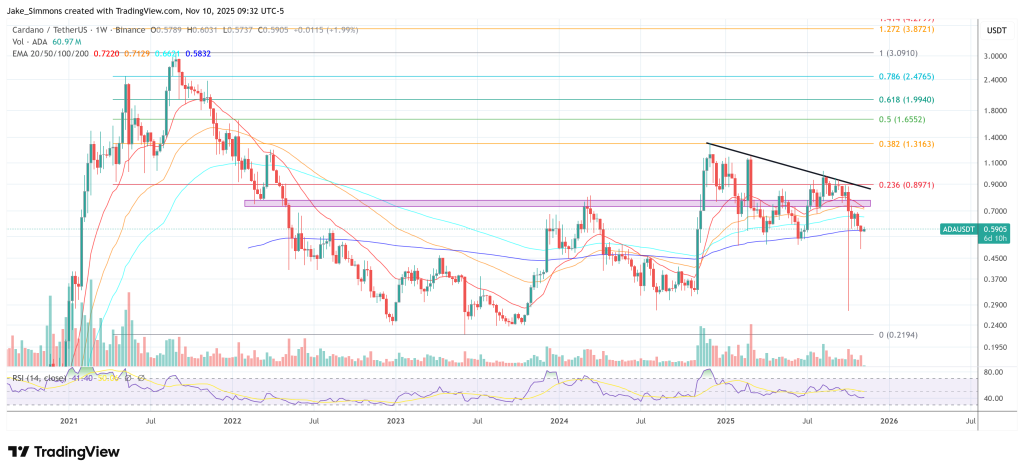
At press time, ADA traded at $0.59.
Cardano price
Disclaimer: The articles reposted on this site are sourced from public platforms and are provided for informational purposes only. They do not necessarily reflect the views of MEXC. All rights remain with the original authors. If you believe any content infringes on third-party rights, please contact [email protected] for removal. MEXC makes no guarantees regarding the accuracy, completeness, or timeliness of the content and is not responsible for any actions taken based on the information provided. The content does not constitute financial, legal, or other professional advice, nor should it be considered a recommendation or endorsement by MEXC.

You May Also Like

Suspected $243M Crypto Hacker Arrested After Major Breakthrough in Global Heist

Suspected $243M Crypto Hacker Arrested After Major Breakthrough in Global Heist

Major breakthrough in $243M crypto heist as suspect arrested! $18.58M in crypto seized, linked to suspected hacker’s wallet. Dubai villa raid leads to possible arrest of crypto thief. A major breakthrough in the investigation into the $243 million crypto theft has emerged, as blockchain investigator ZachXBT claims that a British hacker, suspected of orchestrating one of the largest individual thefts in crypto history, may have been arrested. On December 5, ZachXBT revealed in a Telegram post that Danny (also known as Meech or Danish Zulfiqar Khan), the primary suspect behind the attack, was likely apprehended by law enforcement. ZachXBT pointed to a significant find: approximately $18.58 million worth of crypto currently sitting in an Ethereum wallet linked to the suspect. The investigator claimed that several addresses connected to Zulfiqar had consolidated funds to this address, mirroring patterns previously seen in law enforcement seizures. This discovery has raised suspicions that authorities may have closed in on the hacker. Moreover, ZachXBT mentioned that Zulfiqar was last known to be in Dubai, where it is alleged that a villa was raided, and multiple individuals associated with the hacker were arrested. He also noted that several contacts of Zulfiqar had gone silent in recent days, adding to the growing belief that law enforcement had made a major move against the hacker. However, no official statements from Dubai Police or UAE regulators have confirmed the arrest, and local media reports remain silent on the matter. Also Read: Song Chi-hyung: The Visionary Behind Upbit and the Future of Blockchain Innovation The $243 Million Genesis Creditor Heist: How the Attack Unfolded The arrest of Zulfiqar may be linked to one of the largest known individual crypto heists. In September 2024, ZachXBT uncovered that three attackers were involved in stealing 4,064 BTC (valued at $243 million at the time) from a Genesis creditor. The attack was carried out using sophisticated social engineering tactics. The hackers impersonated Google support to trick the victim into resetting two-factor authentication on their Gemini account, giving them access to the victim’s private keys. From there, they drained the wallet, moving the stolen BTC through a complex network of exchanges and swap services. ZachXBT previously identified the suspects by their online handles, “Greavys,” “Wiz,” and “Box,” later tying them to individuals Malone Lam, Veer Chetal, and Jeandiel Serrano. The U.S. Department of Justice later charged two of the suspects with orchestrating a $230 million crypto scam involving the theft. Further court documents revealed that the criminals had used a mix of SIM swaps, social engineering, and even physical burglaries to carry out the theft, spending millions on luxury items like cars and travel. ZachXBT’s tracking work has played a key role in uncovering several related thefts, including a $2 million scam in which Chetal was involved while out on bond. The news of Zulfiqar’s potential arrest could mark a significant turning point in the investigation, although full details are yet to emerge. Also Read: Kevin O’Leary Warns: Only Bitcoin and Ethereum Will Survive Crypto’s Reality Check! The post Suspected $243M Crypto Hacker Arrested After Major Breakthrough in Global Heist appeared first on 36Crypto.
Share
Coinstats2025/12/06 18:27