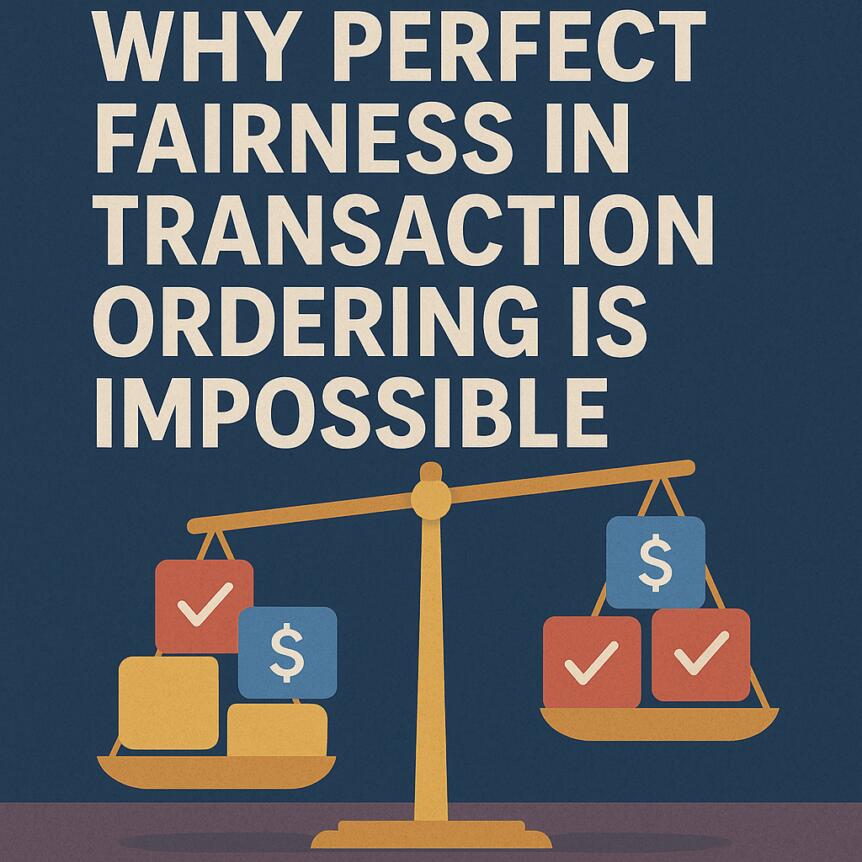
Why Perfect Fairness in Transaction Ordering is Impossible
Certainly! Here’s the rewritten article with an engaging introduction, optimized SEO keywords, and a clear, trustworthy tone while maintaining the original HTML structure:
—
As blockchain technology matures, ensuring fair and tamper-resistant transaction ordering remains a critical challenge. Traditional consensus mechanisms excel at maintaining consistency and liveness but fall short when it comes to preventing malicious actors from manipulating transaction orderings for profit, especially in decentralized finance (DeFi). Recent research highlights inherent limitations in achieving perfect fairness, prompting the development of innovative protocols designed to address these vulnerabilities and uphold trust in cryptocurrency and blockchain networks.
- Traditional distributed consensus focuses on consistency and liveness but struggles with transaction order fairness.
- Maximal Extractable Value (MEV) exploits allows winners in DeFi to manipulate transaction order, risking fairness and security.
- Protocols like Aequitas and Themis introduce practical fairness solutions, balancing security, scalability, and network performance.
- Fundamental limitations, highlighted by the Condorcet paradox, make perfect fairness impossible in asynchronous blockchain networks.
- Cryptographic verification and probabilistic models are shaping the future of fair transaction ordering in cryptocurrency ecosystems.
In the rapidly evolving landscape of cryptocurrency, maintaining trustworthy transaction ordering on public blockchains poses a significant challenge. While classical distributed systems prioritize consistency and liveness, they do not inherently prevent malicious actors from reordering transactions post-receipt—a vulnerability that has profound implications for DeFi applications, NFTs, and the broader crypto markets. Addressing this gap has become a focal point for researchers and protocol developers aiming to enhance decentralization and fairness.
Traditionally, validators, block builders, and sequencers in blockchain networks have exploited their privileged roles to maximize profits via Maximal Extractable Value (MEV). This practice involves frontrunning, backrunning, and sandwich attacks, undermining fairness and trust in decentralized exchanges and lending platforms. To counter this, transaction order-fairness, a proposed third pillar of consensus, seeks to ensure that transaction sequencing depends on external, objective factors such as arrival times, limiting the influence of malicious reorderings.
The Condorcet Paradox and Impossibility of Perfect Fairness
The quest for Receive-Order-Fairness (ROF)—where transactions are processed in the order they arrive—is fundamentally flawed. It hinges on an assumption of perfect, instant communication among nodes, which is unrealistic in decentralized networks. This challenge is formalized through the Condorcet paradox, which shows that collective preferences can cycle indefinitely, making a universally fair ordering impossible. As a result, no protocol can guarantee perfect fairness in asynchronous or even moderately delayed networks, necessitating weaker fairness models like batch order fairness.
Hedera Hashgraph and the Limitations of Median Timestamping
Hedera Hashgraph employs median timestamping to approximate fairness, assigning each transaction a timestamp based on the median of local node clocks. However, this approach is vulnerable—malicious nodes can manipulate their timestamps to bias transaction ordering, undermining the protocol’s fairness. For example, with five consensus nodes, a single adversary can skew timestamps to reverse the true order of transactions, demonstrating that median timestamping is susceptible to manipulation and cannot guarantee receive-order fairness.
Because of these vulnerabilities, Hashgraph’s timestamp-based fairness is considered weak, making it dependent on trust and a permissioned validator set rather than cryptographically verifiable fairness.
Practical Fairness: Moving Towards Achievable Guarantees
Recognizing the impossibility of perfect fairness, protocols like Aequitas introduce the concept of Block-Order-Fairness (BOF), where if the majority of nodes receive one transaction before another, the protocol ensures it is processed accordingly or grouped into the same batch. When conflicts arise, conflicting transactions are batched together, processed simultaneously, and ordered within the batch using deterministic tie-breakers like hashes. This approach preserves fairness conditions in real-world networks, where perfect orderings are unattainable.
The Aequitas protocol, despite achieving BC-BOF, faced challenges related to high communication complexity and weak liveness guarantees—where transaction finality could be delayed by cycles. To address this, Themis was developed, optimizing fairness through techniques like Batch Unspooling and cryptographic proofs, which allow the protocol to scale efficiently using linear communication while maintaining strong fairness guarantees.
In a network of five nodes with conflicting transaction views, Themis dynamically groups transactions into strongly connected components, allowing the system to advance without stalling—ensuring both fairness and network sustainability. This approach exemplifies how cryptographic techniques and clever protocol design are shaping the future of transaction ordering in blockchain and cryptocurrency systems.
Overview
While the idea of perfect fairness in transaction ordering may seem straightforward, foundational paradoxes like Condorcet’s demonstrate its fundamental impossibility in distributed blockchain networks. Approaches like Hedera Hashgraph’s median timestamping fall short of true fairness, prompting a shift toward probabilistic and cryptographic solutions. Protocols such as Aequitas and Themis recognize these limitations and redefine fairness with practical, verifiable guarantees. These advancements underscore the importance of cryptographically embedded fairness models, moving toward more transparent, secure, and predictable blockchain ecosystems for decentralized finance, NFTs, and the wider crypto markets.
This article does not contain investment advice or recommendations. Every investment and trading move involves risk, and readers should conduct their own research when making a decision.
This article is for general informational purposes and is not intended to be and should not be taken as legal or investment advice. The views, thoughts, and opinions expressed here are the author’s alone and do not necessarily reflect or represent the views and opinions of the publication.
Readers should perform their own due diligence before acting on any products or services mentioned herein. Cointelegraph does not endorse or guarantee any proprietary content or recommendations made in this article.
This article was originally published as Why Perfect Fairness in Transaction Ordering is Impossible on Crypto Breaking News – your trusted source for crypto news, Bitcoin news, and blockchain updates.
You May Also Like
X Üst Düzey Yetkilisi, Platformda Kripto Paralar İçin Müjdeyi Verdi! Ancak Bazı Altcoinler İçin Kötü Haber Olabilir

China Blocks Nvidia’s RTX Pro 6000D as Local Chips Rise