Over $116 million in crypto assets have been drained from Balancer Protocol, marking one of the most severe decentralized finance (DeFi) exploits of 2025. At approximately 9:12 AM on Monday, blockchain analytics firm Lookonchain first raised the alarm, reporting that Balancer had been exploited for $70.6 million in crypto assets. Initial data revealed that the attacker siphoned off 6,587 WETH ($24.46 million), 6,851 osETH ($26.86 million), and 4,260 wstETH (~$19.27 million) across multiple blockchains. Balancer $116M DeFi Exploit Unfolds Within just thirty minutes, Lookonchain updated that the attack was still ongoing, with total stolen funds exceeding $116 million. The scale and precision of the exploit suggest a highly coordinated and technically sophisticated operation spanning several DeFi ecosystems. As of press time, on-chain data shows the hacker’s DeBank portfolio holding around $95 million, while roughly $21 million has been distributed to various wallets, likely an early move toward obfuscating and liquidating the stolen assets.Source: DeBank The exploit has also triggered a ripple effect across Balancer-forked projects, as many associated protocols reported security breaches or precautionary withdrawals. Panic withdrawals began soon after news of the attack broke, most notably from a whale wallet (0x0090) that had been dormant for three years but suddenly withdrew $6.5 million from Balancer pools. Major DeFi Protocols Respond Major Ethereum-based protocols have been quick to respond. Lido, a leading liquid staking platform, confirmed that certain Balancer V2 pools were impacted but clarified that Lido’s core protocol and user funds remain safe. In an official statement, Lido noted: “Out of an abundance of caution, the Veda team — curators of Lido GGV — has withdrawn its unaffected Balancer position.” Meanwhile, Aave, another top DeFi lending protocol, emphasized that it remains completely unaffected. Aave explained that its Aave/stETH stkBPT pool uses a custom version of Balancer V2 that operates independently of Balancer’s vulnerable components. “The Aave protocol has no dependencies over Balancer V2 and is unaffected to the best of our knowledge,” the team stated. Unclear Root Cause and Ongoing Investigation Balancer developers have acknowledged the exploit but have not revealed the root cause or the extent of the loss. However, early signs point to a complex cross-chain exploit vector that may have targeted the protocol’s unique liquidity architecture. Moreover, today’s exploit is not the first time the Balancer protocol has faced attacks and drains from its pools. In August 2023, the protocol suffered a $2 million drain associated with a code vulnerability, and then the following month, over $900,000 was drained again across its V2 pool. Just like the recent exploit, the vulnerable assets were spread across various networks, including Ethereum, Polygon, Arbitrum, Optimism, Avalanche, Gnosis, Fantom, and zkEVM. Growing DeFi Security Concerns Another noticeable concern about the recent crypto exploit is how it’s now spreading across every major chain aside from Ethereum. On September 8, Nemo Protocol, a decentralized finance (DeFi) yield platform operating on the Sui blockchain, fell victim to a cyberattack that resulted in $2.4 million in losses just ahead of its scheduled maintenance window. On the same day, Swiss crypto platform SwissBorg lost $41.5 million worth of Solana (SOL) tokens after hackers compromised partner API provider Kiln. Similarly, in May, Cryptonews reported that Cetus Protocol, a decentralized exchange built on the Sui blockchain, fell victim to an exploit that siphoned off more than $200 million in crypto assets. PeckShield’s latest report reveals that crypto hacks caused $127.06 million in losses in September 2025 alone, noting the continued risk of large-scale attacks on decentralized finance (DeFi) and blockchain platforms. In just the first half of 2025, crypto exploits reached $2.1 billion, nearly matching all of 2024’s total losses. Why Crypto Hacks Keep Happening When Cryptonews spoke with Mitchell Amador, founder and CEO of Immunefi, in August, he revealed that most crypto hacks happen for three major reasons, which are: Static audits: Enterprises rely on one-time checks, missing post-launch flaws in evolving smart contracts. Ignoring incentives: They underestimate Web3’s open-ledger attack appeal, needing bounties to outbid black hats. No Web3 expertise: Many teams lack prior blockchain knowledge, missing composability or oracle risksOver $116 million in crypto assets have been drained from Balancer Protocol, marking one of the most severe decentralized finance (DeFi) exploits of 2025. At approximately 9:12 AM on Monday, blockchain analytics firm Lookonchain first raised the alarm, reporting that Balancer had been exploited for $70.6 million in crypto assets. Initial data revealed that the attacker siphoned off 6,587 WETH ($24.46 million), 6,851 osETH ($26.86 million), and 4,260 wstETH (~$19.27 million) across multiple blockchains. Balancer $116M DeFi Exploit Unfolds Within just thirty minutes, Lookonchain updated that the attack was still ongoing, with total stolen funds exceeding $116 million. The scale and precision of the exploit suggest a highly coordinated and technically sophisticated operation spanning several DeFi ecosystems. As of press time, on-chain data shows the hacker’s DeBank portfolio holding around $95 million, while roughly $21 million has been distributed to various wallets, likely an early move toward obfuscating and liquidating the stolen assets.Source: DeBank The exploit has also triggered a ripple effect across Balancer-forked projects, as many associated protocols reported security breaches or precautionary withdrawals. Panic withdrawals began soon after news of the attack broke, most notably from a whale wallet (0x0090) that had been dormant for three years but suddenly withdrew $6.5 million from Balancer pools. Major DeFi Protocols Respond Major Ethereum-based protocols have been quick to respond. Lido, a leading liquid staking platform, confirmed that certain Balancer V2 pools were impacted but clarified that Lido’s core protocol and user funds remain safe. In an official statement, Lido noted: “Out of an abundance of caution, the Veda team — curators of Lido GGV — has withdrawn its unaffected Balancer position.” Meanwhile, Aave, another top DeFi lending protocol, emphasized that it remains completely unaffected. Aave explained that its Aave/stETH stkBPT pool uses a custom version of Balancer V2 that operates independently of Balancer’s vulnerable components. “The Aave protocol has no dependencies over Balancer V2 and is unaffected to the best of our knowledge,” the team stated. Unclear Root Cause and Ongoing Investigation Balancer developers have acknowledged the exploit but have not revealed the root cause or the extent of the loss. However, early signs point to a complex cross-chain exploit vector that may have targeted the protocol’s unique liquidity architecture. Moreover, today’s exploit is not the first time the Balancer protocol has faced attacks and drains from its pools. In August 2023, the protocol suffered a $2 million drain associated with a code vulnerability, and then the following month, over $900,000 was drained again across its V2 pool. Just like the recent exploit, the vulnerable assets were spread across various networks, including Ethereum, Polygon, Arbitrum, Optimism, Avalanche, Gnosis, Fantom, and zkEVM. Growing DeFi Security Concerns Another noticeable concern about the recent crypto exploit is how it’s now spreading across every major chain aside from Ethereum. On September 8, Nemo Protocol, a decentralized finance (DeFi) yield platform operating on the Sui blockchain, fell victim to a cyberattack that resulted in $2.4 million in losses just ahead of its scheduled maintenance window. On the same day, Swiss crypto platform SwissBorg lost $41.5 million worth of Solana (SOL) tokens after hackers compromised partner API provider Kiln. Similarly, in May, Cryptonews reported that Cetus Protocol, a decentralized exchange built on the Sui blockchain, fell victim to an exploit that siphoned off more than $200 million in crypto assets. PeckShield’s latest report reveals that crypto hacks caused $127.06 million in losses in September 2025 alone, noting the continued risk of large-scale attacks on decentralized finance (DeFi) and blockchain platforms. In just the first half of 2025, crypto exploits reached $2.1 billion, nearly matching all of 2024’s total losses. Why Crypto Hacks Keep Happening When Cryptonews spoke with Mitchell Amador, founder and CEO of Immunefi, in August, he revealed that most crypto hacks happen for three major reasons, which are: Static audits: Enterprises rely on one-time checks, missing post-launch flaws in evolving smart contracts. Ignoring incentives: They underestimate Web3’s open-ledger attack appeal, needing bounties to outbid black hats. No Web3 expertise: Many teams lack prior blockchain knowledge, missing composability or oracle risks

$116M in Crypto Assets Gone – Balancer Suffers One of DeFi’s Largest Exploits

2025/11/03 23:59
4 min read

Over $116 million in crypto assets have been drained from Balancer Protocol, marking one of the most severe decentralized finance (DeFi) exploits of 2025.

At approximately 9:12 AM on Monday, blockchain analytics firm Lookonchain first raised the alarm, reporting that Balancer had been exploited for $70.6 million in crypto assets.

Initial data revealed that the attacker siphoned off 6,587 WETH ($24.46 million), 6,851 osETH ($26.86 million), and 4,260 wstETH (~$19.27 million) across multiple blockchains.

Balancer $116M DeFi Exploit Unfolds

Within just thirty minutes, Lookonchain updated that the attack was still ongoing, with total stolen funds exceeding $116 million.

The scale and precision of the exploit suggest a highly coordinated and technically sophisticated operation spanning several DeFi ecosystems.

As of press time, on-chain data shows the hacker’s DeBank portfolio holding around $95 million, while roughly $21 million has been distributed to various wallets, likely an early move toward obfuscating and liquidating the stolen assets.
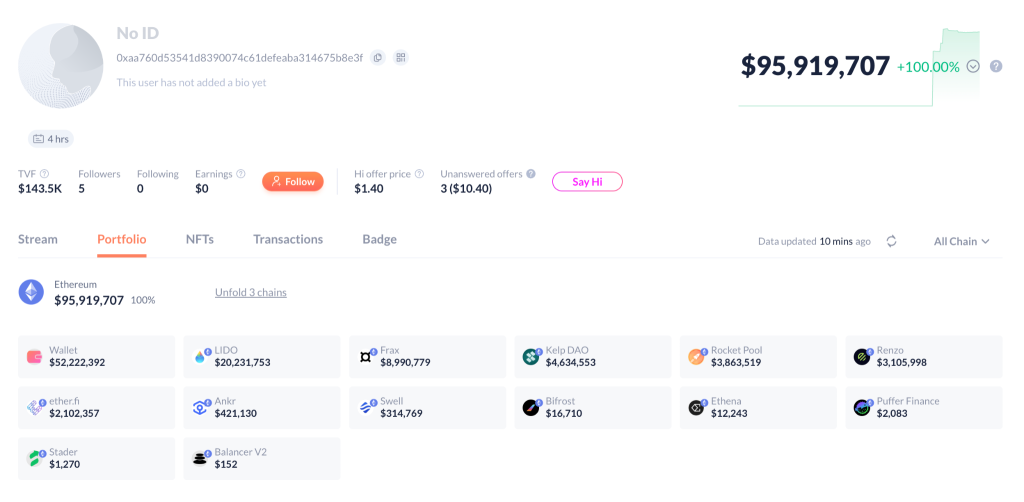
$116M in Crypto Assets Gone – Balancer Suffers One of DeFi’s Largest ExploitsSource: DeBank

The exploit has also triggered a ripple effect across Balancer-forked projects, as many associated protocols reported security breaches or precautionary withdrawals.

Panic withdrawals began soon after news of the attack broke, most notably from a whale wallet (0x0090) that had been dormant for three years but suddenly withdrew $6.5 million from Balancer pools.

Major DeFi Protocols Respond

Major Ethereum-based protocols have been quick to respond.

Lido, a leading liquid staking platform, confirmed that certain Balancer V2 pools were impacted but clarified that Lido’s core protocol and user funds remain safe.

In an official statement, Lido noted:

“Out of an abundance of caution, the Veda team — curators of Lido GGV — has withdrawn its unaffected Balancer position.”

Meanwhile, Aave, another top DeFi lending protocol, emphasized that it remains completely unaffected.

Aave explained that its Aave/stETH stkBPT pool uses a custom version of Balancer V2 that operates independently of Balancer’s vulnerable components.

“The Aave protocol has no dependencies over Balancer V2 and is unaffected to the best of our knowledge,” the team stated.

Unclear Root Cause and Ongoing Investigation

Balancer developers have acknowledged the exploit but have not revealed the root cause or the extent of the loss.

However, early signs point to a complex cross-chain exploit vector that may have targeted the protocol’s unique liquidity architecture.

Moreover, today’s exploit is not the first time the Balancer protocol has faced attacks and drains from its pools.

In August 2023, the protocol suffered a $2 million drain associated with a code vulnerability, and then the following month, over $900,000 was drained again across its V2 pool.

Just like the recent exploit, the vulnerable assets were spread across various networks, including Ethereum, Polygon, Arbitrum, Optimism, Avalanche, Gnosis, Fantom, and zkEVM.

Growing DeFi Security Concerns

Another noticeable concern about the recent crypto exploit is how it’s now spreading across every major chain aside from Ethereum.

On September 8, Nemo Protocol, a decentralized finance (DeFi) yield platform operating on the Sui blockchain, fell victim to a cyberattack that resulted in $2.4 million in losses just ahead of its scheduled maintenance window.

On the same day, Swiss crypto platform SwissBorg lost $41.5 million worth of Solana (SOL) tokens after hackers compromised partner API provider Kiln.

Similarly, in May, Cryptonews reported that Cetus Protocol, a decentralized exchange built on the Sui blockchain, fell victim to an exploit that siphoned off more than $200 million in crypto assets.

PeckShield’s latest report reveals that crypto hacks caused $127.06 million in losses in September 2025 alone, noting the continued risk of large-scale attacks on decentralized finance (DeFi) and blockchain platforms.

In just the first half of 2025, crypto exploits reached $2.1 billion, nearly matching all of 2024’s total losses.

Why Crypto Hacks Keep Happening

When Cryptonews spoke with Mitchell Amador, founder and CEO of Immunefi, in August, he revealed that most crypto hacks happen for three major reasons, which are:

  • Static audits: Enterprises rely on one-time checks, missing post-launch flaws in evolving smart contracts.
  • Ignoring incentives: They underestimate Web3’s open-ledger attack appeal, needing bounties to outbid black hats.
  • No Web3 expertise: Many teams lack prior blockchain knowledge, missing composability or oracle risks.
Market Opportunity
DeFi Logo
DeFi Price(DEFI)
$0.000292
$0.000292$0.000292
-1.68%
USD
DeFi (DEFI) Live Price Chart
Disclaimer: The articles reposted on this site are sourced from public platforms and are provided for informational purposes only. They do not necessarily reflect the views of MEXC. All rights remain with the original authors. If you believe any content infringes on third-party rights, please contact [email protected] for removal. MEXC makes no guarantees regarding the accuracy, completeness, or timeliness of the content and is not responsible for any actions taken based on the information provided. The content does not constitute financial, legal, or other professional advice, nor should it be considered a recommendation or endorsement by MEXC.

You May Also Like

Solid growth outlook supports Ringgit – Standard Chartered

Solid growth outlook supports Ringgit – Standard Chartered

The post Solid growth outlook supports Ringgit – Standard Chartered appeared on BitcoinEthereumNews.com. Standard Chartered’s Edward Lee and Jonathan Koh highlight
Share
BitcoinEthereumNews2026/02/14 03:14
CME Group to launch options on XRP and SOL futures

CME Group to launch options on XRP and SOL futures

The post CME Group to launch options on XRP and SOL futures appeared on BitcoinEthereumNews.com. CME Group will offer options based on the derivative markets on Solana (SOL) and XRP. The new markets will open on October 13, after regulatory approval.  CME Group will expand its crypto products with options on the futures markets of Solana (SOL) and XRP. The futures market will start on October 13, after regulatory review and approval.  The options will allow the trading of MicroSol, XRP, and MicroXRP futures, with expiry dates available every business day, monthly, and quarterly. The new products will be added to the existing BTC and ETH options markets. ‘The launch of these options contracts builds on the significant growth and increasing liquidity we have seen across our suite of Solana and XRP futures,’ said Giovanni Vicioso, CME Group Global Head of Cryptocurrency Products. The options contracts will have two main sizes, tracking the futures contracts. The new market will be suitable for sophisticated institutional traders, as well as active individual traders. The addition of options markets singles out XRP and SOL as liquid enough to offer the potential to bet on a market direction.  The options on futures arrive a few months after the launch of SOL futures. Both SOL and XRP had peak volumes in August, though XRP activity has slowed down in September. XRP and SOL options to tap both institutions and active traders Crypto options are one of the indicators of market attitudes, with XRP and SOL receiving a new way to gauge sentiment. The contracts will be supported by the Cumberland team.  ‘As one of the biggest liquidity providers in the ecosystem, the Cumberland team is excited to support CME Group’s continued expansion of crypto offerings,’ said Roman Makarov, Head of Cumberland Options Trading at DRW. ‘The launch of options on Solana and XRP futures is the latest example of the…
Share
BitcoinEthereumNews2025/09/18 00:56
Pibble AI platform: Revolutionary AION Completes POSCO International POC with Stunning Success

Pibble AI platform: Revolutionary AION Completes POSCO International POC with Stunning Success

BitcoinWorld Pibble AI platform: Revolutionary AION Completes POSCO International POC with Stunning Success The world of trade is constantly evolving, with businesses seeking innovative solutions to enhance efficiency and accuracy. In this dynamic landscape, the Pibble AI platform AION has emerged as a groundbreaking force, recently completing a significant Proof-of-Concept (POC) with global trading giant POSCO International. This achievement signals a major leap forward in how artificial intelligence and blockchain technology can revolutionize B2B operations. What is the Pibble AI Platform AION and Its Recent Breakthrough? AION is an advanced AI trade solution developed by Caramel Bay, the innovative operator behind the Pibble (PIB) blockchain project. Its core mission is to streamline complex trade processes, which traditionally involve extensive manual labor and time-consuming documentation. The recent POC with POSCO International was a pivotal moment for the Pibble AI platform. It served as a real-world test, demonstrating AION’s capabilities in a demanding corporate environment. This collaboration showcased how cutting-edge technology can address practical business challenges, particularly in international trade. The results were truly impressive. The platform proved its ability to drastically cut down the time required for specific tasks. What once took hours of meticulous work can now be completed in mere minutes. Moreover, AION achieved an astonishing document accuracy rate of over 95%, setting a new benchmark for efficiency and reliability in trade operations. This high level of precision is crucial for reducing errors and associated costs in large-scale international transactions. Revolutionizing Trade: How the Pibble AI Platform Delivers Speed and Accuracy Imagine reducing hours of work to just minutes while simultaneously boosting accuracy. This isn’t a futuristic fantasy; it’s the tangible reality delivered by the Pibble AI platform AION. The successful POC with POSCO International vividly illustrates the transformative power of this technology. Key benefits highlighted during the POC include: Unprecedented Speed: Tasks that typically consumed significant human resources and time were executed with remarkable swiftness. This acceleration translates directly into faster transaction cycles and improved operational flow for businesses. Superior Accuracy: Achieving over 95% document accuracy is a monumental feat in an industry where even minor errors can lead to substantial financial losses and logistical nightmares. AION’s precision minimizes risks and enhances trust in digital documentation. Operational Efficiency: By automating and optimizing critical trade processes, the Pibble AI platform frees up human capital. Employees can then focus on more strategic tasks that require human intuition and decision-making, rather than repetitive data entry or verification. This efficiency isn’t just about saving time; it’s about creating a more robust, less error-prone system that can handle the complexities of global trade with ease. The implications for businesses involved in import/export, logistics, and supply chain management are profound. Beyond the POC: Pibble’s Vision for AI and Blockchain Integration The successful POC with POSCO International is just one step in Pibble’s ambitious journey. The company is dedicated to building validated platforms that leverage both blockchain and AI technologies, catering to a broad spectrum of needs. Pibble’s strategic focus encompasses: B2C Social Platforms: Developing consumer-facing applications that integrate blockchain for enhanced data security, content ownership, and user engagement. B2B Business Solutions: Expanding on successes like AION to offer robust, scalable solutions for various industries, addressing critical business challenges with AI-driven insights and blockchain transparency. The synergy between AI and blockchain is powerful. AI provides the intelligence for automation and optimization, while blockchain offers immutable records, transparency, and enhanced security. Together, they create a formidable foundation for future digital ecosystems. As the digital transformation accelerates, platforms like the Pibble AI platform are poised to play a crucial role in shaping how businesses operate and interact globally. Their commitment to innovation and practical application demonstrates a clear path forward for enterprise-grade blockchain and AI solutions. In conclusion, the successful POC of Pibble’s AION with POSCO International marks a significant milestone in the adoption of AI and blockchain in enterprise solutions. By dramatically reducing task times and achieving exceptional accuracy, the Pibble AI platform has demonstrated its potential to redefine efficiency in global trade. This achievement not only validates Caramel Bay’s vision but also paves the way for a future where intelligent, secure, and highly efficient digital platforms drive business success. It’s an exciting glimpse into the future of B2B innovation. Frequently Asked Questions (FAQs) Q1: What is the Pibble AI platform AION? AION is an advanced AI trade solution developed by Caramel Bay, the company behind the Pibble blockchain project. It’s designed to automate and optimize complex trade processes, reducing manual effort and improving accuracy. Q2: What was the significance of the POC with POSCO International? The Proof-of-Concept (POC) with POSCO International demonstrated AION’s real-world effectiveness. It showed that the Pibble AI platform could reduce tasks from hours to minutes and achieve over 95% document accuracy in a demanding corporate environment, validating its capabilities. Q3: How does AION achieve such high accuracy and speed? AION leverages sophisticated artificial intelligence algorithms to process and verify trade documentation. This AI-driven approach allows for rapid analysis and identification of discrepancies, leading to significant time savings and a dramatic reduction in human error. Q4: What is Pibble’s broader vision beyond B2B solutions? Pibble is committed to integrating blockchain and AI across various platforms. While AION focuses on B2B solutions, Pibble also develops B2C social platforms, aiming to enhance user experience, data security, and content ownership through these advanced technologies. Q5: Why is the combination of AI and blockchain important for trade? AI provides the intelligence for automation and optimization, making processes faster and more accurate. Blockchain, on the other hand, offers immutable records, transparency, and enhanced security, ensuring that trade data is reliable and tamper-proof. Together, they create a powerful, trustworthy, and efficient trade ecosystem. If you found this insight into Pibble’s groundbreaking achievements inspiring, consider sharing this article with your network! Help us spread the word about how AI and blockchain are transforming global trade. Your shares on social media platforms like X (Twitter), LinkedIn, and Facebook can help more people discover the future of business solutions. To learn more about the latest crypto market trends, explore our article on key developments shaping AI in crypto institutional adoption. This post Pibble AI platform: Revolutionary AION Completes POSCO International POC with Stunning Success first appeared on BitcoinWorld.
Share
Coinstats2025/09/18 19:45