This section critically reviews the status of holographic duality in condensed matter physics, noting the decline of the heuristic 'holo-hacking' approach.This section critically reviews the status of holographic duality in condensed matter physics, noting the decline of the heuristic 'holo-hacking' approach.

The Ubiquitous NFL Problem: Comparing Bosonization, Eikonal, and Holographic Techniques

2025/10/31 23:00
  • Prologue
  • Diagrammatic(s) Rules
  • Straight-forward Eikonal
  • Legacy Bosonization
  • Wonton Holography
  • Holographic Propagators
  • Strange Cuprates
  • Stranger Things
  • Epilogue

Wonton Holography

Compared to what it has been just recently [26], the seemingly endless flurry of holographic publications in JHEP, PRD, and other traditional ’condensed matter oriented’ venues has been steadily coming to a mere trickle. Those few holographic exercises that do occasionally pop out still tend to begin with the mantra ’holography is well known to be an established method for studying strongly correlated systems’. However, this optimistic reassurance often appears to be in a rather stark contrast with the typical summary that sounds more like ’as no unambiguous agreement with experiment was found, the problem is left to future work’.

\ Also, much of the original thrust towards boldly treating an arbitrary condensed matter system of interest as yet another application of some opportunistically chosen weakly-coupled semiclassical gravity has retreated into a ’safer-haven’ topic of hydrodynamics (which, while highlighted and revitalized by holography, can be - and of course had long been - successfully discussed without ever mentioning the latter).

\ On the outside, it may seem as though the heuristic ’holo-hacking’ (a.k.a. ’bottom up’ or ’non-AdS/nonCFT’) approach tends to pick out its favorite gravity-like bulk theory on the basis of such physically compelling reasons as an existence of the previously found classical solutions and normal modes’ spectra, availability of the numerical simulation software, or mere need to engage students with the tangible computational tasks.

\ However, apart from having become a massive and customary practice, there hasn’t been much effort made towards any serious justification of neither the overall holographic scheme, nor its specific ’dictionary’ which was copy-pasted from the original string-theoretical framework. In that regard, it might be worth keeping in mind that just because everyone else on a highway may be driving above the posted speed limit does not by itself make it legal.

\ In light of the above, comparing holographic propagators to the predictions of other techniques could provide an additional testing ground for, both, the alternate methods as well as the holographic approach itself. the bulk metric, gauge, and scalar (dilaton) fields [26]

\
\
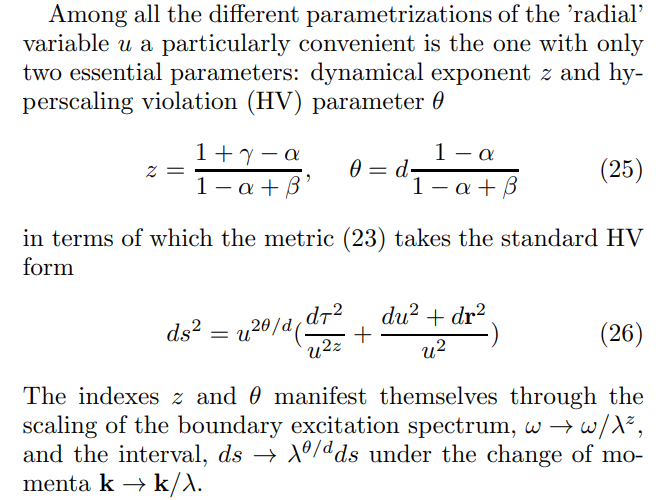
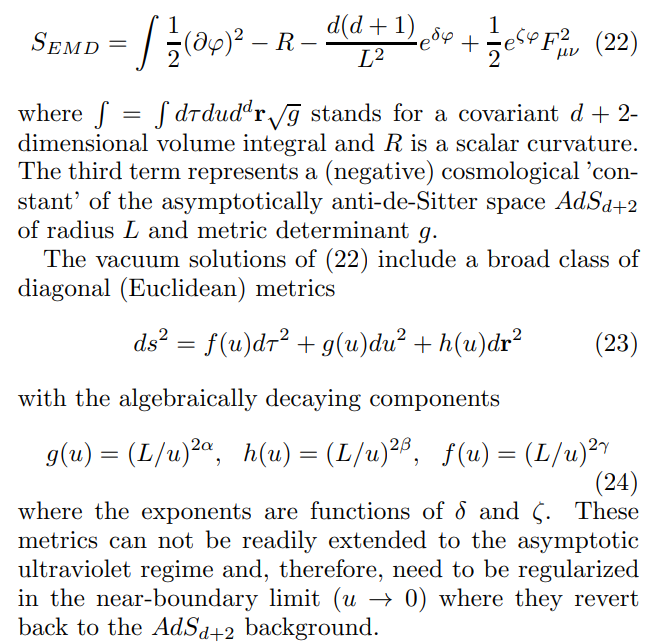
\ Among all the classical solutions of the theory (22) there is a special class of Lifshitz metrics (θ = 0) which were discovered in the semiclassical (ThomasFermi) analysis of matter back-reaction on the metric, as well as in the ’electron star’ scenarios, etc. [27].

\ More generally, any viable solutions of (22) must obey certain stability (’null energy’) conditions [26]

\

\

:::info Author:

(1) D. V. Khveshchenko, Department of Physics and Astronomy, University of North Carolina, Chapel Hill, NC 27599.

:::


:::info This paper is available on arxiv under CC BY 4.0 DEED license.

:::

\

Disclaimer: The articles reposted on this site are sourced from public platforms and are provided for informational purposes only. They do not necessarily reflect the views of MEXC. All rights remain with the original authors. If you believe any content infringes on third-party rights, please contact [email protected] for removal. MEXC makes no guarantees regarding the accuracy, completeness, or timeliness of the content and is not responsible for any actions taken based on the information provided. The content does not constitute financial, legal, or other professional advice, nor should it be considered a recommendation or endorsement by MEXC.

You May Also Like

Japan-Based Bitcoin Treasury Company Metaplanet Completes $1.4 Billion IPO! Will It Buy Bitcoin? Here Are the Details

Japan-Based Bitcoin Treasury Company Metaplanet Completes $1.4 Billion IPO! Will It Buy Bitcoin? Here Are the Details

The post Japan-Based Bitcoin Treasury Company Metaplanet Completes $1.4 Billion IPO! Will It Buy Bitcoin? Here Are the Details appeared on BitcoinEthereumNews.com. Japan-based Bitcoin treasury company Metaplanet announced today that it has successfully completed its public offering process. Metaplanet Grows Bitcoin Treasury with $1.4 Billion IPO The company’s CEO, Simon Gerovich, stated in a post on the X platform that a large number of institutional investors participated in the process. Among the investors, mutual funds, sovereign wealth funds, and hedge funds were notable. According to Gerovich, approximately 100 institutional investors participated in roadshows held prior to the IPO. Ultimately, over 70 investors participated in Metaplanet’s capital raising. Previously disclosed information indicated that the company had raised approximately $1.4 billion through the IPO. This funding will accelerate Metaplanet’s growth plans and, in particular, allow the company to increase its balance sheet Bitcoin holdings. Gerovich emphasized that this step will propel Metaplanet to its next stage of development and strengthen the company’s global Bitcoin strategy. Metaplanet has recently become one of the leading companies in Japan in promoting digital asset adoption. The company has previously stated that it views Bitcoin as a long-term store of value. This large-scale IPO is considered a significant step in not only strengthening Metaplanet’s capital but also consolidating Japan’s role in the global crypto finance market. *This is not investment advice. Follow our Telegram and Twitter account now for exclusive news, analytics and on-chain data! Source: https://en.bitcoinsistemi.com/japan-based-bitcoin-treasury-company-metaplanet-completes-1-4-billion-ipo-will-it-buy-bitcoin-here-are-the-details/
Share
BitcoinEthereumNews2025/09/18 08:42
Single Currency-Pegged Tokens Surge Following MiCA Rollout.

Single Currency-Pegged Tokens Surge Following MiCA Rollout.

The post Single Currency-Pegged Tokens Surge Following MiCA Rollout. appeared on BitcoinEthereumNews.com. The euro stablecoin market has rebounded in the year since the European Union’s (EU) Markets in Crypto-Assets Regulation (MiCA) came into force, with market capitalization doubling after regulations governing the tokens rolled out in June 2024, according to a new report. The “Euro Stablecoin Trends Report 2025” from London-based payments processing company Decta points a potential shift for the tokens, whose value is pegged to the single European currency and which have historically struggled to gain traction against their U.S. dollar-pegged counterparts. The swing contrasts with the 48% contraction experienced the year before, according to the report. It also contrasts with a 26% advance in total stablecoin market cap. Euro coin market cap climbed to some $500 million by May 2025, the report said, mainly due to improved issuer obligations and standardized reserve requirements. It’s now $680 million, according to data tracked by CoinGecko. Even so, that’s just a tiny fraction of the $300 billion held in U.S. dollar-pegged tokens, a market dominated by Tether’s USDT with Circle Internet’s (CRCL) USDC in second place. Growth has been especially concentrated among a few standout tokens. EURS, issued by Malta-based Stasis, posted the most dramatic gains, soaring 644% million to $283.9 million by October 2025. Circle Internet’s EURC and EURCV, from Societe Generale’s SG-Forge, also recorded significant gains. Transaction activity surged in parallel. Monthly euro-stablecoin volume rose nearly ninefold after MiCA’s implementation US$3.83 billion. EURC and EURCV were among the biggest beneficiaries, with volume expanding 1,139% and 343% respectively, driven by increased usage in payments, fiat on-ramps and digital-asset trading. Consumer awareness also appears to be climbing. Decta found substantial spikes in search activity across the EU, including 400% growth in Finland and 313.3% in Italy, with smaller but steady increases in markets such as Cyprus and Slovakia. Source: https://www.coindesk.com/business/2025/12/06/hold-euro-stablecoin-market-cap-doubles-in-year-after-mica-decta-says
Share
BitcoinEthereumNews2025/12/06 21:25