Blockchain analytics firm Chainalysis reports criminal-linked wallets hold $75 billion in crypto, with darknet operators controlling $46 billion of it. The post Chainalysis Flags $75B in Illicit Crypto as Governments Eye Strategic Reserves appeared first on Coinspeaker.Blockchain analytics firm Chainalysis reports criminal-linked wallets hold $75 billion in crypto, with darknet operators controlling $46 billion of it. The post Chainalysis Flags $75B in Illicit Crypto as Governments Eye Strategic Reserves appeared first on Coinspeaker.

Chainalysis Flags $75B in Illicit Crypto as Governments Eye Strategic Reserves

3 min read

Blockchain analytics firm Chainalysis says more than $75 billion in illicit crypto sits untouched across public blockchains.

According to the firm’s latest report, criminal-linked wallets currently hold nearly $15 billion in digital assets, with another $60 billion in wallets connected indirectly to scams, hacks, or darknet markets.
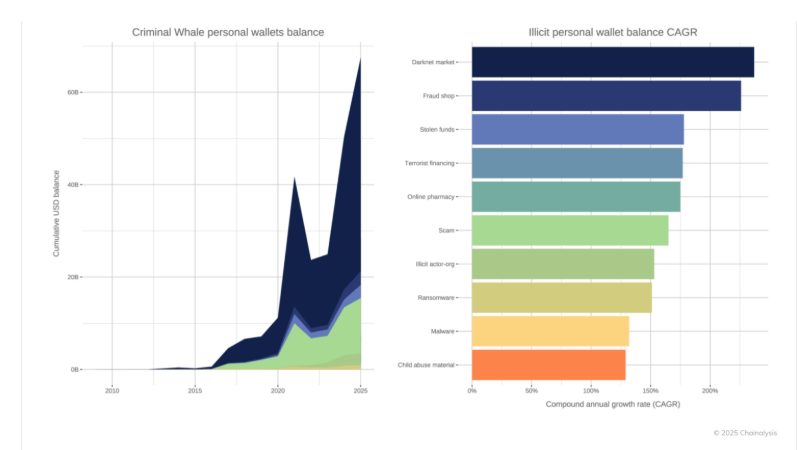
Criminal wallet balances | Source: Chainalysis

Criminal wallet balances | Source: Chainalysis

Chainalysis also found darknet administrators alone control over $46 billion in crypto, accounting for the bulk of the shadow economy.

While Bitcoin BTC $120 511 24h volatility: 2.8% Market cap: $2.40 T Vol. 24h: $69.85 B remains the dominant asset held by illicit actors by value, Ethereum ETH $4 313 24h volatility: 5.1% Market cap: $520.10 B Vol. 24h: $43.24 B and stablecoin balances have grown rapidly due to their rising adoption and relative price stability.

Governments Could Target Illicit Crypto For Strategic Reserves

Chainalysis data shows inflows from illicit sources to centralized crypto exchanges (CEXs) have averaged $14 billion annually since 2020 but are trending downward. In the first half of 2025 alone, about $7 billion in illegal crypto funds hit exchanges, a sharp decline from 2022 levels.
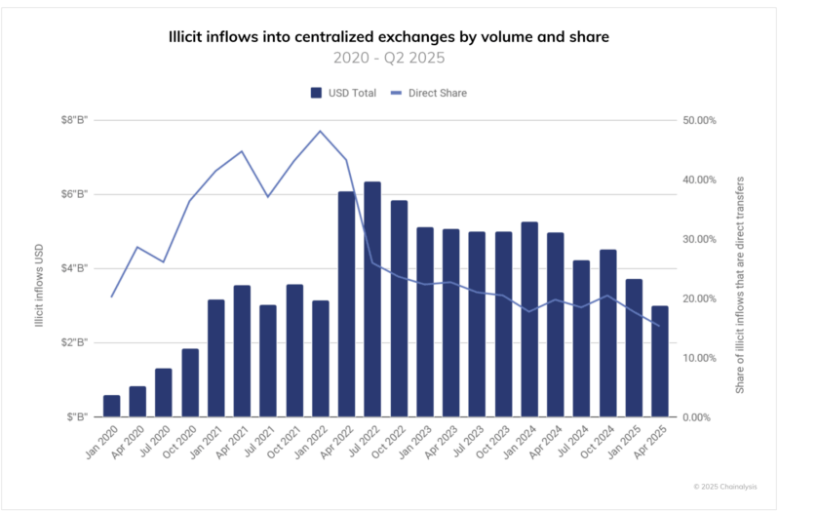
Illicit Fund Flows on Centralized Exchanges | Source: Chainalysis

Illicit Fund Flows on Centralized Exchanges | Source: Chainalysis

The report attributes this to criminals increasingly using crypto as a payment method and store of value, avoiding fiat conversion. Direct transfers to exchanges have plummeted from 40% in July 2022 to 15% in 2025, as illicit actors turn to crypto mixers and cross-chain bridges.

Stablecoins, which can be frozen by issuers, are the least concentrated, as criminals diversify holdings to avoid total losses from asset freezes.

Trump issued executive orders to establish the US Strategic Bitcoin Reserve (SBR) and Digital Asset Stockpile (DAS), creating frameworks for the government to confiscate and manage seized crypto funds.

With sovereign nations like El Salvador and Bhutan officially adopting crypto reserves in recent years, Chainalysis argues that coordinated seizures of illicit crypto could strengthen the national treasury.

The firm has already helped global authorities including Spain and the US seize $12.6 billion in illegal funds through forensic investigations.

Maxi Doge Presale Nears $3M as Chainalysis Investigates Illicit Actors

As Chainalysis investigations aid governments to clamp down on illicit actors, improved market sentiment has seen traders rotate toward early-stage projects like Maxi Doge (MAXI), a meme-driven ecosystem offering traders up to 1000% in leverage.

Maxi Doge Presale

Maxi Doge Presale

The Maxi Doge presale has raised over $2.7 million of its $3 million target, underscoring strong retail demand ahead of its official launch. Currently priced at $0.00026, early investors can still secure MAXI tokens via the official presale website before the next price tier activates in 48 hours.

next

The post Chainalysis Flags $75B in Illicit Crypto as Governments Eye Strategic Reserves appeared first on Coinspeaker.

Disclaimer: The articles reposted on this site are sourced from public platforms and are provided for informational purposes only. They do not necessarily reflect the views of MEXC. All rights remain with the original authors. If you believe any content infringes on third-party rights, please contact [email protected] for removal. MEXC makes no guarantees regarding the accuracy, completeness, or timeliness of the content and is not responsible for any actions taken based on the information provided. The content does not constitute financial, legal, or other professional advice, nor should it be considered a recommendation or endorsement by MEXC.

You May Also Like

USDT Transfer Stuns Market: $238 Million Whale Movement to Bitfinex Reveals Critical Patterns

USDT Transfer Stuns Market: $238 Million Whale Movement to Bitfinex Reveals Critical Patterns

BitcoinWorld USDT Transfer Stuns Market: $238 Million Whale Movement to Bitfinex Reveals Critical Patterns In a stunning development that captured global cryptocurrency
Share
bitcoinworld2026/02/06 21:45
The market value of NFTs has fallen back to pre-2021 levels, close to $1.5 billion.

The market value of NFTs has fallen back to pre-2021 levels, close to $1.5 billion.

PANews reported on February 6th, citing Cointelegraph, that the global NFT market capitalization has fallen below $1.5 billion, returning to pre-2021 levels. This
Share
PANews2026/02/06 21:13
Fed’s Hammack Backs Restrictive Policy Over Fed Rate Cuts

Fed’s Hammack Backs Restrictive Policy Over Fed Rate Cuts

The post Fed’s Hammack Backs Restrictive Policy Over Fed Rate Cuts appeared on BitcoinEthereumNews.com. Cleveland Federal Reserve President Beth Hammack has advocated for a restrictive monetary policy amid growing concerns of rising inflation . Her comment comes as Fed officials remain divided on whether they should make a Fed rate cut at the October FOMC meeting, a move that would impact the crypto market. Hammack Raises Inflation Concerns Amid Fed Rate Cut Debate Hammack stated that inflation continues to exceed the Fed’s objective and remains a concern across both headline and core categories. Speaking on CNBC, she noted that price growth remains above the Federal Reserve’s 2% objective and is not expected to return to target until the end of 2027 or early 2028. The Fed president added that pressures are most apparent in the services sector, where inflation has proven more persistent. Notably, her comments follow the first Fed rate cut of the year, two weeks ago at the September FOMC meeting.  In her remarks, Hammack said monetary policy must remain restrictive to ensure progress toward the inflation target, indicating that she doesn’t favor further Fed rate cuts for now. She explained that the Federal Reserve’s dual mandate requires balancing price stability with employment, but argued that inflation remains the greater challenge at present. “When I balance those two sides of our mandate, I think we really need to maintain a restrictive stance of policy so that we can get inflation back down to our goal,” she said. Inflation Over the Jobs Market Hammack pointed to service-related spending as an area where inflationary pressures remain strong. She explained that both headline and main price levels are still above target, with little evidence of near-term relief. She described the U.S. labor market as “reasonably healthy” and overall balanced, noting that current conditions do not show major weaknesses. However, Hammack stressed that maintaining this balance…
Share
BitcoinEthereumNews2025/09/29 23:50