A threat actor stole eight Hypurr NFTs worth approximately $400,000 within hours of the collection’s launch by compromising wallets that received the airdropped tokens on Hyperliquid’s HyperEVM layer. Blockchain investigator ZachXBT first reported the sophisticated theft targeting early Genesis Event participants who had opted to receive the free digital collectibles.Source: ZachXTB The Hyper Foundation distributed 4,600 unique cat-themed NFTs on September 28 to reward early supporters from the November 2024 Genesis Event. The collection immediately achieved a floor price of $68,900, with total trading volume reaching $45 million within 24 hours on OpenSea. At the time of writing, the floor price has surpassed $70K. The most expensive sale involved Hypurr #21, which featured rare “Knight Ghost Armor” traits, selling for 9,999 HYPE tokens, worth approximately $470,000. Some NFTs had traded over-the-counter for $88,000 before the official launch through DripTrade’s collateralized pre-sale system. The theft compounds security concerns plaguing Hyperliquid’s ecosystem following the $773,000 HyperDrive exploit and $3.6 million HyperVault rug pull within the same week. The rapid succession of attacks has intensified scrutiny of security practices across projects building on the decentralized exchange platform. Digital Cats Command Six-Figure Prices Despite Global Economic Pressures The Hypurr collection features generative art depicting cartoon cats with various traits, including sunglasses, wizard robes, and armor elements. Distribution allocated 4,313 NFTs to Genesis Event participants, 144 to the Hyper Foundation, and 143 to core contributors, including developers and artists. According to OpenSea data, over 1.3 million HYPE tokens were traded in the past 24 hours, equivalent to $61 million at current prices. The collection maintained 92.8% of supply held by 4,270 unique owners. Community reactions varied widely, with some celebrating life-changing windfalls while others criticized the wealth disparity. Creative director Alex Obymuralex praised the Hypurr design language as “timeless” rather than trend-driven, noting the collection’s simple forms and saturated colors lower intimidation barriers for mainstream adoption. He argued that recognizable silhouettes and joyful palettes create lasting brand equity beyond speculation cycles. Early adopters who participated in November’s Genesis Event received the NFTs at no cost beyond their initial platform engagement. The event centered on the launch of Hyperliquid’s native HYPE token and HyperEVM programmability layer. Notably, DripTrade’s over-the-counter system enabled pre-launch trading through collateralized agreements requiring sellers to fulfill transactions within seven days of receiving NFTs or forfeit deposited security. This mechanism allowed price discovery even before official distribution. Security Breaches Threaten Ecosystem Credibility The Hypurr NFT theft follows three major security incidents targeting Hyperliquid projects within one week. HyperDrive DeFi lost $773,000 through router contract vulnerabilities that enabled arbitrary function calls, while HyperVault developers executed a $3.6 million exit scam after ignoring community warnings about fabricated audit claims. Previous exploits include the March JELLY token manipulation, which cost $13.5 million, and the “ETH 50x Big Guy” trader, who netted a $1.8 million profit while causing $4 million in vault losses. This incident prompted a reduction in maximum leverage limits from 40x to 25x for major cryptocurrencies. Competition intensifies as ASTER DEX processes over $13 billion in daily perpetual futures volume, compared to Hyperliquid’s reduced activity. ASTER’s Trust Wallet integration provides 100 million users with direct access to perpetual contracts, challenging Hyperliquid’s market dominance. Arthur Hayes exited his entire HYPE position with a $823,000 profit, citing the massive token unlocks worth $11.9 billion that were set to start on November 29. He recently polled followers about re-entering after HYPE dropped 23% weekly to $35.50. However, community members have proposed blacklisting Hayes from purchasing HYPE, with some labeling his trades as the “ultimate sell signal.” Despite security challenges, Hyperliquid launched its USDH stablecoin, generating $2.2 million in early volume, while Native Markets secured the issuance mandate through a competitive governance voting process. The platform also activated HYPE/USDH spot trading following Native Markets’ commitment to stake 200,000 tokens for a period of three years. HYPE traded up 4.65% following the Hypurr launch, reaching $47.14 as community enthusiasm temporarily overshadowed ongoing security concerns and competition threats across the broader ecosystemA threat actor stole eight Hypurr NFTs worth approximately $400,000 within hours of the collection’s launch by compromising wallets that received the airdropped tokens on Hyperliquid’s HyperEVM layer. Blockchain investigator ZachXBT first reported the sophisticated theft targeting early Genesis Event participants who had opted to receive the free digital collectibles.Source: ZachXTB The Hyper Foundation distributed 4,600 unique cat-themed NFTs on September 28 to reward early supporters from the November 2024 Genesis Event. The collection immediately achieved a floor price of $68,900, with total trading volume reaching $45 million within 24 hours on OpenSea. At the time of writing, the floor price has surpassed $70K. The most expensive sale involved Hypurr #21, which featured rare “Knight Ghost Armor” traits, selling for 9,999 HYPE tokens, worth approximately $470,000. Some NFTs had traded over-the-counter for $88,000 before the official launch through DripTrade’s collateralized pre-sale system. The theft compounds security concerns plaguing Hyperliquid’s ecosystem following the $773,000 HyperDrive exploit and $3.6 million HyperVault rug pull within the same week. The rapid succession of attacks has intensified scrutiny of security practices across projects building on the decentralized exchange platform. Digital Cats Command Six-Figure Prices Despite Global Economic Pressures The Hypurr collection features generative art depicting cartoon cats with various traits, including sunglasses, wizard robes, and armor elements. Distribution allocated 4,313 NFTs to Genesis Event participants, 144 to the Hyper Foundation, and 143 to core contributors, including developers and artists. According to OpenSea data, over 1.3 million HYPE tokens were traded in the past 24 hours, equivalent to $61 million at current prices. The collection maintained 92.8% of supply held by 4,270 unique owners. Community reactions varied widely, with some celebrating life-changing windfalls while others criticized the wealth disparity. Creative director Alex Obymuralex praised the Hypurr design language as “timeless” rather than trend-driven, noting the collection’s simple forms and saturated colors lower intimidation barriers for mainstream adoption. He argued that recognizable silhouettes and joyful palettes create lasting brand equity beyond speculation cycles. Early adopters who participated in November’s Genesis Event received the NFTs at no cost beyond their initial platform engagement. The event centered on the launch of Hyperliquid’s native HYPE token and HyperEVM programmability layer. Notably, DripTrade’s over-the-counter system enabled pre-launch trading through collateralized agreements requiring sellers to fulfill transactions within seven days of receiving NFTs or forfeit deposited security. This mechanism allowed price discovery even before official distribution. Security Breaches Threaten Ecosystem Credibility The Hypurr NFT theft follows three major security incidents targeting Hyperliquid projects within one week. HyperDrive DeFi lost $773,000 through router contract vulnerabilities that enabled arbitrary function calls, while HyperVault developers executed a $3.6 million exit scam after ignoring community warnings about fabricated audit claims. Previous exploits include the March JELLY token manipulation, which cost $13.5 million, and the “ETH 50x Big Guy” trader, who netted a $1.8 million profit while causing $4 million in vault losses. This incident prompted a reduction in maximum leverage limits from 40x to 25x for major cryptocurrencies. Competition intensifies as ASTER DEX processes over $13 billion in daily perpetual futures volume, compared to Hyperliquid’s reduced activity. ASTER’s Trust Wallet integration provides 100 million users with direct access to perpetual contracts, challenging Hyperliquid’s market dominance. Arthur Hayes exited his entire HYPE position with a $823,000 profit, citing the massive token unlocks worth $11.9 billion that were set to start on November 29. He recently polled followers about re-entering after HYPE dropped 23% weekly to $35.50. However, community members have proposed blacklisting Hayes from purchasing HYPE, with some labeling his trades as the “ultimate sell signal.” Despite security challenges, Hyperliquid launched its USDH stablecoin, generating $2.2 million in early volume, while Native Markets secured the issuance mandate through a competitive governance voting process. The platform also activated HYPE/USDH spot trading following Native Markets’ commitment to stake 200,000 tokens for a period of three years. HYPE traded up 4.65% following the Hypurr launch, reaching $47.14 as community enthusiasm temporarily overshadowed ongoing security concerns and competition threats across the broader ecosystem

Hyperliquid’s Hypurr NFTs Hit $76K Floor Price, But Hacker Steals 8 for $400K Profit

2025/09/29 17:36
4 min read

A threat actor stole eight Hypurr NFTs worth approximately $400,000 within hours of the collection’s launch by compromising wallets that received the airdropped tokens on Hyperliquid’s HyperEVM layer.

Blockchain investigator ZachXBT first reported the sophisticated theft targeting early Genesis Event participants who had opted to receive the free digital collectibles.
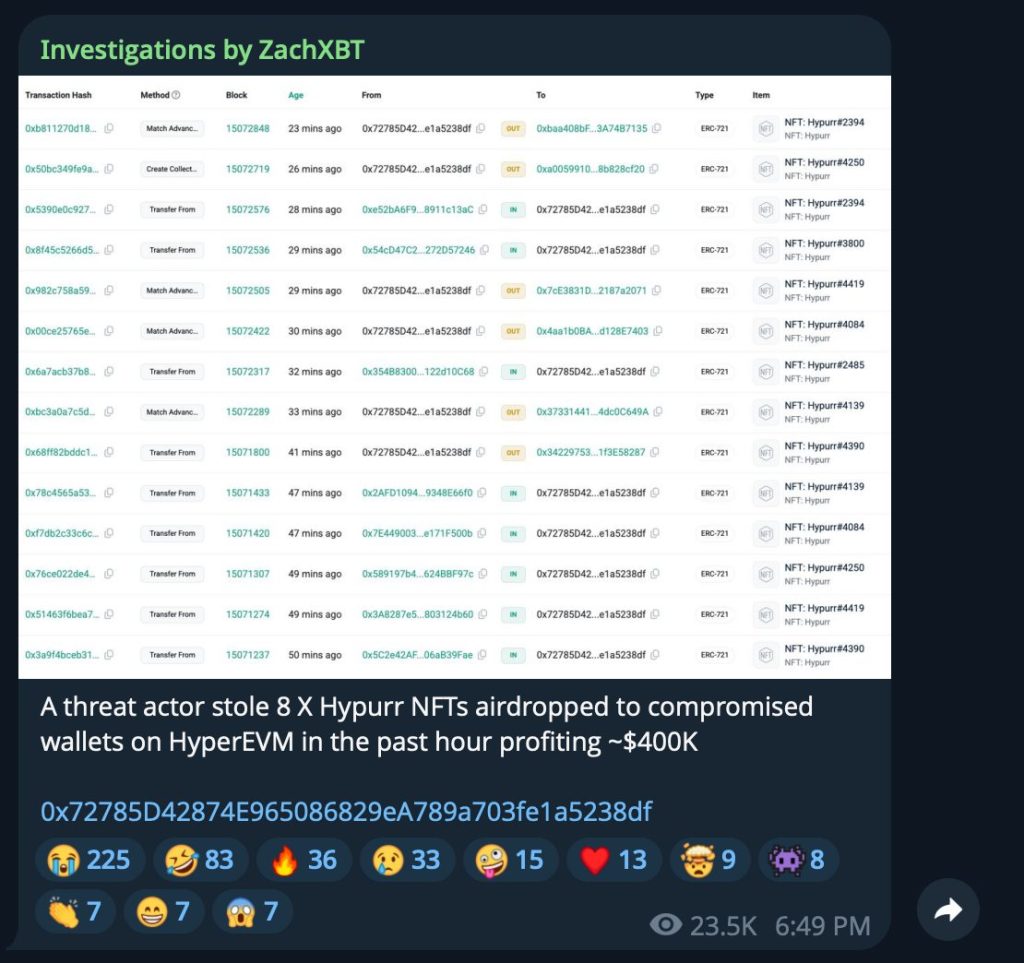
Hyperliquid's Hypurr NFTs Hit $76K Floor Price, But Hacker Steals 8 for $400K ProfitSource: ZachXTB

The Hyper Foundation distributed 4,600 unique cat-themed NFTs on September 28 to reward early supporters from the November 2024 Genesis Event.

The collection immediately achieved a floor price of $68,900, with total trading volume reaching $45 million within 24 hours on OpenSea. At the time of writing, the floor price has surpassed $70K.

The most expensive sale involved Hypurr #21, which featured rare “Knight Ghost Armor” traits, selling for 9,999 HYPE tokens, worth approximately $470,000.

Some NFTs had traded over-the-counter for $88,000 before the official launch through DripTrade’s collateralized pre-sale system.

The theft compounds security concerns plaguing Hyperliquid’s ecosystem following the $773,000 HyperDrive exploit and $3.6 million HyperVault rug pull within the same week.

The rapid succession of attacks has intensified scrutiny of security practices across projects building on the decentralized exchange platform.

Digital Cats Command Six-Figure Prices Despite Global Economic Pressures

The Hypurr collection features generative art depicting cartoon cats with various traits, including sunglasses, wizard robes, and armor elements.

Distribution allocated 4,313 NFTs to Genesis Event participants, 144 to the Hyper Foundation, and 143 to core contributors, including developers and artists.

According to OpenSea data, over 1.3 million HYPE tokens were traded in the past 24 hours, equivalent to $61 million at current prices.

The collection maintained 92.8% of supply held by 4,270 unique owners.

Community reactions varied widely, with some celebrating life-changing windfalls while others criticized the wealth disparity.

Creative director Alex Obymuralex praised the Hypurr design language as “timeless” rather than trend-driven, noting the collection’s simple forms and saturated colors lower intimidation barriers for mainstream adoption.

He argued that recognizable silhouettes and joyful palettes create lasting brand equity beyond speculation cycles.

Early adopters who participated in November’s Genesis Event received the NFTs at no cost beyond their initial platform engagement.

The event centered on the launch of Hyperliquid’s native HYPE token and HyperEVM programmability layer.

Notably, DripTrade’s over-the-counter system enabled pre-launch trading through collateralized agreements requiring sellers to fulfill transactions within seven days of receiving NFTs or forfeit deposited security.

This mechanism allowed price discovery even before official distribution.

Security Breaches Threaten Ecosystem Credibility

The Hypurr NFT theft follows three major security incidents targeting Hyperliquid projects within one week.

HyperDrive DeFi lost $773,000 through router contract vulnerabilities that enabled arbitrary function calls, while HyperVault developers executed a $3.6 million exit scam after ignoring community warnings about fabricated audit claims.

Previous exploits include the March JELLY token manipulation, which cost $13.5 million, and the “ETH 50x Big Guy” trader, who netted a $1.8 million profit while causing $4 million in vault losses.

This incident prompted a reduction in maximum leverage limits from 40x to 25x for major cryptocurrencies.

Competition intensifies as ASTER DEX processes over $13 billion in daily perpetual futures volume, compared to Hyperliquid’s reduced activity.

ASTER’s Trust Wallet integration provides 100 million users with direct access to perpetual contracts, challenging Hyperliquid’s market dominance.

Arthur Hayes exited his entire HYPE position with a $823,000 profit, citing the massive token unlocks worth $11.9 billion that were set to start on November 29.

He recently polled followers about re-entering after HYPE dropped 23% weekly to $35.50.

However, community members have proposed blacklisting Hayes from purchasing HYPE, with some labeling his trades as the “ultimate sell signal.”

Despite security challenges, Hyperliquid launched its USDH stablecoin, generating $2.2 million in early volume, while Native Markets secured the issuance mandate through a competitive governance voting process.

The platform also activated HYPE/USDH spot trading following Native Markets’ commitment to stake 200,000 tokens for a period of three years.

HYPE traded up 4.65% following the Hypurr launch, reaching $47.14 as community enthusiasm temporarily overshadowed ongoing security concerns and competition threats across the broader ecosystem.

Disclaimer: The articles reposted on this site are sourced from public platforms and are provided for informational purposes only. They do not necessarily reflect the views of MEXC. All rights remain with the original authors. If you believe any content infringes on third-party rights, please contact [email protected] for removal. MEXC makes no guarantees regarding the accuracy, completeness, or timeliness of the content and is not responsible for any actions taken based on the information provided. The content does not constitute financial, legal, or other professional advice, nor should it be considered a recommendation or endorsement by MEXC.

You May Also Like

Dramatic Spot Crypto ETF Outflows Rock US Market

Dramatic Spot Crypto ETF Outflows Rock US Market

BitcoinWorld Dramatic Spot Crypto ETF Outflows Rock US Market The cryptocurrency market is always buzzing with activity, and recent developments surrounding US spot Bitcoin and Ethereum ETFs have certainly grabbed attention. After a brief period of inflows, these prominent investment vehicles experienced a significant reversal, recording notable Spot Crypto ETF Outflows on September 22. This shift has sparked discussions among investors and analysts alike, prompting a closer look at what drove these movements and their potential implications for the broader digital asset landscape. What Triggered These Dramatic Spot Crypto ETF Outflows? On September 22, both US spot Bitcoin and Ethereum ETFs collectively observed net outflows, effectively ending a two-day streak of positive inflows. This sudden reversal indicates a potential shift in investor sentiment or market dynamics. Understanding the specifics of these Spot Crypto ETF Outflows is crucial for anyone tracking the pulse of the crypto market. Data from Trader T revealed that spot Bitcoin ETFs alone registered total net outflows amounting to $363.17 million. This substantial figure highlights a notable selling pressure across several key funds. Fidelity’s FBTC led the pack with $276.68 million in outflows. Ark Invest’s ARKB followed, seeing $52.30 million depart. Grayscale’s GBTC, a long-standing player, recorded $24.65 million in outflows. VanEck’s HODL also contributed with $9.54 million. Interestingly, BlackRock’s IBIT and several other funds reported zero flows on this particular day, indicating a concentrated selling activity in specific products rather than a market-wide exodus. How Did Ethereum ETFs Respond to the Spot Crypto ETF Outflows? The trend of net outflows wasn’t limited to Bitcoin. Spot Ethereum ETFs also faced considerable pressure, collectively experiencing $76.06 million in net outflows during the same period. This indicates a broader market sentiment affecting both major cryptocurrencies. Fidelity’s FETH accounted for $33.12 million of the outflows. Bitwise’s ETHW saw $22.30 million withdrawn. BlackRock’s ETHA registered $15.19 million in outflows. Grayscale’s Mini ETH contributed $5.45 million to the total. These figures underscore that while Bitcoin ETFs saw larger absolute outflows, Ethereum ETFs also experienced a significant cooling of investor interest. Such synchronized movements often suggest overarching market factors rather than isolated fund-specific issues. What Are the Broader Implications of These Spot Crypto ETF Outflows? The reversal from inflows to substantial Spot Crypto ETF Outflows could signal a few things. It might reflect profit-taking by investors after recent market rallies, or it could indicate a cautious stance due to macroeconomic uncertainties. Moreover, such movements can influence market sentiment, potentially leading to increased volatility in the short term. For investors, monitoring these ETF flows provides valuable insights into institutional and retail sentiment. Significant outflows can sometimes precede price corrections, offering an opportunity for strategic re-evaluation. Conversely, sustained inflows often suggest growing confidence in digital assets. It is important to remember that ETF flows are just one metric among many. A holistic view, considering on-chain data, macroeconomic indicators, and regulatory news, is essential for making informed decisions in the dynamic crypto space. These Spot Crypto ETF Outflows serve as a reminder of the market’s inherent volatility and the need for continuous vigilance. In summary, the recent dramatic Spot Crypto ETF Outflows from US Bitcoin and Ethereum funds mark a notable shift in the investment landscape. While a two-day inflow streak was broken, these movements are a natural part of a maturing market. They highlight the ebb and flow of investor confidence and the dynamic nature of digital asset investments. As the market continues to evolve, keeping a close eye on these ETF trends will remain crucial for understanding broader sentiment and potential future directions. Frequently Asked Questions (FAQs) Q1: What does “net outflows” mean for crypto ETFs? A1: Net outflows occur when investors redeem more shares from an ETF than they purchase, indicating more money is leaving the fund than entering it. Q2: Which US spot Bitcoin ETFs saw the largest outflows? A2: Fidelity’s FBTC led with $276.68 million in outflows, followed by Ark Invest’s ARKB and Grayscale’s GBTC, contributing significantly to the overall Spot Crypto ETF Outflows. Q3: Were Ethereum ETFs also affected by outflows? A3: Yes, US spot Ethereum ETFs experienced $76.06 million in net outflows, with Fidelity’s FETH and Bitwise’s ETHW being major contributors. Q4: What do these Spot Crypto ETF Outflows suggest about market sentiment? A4: They can suggest a shift towards profit-taking, increased caution due to macroeconomic factors, or a temporary cooling of investor interest in digital assets. Did you find this analysis of Spot Crypto ETF Outflows insightful? Share this article with your network on social media to help others understand the latest trends in the crypto ETF market and contribute to informed discussions! To learn more about the latest crypto market trends, explore our article on key developments shaping Bitcoin and Ethereum institutional adoption. This post Dramatic Spot Crypto ETF Outflows Rock US Market first appeared on BitcoinWorld.
Share
Coinstats2025/09/23 10:55
Remittix Success Leads To Rewarding Presale Investors With 300% Bonus – Here’s How To Get Involved

Remittix Success Leads To Rewarding Presale Investors With 300% Bonus – Here’s How To Get Involved

Besides its enormous presale success, Remittix is also extending a 300% bonus to early purchasers. This temporary bonus can be […] The post Remittix Success Leads
Share
Coindoo2026/02/07 16:39
Korean Crypto Exchange Bithumb Accidentally Gives Away Millions in Bitcoin During Promotion

Korean Crypto Exchange Bithumb Accidentally Gives Away Millions in Bitcoin During Promotion

TLDR Bithumb accidentally sent excess Bitcoin to customers during a promotional “Random Box” event in South Korea Some users reportedly received 2,000 BTC ($139
Share
Coincentral2026/02/07 16:39