Author: David, TechFlow Recently, amid the Perp DEX craze, various new projects have sprung up like mushrooms after rain, constantly challenging Hyperliquid's status as the big brother. With so much attention focused on the innovations of new players, the price fluctuations of the leading token, $HYPE, have been overlooked. However, the most direct correlation to token price fluctuations is the supply of $HYPE. What affects the supply is, first, continuous repurchases, which is equivalent to constantly buying in the stock market to reduce circulation and reduce the water in the pool; and the other is the adjustment of the overall supply mechanism, which is equivalent to turning off the tap. A closer look at $HYPE's current supply design reveals issues: The circulating supply is approximately 339 million coins, with a market capitalization of approximately $15.4 billion; however, the total supply is close to 1 billion coins, with an FDV of up to $46 billion. The nearly threefold gap between MC and FDV comes mainly from two parts: 421 million tokens allocated to the Future Emissions and Community Rewards (FECR) and 31.26 million tokens in the Assistance Fund (AF). The Assistance Fund is Hyperliquid's account for repurchasing HYPE using protocol revenue. It buys HYPE daily but doesn't burn it, instead holding it. The problem is that investors often feel overvalued when they see 46 billion FDV, even though only a third of it is actually in circulation. Against this backdrop, investment manager Jon Charbonneau (DBA Asset Management, which holds a large position in HYPE) and independent researcher Hasu released an unofficial proposal for $HYPE on September 22nd. The content is very radical; the simplified version is: Burning 45% of the current total $HYPE supply will bring FDV closer to its actual circulation value. This proposal quickly sparked community discussion, and as of press time, the post had received 410,000 views. Why such a strong response? If the proposal is adopted, burning 45% of the HYPE supply means the value of each HYPE token will almost double. A lower FDV may also attract investors who were previously on the sidelines. We have also quickly summarized the content of the original post of this proposal and organized it below. Reduce FDV to make HYPE look less expensive Jon and Hasu's proposal looks simple, burning 45% of the supply, but the actual operation is more complicated. To understand this proposal, we first need to understand HYPE's current supply structure. According to the data sheet Jon provided, at $49 (the HYPE price at the time of their proposal), of the total HYPE supply of 1 billion, only 337 million were actually in circulation, corresponding to a market capitalization of $16.5 billion. But where did the remaining 660 million go? The two largest pieces are: 421 million are allocated to "Future Emissions and Community Rewards" (FECR), which is equivalent to a huge reserve pool, but no one knows when and how to use it; the other 31.26 million are in the hands of the Assistance Fund (AF), which buys HYPE every day but does not sell it, and just hoards it. Let’s first talk about how to burn. The proposal includes three core actions: First, the authorization for 421 million FECRs (Future Emissions and Community Rewards) was revoked. These tokens were originally intended for future staking rewards and community incentives, but there has been no clear issuance schedule. Jon believes that rather than letting these tokens hang like a sword of Damocles over the market, it would be better to directly revoke the authorization. When necessary, the issuance can be re-approved through a governance vote. Second, the 31.26 million HYPE tokens held by the Assistance Fund (AF) will be destroyed, and all future HYPE tokens purchased by AF will also be destroyed. Currently, AF uses protocol revenue (primarily 99% of transaction fees) to repurchase HYPE daily, with an average daily purchase volume of approximately $1 million. Under Jon's plan, these purchased tokens will no longer be held but will be burned immediately. Third, remove the 1 billion supply cap. This sounds counterintuitive: if we want to reduce the supply, why remove the cap? Jon explained that the fixed cap is a legacy of Bitcoin's 21 million token model and is meaningless for most projects. With the cap removed, any future issuance of new coins (such as staking rewards) could be determined through governance, rather than allocated from a reserved pool. The comparison table below clearly shows the changes before and after the proposal: the left side is the current situation, and the right side is the situation after the proposal. Why are they so radical? The core reason given by Jon and Hasu is that HYPE’s token supply design is an accounting issue, not an economic issue. The problem lies in the calculation methods of major data platforms such as CoinmarketCap. Each platform handles burned tokens, FECR reserves, and AF holdings differently when calculating FDV, total supply, and circulating supply. For example, CoinMarketCap always uses a maximum supply of 1 billion to calculate FDV, and does not adjust even if tokens are burned. The result is that no matter how HYPE repurchases or burns it, the displayed FDV cannot be reduced. It can be seen that the biggest change in the proposal is that 421 million FECR and 31 million AF will disappear, and the 1 billion hard cap will also be cancelled and replaced by issuance through governance as needed. Jon wrote in the proposal: "Many investors, including some of the largest and most mature funds, only look at the superficial FDV numbers." With a FDV of $46 billion, HYPE looks more expensive than Ethereum. Who would dare to buy it? However, most proposals seem to be driven by one's own opinion. Jon explicitly stated that the DBA Fund he manages holds a "material position" in HYPE, which he personally holds as well, and that if there were a vote, they would vote in favor. The proposal concludes by emphasizing that these changes will not affect the relative shares of existing holders, will not affect Hyperliquid's ability to fund projects, and will not change the decision-making mechanism. In Jon's words, “It just keeps the books more honest.” When “distribution to the community” becomes an unspoken rule But will the community buy into this proposal? The original post's comments section has already exploded. Among them, Dragonfly Capital partner Haseeb Qureshi's comments put this proposal into a larger industry context: “Some of the ‘sacred cows’ in the crypto industry just won’t die, and it’s time to slaughter them.” He was referring to an unspoken rule throughout the crypto industry: after tokens are generated, projects must always reserve 40-50% of their tokens for the "community." This sounds very decentralized and Web3-esque, but it's actually a form of performance art. In 2021, at the height of the bull market, every project was competing to be more "decentralized." Consequently, token economics specifications included claims of 50%, 60%, or even 70% community ownership, with the higher the number, the more politically correct it seemed. But how exactly will these tokens be used? No one can explain. From a more malicious perspective, some project parties are more realistic about the tokens they allocate to the community, allowing them to use them whenever and however they want, under the euphemism of "for the community." The problem is, the market is not stupid. Haseeb also revealed an open secret: professional investors automatically give these "community reserves" a 50% discount when evaluating projects. A project with a FDV of 50 billion but 50% of it allocated to the community is only worth 25 billion in their eyes. Unless there is a clear ROI, these tokens are just empty promises. This is precisely the problem HYPE faces. Of HYPE's $49 billion in FDV, over 40% is reserved for "future emissions and community rewards." This figure can be dissuading for investors. It's not because HYPE is bad, but because the numbers on paper are too inflated. Haseeb believes that Jon's proposal has a driving effect, gradually turning radical ideas that were originally not openly discussed into acceptable mainstream views; we need to question the crypto industry's practice of allocating tokens to "community reserves." To summarize, the supporters' argument is simple: If you want to use tokens, you need to implement governance, clearly stating why they are being issued, how much to issue, and what the expected returns are. It should be transparent and accountable, not a black box. At the same time, because this post is too radical, there are some objections in the comment section. We can summarize it into three parts: First, some HYPE must be used as a risk reserve. From a risk management perspective, some believe the 31 million HYPE in the AF support fund isn't just inventory, but also emergency funds. What if regulatory fines or hacker attacks require compensation? Burning all the reserves would eliminate the crisis buffer. Second, HYPE already has a complete destruction mechanism technically. Hyperliquid already has three natural destruction mechanisms: spot transaction fee destruction, HyperEVM gas fee destruction, and token auction fee destruction. These mechanisms automatically adjust supply based on platform usage, so why would anyone need to intervene? Usage-based destruction is healthier than a one-time destruction. Third, large-scale destruction is not conducive to incentives. Future emissions are Hyperliquid's most important growth tool, used to incentivize users and reward contributors. Burning them would be tantamount to self-destruction. Furthermore, large stakers would be locked out. Without new token rewards, who would be willing to stake? Who does the token serve? On the surface, this seems to be a technical discussion about whether to burn the coin or not. However, a closer look at the positions of all parties reveals that the disagreement is actually a matter of opinion. The view represented by Jon and Haseeb is clear: institutional investors are the main source of incremental funds. These funds manage billions of dollars, and their purchases can truly drive prices. The problem is, they're hesitant to enter the market when they see the $49 billion FDV. So, we need to correct this number to make HYPE more attractive to institutions. The community's perspective is completely different. They see the platform's foundation as the retail traders who open and close positions daily. Hyperliquid's success isn't due to VC funding, but rather the support of 94,000 airdrop recipients. Changing the economic model to cater to institutions is putting the cart before the horse. This isn't the first time this disagreement has arisen. Looking back at DeFi history, almost every successful project has experienced a similar crossroads. When Uniswap launched its token, the community and investors argued fiercely over control of the treasury. The core issue is always the same: Does a project on a blockchain serve big money or grassroots crypto natives? This proposal seems to serve the former. "Many of the largest and most mature funds only look at FDV." The implication is clear: if you want to let these big money come in, you have to play by their rules. Jon, the proposer, is an institutional investor himself, and his DBA Fund holds a significant amount of HYPE. If the proposal passes, it will be large investors like him who will benefit the most. With a reduced supply, the price of the coin is likely to rise, and the value of their holdings will also increase. Considering Arthur Hayes' recent $800,000 sale of HYPE, which he jokingly described as buying a Ferrari, we can sense a subtle timing. The earliest backers are cashing out, and now some are proposing to burn tokens to drive up the price. Who are they actually helping? As of press time, Hyperliquid has yet to officially release its position. Regardless of the final decision, this debate has revealed a truth that no one wants to face: With profit at the forefront, we may never have cared that much about decentralization and were just pretending.Author: David, TechFlow Recently, amid the Perp DEX craze, various new projects have sprung up like mushrooms after rain, constantly challenging Hyperliquid's status as the big brother. With so much attention focused on the innovations of new players, the price fluctuations of the leading token, $HYPE, have been overlooked. However, the most direct correlation to token price fluctuations is the supply of $HYPE. What affects the supply is, first, continuous repurchases, which is equivalent to constantly buying in the stock market to reduce circulation and reduce the water in the pool; and the other is the adjustment of the overall supply mechanism, which is equivalent to turning off the tap. A closer look at $HYPE's current supply design reveals issues: The circulating supply is approximately 339 million coins, with a market capitalization of approximately $15.4 billion; however, the total supply is close to 1 billion coins, with an FDV of up to $46 billion. The nearly threefold gap between MC and FDV comes mainly from two parts: 421 million tokens allocated to the Future Emissions and Community Rewards (FECR) and 31.26 million tokens in the Assistance Fund (AF). The Assistance Fund is Hyperliquid's account for repurchasing HYPE using protocol revenue. It buys HYPE daily but doesn't burn it, instead holding it. The problem is that investors often feel overvalued when they see 46 billion FDV, even though only a third of it is actually in circulation. Against this backdrop, investment manager Jon Charbonneau (DBA Asset Management, which holds a large position in HYPE) and independent researcher Hasu released an unofficial proposal for $HYPE on September 22nd. The content is very radical; the simplified version is: Burning 45% of the current total $HYPE supply will bring FDV closer to its actual circulation value. This proposal quickly sparked community discussion, and as of press time, the post had received 410,000 views. Why such a strong response? If the proposal is adopted, burning 45% of the HYPE supply means the value of each HYPE token will almost double. A lower FDV may also attract investors who were previously on the sidelines. We have also quickly summarized the content of the original post of this proposal and organized it below. Reduce FDV to make HYPE look less expensive Jon and Hasu's proposal looks simple, burning 45% of the supply, but the actual operation is more complicated. To understand this proposal, we first need to understand HYPE's current supply structure. According to the data sheet Jon provided, at $49 (the HYPE price at the time of their proposal), of the total HYPE supply of 1 billion, only 337 million were actually in circulation, corresponding to a market capitalization of $16.5 billion. But where did the remaining 660 million go? The two largest pieces are: 421 million are allocated to "Future Emissions and Community Rewards" (FECR), which is equivalent to a huge reserve pool, but no one knows when and how to use it; the other 31.26 million are in the hands of the Assistance Fund (AF), which buys HYPE every day but does not sell it, and just hoards it. Let’s first talk about how to burn. The proposal includes three core actions: First, the authorization for 421 million FECRs (Future Emissions and Community Rewards) was revoked. These tokens were originally intended for future staking rewards and community incentives, but there has been no clear issuance schedule. Jon believes that rather than letting these tokens hang like a sword of Damocles over the market, it would be better to directly revoke the authorization. When necessary, the issuance can be re-approved through a governance vote. Second, the 31.26 million HYPE tokens held by the Assistance Fund (AF) will be destroyed, and all future HYPE tokens purchased by AF will also be destroyed. Currently, AF uses protocol revenue (primarily 99% of transaction fees) to repurchase HYPE daily, with an average daily purchase volume of approximately $1 million. Under Jon's plan, these purchased tokens will no longer be held but will be burned immediately. Third, remove the 1 billion supply cap. This sounds counterintuitive: if we want to reduce the supply, why remove the cap? Jon explained that the fixed cap is a legacy of Bitcoin's 21 million token model and is meaningless for most projects. With the cap removed, any future issuance of new coins (such as staking rewards) could be determined through governance, rather than allocated from a reserved pool. The comparison table below clearly shows the changes before and after the proposal: the left side is the current situation, and the right side is the situation after the proposal. Why are they so radical? The core reason given by Jon and Hasu is that HYPE’s token supply design is an accounting issue, not an economic issue. The problem lies in the calculation methods of major data platforms such as CoinmarketCap. Each platform handles burned tokens, FECR reserves, and AF holdings differently when calculating FDV, total supply, and circulating supply. For example, CoinMarketCap always uses a maximum supply of 1 billion to calculate FDV, and does not adjust even if tokens are burned. The result is that no matter how HYPE repurchases or burns it, the displayed FDV cannot be reduced. It can be seen that the biggest change in the proposal is that 421 million FECR and 31 million AF will disappear, and the 1 billion hard cap will also be cancelled and replaced by issuance through governance as needed. Jon wrote in the proposal: "Many investors, including some of the largest and most mature funds, only look at the superficial FDV numbers." With a FDV of $46 billion, HYPE looks more expensive than Ethereum. Who would dare to buy it? However, most proposals seem to be driven by one's own opinion. Jon explicitly stated that the DBA Fund he manages holds a "material position" in HYPE, which he personally holds as well, and that if there were a vote, they would vote in favor. The proposal concludes by emphasizing that these changes will not affect the relative shares of existing holders, will not affect Hyperliquid's ability to fund projects, and will not change the decision-making mechanism. In Jon's words, “It just keeps the books more honest.” When “distribution to the community” becomes an unspoken rule But will the community buy into this proposal? The original post's comments section has already exploded. Among them, Dragonfly Capital partner Haseeb Qureshi's comments put this proposal into a larger industry context: “Some of the ‘sacred cows’ in the crypto industry just won’t die, and it’s time to slaughter them.” He was referring to an unspoken rule throughout the crypto industry: after tokens are generated, projects must always reserve 40-50% of their tokens for the "community." This sounds very decentralized and Web3-esque, but it's actually a form of performance art. In 2021, at the height of the bull market, every project was competing to be more "decentralized." Consequently, token economics specifications included claims of 50%, 60%, or even 70% community ownership, with the higher the number, the more politically correct it seemed. But how exactly will these tokens be used? No one can explain. From a more malicious perspective, some project parties are more realistic about the tokens they allocate to the community, allowing them to use them whenever and however they want, under the euphemism of "for the community." The problem is, the market is not stupid. Haseeb also revealed an open secret: professional investors automatically give these "community reserves" a 50% discount when evaluating projects. A project with a FDV of 50 billion but 50% of it allocated to the community is only worth 25 billion in their eyes. Unless there is a clear ROI, these tokens are just empty promises. This is precisely the problem HYPE faces. Of HYPE's $49 billion in FDV, over 40% is reserved for "future emissions and community rewards." This figure can be dissuading for investors. It's not because HYPE is bad, but because the numbers on paper are too inflated. Haseeb believes that Jon's proposal has a driving effect, gradually turning radical ideas that were originally not openly discussed into acceptable mainstream views; we need to question the crypto industry's practice of allocating tokens to "community reserves." To summarize, the supporters' argument is simple: If you want to use tokens, you need to implement governance, clearly stating why they are being issued, how much to issue, and what the expected returns are. It should be transparent and accountable, not a black box. At the same time, because this post is too radical, there are some objections in the comment section. We can summarize it into three parts: First, some HYPE must be used as a risk reserve. From a risk management perspective, some believe the 31 million HYPE in the AF support fund isn't just inventory, but also emergency funds. What if regulatory fines or hacker attacks require compensation? Burning all the reserves would eliminate the crisis buffer. Second, HYPE already has a complete destruction mechanism technically. Hyperliquid already has three natural destruction mechanisms: spot transaction fee destruction, HyperEVM gas fee destruction, and token auction fee destruction. These mechanisms automatically adjust supply based on platform usage, so why would anyone need to intervene? Usage-based destruction is healthier than a one-time destruction. Third, large-scale destruction is not conducive to incentives. Future emissions are Hyperliquid's most important growth tool, used to incentivize users and reward contributors. Burning them would be tantamount to self-destruction. Furthermore, large stakers would be locked out. Without new token rewards, who would be willing to stake? Who does the token serve? On the surface, this seems to be a technical discussion about whether to burn the coin or not. However, a closer look at the positions of all parties reveals that the disagreement is actually a matter of opinion. The view represented by Jon and Haseeb is clear: institutional investors are the main source of incremental funds. These funds manage billions of dollars, and their purchases can truly drive prices. The problem is, they're hesitant to enter the market when they see the $49 billion FDV. So, we need to correct this number to make HYPE more attractive to institutions. The community's perspective is completely different. They see the platform's foundation as the retail traders who open and close positions daily. Hyperliquid's success isn't due to VC funding, but rather the support of 94,000 airdrop recipients. Changing the economic model to cater to institutions is putting the cart before the horse. This isn't the first time this disagreement has arisen. Looking back at DeFi history, almost every successful project has experienced a similar crossroads. When Uniswap launched its token, the community and investors argued fiercely over control of the treasury. The core issue is always the same: Does a project on a blockchain serve big money or grassroots crypto natives? This proposal seems to serve the former. "Many of the largest and most mature funds only look at FDV." The implication is clear: if you want to let these big money come in, you have to play by their rules. Jon, the proposer, is an institutional investor himself, and his DBA Fund holds a significant amount of HYPE. If the proposal passes, it will be large investors like him who will benefit the most. With a reduced supply, the price of the coin is likely to rise, and the value of their holdings will also increase. Considering Arthur Hayes' recent $800,000 sale of HYPE, which he jokingly described as buying a Ferrari, we can sense a subtle timing. The earliest backers are cashing out, and now some are proposing to burn tokens to drive up the price. Who are they actually helping? As of press time, Hyperliquid has yet to officially release its position. Regardless of the final decision, this debate has revealed a truth that no one wants to face: With profit at the forefront, we may never have cared that much about decentralization and were just pretending.

What’s the intention behind a radical proposal to burn 45% of HYPE’s supply?

2025/09/23 19:00
10 min read

Author: David, TechFlow

Recently, amid the Perp DEX craze, various new projects have sprung up like mushrooms after rain, constantly challenging Hyperliquid's status as the big brother.

With so much attention focused on the innovations of new players, the price fluctuations of the leading token, $HYPE, have been overlooked. However, the most direct correlation to token price fluctuations is the supply of $HYPE.

What affects the supply is, first, continuous repurchases, which is equivalent to constantly buying in the stock market to reduce circulation and reduce the water in the pool; and the other is the adjustment of the overall supply mechanism, which is equivalent to turning off the tap.

A closer look at $HYPE's current supply design reveals issues:

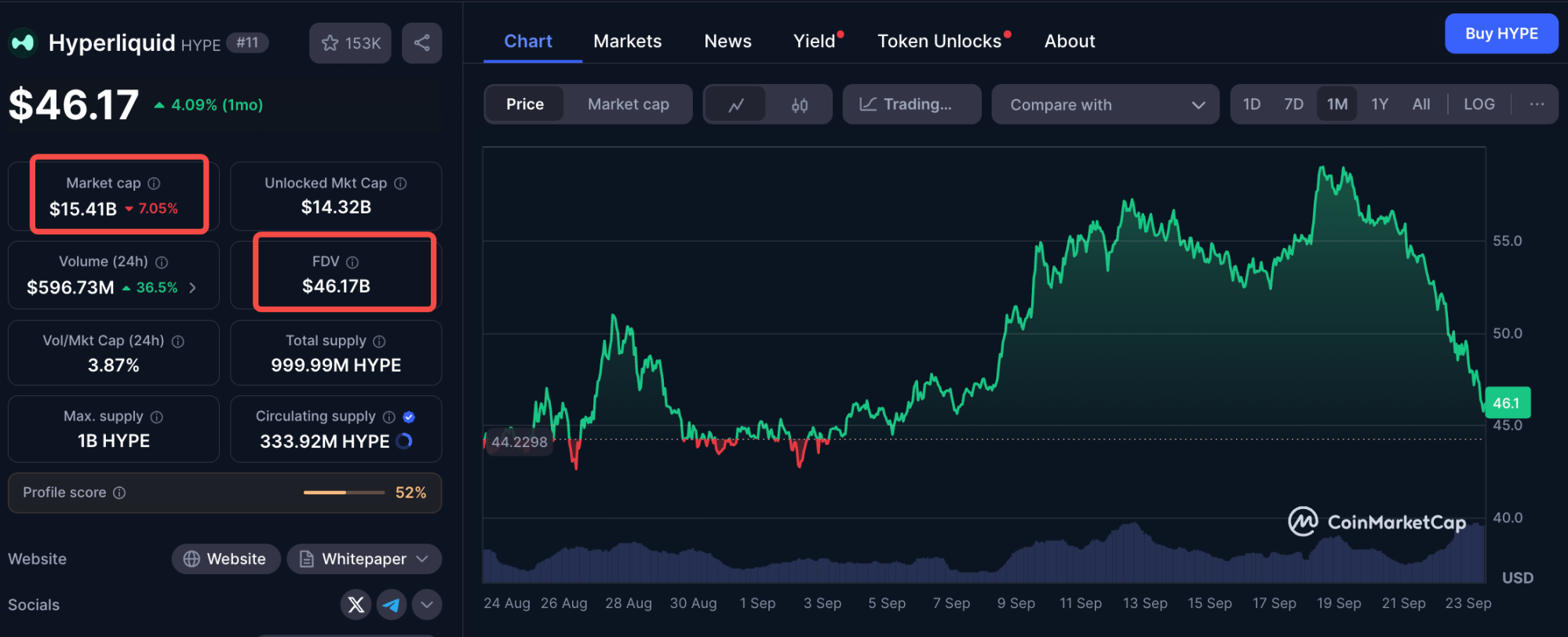
The circulating supply is approximately 339 million coins, with a market capitalization of approximately $15.4 billion; however, the total supply is close to 1 billion coins, with an FDV of up to $46 billion.

The nearly threefold gap between MC and FDV comes mainly from two parts: 421 million tokens allocated to the Future Emissions and Community Rewards (FECR) and 31.26 million tokens in the Assistance Fund (AF).

The Assistance Fund is Hyperliquid's account for repurchasing HYPE using protocol revenue. It buys HYPE daily but doesn't burn it, instead holding it. The problem is that investors often feel overvalued when they see 46 billion FDV, even though only a third of it is actually in circulation.
Against this backdrop, investment manager Jon Charbonneau (DBA Asset Management, which holds a large position in HYPE) and independent researcher Hasu released an unofficial proposal for $HYPE on September 22nd. The content is very radical; the simplified version is:

Burning 45% of the current total $HYPE supply will bring FDV closer to its actual circulation value.

This proposal quickly sparked community discussion, and as of press time, the post had received 410,000 views.

Why such a strong response? If the proposal is adopted, burning 45% of the HYPE supply means the value of each HYPE token will almost double. A lower FDV may also attract investors who were previously on the sidelines.
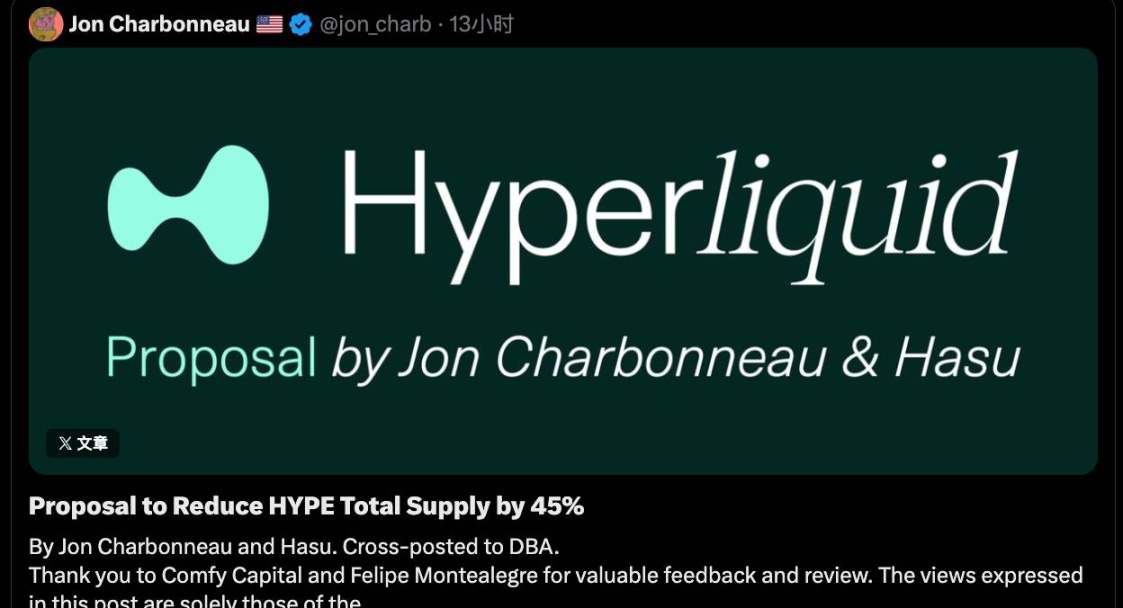
We have also quickly summarized the content of the original post of this proposal and organized it below.

Reduce FDV to make HYPE look less expensive

Jon and Hasu's proposal looks simple, burning 45% of the supply, but the actual operation is more complicated.

To understand this proposal, we first need to understand HYPE's current supply structure. According to the data sheet Jon provided, at $49 (the HYPE price at the time of their proposal), of the total HYPE supply of 1 billion, only 337 million were actually in circulation, corresponding to a market capitalization of $16.5 billion.

But where did the remaining 660 million go?

The two largest pieces are: 421 million are allocated to "Future Emissions and Community Rewards" (FECR), which is equivalent to a huge reserve pool, but no one knows when and how to use it; the other 31.26 million are in the hands of the Assistance Fund (AF), which buys HYPE every day but does not sell it, and just hoards it.
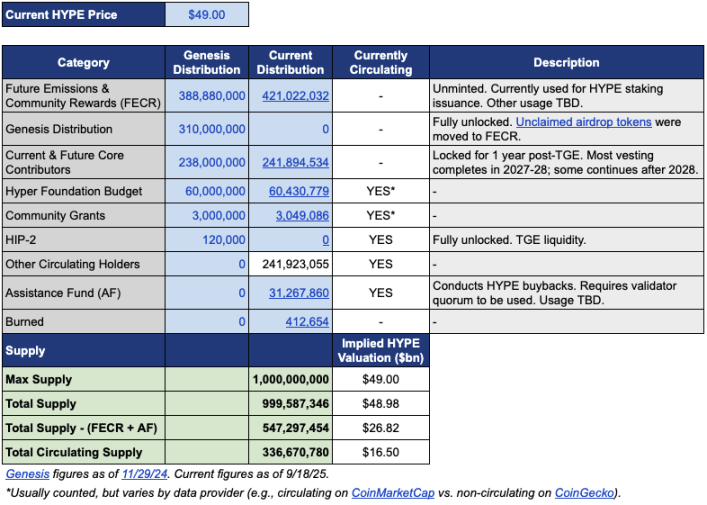
Let’s first talk about how to burn. The proposal includes three core actions:

First, the authorization for 421 million FECRs (Future Emissions and Community Rewards) was revoked. These tokens were originally intended for future staking rewards and community incentives, but there has been no clear issuance schedule. Jon believes that rather than letting these tokens hang like a sword of Damocles over the market, it would be better to directly revoke the authorization. When necessary, the issuance can be re-approved through a governance vote.

Second, the 31.26 million HYPE tokens held by the Assistance Fund (AF) will be destroyed, and all future HYPE tokens purchased by AF will also be destroyed. Currently, AF uses protocol revenue (primarily 99% of transaction fees) to repurchase HYPE daily, with an average daily purchase volume of approximately $1 million. Under Jon's plan, these purchased tokens will no longer be held but will be burned immediately.

Third, remove the 1 billion supply cap. This sounds counterintuitive: if we want to reduce the supply, why remove the cap?

Jon explained that the fixed cap is a legacy of Bitcoin's 21 million token model and is meaningless for most projects. With the cap removed, any future issuance of new coins (such as staking rewards) could be determined through governance, rather than allocated from a reserved pool.

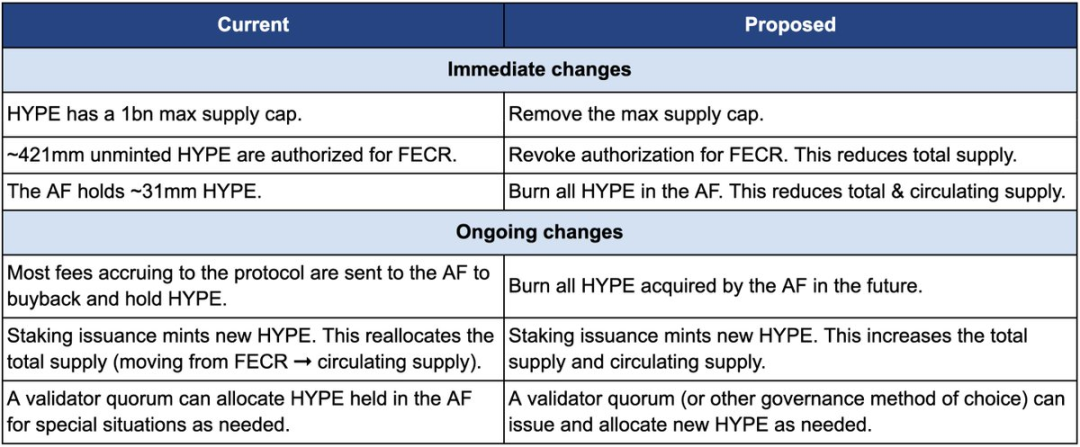
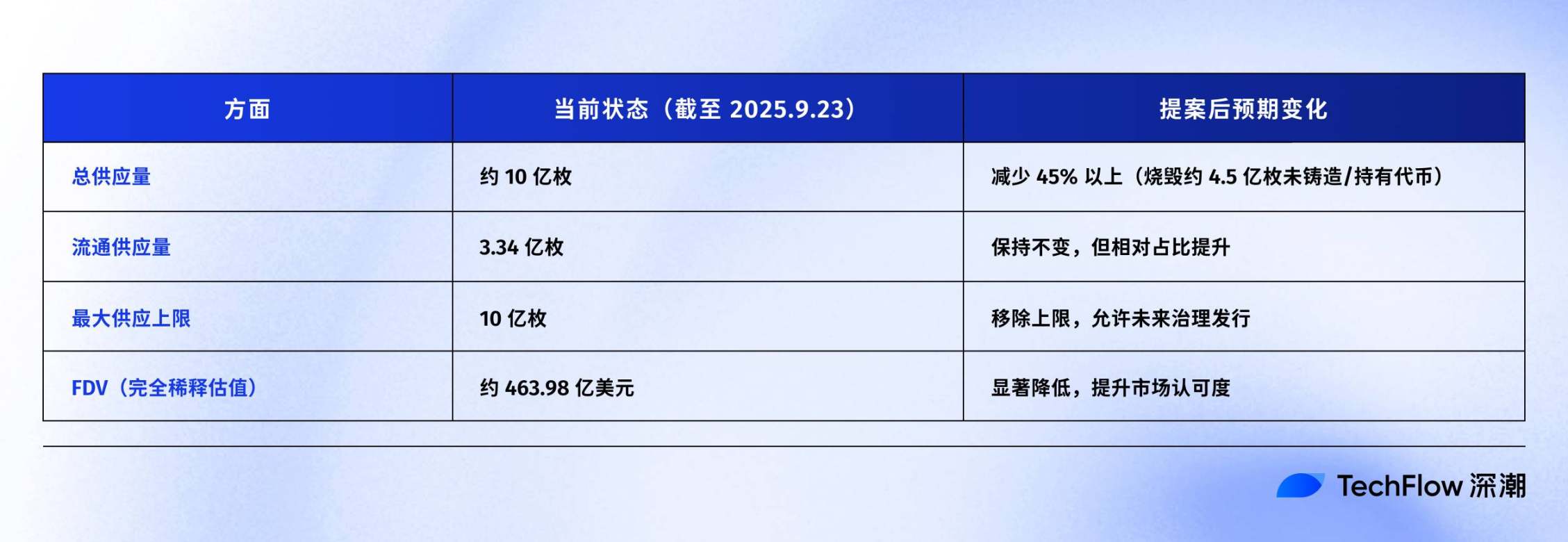
The comparison table below clearly shows the changes before and after the proposal: the left side is the current situation, and the right side is the situation after the proposal.
Why are they so radical? The core reason given by Jon and Hasu is that HYPE’s token supply design is an accounting issue, not an economic issue.

The problem lies in the calculation methods of major data platforms such as CoinmarketCap.

Each platform handles burned tokens, FECR reserves, and AF holdings differently when calculating FDV, total supply, and circulating supply. For example, CoinMarketCap always uses a maximum supply of 1 billion to calculate FDV, and does not adjust even if tokens are burned.

The result is that no matter how HYPE repurchases or burns it, the displayed FDV cannot be reduced.

It can be seen that the biggest change in the proposal is that 421 million FECR and 31 million AF will disappear, and the 1 billion hard cap will also be cancelled and replaced by issuance through governance as needed.
Jon wrote in the proposal: "Many investors, including some of the largest and most mature funds, only look at the superficial FDV numbers." With a FDV of $46 billion, HYPE looks more expensive than Ethereum. Who would dare to buy it?

However, most proposals seem to be driven by one's own opinion. Jon explicitly stated that the DBA Fund he manages holds a "material position" in HYPE, which he personally holds as well, and that if there were a vote, they would vote in favor.

The proposal concludes by emphasizing that these changes will not affect the relative shares of existing holders, will not affect Hyperliquid's ability to fund projects, and will not change the decision-making mechanism. In Jon's words,

“It just keeps the books more honest.”

When “distribution to the community” becomes an unspoken rule

But will the community buy into this proposal? The original post's comments section has already exploded.

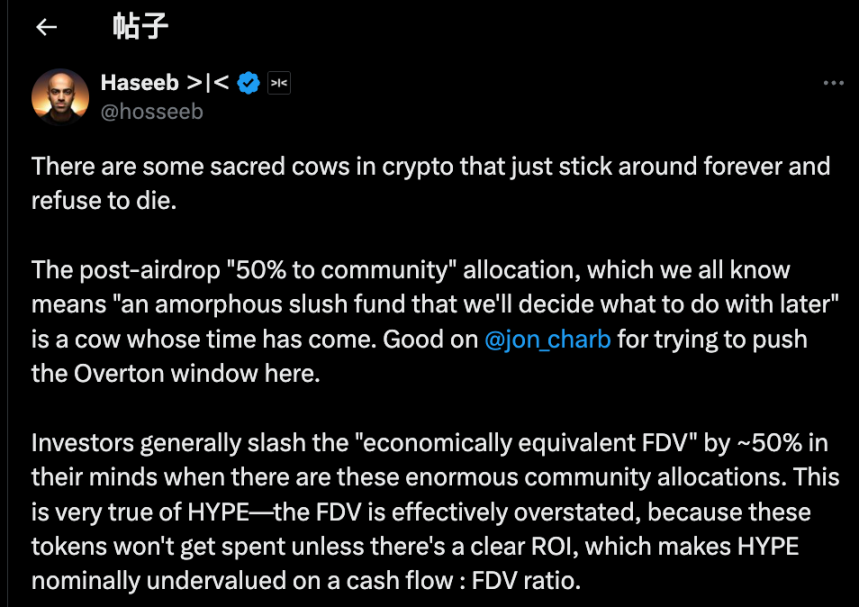
Among them, Dragonfly Capital partner Haseeb Qureshi's comments put this proposal into a larger industry context:

“Some of the ‘sacred cows’ in the crypto industry just won’t die, and it’s time to slaughter them.”

He was referring to an unspoken rule throughout the crypto industry: after tokens are generated, projects must always reserve 40-50% of their tokens for the "community." This sounds very decentralized and Web3-esque, but it's actually a form of performance art.

In 2021, at the height of the bull market, every project was competing to be more "decentralized." Consequently, token economics specifications included claims of 50%, 60%, or even 70% community ownership, with the higher the number, the more politically correct it seemed.

But how exactly will these tokens be used? No one can explain.
From a more malicious perspective, some project parties are more realistic about the tokens they allocate to the community, allowing them to use them whenever and however they want, under the euphemism of "for the community."

The problem is, the market is not stupid.

Haseeb also revealed an open secret: professional investors automatically give these "community reserves" a 50% discount when evaluating projects.

A project with a FDV of 50 billion but 50% of it allocated to the community is only worth 25 billion in their eyes. Unless there is a clear ROI, these tokens are just empty promises.

This is precisely the problem HYPE faces. Of HYPE's $49 billion in FDV, over 40% is reserved for "future emissions and community rewards." This figure can be dissuading for investors.

It's not because HYPE is bad, but because the numbers on paper are too inflated. Haseeb believes that Jon's proposal has a driving effect, gradually turning radical ideas that were originally not openly discussed into acceptable mainstream views; we need to question the crypto industry's practice of allocating tokens to "community reserves."

To summarize, the supporters' argument is simple:

If you want to use tokens, you need to implement governance, clearly stating why they are being issued, how much to issue, and what the expected returns are. It should be transparent and accountable, not a black box.

At the same time, because this post is too radical, there are some objections in the comment section. We can summarize it into three parts:

First, some HYPE must be used as a risk reserve.

From a risk management perspective, some believe the 31 million HYPE in the AF support fund isn't just inventory, but also emergency funds. What if regulatory fines or hacker attacks require compensation? Burning all the reserves would eliminate the crisis buffer.

Second, HYPE already has a complete destruction mechanism technically.

Hyperliquid already has three natural destruction mechanisms: spot transaction fee destruction, HyperEVM gas fee destruction, and token auction fee destruction.

These mechanisms automatically adjust supply based on platform usage, so why would anyone need to intervene? Usage-based destruction is healthier than a one-time destruction.

Third, large-scale destruction is not conducive to incentives.

Future emissions are Hyperliquid's most important growth tool, used to incentivize users and reward contributors. Burning them would be tantamount to self-destruction. Furthermore, large stakers would be locked out. Without new token rewards, who would be willing to stake?

Who does the token serve?

On the surface, this seems to be a technical discussion about whether to burn the coin or not. However, a closer look at the positions of all parties reveals that the disagreement is actually a matter of opinion.

The view represented by Jon and Haseeb is clear: institutional investors are the main source of incremental funds.

These funds manage billions of dollars, and their purchases can truly drive prices. The problem is, they're hesitant to enter the market when they see the $49 billion FDV. So, we need to correct this number to make HYPE more attractive to institutions.

The community's perspective is completely different. They see the platform's foundation as the retail traders who open and close positions daily. Hyperliquid's success isn't due to VC funding, but rather the support of 94,000 airdrop recipients. Changing the economic model to cater to institutions is putting the cart before the horse.

This isn't the first time this disagreement has arisen.

Looking back at DeFi history, almost every successful project has experienced a similar crossroads. When Uniswap launched its token, the community and investors argued fiercely over control of the treasury.

The core issue is always the same: Does a project on a blockchain serve big money or grassroots crypto natives?

This proposal seems to serve the former. "Many of the largest and most mature funds only look at FDV." The implication is clear: if you want to let these big money come in, you have to play by their rules.

Jon, the proposer, is an institutional investor himself, and his DBA Fund holds a significant amount of HYPE. If the proposal passes, it will be large investors like him who will benefit the most. With a reduced supply, the price of the coin is likely to rise, and the value of their holdings will also increase.

Considering Arthur Hayes' recent $800,000 sale of HYPE, which he jokingly described as buying a Ferrari, we can sense a subtle timing. The earliest backers are cashing out, and now some are proposing to burn tokens to drive up the price. Who are they actually helping?

As of press time, Hyperliquid has yet to officially release its position. Regardless of the final decision, this debate has revealed a truth that no one wants to face:

With profit at the forefront, we may never have cared that much about decentralization and were just pretending.

Market Opportunity
Threshold Logo
Threshold Price(T)
$0,006991
$0,006991$0,006991
+0,61%
USD
Threshold (T) Live Price Chart
Disclaimer: The articles reposted on this site are sourced from public platforms and are provided for informational purposes only. They do not necessarily reflect the views of MEXC. All rights remain with the original authors. If you believe any content infringes on third-party rights, please contact [email protected] for removal. MEXC makes no guarantees regarding the accuracy, completeness, or timeliness of the content and is not responsible for any actions taken based on the information provided. The content does not constitute financial, legal, or other professional advice, nor should it be considered a recommendation or endorsement by MEXC.

You May Also Like

Momentous Grayscale ETF: GDLC Fund’s Historic Conversion Set to Trade Tomorrow

Momentous Grayscale ETF: GDLC Fund’s Historic Conversion Set to Trade Tomorrow

BitcoinWorld Momentous Grayscale ETF: GDLC Fund’s Historic Conversion Set to Trade Tomorrow Get ready for a significant shift in the world of digital asset investing! A truly momentous event is unfolding as Grayscale’s Digital Large Cap Fund (GDLC) makes its highly anticipated transition into a spot crypto exchange-traded fund. This isn’t just a name change; it’s a pivotal moment for the broader cryptocurrency market, bringing a new era of accessibility and institutional participation through the Grayscale ETF. What’s Happening with the Grayscale ETF Conversion? Tomorrow marks a historic day for Grayscale’s Digital Large Cap Fund (GDLC). This existing spot crypto basket is officially scheduled to begin trading under its new identity: the Grayscale CoinDesk Crypto5 ETF. This exciting development comes directly after the U.S. Securities and Exchange Commission (SEC) gave its stamp of approval to Grayscale’s application for this conversion. As Bloomberg ETF analyst Eric Balchunas highlighted, this move has been keenly watched. The approval and subsequent launch underscore a growing acceptance of crypto-backed financial products within traditional markets. For investors, this conversion of the Grayscale ETF represents a more streamlined and regulated way to gain exposure to a diversified basket of large-cap digital assets. Why is the Grayscale ETF a Game-Changer for Investors? The conversion of GDLC into a Grayscale ETF offers several compelling benefits, fundamentally changing how investors can access the crypto market. Firstly, ETFs are known for their ease of trading. They can be bought and sold on traditional stock exchanges, just like company shares, making them incredibly accessible to a wider range of investors who might be hesitant to directly hold cryptocurrencies. Consider these key advantages: Enhanced Accessibility: Investors can gain exposure to a diversified crypto portfolio without needing to set up crypto wallets or manage private keys. Increased Liquidity: Trading on major exchanges typically means higher liquidity, allowing for easier entry and exit points. Regulatory Oversight: As an SEC-approved product, the Grayscale ETF operates under a regulated framework, potentially offering greater investor protection and confidence. Diversification: The Grayscale CoinDesk Crypto5 ETF tracks a basket of large-cap cryptocurrencies, offering immediate diversification rather than exposure to a single asset. This development is a strong indicator of the maturation of the digital asset space. It signals a bridge between the innovative world of crypto and the established financial system. Navigating the New Grayscale ETF Landscape While the launch of the Grayscale CoinDesk Crypto5 ETF brings exciting opportunities, it’s also important for investors to understand its implications. The shift from a closed-end fund structure (GDLC) to an open-ended ETF means that the fund’s shares can now be created and redeemed daily. This mechanism helps keep the ETF’s market price closely aligned with the net asset value (NAV) of its underlying holdings. Historically, closed-end funds like GDLC could trade at significant premiums or discounts to their NAV. The ETF structure is designed to mitigate these discrepancies, providing a more efficient pricing mechanism. This change offers a more transparent and potentially less volatile investment experience for those looking to invest in a Grayscale ETF. What’s Next for Crypto ETFs and Grayscale? The successful conversion and launch of the Grayscale CoinDesk Crypto5 ETF could pave the way for similar transformations of other Grayscale products. It also sets a precedent for how existing crypto investment vehicles might evolve to meet market demand for regulated, accessible products. The increasing number of spot crypto ETFs, including this new Grayscale ETF, reflects a growing institutional appetite for digital assets. This trend suggests a future where cryptocurrency investing becomes an even more integrated part of mainstream financial portfolios. As regulatory clarity continues to improve, we can anticipate further innovation and expansion in the crypto ETF landscape, offering investors diverse options to participate in the digital economy. The launch of the Grayscale CoinDesk Crypto5 ETF is more than just a new product; it’s a testament to the persistent efforts to bring digital assets into the mainstream financial fold. By offering a regulated, accessible, and diversified investment vehicle, Grayscale is not only expanding opportunities for investors but also reinforcing the legitimacy and staying power of the crypto market. This momentous step truly reshapes the investment landscape, making it easier for a broader audience to engage with the exciting potential of cryptocurrencies through a trusted Grayscale ETF. Frequently Asked Questions (FAQs) What is the Grayscale CoinDesk Crypto5 ETF? The Grayscale CoinDesk Crypto5 ETF is the new name and structure for Grayscale’s former Digital Large Cap Fund (GDLC). It’s a spot crypto basket that holds a diversified portfolio of large-cap digital assets, now trading as an exchange-traded fund. When will the Grayscale ETF begin trading? The Grayscale CoinDesk Crypto5 ETF is scheduled to begin trading tomorrow, following its approval by the U.S. Securities and Exchange Commission (SEC). How does an ETF differ from the previous GDLC fund? As an ETF, the fund’s shares can be created and redeemed daily, which helps keep its market price closely aligned with the value of its underlying assets. The previous GDLC fund was a closed-end fund that could trade at significant premiums or discounts to its net asset value. What are the benefits of investing in the Grayscale ETF? Benefits include enhanced accessibility (trading on traditional exchanges), increased liquidity, regulatory oversight by the SEC, and immediate diversification into a basket of large-cap cryptocurrencies. Is the Grayscale ETF suitable for all investors? While the Grayscale ETF offers a regulated and accessible way to invest in crypto, all investments carry risks. Investors should conduct their own research and consider their financial goals and risk tolerance before investing in any ETF, including this Grayscale ETF. Did you find this article informative? Share this exciting news about the Grayscale ETF conversion with your friends, family, and fellow investors on social media to keep them informed about the latest developments in the crypto world! To learn more about the latest crypto market trends, explore our article on key developments shaping Bitcoin and Ethereum price action. This post Momentous Grayscale ETF: GDLC Fund’s Historic Conversion Set to Trade Tomorrow first appeared on BitcoinWorld.
Share
Coinstats2025/09/19 17:45
The UA Sprinkler Fitters Local 669 JATC – Notice of Privacy Incident

The UA Sprinkler Fitters Local 669 JATC – Notice of Privacy Incident

Landover, Maryland, February 6, 2026– The UA Sprinkler Fitters Local 669 Joint Apprenticeship and Training Committee (“JATC”) is providing notice of an event that
Share
AI Journal2026/02/07 07:30
Vitalik Buterin Reveals Ethereum’s (ETH) Future Plans – Here’s What’s Planned

Vitalik Buterin Reveals Ethereum’s (ETH) Future Plans – Here’s What’s Planned

The post Vitalik Buterin Reveals Ethereum’s (ETH) Future Plans – Here’s What’s Planned appeared on BitcoinEthereumNews.com. Ethereum founder Vitalik Buterin presented the network’s new roadmap, which includes its short-, medium-, and long-term goals, at the Developer Conference held in Japan today. Scalability, cross-layer compatibility, privacy, and security were the prominent topics in Buterin’s speech. Buterin stated that the short-term focus will be on increasing gas limits on the Ethereum mainnet (L1). He said that tools such as block-level access lists, ZK-EVMs, gas price restructuring, and slot optimization will be used in this context. The goal is to maintain the network’s decentralization while increasing scalability. The medium-term goal is to enable trustless asset transfers between Layer-2 (L2) networks and achieve faster transaction finality. In this context, “Stage 2 Rollup” solutions, proof-of-conduct combinations, and optimizations for reading data from L1 are on the agenda. Furthermore, network optimizations such as shortening slot times, fast finality protocols, and erasure coding are planned to improve user experience and security. Buterin emphasized that privacy is a priority for both the short and medium term. Zero-knowledge (ZK) proofs, anonymous pools, encrypted voting, and scrambling network solutions are highlighted to protect the privacy of users’ on-chain payments, voting, DeFi transactions, and account changes. Furthermore, secure execution environments, secret query techniques, and the ability to conceal fraudulent requests and data access patterns are also targeted when reading data from the chain. Buterin’s long-term vision highlights a minimalist, secure, and simple Ethereum. This roadmap includes resistance to the risks posed by quantum computers, securing the protocol with mathematical methods (formal verification), and transitioning to ideal cryptographic solutions. Buterin stated that these strategic steps will transform Ethereum into a more scalable, user-friendly, and secure infrastructure. With the strengthening of L2 networks, more users will be able to use Ethereum with less trust assumptions. The ultimate goal is for Ethereum to become a reliable foundational infrastructure for global…
Share
BitcoinEthereumNews2025/09/18 15:57