Ethereum is facing its largest validator exit in history as more than 2.6 million ETH, worth over $12 billion, have entered the withdrawal queue. According to on-chain data from ValidatorQueue.com, the exit backlog has surged to unexpected levels, and the investors making the withdrawals are now facing a wait time of more than 44 days […]Ethereum is facing its largest validator exit in history as more than 2.6 million ETH, worth over $12 billion, have entered the withdrawal queue. According to on-chain data from ValidatorQueue.com, the exit backlog has surged to unexpected levels, and the investors making the withdrawals are now facing a wait time of more than 44 days […]

Ethereum Exit Queue Crosses 2.6 Million ETH With 44-Day Wait Time, Is A $12 Billion Sell-Off Coming?

2025/09/19 08:00

Ethereum is facing its largest validator exit in history as more than 2.6 million ETH, worth over $12 billion, have entered the withdrawal queue. According to on-chain data from ValidatorQueue.com, the exit backlog has surged to unexpected levels, and the investors making the withdrawals are now facing a wait time of more than 44 days before their ETH is fully unstaked. This sudden spike in withdrawals raises serious questions about the possibility of looming selling pressure and how it might affect the Ethereum price.

Largest Exit Queue Ever Recorded

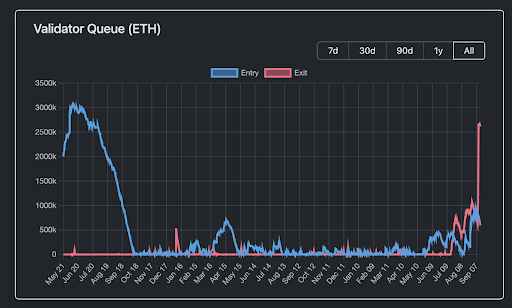
According to data from ValidatorQueue.com, about 2.6 million ETH were queued up to be unstaked, its largest exit number on record. This exit queue number dwarfs all previous periods of validator exits since Ethereum’s transition to proof-of-stake in September 2022. At its peak, the ETH tokens in the queue were worth about $12 billion. 

Interestingly, the chart data from ValidatorQueue shows a growing trend of more validators unstaking their ETH in recent weeks, as evidenced by the parabolic rise since mid-August. Analyst MartyParty commented on social media platform X, stating, “Ethereum Staking Exit Queue parabolic.”  Such a large-scale withdrawal event highlights growing unease among stakers, and institutional participants or large staking providers are behind the sudden mass exits.

The exit queue has witnessed a parabolic rise in recent months that is hard to ignore. This rise started in July 2025, when the average number of ETH waiting to be unstaked jumped from below 10,000 ETH to about 250,000 ETH within a matter of days. By the end of the month, the exit queue had escalated and climbed past 740,000 ETH. August also saw a similar rise, with queue numbers averaging around 800,000 ETH before crossing 1 million ETH at the end of the month.
Ethereum

 Now, the queue numbers have more than doubled in September, reaching a peak of 2.63 million ETH last week. As it stands, there are more than 2.4 million ETH waiting to leave the network. The backlog is so large that validators are facing an estimated 43 days and 3 hours of wait time before their ETH can be fully unstaked.

Implications For Ethereum Price

With more than $12 billion in ETH queued for withdrawal, the looming question is whether this will translate into significant sell pressure on exchanges. If these withdrawals are liquidated, the Ethereum price could face downward pressure. This would damage Ethereum’s rally, which has picked up this week.  

However, not all unstaked ETH is necessarily heading for the open market. Some may be repositioned into restaking protocols or into Spot Ethereum ETFs.

On the other hand, ETH staking has slowed down massively. At the time of writing, 451,950 ETH are currently in the entry queue to be staked. This is a 53% decline from 959,717 ETH on September 5.

At the time of writing, Ethereum is trading at $4,572, up by 2.1% in the past 24 hours.

Ethereum
Disclaimer: The articles reposted on this site are sourced from public platforms and are provided for informational purposes only. They do not necessarily reflect the views of MEXC. All rights remain with the original authors. If you believe any content infringes on third-party rights, please contact [email protected] for removal. MEXC makes no guarantees regarding the accuracy, completeness, or timeliness of the content and is not responsible for any actions taken based on the information provided. The content does not constitute financial, legal, or other professional advice, nor should it be considered a recommendation or endorsement by MEXC.

You May Also Like

BFX Presale Raises $7.5M as Solana Holds $243 and Avalanche Eyes $1B Treasury — Best Cryptos to Buy in 2025

BFX Presale Raises $7.5M as Solana Holds $243 and Avalanche Eyes $1B Treasury — Best Cryptos to Buy in 2025

BFX presale hits $7.5M with tokens at $0.024 and 30% bonus code BLOCK30, while Solana holds $243 and Avalanche builds a $1B treasury to attract institutions.
Share
Blockchainreporter2025/09/18 01:07
Crypto ETF Update: This Altcoin Could 1000x by 2026

Crypto ETF Update: This Altcoin Could 1000x by 2026

Enjoy the videos and music you love, upload original content, and share it all with friends, family, and the world on YouTube.
Share
Blockchainreporter2025/09/19 04:15
OCC Findings Suggest Major U.S. Banks Restricted Access for Digital Asset Firms Amid Debanking Probe

OCC Findings Suggest Major U.S. Banks Restricted Access for Digital Asset Firms Amid Debanking Probe

The post OCC Findings Suggest Major U.S. Banks Restricted Access for Digital Asset Firms Amid Debanking Probe appeared on BitcoinEthereumNews.com. The Office of the Comptroller of the Currency (OCC) has confirmed that nine major U.S. banks engaged in debanking practices from 2020 to 2023, restricting access for digital asset firms and other sectors. This marks the first official acknowledgment of these policies, which limited services based on customer types, affecting crypto businesses significantly. OCC report highlights inappropriate distinctions by banks like JPMorgan Chase and Bank of America, targeting crypto and high-risk sectors. Nine banks reviewed showed similar policies restricting customer access without objective risk assessments. Impacted industries include digital asset firms, with potential referrals to the Attorney General for unlawful practices. Discover how major U.S. banks’ debanking policies hit crypto firms hard, per OCC’s 2025 report. Learn the implications for digital assets and what regulators are doing next—stay informed on banking risks today! What Are the OCC’s Findings on Banks Debanking Crypto Firms? Banks debanking crypto firms involves major financial institutions limiting or denying services to digital asset businesses based on perceived risks, as detailed in a recent Office of the Comptroller of the Currency (OCC) report. From 2020 to 2023, nine of the largest U.S. banks implemented policies that required escalated reviews or outright restrictions for certain customers, including those in the crypto sector. This practice, now publicly confirmed, underscores ongoing tensions between traditional banking and emerging digital asset industries. How Did These Debanking Practices Affect Digital Asset Companies? The OCC’s six-page report, released on Wednesday, revealed that institutions such as JPMorgan Chase, Bank of America, Citigroup, Wells Fargo, U.S. Bancorp, Capital One, PNC Financial Services Group, Toronto-Dominion Bank, and Bank of Montreal made distinctions among customers that were deemed inappropriate. For digital asset firms, this meant heightened scrutiny or complete denial of banking services, hindering operations in an already volatile market. The regulator noted that these policies spanned…
Share
BitcoinEthereumNews2025/12/11 11:01
