

How to Short Crypto on MEXC? Complete Guide for Beginners
Key Takeaways
- Shorting Basics on MEXC Shorting crypto on MEXC means borrowing and selling an asset you don't own, then buying it back at a lower price to profit from price declines. MEXC offers futures trading with up to 200x leverage for experienced traders.
- How to Short Crypto on MEXC You can short crypto on MEXC through Futures Trading (perpetual contracts with leverage) . Futures are more popular and offer higher leverage options.
- Risk Management is Essential Always use stop-loss orders, start with low leverage (5-10x for beginners), and never risk more than 2-5% of your capital per trade. High leverage amplifies both gains and losses.
- Account Requirements You need a verified MEXC account, completed KYC, and funds transferred to your Futures Wallet. Identity verification is mandatory for futures trading access.
- Trading Costs Trading perpetual futures on MEXC incurs no order placement fee; the taker fee is typically 0.02%, and holding a certain amount of MX can qualify for a commission discount of up to 50%. While holding a perpetual position, a funding rate may also apply every 8 hours. Calculate these costs before opening a position.
1.What Does Shorting Crypto Mean?
2.Why Short Crypto on MEXC?
- High Leverage Options: MEXC offers up to 500x leverage on select trading pairs, allowing traders to amplify their positions significantly. However, beginners should start with much lower leverage (5-10x).
- Wide Selection of Trading Pairs: With over 2,700+ cryptocurrencies and 800+ futures contracts, MEXC provides extensive opportunities to short various assets beyond just Bitcoin and Ethereum.
- Low Trading Fees: MEXC's competitive fee structure (0 maker fees, 0.02% taker fees) makes it cost-effective for frequent traders.
- Advanced Trading Tools: The platform offers real-time charts, technical indicators, stop-loss/take-profit orders, and risk management features essential for successful shorting.
- High Liquidity: Strong liquidity ensures your orders are executed quickly at expected prices, minimizing slippage during volatile market conditions.
3.Prerequisites Before You Short Crypto on MEXC
Account Setup and Verification
- Registered MEXC Account: Sign up at the official MEXC website or download the mobile app. The registration process takes 2-3 minutes.
- Completed KYC Verification: Identity verification is mandatory for futures trading. You'll need to submit a government-issued ID and complete facial recognition. Verification typically takes 10-30 minutes.
- Funded Futures Wallet: Transfer cryptocurrency (USDT is most common) from your Spot Wallet to your Futures Wallet. This is where your margin will be held.
Understanding Risk Management
- Understand liquidation risk: If the market moves against you and your margin falls below the maintenance level, your position will be automatically closed
- Know your risk tolerance: Only use capital you can afford to lose
- Practice in small amounts: Start with minimal positions to learn mechanics
- Study market analysis: Learn technical and fundamental analysis to make informed decisions
4.How to Short Crypto on MEXC? Step-by-Step Guide
Shorting via Futures Trading
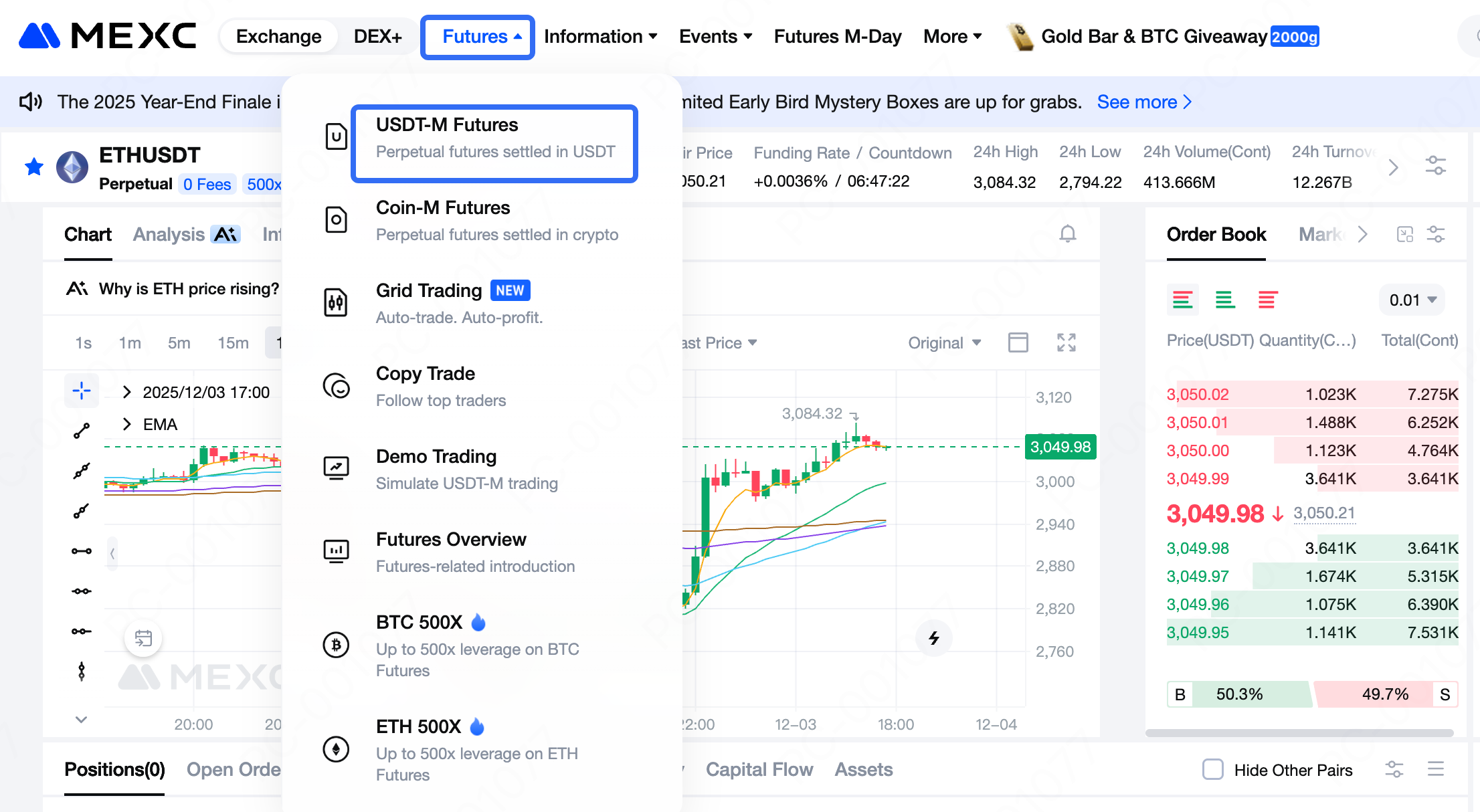

- Limit Order: Set your specific entry price. The order executes only at that price or better
- Market Order: Execute immediately at the current market price
- Trigger Order: Automatically place an order when price reaches your specified level
- Market Close: Click "Close" on your position for immediate exit at market price
- Limit Close: Place a buy order at your target price to close the short position
5.Understanding Leverage When You Short Crypto on MEXC
How Leverage Works
Leverage Recommendations by Experience
- Beginners: 3-5x leverage maximum
- Intermediate: 5-20x leverage
- Advanced: 20-50x leverage
- Professional: 50-500x leverage (extreme risk)
Liquidation Risk
6.Risk Management Strategies for Shorting Crypto on MEXC
Always Use Stop-Loss Orders
Position Sizing
Avoid Shorting During Strong Uptrends
Monitor Funding Rates
Use Take-Profit Orders
Diversify Short Positions
7.Common Mistakes to Avoid When Shorting Crypto on MEXC
8.Advanced Shorting Strategies on MEXC
Hedging Long Positions
Scalping Short Positions
Swing Shorting
Arbitrage Opportunities
9.Fees and Costs When You Short Crypto on MEXC
Trading Fees
- Maker Fee: 0 (when you add liquidity with limit orders)
- Taker Fee: 0.02%-0.06% (when you remove liquidity with market orders), users in different countries or regions may have different rates; please refer to your actual rate.
Funding Rates
- Positive rate: Shorts pay longs
- Negative rate: Longs pay shorts
- Typical range: -0.05% to +0.05% per funding period
10.Frequently Asked Questions
Is shorting crypto on MEXC legal?
What's the minimum amount needed to short crypto on MEXC?
How long can I hold a short position on MEXC?
What happens if my short position gets liquidated?
Can I short all cryptocurrencies on MEXC?
What's the difference between cross margin and isolated margin when shorting?
How do funding rates affect my short positions?
Conclusion

Popular Articles
When Will Bitcoin Go Back Up? Expert Analysis and Price Predictions
Bitcoin has pulled back from its recent highs, leaving investors wondering when the recovery will begin. This article examines short-term price signals, historical recovery patterns, and expert predic
What is Mog Coin (MOG)? Complete Guide to Mog Crypto Price, Price Prediction, News & Investment
In the dynamic world of cryptocurrency, meme coins continue to capture global attention through viral culture and community-driven movements. Mog Coin (MOG) stands as a revolutionary example of how in

What Shiba Inu (SHIB)? A Complete Guide: Ecosystem, Shibarium & Tokenomics Explained
Shiba Inu (SHIB) is a decentralized cryptocurrency originally known as a meme coin but has evolved into a full DeFi ecosystem with a Layer-2 blockchain (Shibarium) and multiple tokens including SHIB,

How to Stake SHIB on ShibaSwap: Complete Bury & Dig Guide to Earn Rewards
ShibaSwap is the decentralized exchange (DEX) for the Shiba Inu ecosystem, allowing users to swap tokens, provide liquidity (Dig), and stake assets (Bury) to earn rewards like BONE. Burying SHIB, LEAS
Hot Crypto Updates
View More
BEEG Outlook 2026: Sui's First "Productive" Meme Coin Redefining Meme Economy Through Creative Studio
BEEG is more than a meme coin—it's Sui's "visual factory." Discover how BEEG transforms from consumptive asset to productive infrastructure through branding services and creative studio, and why MEXC
114514 vs Bitcoin/Altcoins: Correlation Trading Guide
What is Market Correlation in Cryptocurrency? Market correlation in cryptocurrency refers to the statistical measure of how two or more digital assets move in relation to each other. Understanding

114514 (114514) Spot Trading Platform Comparison: Why MEXC Leads the Market
Choosing the right 114514 (114514) spot trading platform can significantly impact your trading success. MEXC stands out among cryptocurrency exchanges with superior features, competitive fees, and
MEXC vs KuCoin: Which Crypto Exchange Should You Choose in 2026?
Meta Description Comprehensive MEXC vs KuCoin comparison: trading fees, coin selection, security, and user experience analyzed. Discover why MEXC is becoming traders' top choice in 2026 with zero
Trending News
View More
XRP Price to $100? Burned Supply and Bank-Grade Design Are Changing the Math
A long-running argument around XRP is resurfacing, this time focused less on speculation and more on mechanics. Crypto analyst 24HrsCrypto recently highlighted

Trump Family-Backed Crypto Platform Partners With Pakistan To 'Explore' Stablecoin Payments
Pakistan’s government said Wednesday it’s partnering with World Liberty Financial (CRYPTO: WLFI), a decentralized platform afread more

US Dollar holds gains ahead of US data, Fedspeak
The post US Dollar holds gains ahead of US data, Fedspeak appeared on BitcoinEthereumNews.com. Here is what you need to know on Thursday, January 15: The US Dollar

Whale Activity Surges in Chainlink as Second ETF Hits the Market
The post Whale Activity Surges in Chainlink as Second ETF Hits the Market appeared on BitcoinEthereumNews.com. Crypto whales are increasing their exposure to Chainlink
Related Articles
When Will Bitcoin Go Back Up? Expert Analysis and Price Predictions
Bitcoin has pulled back from its recent highs, leaving investors wondering when the recovery will begin. This article examines short-term price signals, historical recovery patterns, and expert predic
What is Mog Coin (MOG)? Complete Guide to Mog Crypto Price, Price Prediction, News & Investment
In the dynamic world of cryptocurrency, meme coins continue to capture global attention through viral culture and community-driven movements. Mog Coin (MOG) stands as a revolutionary example of how in
What Shiba Inu (SHIB)? A Complete Guide: Ecosystem, Shibarium & Tokenomics Explained
Shiba Inu (SHIB) is a decentralized cryptocurrency originally known as a meme coin but has evolved into a full DeFi ecosystem with a Layer-2 blockchain (Shibarium) and multiple tokens including SHIB,
How to Stake SHIB on ShibaSwap: Complete Bury & Dig Guide to Earn Rewards
ShibaSwap is the decentralized exchange (DEX) for the Shiba Inu ecosystem, allowing users to swap tokens, provide liquidity (Dig), and stake assets (Bury) to earn rewards like BONE. Burying SHIB, LEAS
