With 11 billion payments processed and a clear-eyed view of who still sits outside the system, the CBN is laying the groundwork for inclusion at scale and openingWith 11 billion payments processed and a clear-eyed view of who still sits outside the system, the CBN is laying the groundwork for inclusion at scale and opening

11 Billion Transactions and 26% Exclusion: The Infrastructure Gap the CBN Wants to Close

2026/03/13 20:23
4 min read
For feedback or concerns regarding this content, please contact us at [email protected]

With 11 billion payments processed and a clear-eyed view of who still sits outside the system, the CBN is laying the groundwork for inclusion at scale and opening up one of Africa’s most significant untapped markets in the process.

Nigeria’s payments infrastructure is among the most advanced in the world. But the digital rails powering that system tell only part of the story.

According to the Central Bank of Nigeria’s Fintech Policy Insight Report, released in February 2026, nearly 11 billion transactions were processed through the NIBSS Instant Payment (NIP) platform in 2024, more than double the roughly 5 billion transactions recorded in 2022. The scale places Nigeria among the most active real-time payments markets globally and underscores the strength of its financial infrastructure. 

Yet even as digital payments expand rapidly, financial access remains uneven. The report notes that 26% of Nigerian adults remain financially excluded, with exclusion rising to 37% in rural areas and nearly 47% in northern Nigeria.

For policymakers, that contrast reveals the next challenge for Nigeria’s fintech ecosystem: building the infrastructure around payments that allows innovation to reach the people who need it most.

Nigeria’s payments rails are already world-class

Nigeria was an early mover in real-time payments. In 2011, the country rolled out a nationwide instant payments system years before similar infrastructure appeared in markets like the United States. Today, the NIP platform processes a growing share of Nigeria’s electronic transactions and has become the backbone of everyday financial activity. 

This infrastructure has helped power the growth of Nigeria’s fintech sector, as fintech startups attracted over $215 million in venture funding in 2025, and the country continues to host one of Africa’s largest fintech ecosystems. But while payments have scaled, structural bottlenecks still limit the reach of digital financial services.

The report highlights four major constraints:

  • The cost and accessibility of digital identity verification
  • Gaps in system interoperability
  • Infrastructure stress during peak transaction periods
  • Regulatory constraints affecting inclusive lending

Each affects how effectively fintech companies can serve underserved communities.

The infrastructure problem behind financial exclusion

Digital identity remains one of the biggest barriers to financial inclusion. Fintech firms rely on identity systems such as the Bank Verification Number (BVN) and the National Identification Number (NIN) to verify customers and meet anti-money laundering requirements. While these systems exist, the report notes that integration costs and system reliability can still pose challenges for fintechs trying to scale services.

Stakeholders participating in the CBN’s fintech survey cited digital identity integration and limited credit history data as key obstacles when trying to reach excluded populations. 

Interoperability presents another challenge. While Nigeria’s payments infrastructure is robust, fintechs still face fragmented connections across APIs, data-sharing systems, and credit infrastructure. Without reliable interoperability, services such as credit scoring, account aggregation, and cross-platform payments become harder to deploy at scale. The result is a system where payments work well, but the broader financial ecosystem still faces friction.

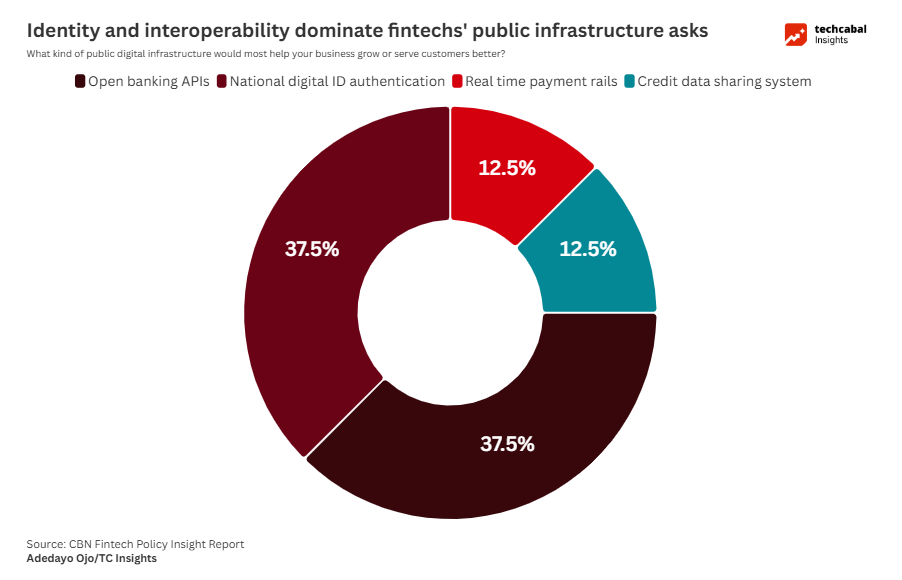
Survey responses highlight where improvements in public digital infrastructure could have the greatest impact. Open banking APIs and national digital ID authentication were each identified by 37.5% of fintech operators as the most important infrastructure enablers.
Unlocking the next phase of fintech growth

Another policy debate centres on lending. Payment Service Banks (PSBs), many backed by telecommunications companies, are currently restricted from offering credit. Some ecosystem participants believe easing these restrictions or introducing a dedicated digital banking licence could help fintech firms extend credit to underserved individuals and small businesses. 

This reflects a broader shift in Nigeria’s fintech ecosystem. As payments infrastructure matures, the next frontier for innovation is moving beyond transactions toward savings, credit, and financial tools that support economic growth.

Disclaimer: The articles reposted on this site are sourced from public platforms and are provided for informational purposes only. They do not necessarily reflect the views of MEXC. All rights remain with the original authors. If you believe any content infringes on third-party rights, please contact [email protected] for removal. MEXC makes no guarantees regarding the accuracy, completeness, or timeliness of the content and is not responsible for any actions taken based on the information provided. The content does not constitute financial, legal, or other professional advice, nor should it be considered a recommendation or endorsement by MEXC.

You May Also Like

Whales Dump 200 Million XRP in Just 2 Weeks – Is XRP’s Price on the Verge of Collapse?

Whales Dump 200 Million XRP in Just 2 Weeks – Is XRP’s Price on the Verge of Collapse?

Whales offload 200 million XRP leaving market uncertainty behind. XRP faces potential collapse as whales drive major price shifts. Is XRP’s future in danger after massive sell-off by whales? XRP’s price has been under intense pressure recently as whales reportedly offloaded a staggering 200 million XRP over the past two weeks. This massive sell-off has raised alarms across the cryptocurrency community, as many wonder if the market is on the brink of collapse or just undergoing a temporary correction. According to crypto analyst Ali (@ali_charts), this surge in whale activity correlates directly with the price fluctuations seen in the past few weeks. XRP experienced a sharp spike in late July and early August, but the price quickly reversed as whales began to sell their holdings in large quantities. The increased volume during this period highlights the intensity of the sell-off, leaving many traders to question the future of XRP’s value. Whales have offloaded around 200 million $XRP in the last two weeks! pic.twitter.com/MiSQPpDwZM — Ali (@ali_charts) September 17, 2025 Also Read: Shiba Inu’s Price Is at a Tipping Point: Will It Break or Crash Soon? Can XRP Recover or Is a Bigger Decline Ahead? As the market absorbs the effects of the whale offload, technical indicators suggest that XRP may be facing a period of consolidation. The Relative Strength Index (RSI), currently sitting at 53.05, signals a neutral market stance, indicating that XRP could move in either direction. This leaves traders uncertain whether the XRP will break above its current resistance levels or continue to fall as more whales sell off their holdings. Source: Tradingview Additionally, the Bollinger Bands, suggest that XRP is nearing the upper limits of its range. This often points to a potential slowdown or pullback in price, further raising concerns about the future direction of the XRP. With the price currently around $3.02, many are questioning whether XRP can regain its footing or if it will continue to decline. The Aftermath of Whale Activity: Is XRP’s Future in Danger? Despite the large sell-off, XRP is not yet showing signs of total collapse. However, the market remains fragile, and the price is likely to remain volatile in the coming days. With whales continuing to influence price movements, many investors are watching closely to see if this trend will reverse or intensify. The coming weeks will be critical for determining whether XRP can stabilize or face further declines. The combination of whale offloading and technical indicators suggest that XRP’s price is at a crossroads. Traders and investors alike are waiting for clear signals to determine if the XRP will bounce back or continue its downward trajectory. Also Read: Metaplanet’s Bold Move: $15M U.S. Subsidiary to Supercharge Bitcoin Strategy The post Whales Dump 200 Million XRP in Just 2 Weeks – Is XRP’s Price on the Verge of Collapse? appeared first on 36Crypto.
Share
Coinstats2025/09/17 23:42
Wall Street expert predicts 80% Tesla stock crash in 2026

Wall Street expert predicts 80% Tesla stock crash in 2026

The post Wall Street expert predicts 80% Tesla stock crash in 2026 appeared on BitcoinEthereumNews.com. Tesla (NASDAQ: TSLA) FSD – the autonomous driving technology
Share
BitcoinEthereumNews2026/03/16 22:04
Trump: Iran is "not ready" to reach a deal; believes the war won't be long before it ends.

Trump: Iran is "not ready" to reach a deal; believes the war won't be long before it ends.

PANews reported on March 16th that, according to market sources, US President Trump stated that without significant damage to Iranian infrastructure, Iran is "not
Share
PANews2026/03/16 21:53
