Private Equity Market Statistics 2026: Growth, Challenges, and Opportunities
The private equity (PE) market stands at a crossroads shaped by economic shifts, investor sentiment, and sector-specific dynamics. From global fundraising peaks to groundbreaking innovations, private equity continues to evolve. Navigating these trends and statistics can help stakeholders, investors, fund managers, and entrepreneurs alike understand the complex environment and identify opportunities.
This article delves into critical market trends, with an in-depth look at fundraising, investment performance, and how economic and technological factors influence today’s private equity landscape.
Editor’s Choice
- Buyout investments surged to $904 billion in 2025, a 44% increase year-over-year.
- Buyout-backed exit value jumped 47% to $717 billion, the second-best year on record.
- Fundraising for buyout funds fell 16% to $395 billion, with fund closures down 23%.
- North America dominated investments at $1.1 trillion, comprising over half of the global total.
- Average buyout deal size hit a record $1.2 billion amid fewer but larger transactions.
- Deals over $500 million reached $1.1 trillion, up 44% and the highest ever.
- Dry powder stands at $1.3 trillion, pressuring deployment amid a maturing market.
Recent Developments
- Blackstone launched a $30 billion infrastructure fund targeting digital infrastructure and renewable energy projects worldwide.
- Carlyle Group acquired Vantive for $4.1 billion, expanding its healthcare portfolio with advanced kidney care technologies.
- Blackstone distributed $115 billion to investors in 2025, reflecting a 45% year-over-year surge in realizations.
- KKR completed a $2.5 billion buyout of a leading AI data center operator amid surging infrastructure demand.
- Apollo Global launched a $20 billion continuation vehicle for legacy tech assets to optimize exits in maturing portfolios.
- Global PE deployment reached $250 billion in Q1 2026, driven by mega-deals exceeding $1 billion.
- TPG executed a $1.8 billion energy transition deal focusing on carbon capture and green hydrogen technologies.
Private Equity Market Size Forecast
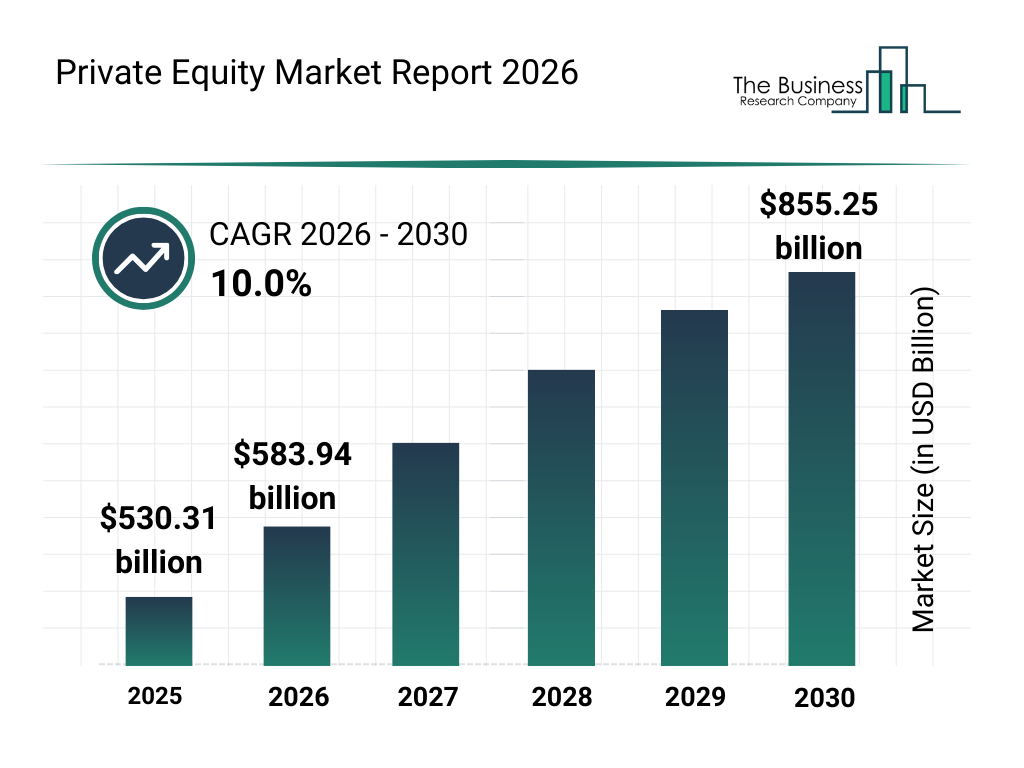
- The global private equity market reached $530.31 billion in 2025, reflecting strong investment activity worldwide.
- The market is expected to grow to $583.94 billion in 2026, showing steady expansion in private capital markets.
- By 2027, the private equity market size is projected to reach $642.33 billion as institutional investors continue increasing allocations.
- The market may climb to $706.56 billion in 2028, driven by rising deal activity and capital inflows.
- In 2029, the market is forecast to reach about $777.22 billion, highlighting sustained global demand for private equity investments.
- By 2030, the private equity market could grow to $855.25 billion, marking a major expansion in the industry.
- Overall, the market is projected to grow at a 10.0% CAGR between 2026 and 2030, showing strong long-term growth potential.
 (Reference: The Business Research Company)
Sector Focus and Portfolio Diversification
- Technology captured 35% of total buyout deal value in early 2026, remaining dominant.
- Healthcare investments grew 18% year-over-year, driven by biotech and digital health solutions.
- Financial services deal value surged 25% to $95 billion, fueled by fintech consolidation.
- Energy transition projects attracted $120 billion, focusing on renewables and grid modernization.
- Consumer sectors maintained 15% market share amid resilient retail and e-commerce targets.
- EdTech investments rose 30%, targeting AI-driven learning platforms and remote tools.
- Infrastructure allocations hit 12% of portfolios, diversifying beyond traditional buyouts.
- Portfolio diversification increased with 28% of funds spreading across five-plus sectors.
Fundraising Dynamics and Challenges
- Average time to close a fund reached 20 months in early 2026, up from 18 months prior year.
- The secondary market volume surged to $125 billion in H1 2026, a 23% year-over-year increase.
- Mega-funds over $5 billion raised $105 billion, accounting for 28% of all commitments.
- Smaller funds under $500 million saw fundraising drop 35%, facing intense LP scrutiny.
- Cross-border fundraising in Europe declined 18% amid ongoing geopolitical uncertainties.
- Private equity real estate raised $68 billion in Q1 2026, driven by logistics and multifamily demand.
- Dry powder levels hit $2.1 trillion industry-wide, intensifying deployment pressures.
Most Attractive Investment Assets in the Next 12 Months
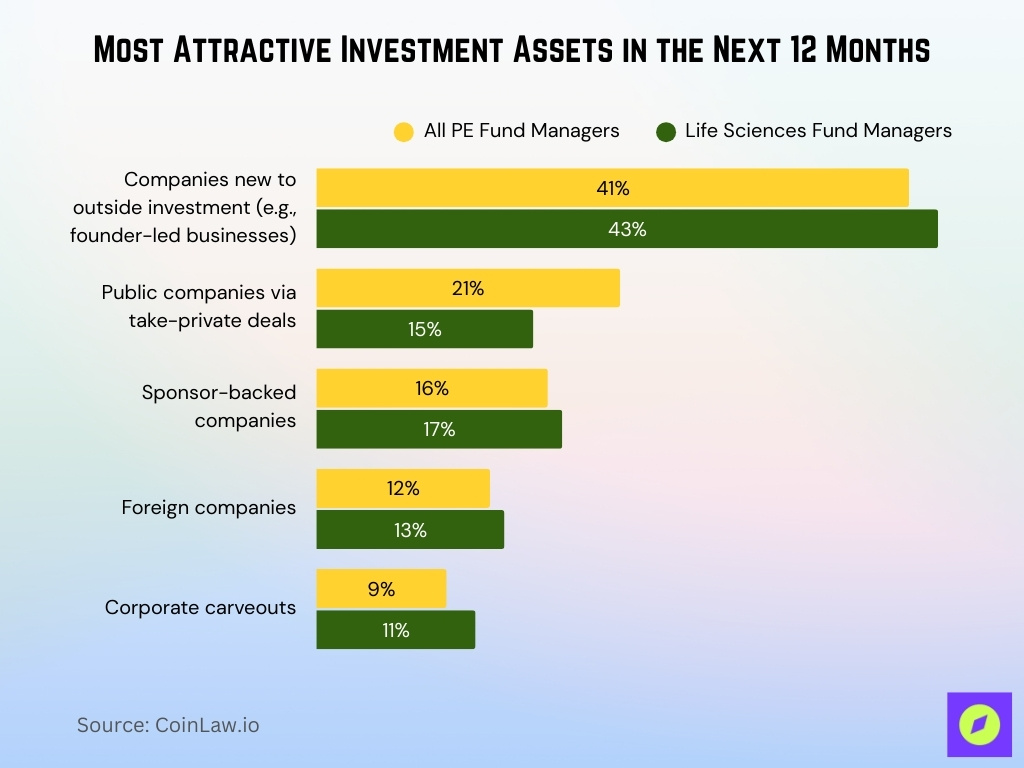
- Founder-led companies and businesses new to outside investment rank as the top investment target, with 41% of all private equity fund managers and 43% of life sciences fund managers calling them the most attractive opportunities.
- Public companies through take-private deals attract strong interest, with 21% of PE fund managers and 15% of life sciences fund managers viewing them as attractive investments.
- Sponsor-backed companies also draw attention, as 16% of PE fund managers and 17% of life sciences fund managers consider them promising investment options.
- Foreign companies remain a moderate opportunity, with 12% of PE fund managers and 13% of life sciences fund managers identifying them as appealing targets.
- Corporate carveouts rank lowest in investor preference, with only 9% of PE fund managers and 11% of life sciences fund managers selecting them as attractive investments.
 (Reference: BDO USA)
Investment Performance and Returns
- Private equity delivered +2.0% annualized excess returns net of fees versus public equities over recent vintages.
- Median VC IRR for 2017 vintage funds reached 11.5% net by early 2026.
- Top-quartile VC funds achieved 28.3% IRR, highlighting wide performance dispersion.
- Infrastructure funds posted 9% annualized returns over the last two decades.
- Private equity real estate strategies yielded mid-teens 14-16% annualized returns.
- Emerging market PE funds averaged 20% net IRR for top performers in Southeast Asia.
- Top-quartile buyout managers outperformed public benchmarks by 10-15% across horizons.
Deal Flow and Transactional Trends
- U.S. private equity deal value captured 52% of total M&A activity in early 2026.
- Billion-dollar deals numbered 187, up 12% from the prior year.- Large-scale transactions over $10 billion accounted for 29% of H1 deal value.
- Carve-out deals represented 12% of U.S. buyout transactions in Q1 2026.
- U.S. outbound cross-border deals rose 28%, while inbound activity fell 35%.
- Global PE and M&A deal value hit $2.4 trillion in H1 2026, up 9% year-over-year.
- Total private equity deal value climbed 22% to $428 billion in the first half.
- Infrastructure megadeals contributed $180 billion, fueling tech and energy sectors.
Technological and Operational Innovations
- Digital transformation is essential for 83% of private equity firms implementing advanced tech stacks.
- 45% of firms adopted formal AI strategies with generative AI pilots in core operations.
- 25% of portfolio companies operationalized generative AI, delivering 15-20% efficiency gains.
- Cybersecurity and AI investments are prioritized by 92% of firms for protection and operational gains.
- AI captured 55% of VC deal value, with enterprise AI solutions leading deployment trends.
- 65% of firms expect AI automation in fund accounting, compliance, and deal origination.
- AI adopters report 30% faster insights and 25% reduced decision-making timelines.
- 78% of PE leaders cite tech integration as critical for competitive portfolio outperformance.
Influence of Macroeconomic Factors
- Interest rates eased to 4.5% by Q1 2026, boosting add-on transactions by 22%.
- 89% of LPs identified inflation as the primary investment challenge amid persistent pressures.
- U.S. dollar weakened 8% against major currencies, spurring emerging market investments.
- Geopolitical risks drove $45 billion record inflows into stable emerging market funds.
- Supply chain localization efforts increased 35% in PE-backed manufacturing portfolios.
- Labor shortages are projected 4.2% inflation in key sectors due to workforce constraints.
- Direct lending defaults stayed low at 0.8%, with 6% of borrowers under debt stress.
Regional Variations in Private Equity Activity
- North America holds 52% of global private equity AUM with 4.8% moderated growth.
- Europe led exits with 528 transactions in H1 2026, overtaking North America.
- Asia-Pacific deal activity shifted to India and Southeast Asia with 22% growth.
- Latin America fund sizes matched smaller Asian markets, with $35 billion raised.
- Middle East investors planned 82% allocation increases to private equity.
- Africa saw 18% growth in agriculture, telecom, and financial services deals.
Private Debt Entry Routes for Institutional Investors
- Co-investments lead with 42.5% of all private debt entry opportunities for institutions.
- Fund of Funds holds 23% share as a key diversified entry channel for investors.
- Single investor-managed accounts with a multi-manager approach at 10.2% of the market.
- Single investor-managed GP structures represent 9.1% of total entry strategies.
- Secondaries captured 9.3%, offering liquidity-driven private debt exposure.
- Direct investments grew to 5.2%, reflecting selective institutional allocations.
- Single funds remain the smallest at 4.7% of overall institutional participation.
Regulatory and Compliance Landscape
- ESG compliance costs rose for 92% of PE firms, materially impacting operational budgets.
- Transparency disclosures increased 32% in North America and Europe for performance metrics.
- AML regulations impacted 16% of cross-border deals in high-risk jurisdictions.
- U.S. capital gains tax changes prompted 28% of firms to adjust deal structures.
- Data privacy compliance added 12% to operational expenses under GDPR equivalents.
- Antitrust and FDI reviews are expected by 68% of firms, especially in tech sectors.
- Offshore structure deals declined 8%, favoring transparent jurisdictional models.
Private Equity Trends to Watch
- Impact investing AUM reached $1.7 trillion globally, growing 15% year-over-year.
- Continuation funds raised $48 billion in H1 2026, extending portfolio liquidity.
- 65% of PE firms leverage generative AI for portfolio operations and value creation.
- Healthcare and biotech inflows projected at $180 billion amid innovation demand.
- 85% of PE/VC firms adopted AI-driven investment management solutions.
- Resiliency investments in infrastructure rose 22%, targeting essential services.
- Cybersecurity investments surged 30% for portfolio protection and asset plays.
Frequently Asked Questions (FAQs)
53% of LPs are limited by undrawn past commitments.
Private equity holds 32,000 unsold companies worth $3.8 trillion.
Secondaries volumes rose 34% to $226 billion.
Conclusion
The private equity market today presents a nuanced landscape where global shifts, regional dynamics, and regulatory pressures shape investment strategies. With an ever-growing focus on sustainability, technological innovation, and sector diversification, private equity firms continue to adapt to an evolving financial ecosystem.
While challenges like high interest rates and compliance costs pose hurdles, the potential for growth in emerging markets, along with innovations in AI and digital transformations, offers promising paths forward. The private equity industry is poised for a future where resilience and adaptability will define success, ensuring that firms remain aligned with market demands and investor priorities.
The post Private Equity Market Statistics 2026: Growth, Challenges, and Opportunities appeared first on CoinLaw.
You May Also Like

Trump Wants Rate Cuts Now — The Iran War and Oil Prices Say Otherwise

UK GDP arrives at 0% MoM in January vs. 0.2% expected