

MVP Development for SaaS Products: A Guide for U.S. Entrepreneurs

Is your MVP built to scale or destined to fail? In the 2026 market, the “bare minimum” is no longer enough. While tools like GenAI have lowered the technical barrier, commercial success is harder than ever. Current data reveals a sobering reality: 95% of generative AI pilot projects fail to deliver any measurable ROI. Even worse, 42% of all startups collapse because they build products without verified market demand.
The definition of “viable” has shifted. Today’s investors ignore pitch decks in favor of validated learning and unit economics. To survive, your MVP must act as a sophisticated instrument of risk mitigation, not just a lite version of your vision.
Do you have the three high-signal metrics required to secure funding in 2026? Keep reading to master the new protocol for building resilient, market-ready products.
Key takeaways:
- The MVP is a financial de-risking tool; 95% of generative AI pilots fail to deliver ROI, underscoring the need for verified market demand.
- Innovation shifts to Vertical SaaS 2.0 and “Self-Driving SaaS,” where AI-driven iteration automates the “Build-Measure-Learn” loop.
- Modern MVPs utilize Usage-Based Pricing and Generative BI, with up to 40% of analytics queries generated through natural language.
- Cloud-native architecture and serverless models can drop cost-per-user by up to 90%, while AI-Augmented developers accelerate coding by 20–50%.
Why SaaS Startups Rely on MVPs for Market Validation
In the 2026 SaaS landscape, the Minimum Viable Product (MVP) has evolved from a simple prototype into a high-stakes financial de-risking mechanism. With global venture funding for AI and Fintech reaching $22 billion in early 2025, investors have shifted their focus from “visionary decks” to “verified metrics,” making rigorous market validation the only path to survival.
The Evolution of the “Build-Measure-Learn” Loop
By 2026, the traditional feedback loop has become autonomous. The speed of iteration is no longer limited by human analysis but is driven by Self-Driving SaaS architectures.
- Automated Feedback: Real-time autonomous agents now monitor user behavior, identifying friction points and churn risks without manual surveys.
- AI-Driven Iteration: Vinova integrates predictive analytics directly into the MVP infrastructure, allowing the product to suggest feature optimizations based on usage patterns.
Vertical SaaS 2.0: The “Niche” is the New Mass Market
Horizontal markets (CRM, generic project management) are saturated by entrenched incumbents. Innovation has moved into Vertical SaaS 2.0, targeting regulatory-heavy and complex blue-collar sectors.
- Domain Specificity as a Moat: Successful MVPs in 2026, like those Vinova developed for Engine Web and Navig8 Pools, focus on marine logistics, construction, and clinical trials where generic tools fail.
- Micro-SaaS: Lightweight tools solving one acute problem exceptionally well are seeing faster go-to-market cycles and clearer product-market fit.
Outcome-Based Validation for AI-Native Startups
Users now expect “Service-as-Software,” where the value is the outcome, not the tool.
- Validation through Automation: An accounting MVP is validated if it reconciles books with zero human input, not just by how “easy” the UI is to use.
- Agentic Workflows: Validation now tests multi-step chains where AI agents research, execute, and verify tasks autonomously.
Essential Infrastructure for 2026 SaaS Founders
To support high-velocity validation and “Diamond” workforce models, founders need a robust tech stack—from analytics to the hardware that powers their daily sprints.
Product Analytics Platforms
Validation requires high-fidelity signal. These tools allow you to track the “Aha! Moment” of your users.
- Mixpanel: Excellent for segmentation and retention analysis. Its 2025/2026 plans often include a free first year for startups, with paid “Growth” tiers scaling with your Monthly Tracked Users (MTU).
- Amplitude: Best-in-class for behavioral analytics. While powerful, its “Growth” plan typically starts higher (around $995/month), making it a favorite for venture-backed teams nearing Series A.
Founder’s Workstations
Your hardware must handle local AI models and massive multitasking without thermal throttling.
- Apple MacBook Pro 14-Inch (M5, 2025): The gold standard for business power. The M5 chip delivers amped-up AI muscle, essential for the “AI-Native” era.
- Lenovo ThinkPad X1 Carbon Gen 13 Aura Edition: The best professional AI PC on Windows. Weighing just 2.17 pounds, it features Intel Core Ultra processors with dedicated NPU for local AI tasks.
Industrial Hardware for Vertical SaaS (Logistics & Warehousing)
If your MVP serves the physical world, your software must be tested on the rugged devices your users actually use.
- Zebra MC9400 Handheld Computer: The ultra-rugged 2025/2026 standard for warehouse logistics. It features Wi-Fi 6E, 5G data options, and a long-range scanner capable of reading barcodes from 100 feet away.
- Honeywell CK67 Mobile Device: A powerhouse for high-volume data capture. Its FlexRange XLR engine and rugged build make it the optimal choice for workers in distribution centers.
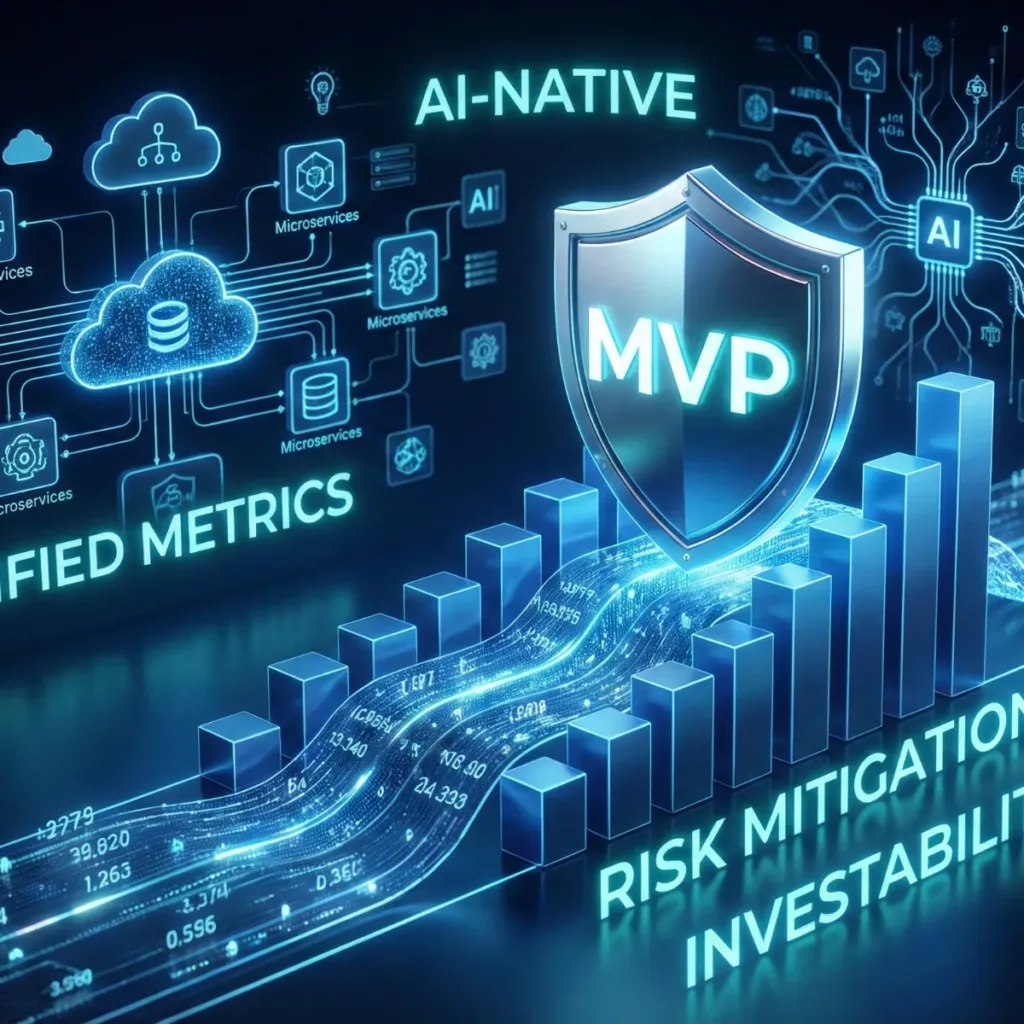
Key Components of a SaaS MVP – Subscription, Dashboard, Analytics
In 2026, the technical skeleton of a SaaS MVP is no longer just a “basic build.” The “plumbing”—billing, data visualization, and analytics—has become a strategic differentiator. Users now expect consumer-grade speed and AI-driven intelligence in their enterprise tools. A clunky billing portal or a static dashboard is a leading indicator of churn.
1. Subscription Management: The Usage-Based Shift
The traditional “per-seat” model is facing a crisis. If an AI agent can perform the work of ten people, pricing by headcount cannibalizes your revenue. Consequently, 2026 MVPs are built around Usage-Based Pricing (UBP).
Vinova typically integrates platforms like Stripe or Chargebee to handle this complexity. Choosing between them depends on your initial scale and technical resources.
2. The Dashboard: Generative BI & “No-UI”
The dashboard is undergoing a radical reimagining. Static pie charts are being replaced by Generative Business Intelligence (BI) and Natural Language Interfaces.
- “Ask-and-Answer”: By 2026, 40% of analytics queries are generated via natural language. Users simply ask, “Show me the churn rate for North American clients,” and the system generates the visualization on the fly.
- The “No-UI” Trend: For many agentic workflows, the best interface is no interface. AI agents run in the background and only surface a UI element when a human decision (like approving a high-value transaction) is strictly necessary.
3. Analytics: Descriptive to Prescriptive
Displaying data is no longer enough; your MVP must interpret it. We shift from telling users what happened to telling them what to do next.
- Descriptive (2020): “You lost 5 customers last month.”
- Predictive (2025): “You are likely to lose Customer X next week.”
- Prescriptive (2026): “You should offer Customer X a 10% discount today to prevent churn.”
Vinova’s MVPs turn software into a proactive consultant by integrating these prescriptive loops, often utilizing Explainable AI (XAI) to provide transparent audit trails for every AI-generated insight.
4. API-First: The Composable Enterprise
No SaaS app is an island. Enterprise buyers expect new tools to plug into their existing stack of 50+ applications seamlessly.
The Model Context Protocol (MCP) is now the critical integration layer, allowing AI agents to “read” and “write” to external apps. A successful MVP in 2026 advertises “MCP-native” capabilities as a core product feature. This “API-First” strategy ensures that your backend logic can support “Headless” implementations where customers build their own custom UIs.
Vinova’s Expertise in Building Scalable Cloud-Based MVPs
Vinova has established itself as a leading partner for U.S. startups by combining the cost benefits of offshore development with the high-level strategy of a top-tier consultancy. With 15+ years of experience and over 300 projects for giants like Samsung and PwC, they provide the operational rigor required for the 2026 market.
The “Diamond” Staffing Model: Solving the Talent Gap
The IT industry is shifting from the traditional “Pyramid” model (many junior coders) to a “Diamond” model (heavy on mid-level specialists and AI architects). Vinova utilizes AI-Augmented Developers to close this gap.
- The Augmented Engineer: These developers use Generative AI to accelerate routine coding by 20–50%, allowing them to focus on architecture, security, and complex business logic.
- Product Pods: Small, agile teams own vertical slices of the product. Augmented by AI agents for QA and UI design, these pods reduce handoffs and accelerate the Build-Measure-Learn cycle.
Cloud-Native Architecture: Built for Scale
Vinova builds scalable systems from Day One, avoiding the “monolith” trap that often leads to expensive refactoring later.
- Microservices & Containerization: By using Docker and Kubernetes, Vinova builds applications as loosely coupled services. This allows high-traffic components, like a billing engine, to scale independently, significantly optimizing cloud costs.
- Serverless Efficiency: For early-stage MVPs, Vinova often utilizes serverless infrastructure like AWS Lambda. This “pay-per-use” model ensures that your infrastructure costs grow linearly with your user base, preventing expensive “idle server” fees.
Top Cloud-Native Scaling Tools for 2026
To support a global-scale MVP, these are the current industry leaders in container management and orchestration:
- Kubernetes: The industry standard for container orchestration. It automates deployment, scaling, and management of containerized applications, making it essential for any microservices-based MVP.
- Docker Desktop: The foundational tool for containerization, allowing developers to create, share, and run applications in any environment with consistent performance.
Advanced AI & Agent Orchestration
Vinova is “AI-native,” offering specialized services that go beyond simple chatbot integration.
- RAG (Retrieval-Augmented Generation): They build systems that ground AI responses in proprietary data, effectively solving the “hallucination” problem.
- Agent Orchestration: Using frameworks like LangChain, Vinova builds “Agent OS” platforms where multiple AI agents collaborate to execute complex, multi-step business processes autonomously.
Continuous Integration & Deployment (CI/CD)
Speed is sustained through DevOps automation. Vinova implements pipelines that automate testing, security scanning, and deployment. This ensures that features flow to users continuously without downtime, turning “release day” into a non-event.
| Feature | Traditional MVP | Vinova Cloud-Native MVP |
| Architecture | Monolithic (Hard to scale) | Microservices (Scales independently) |
| Development | Manual Coding (Slow) | AI-Augmented (20-50% Faster) |
| Scaling | Step-function jumps (Expensive) | Linear/Serverless (Cost-efficient) |
| AI Integration | Basic Chatbots | Agentic Workflows & RAG |
Use Case: SaaS MVP That Secured Investor Funding in the U.S.
In the 2026 market, a vision is only as valuable as its technical execution. Vinova’s strategic interventions transform high-risk “composites” into investable assets by addressing the three pillars of startup mortality: unit economics, regulatory friction, and market timing.
Hypothesis 1: The “Freemium” Unit Economics Trap
In a Product-Led Growth (PLG) model, a “monolithic” architecture is often a death sentence. If your variable cost per free user is high, scaling actually accelerates bankruptcy.
- The Problem: TaskFlow’s server costs were $\$2/\text{month}$ per user. At $100,000$ users, that is a $\$200,000$ monthly burn before a single dollar of revenue.
- The Vinova Solution: We refactor to a Serverless Multi-Tenant architecture. By using 1$AWS\ Lambda$, compute resources are only invoked when a user is active.2
- Strategic Impact: Fixed costs are replaced by a strictly variable model where $Cost_{active} \ll Cost_{revenue}$. This drops the cost-per-user by 90%, proving to investors that the platform can scale to millions of users profitably.
Hypothesis 2: The “Bank-Grade” Fintech Hurdle
Fintech startups often die in the “waiting room” of legacy banks. Without SOC 2 Type II and PCI-DSS compliance, you cannot move money; without moving money, you cannot raise a Series A.
- The Problem: PaySecure had only 12 weeks of runway, but a traditional compliance audit takes 6 months.
- The Vinova Solution: We deploy a “Security-by-Design” foundation. This integrates automated evidence collection—utilizing tools like Vanta or Drata—directly into the DevSecOps pipeline.
- Strategic Impact: Every code commit triggers an automated security scan and documentation update. Compliance becomes a real-time dashboard rather than a manual project, unblocking bank partnerships in weeks rather than months.
Hypothesis 3: The Enterprise “Speedboat” Spin-off
Corporate innovation often fails because it tries to build new products using old tools. Large healthcare organizations have the data but lack the velocity to capture shifting regulations.
- The Problem: “HealthGiant” faced an 18-month lead time due to legacy mainframes. The market window was only 6 months.
- The Vinova Solution: Vinova acts as an external “Speedboat” team. We build a modern frontend using Flutter for 40% faster cross-platform deployment.
- The Bridge: We don’t touch the legacy code; we build a secure API Gateway. This sanitizes and translates patient data between the high-speed mobile app and the slow-moving mainframe.
- Strategic Impact: The MVP launches in 4 months, securing early-mover advantage. The data generated proves the venture’s viability, leading to a successful corporate spin-off.
The Common Thread: Investability
Investability in 2026 is defined by Risk Mitigation. Vinova does not just write code; we solve the “blockers” that make venture capitalists walk away.
| Blocked Concept | Strategic Intervention | Investable Asset |
| High Burn Rate | Serverless Architecture | Profitable Unit Economics |
| Regulatory Lock | Automated DevSecOps | Bank-Grade Trust |
| Bureaucratic Lag | Speedboat API Bridge | First-to-Market Speed |
Balancing Speed, Security, and Performance in SaaS MVPs
In the 2026 landscape, the “Move Fast and Break Things” philosophy is a liability. Regulatory scrutiny and the threat of sophisticated cyberattacks mean that a SaaS MVP must be secure by design. Vinova resolves the paradox of building quickly while maintaining “bank-grade” standards through a DevSecOps approach that integrates security and performance optimization directly into the agile sprint cycle.
1. Security by Design: The Compliance “Moat”
Security is no longer just IT hygiene; it is a sales enabler. Enterprise buyers will not engage with a vendor—no matter how innovative—if they cannot demonstrate a robust security posture.
- Automated Compliance: We integrate platforms like Vanta or Drata to automate evidence collection for SOC 2 and ISO 27001. This ensures your MVP is “audit-ready” from Day One, shortening enterprise sales cycles by months.
- Identity & Access Management (IAM): We implement “Zero Trust” principles, including Multi-Factor Authentication (MFA), Single Sign-On (SSO), and granular Role-Based Access Control (RBAC) as foundational features, not future add-ons.
- Data Sovereignty: For U.S. clients, we configure cloud environments to ensure data residency compliance, keeping user data on U.S.-based AWS or Azure regions to meet strict local regulations.
2. Performance: UX as a Retention Metric
In a world of abundant software, user patience is scarce. A 1-second delay in page load can result in a 7% drop in conversions.
- Core Web Vitals (2026 Standards): We optimize MVPs to meet Google’s primary experience metrics. The focus for 2026 has shifted to Interaction to Next Paint (INP)—striving for a response time of less than 200ms to ensure the app feels “snappy” even under load.
- Edge Computing & CDNs: To serve a distributed U.S. audience, we push content physically closer to the user, minimizing latency and ensuring high-speed access from Seattle to Miami.
- Database Hardening: We employ read/write splitting and Redis caching layers to ensure that data-heavy dashboards load instantly, even as your dataset grows from megabytes to terabytes.
3. Speed: The AI Acceleration Factor
Building for security doesn’t have to be slow. We leverage AI-augmented development to handle the “boring” parts of the build, allowing your team to focus on core IP.
- Generative Coding: Our developers use AI co-pilots to generate boilerplate code, unit tests, and documentation, reducing manual labor by 20–50%.
- Rapid Prototyping: We create interactive prototypes in Figma to validate user flows before coding begins, preventing costly pivots during the development phase.
Essential Hardware for Operational SaaS MVPs
If your SaaS MVP serves a physical environment like a warehouse, hospital, or field service site, your software is only as good as the hardware running it.
Ultra-Rugged Mobile Scanners
For high-volume data capture in 2026, these devices offer the durability and scanning range required to support your automated backend logic.
- Zebra MC9400: The industrial gold standard. It features Wi-Fi 6E connectivity, an octa-core processor, and the SE58 scan engine capable of reading barcodes from over 100 feet away.
- Honeywell CK67: Built on the Mobility Edge platform, this device is ultra-rugged with IP65/IP68 ratings and is guaranteed to support Android versions through 2028.
High-Performance Power & Charging
Keep your mobile workforce active through multi-shift operations with fast-charging power solutions.
- Anker 737 Power Bank: A 24,000mAh “beast” with 140W two-way fast charging. It features an intelligent digital display to monitor real-time charging status for tablets or scanners.
- EcoFlow River 3: An ultra-light (3.5kg) portable power station with X-Boost technology up to 600W. It is virtually silent (<30dB) and perfect for mobile work setups or remote warehouse zones.
Launch Your SaaS Vision Faster with Vinova
Partnering with Vinova offers U.S. entrepreneurs a strategic pathway to market that balances cost, quality, and speed. Vinova operates as a “Product Co-Creator,” guiding your startup from the initial spark to a scalable, investable asset.
The Vinova MVP Roadmap: From Napkin to Nasdaq
For most 2026 SaaS startups, the journey from concept to launch takes approximately 12 weeks. This timeline is designed to maximize your runway while ensuring you hit the market before your competitors.
| Phase | Duration | Objective | Key Deliverable |
| Phase 1: Discovery | Weeks 1–3 | Validate problem-solution fit through U.S. market analysis. | Validated Product Roadmap |
| Phase 2: UX/UI | Weeks 3–5 | Design “Agentic” interfaces that minimize user friction. | Clickable Prototype (Figma) |
| Phase 3: Development | Weeks 5–12 | Build the core product in 2-week agile sprints. | Functional MVP on AWS/GCP |
| Phase 4: Launch | Week 12+ | Activate “Build-Measure-Learn” loops and iterate. | Scaling & Maintenance Plan |
Investment & Cost Structure
Vinova’s hybrid model (Singapore HQ + Vietnam Development) typically yields a 70% cost saving compared to purely U.S.-based teams.
- Simple MVP ($5k – $20k): Best for content apps or basic data-entry tools.
- Mid-Complexity MVP ($40k – $100k): The “Sweet Spot” for most SaaS startups. Includes Stripe integration, custom AI dashboards, and cross-platform mobile apps.
- Complex/Enterprise ($100k+): For AI-native or Fintech platforms requiring custom model training and deep SOC 2/HIPAA compliance.
Note: We recommend budgeting 15–20% of your initial development cost annually for maintenance (bug fixes, OS updates, and security patches).
Essential Project Management Tools for 2026 Startups
To manage the velocity of a 12-week build, you need a project management tool that keeps your “Product Pods” aligned.
- Jira Software: The gold standard for Agile development. Its deep integration with CI/CD pipelines makes it essential for teams running 2-week sprints and tracking “Zero-Touch” resolution rates.
- Monday.com: Excellent for cross-departmental visibility. If your founder needs to see high-level progress while the engineering team dives into the weeds, Monday’s visual boards are top-tier.
- Asana: Best for design-heavy or marketing-led startups. It excels at managing the “Discovery and Research” phase and UX/UI handoffs between Figma and the dev team.
Scaling Beyond the Launch
Vinova’s value extends long after your initial release:
- Grant Advisory: We assist U.S. startups in identifying and applying for R&D grants.
- The Diamond Model: As you scale toward your Series A, we can rapidly add specialized talent—scaling your team from 2 to 20 engineers in weeks, not months.
Conclusion
The window of opportunity for SaaS innovation in 2026 is vast, but it is reserved for those who execute with precision. The era of the “amateur” MVP is over; success now requires a deep mastery of AI integration, verticalization, and capital efficiency.
Vinova is the strategic partner built for this new era.
We represent a new breed of development partner—technically elite, operationally agile, and perfectly aligned with the demands of the American market. By choosing Vinova, you are doing more than outsourcing code; you are building a resilient, investable business.
Why U.S. Entrepreneurs Choose Vinova:
- Strategic Discovery: We help you validate your vision against the converging forces of the 2026 economy.
- Elite Engineering: Access to R&D centers that specialize in the latest AI and cloud-native stacks.
- Global Presence, Local Alignment: Seamless collaboration through our Seattle office with the efficiency of our Singapore and Vietnam hubs.
The challenges of the next decade require a foundation of excellence. Start building yours today.
Ready to validate your vision? Connect with Vinova to begin your discovery process.
Frequently Asked Questions (FAQs)
1. How has the definition of a Minimum Viable Product (MVP) fundamentally changed for the 2026 SaaS market?
The MVP has shifted from being a simple prototype to a high-stakes financial de-risking mechanism. Investors are no longer focused on “visionary decks” but demand verified metrics and proof of validated market learning. The document states that the new objective is to mitigate risk and demonstrate a scalable unit economy from day one.
2. What are the primary cost-saving benefits of adopting a Serverless/Cloud-Native architecture for an early-stage MVP?
Moving to a Serverless Multi-Tenant architecture (like using AWS Lambda) can drop the cost-per-user by up to 90%. This is achieved by replacing high fixed costs with a strictly variable “pay-per-use” model, ensuring infrastructure costs grow linearly with the user base and proving to investors that the platform can scale profitably.
3. What is the “Vertical SaaS 2.0” trend, and why should new startups focus on it?
Vertical SaaS 2.0 focuses on niche, regulatory-heavy, and complex blue-collar sectors (e.g., marine logistics, construction, clinical trials) where generic tools fail. Innovation has moved here because horizontal markets are saturated. Domain Specificity acts as a competitive moat, leading to faster go-to-market cycles and clearer product-market fit compared to broader solutions.
4. How does Vinova’s “Diamond” Staffing Model and use of AI-Augmented Developers accelerate development?
The “Diamond” model focuses on mid-level specialists and AI architects instead of many junior coders. AI-Augmented Developers use Generative AI co-pilots to automate boilerplate code, unit tests, and documentation, accelerating routine coding tasks by 20–50%. This allows the human team to focus exclusively on architecture, security, and complex business logic.
5. What is the total duration of the Vinova MVP Roadmap, and what are its key deliverables?
The standard Vinova MVP roadmap is approximately 12 weeks long, designed to maximize runway and ensure a fast market launch. The four phases and their key deliverables are:
- Phase 1: Discovery (Weeks 1–3): Validated Product Roadmap
- Phase 2: UX/UI (Weeks 3–5): Clickable Prototype (Figma)
- Phase 3: Development (Weeks 5–12): Functional MVP on AWS/GCP
Phase 4: Launch (Week 12+): Scaling & Maintenance Plan
You May Also Like

DBS Tests Repo With Ripple RLUSD and Franklin sgBENJI

Pepeto Attracts Capital As Early Shiba Inu And Pepe Investors Hunt Big Gains And The Next 100x Story
