Hedera has unveiled x402, a new payment standard that will enable small programmatic payments in the agentic AI economy. x402 utilizes existing standards such asHedera has unveiled x402, a new payment standard that will enable small programmatic payments in the agentic AI economy. x402 utilizes existing standards such as

Hedera Positions Web3 Rails for the Rise of Agentic AI Payments

  • Hedera has unveiled x402, a new payment standard that will enable small programmatic payments in the agentic AI economy.
  • x402 utilizes existing standards such as the HTTP 402, making it easier for developers to build new rails over the existing internet infrastructure.

Hedera is targeting the rise of AI agents and it’s betting big on their increasing abilities to go beyond reasoning into shopping, subscribing and making payments. The network has launched a new payment standard that mainly targets this agentic AI economy.

The new standard is known as x402 and it enables tiny payments over Hedera’s decentralized network, powered by HBAR or any other crypto.

In a blog announcement, the network’s developer advocate Lindsay Walker said that x402 will enable small programmatic payments that AI agents and applications can execute automatically without the friction of traditional payment rails.

x402 is built on existing technology for easier integration. It utilizes HTTP 402’s ‘Payment Required’ code, expanding it to support digital assets. Walker says that this will make payments by applications and AI agents as easy as sending an HTTP request, which is how websites have been communicating for decades.

x402 is an open payment standard and therefore, it can be customized for any network or token. Under the Hedera implementation, developers will use a partially signed transaction model where the facilitator will pay the gas fees and submit the transaction.
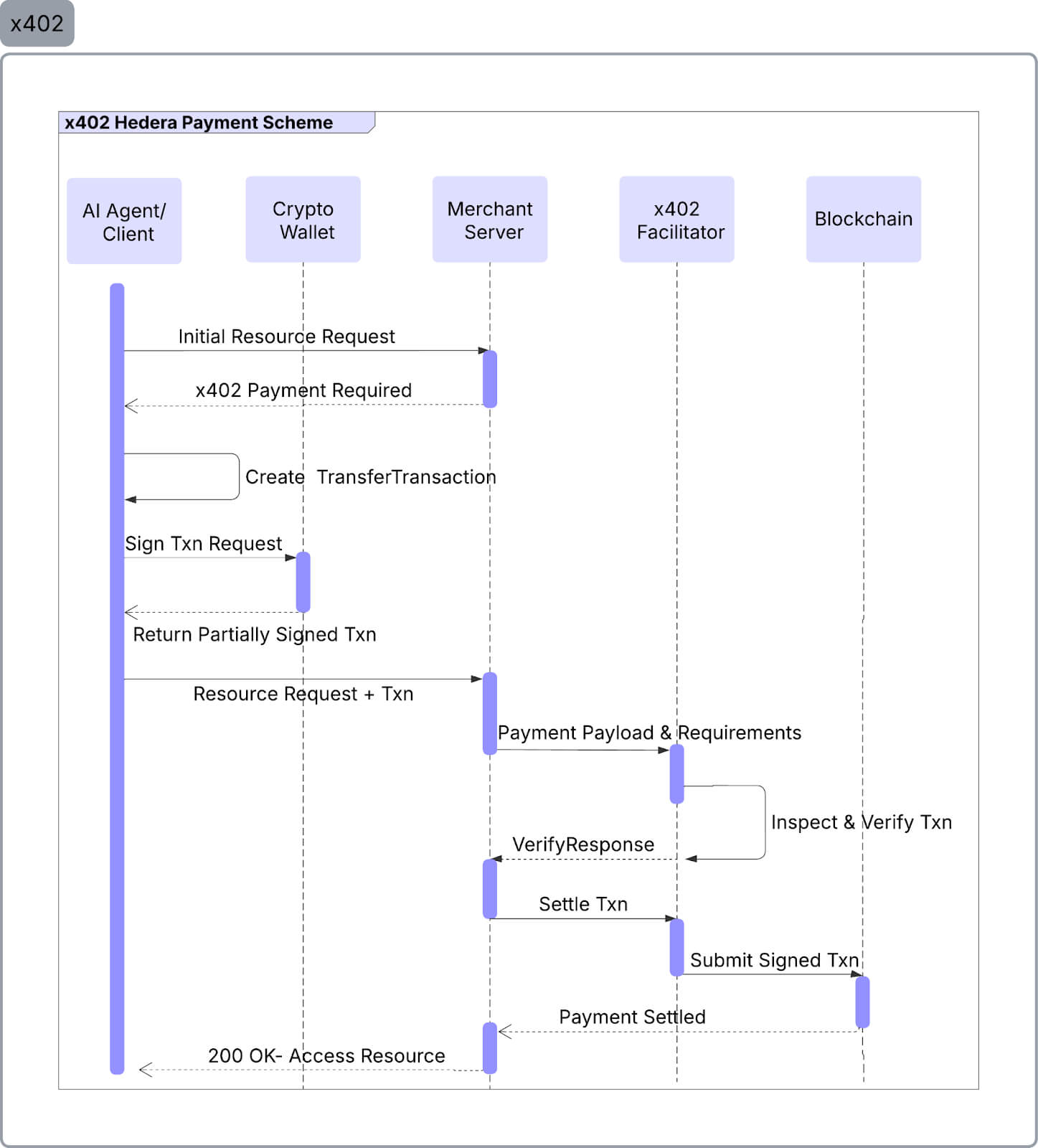
Hedera x402Image courtesy of Hedera.

Under this setup, once a client requests for any resource, such as access to a website, they will receive a 402 “payment required” message describing the cost of access. The payment is then made, before the partially signed transaction is forwarded to a facilitator, who then checks it and, after paying the gas, submits it to the Hedera blockchain for final settlement.

Facilitators handle the gas fees and where required, convert the cryptos if the payment is made in another token or a stablecoin held on another chain. One of the facilitators already available on the network is Blocky402, which offers similar services to other networks like Solana, Avalanche, Arbitrum, Base and Optimism.

AI Agent Payments on Hedera

Hedera becomes the latest blockchain to launch new services targeting AI agents. As we reported, Sui published a new post last month detailing why it’s the best network for the agentic AI economy, claiming it offers an execution environment that can coordinate multi-step actions between the agents and settle them in a single result.

ICP has launched the second version of its Caffeine AI platform, while Arbitrum and Polygon have expanded their AI infrastructure by supporting Ethereum’s ERC-8004 standard for communication between autonomous AI agents. Ethereum had announced a week earlier that this standard was launching on its mainnet.

While most networks have focused on identity and trustlessness, such as with Ethereum’s ERC-8004, Hedera says payments are a more critical aspect. Currently, most people would be hesitant to give AI agents access to their bank accounts. Those who decide to open a separate account for these agents with limited funds must contend with human identity checks, high fees, slow transactions and complex processes.

Digital assets solve this challenge, Walker stated, adding:

HBAR trades at $0.09404, gaining 7% in the past day to push its market cap above the $4 billion mark. In the past week, it has gained over 15% to recover some of the value lost in this month’s market wipeout.

]]>
Market Opportunity
RISE Logo
RISE Price(RISE)
$0.003557
$0.003557$0.003557
+1.25%
USD
RISE (RISE) Live Price Chart
Disclaimer: The articles reposted on this site are sourced from public platforms and are provided for informational purposes only. They do not necessarily reflect the views of MEXC. All rights remain with the original authors. If you believe any content infringes on third-party rights, please contact [email protected] for removal. MEXC makes no guarantees regarding the accuracy, completeness, or timeliness of the content and is not responsible for any actions taken based on the information provided. The content does not constitute financial, legal, or other professional advice, nor should it be considered a recommendation or endorsement by MEXC.

You May Also Like

Ethereum Foundation Leadership Update: Co-Director Tomasz Stańczak to Step Down

Ethereum Foundation Leadership Update: Co-Director Tomasz Stańczak to Step Down

The post Ethereum Foundation Leadership Update: Co-Director Tomasz Stańczak to Step Down appeared on BitcoinEthereumNews.com. Why StaÅ„czak is leaving Ethereum
Share
BitcoinEthereumNews2026/02/14 07:57
Circle Unveils Cross-Chain Transfer Protocol V2 on Stellar, Expanding USDC Interoperability

Circle Unveils Cross-Chain Transfer Protocol V2 on Stellar, Expanding USDC Interoperability

Circle announced that its Cross-Chain Transfer Protocol (CCTP) V2 is coming to the Stellar network, improving interoperability for USDC, the world’s leading regulated stablecoin. The upgrade will allow users to seamlessly transfer USDC between Stellar and more than 15 other blockchains, including Ethereum, Solana, and Base, unlocking deeper liquidity and wider use cases for the Stellar ecosystem. Seamless Cross-Chain Liquidity Historically, users faced challenges when moving USDC across different blockchains, often relying on custodial bridges or Circle accounts. Liquidity was fragmented, making it difficult to dynamically manage assets between ecosystems. With CCTP V2, Stellar becomes natively interoperable with every other CCTP-enabled blockchain. This integration allows USDC liquidity to flow freely, providing exchanges, wallets, and DeFi protocols with more efficient access. For decentralized exchanges (DEXs), this means better rates for traders, while centralized exchanges (CEXs) can consolidate liquidity rather than maintaining isolated pools. Programmable Transfers for Developers CCTP V2 isn’t just about liquidity—it also introduces programmability. Developers can embed cross-chain USDC transfers directly into their decentralized applications (dApps), enabling seamless integration with the Stellar network. Projects can even include metadata within transfers that can trigger autonomous actions on the destination chain via Hooks, opening up new possibilities for automation and innovation. By building on top of CCTP V2, developers can leverage Stellar’s strengths—fast, low-cost payments and robust offramping options—without having to design complex multi-chain liquidity strategies. This creates a unified development experience across chains and accelerates the adoption of cross-chain finance. Eliminating Bridge Risk with Native Transfers A key innovation of CCTP V2 is its 1:1 burning and minting process. Instead of relying on wrapped tokens or custodial intermediaries, USDC is burned on the source chain and minted natively on the destination chain. This model eliminates bridge risk, improves transaction security, and ensures settlement can occur in seconds. For users and businesses, this means simpler, safer, and faster movement of capital across chains. The efficiency of this model also boosts confidence for institutions that require predictable liquidity and compliance-grade infrastructure. Strengthening Stellar’s Global Payments Role The Stellar network already powers global payments with low fees, near-instant settlement, and a network of 475,000+ MoneyGram locations for fiat on- and off-ramps. With CCTP V2, Stellar extends its role in cross-border finance by linking directly to the broader multichain USDC ecosystem. This upgrade makes Stellar a hub for stablecoin liquidity while enabling new financial applications, from treasury management to cross-chain lending. As programmable money gains traction, CCTP V2 ensures Stellar remains at the forefront of innovation, bridging traditional payments with the multichain future
Share
CryptoNews2025/09/18 22:00
a16z's latest in-depth analysis of the AI ​​market: Is your company still operating at a loss?

a16z's latest in-depth analysis of the AI ​​market: Is your company still operating at a loss?

Author: Deep Thinking Circle Have you ever considered that the software industry might be undergoing a transformation even more dramatic than the shift from command
Share
PANews2026/02/14 08:12