Grayscale: Bitcoin Trades Like a Growth Asset, Not Digital Gold

Bitcoin’s long-standing narrative as “digital gold” is under renewed scrutiny as its price action increasingly mirrors that of higher-risk growth assets rather than serving as a traditional safe-haven harbor. Grayscale’s latest Market Byte examines this shift, arguing that the asset’s role in portfolios may be evolving in ways that reflect broader participation from institutional buyers, ETF activity, and shifting macro risk sentiment. While the research maintains that Bitcoin remains a long-term store of value due to its fixed supply and independence from central banks, it cautions that near-term behavior has diverged from gold and other precious metals, opening room for a rethinking of how the market categorizes the digital asset.
In the Grayscale analysis, the first-time reader-facing takeaway is that Bitcoin’s short-term price movements have not tracked gold’s recent rallies. The report notes that bullion and silver have surged to records even as Bitcoin has swooned, suggesting a decoupling from traditional safe-haven dynamics. Instead, Bitcoin’s price action has shown strong correlations with software equities, particularly since the start of 2024. That sector has faced sustained selling pressure amid fears that advances in artificial intelligence could disrupt or render many software services obsolete, amplifying concerns about growth equities’ durability in a high-rate environment.
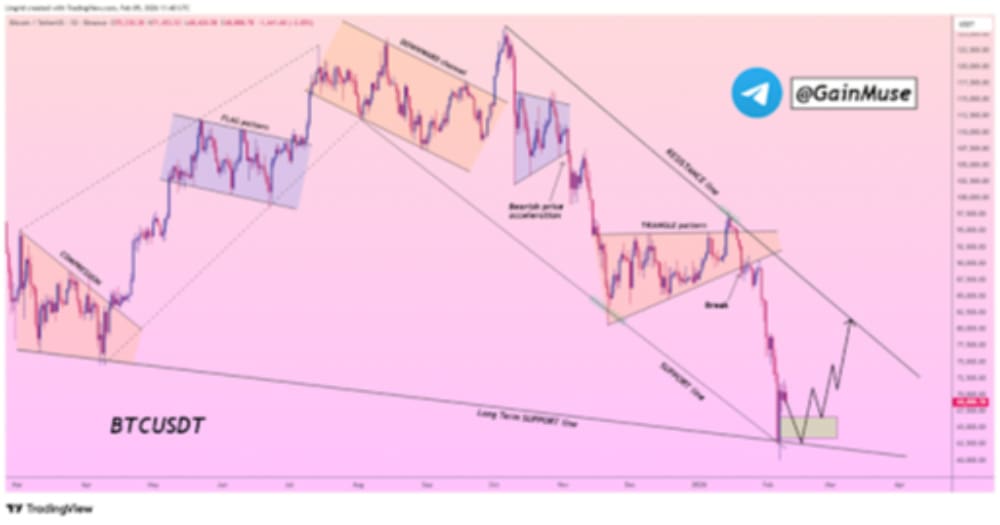
The charted narrative—one that Grayscale emphasizes with data and context—takes on added significance as the asset has logged a roughly 50% drawdown from its October peak that exceeded $126,000. The drawdown has unfolded in a string of waves, beginning with a historically large liquidation in October 2025, followed by renewed selling in late November and again in late January 2026. Grayscale highlights that persistent price discounts on major trading venues such as Coinbase reflect a broader selling impulse among U.S. participants, including “motivated” sellers who have contributed to the softer price dynamics in recent weeks. This backdrop is shaping a narrative in which Bitcoin’s path is increasingly tethered to the health of growth-oriented equities and the liquidity environment around ETFs and other traditional investment vehicles.
The Grayscale report frames these developments as part of Bitcoin’s ongoing evolution rather than a sudden policy failure of the asset’s core investment premise. Zach Pandl, the report’s author, notes that it would have been unrealistic to expect Bitcoin to supplant gold as a monetary asset in a short period of time. Gold’s long history as a monetary anchor—“used as money for thousands of years and serving as the backbone of the international monetary system until the early 1970s”—shadows Bitcoin’s current trajectory, but the author suggests that the digital asset could still contribute to monetary functions over time as the global economy digitizes further through AI, autonomous agents, and tokenized financial markets.
In broader market terms, the evolution described by Grayscale aligns with a trend toward deeper integration of digital assets into established financial markets. Institutional participation, ETF activity, and shifting risk sentiment are cited as key drivers behind Bitcoin’s greater sensitivity to equities and growth assets. The near-term outlook, therefore, hinges on the possibility of fresh capital reentering the market—whether through renewed inflows into Bitcoin-related exchange-traded products or renewed retail interest. Market watchers note that while AI-focused narratives have dominated sentiment in the meantime, a continuation of liquidity inflows could catalyze a partial rebound for crypto assets as macro conditions stabilize.
Despite the near-term softness, the report underscores a longer-term perspective. While Bitcoin’s monetary status remains a work in progress, its potential to assume a more prominent role in digital-first economies could intensify as tokenization of assets and on-chain finance expand. The analysis highlights that the ongoing transition toward tokenized markets, together with the growth of on-chain infrastructure for tokenized assets, might help Bitcoin solidify a more enduring store-of-value or medium-of-exchange function over time—even if such a shift does not materialize immediately.
From a practical standpoint, the near-term recovery hinges on capital inflows. Grayscale notes that ETF activity could serve as a meaningful catalyst should fresh inflows reappear, while retail participation—currently concentrated in AI and growth-driven equities—would need to broaden to crypto assets for a more robust upside. The research also points to ongoing market structure dynamics, including price discovery processes on major exchanges and the degree to which price gaps on venues like Coinbase reflect broader demand gaps in the crypto space. Taken together, these factors suggest Bitcoin’s path remains highly sensitive to macro risk appetite, regulatory signals, and the ebb and flow of liquidity across traditional and digital markets.
Key takeaways
- Bitcoin’s price action has shown stronger ties to growth equities, particularly software stocks, since early 2024, rather than mirroring traditional safe-haven assets like gold.
- The asset has experienced a ~50% drawdown from its October peak above $126,000, with declines unfolding in multiple waves including a major liquidation event in October 2025.
- Grayscale attributes some of the recent volatility to “motivated US sellers” and persistent price discounts on Coinbase, signaling liquidity and demand dynamics within the U.S. market.
- Institutional participation, ETF activity, and shifting macro risk sentiment are cited as factors intensifying Bitcoin’s sensitivity to the broader market environment.
- Although Bitcoin has not displaced gold as a monetary asset, its role could evolve as digital markets grow and tokenized financial systems mature.
Tickers mentioned: $BTC
Price impact: Negative. Bitcoin retraced about half of its October highs, underscoring a softer near-term price backdrop tied to risk-on selling and ETF flow dynamics.
Market context: The landscape for digital assets in 2026 is increasingly shaped by ETF inflows, institutional adoption, and a broader appetite for growth-centric equities, which can both buoy and dampen crypto markets depending on macro liquidity and risk sentiment.
Why it matters
The evolving relationship between Bitcoin and traditional financial assets matters for investors rethinking diversification in a digitizing economy. The Grayscale analysis indicates that Bitcoin remains a long-term store of value by design—its fixed supply and independence from central banking authorities still underpin its investment thesis—but the near-term price behavior reveals an asset whose risk profile is closely tied to broader market cycles. For institutions, the finding that Bitcoin correlates with growth equities adds nuance to portfolio construction, suggesting that crypto exposure may be most effective when paired with assets that can withstand higher interest-rate regimes or leveraged liquidity conditions.
From a market-building perspective, the evolution toward deeper integration with traditional finance could spur further product innovation and regulatory clarity. In a world where tokenized markets and AI-driven economies become more pervasive, Bitcoin’s potential to serve as a digital monetary component—though not guaranteed—could gain new relevance as investors seek hedges against macro uncertainties or asymmetric risk exposures. The Grayscale report highlights these dynamics without overselling the pace or inevitability of such a transition, anchoring expectations in observable market structures, ETF activity, and the behavior of major on-ramps like Coinbase.
What to watch next
- Monitor ETF inflows into Bitcoin-linked funds in the coming quarters to gauge potential liquidity-driven support.
- Track retail participation in crypto amid any renewed appetite for high-growth narratives and AI-related themes.
- Observe price action around major exchange on-ramps (e.g., Coinbase) for signs of demand normalization or persistent discounts.
- Watch for shifts in broader risk sentiment that could re-anchor Bitcoin’s correlations with growth equities rather than traditional safe havens.
- Assess regulation and institutional adoption milestones that might alter the pace of Bitcoin’s integration into mainstream portfolios.
Sources & verification
- Grayscale Market Byte on Bitcoin trading more like growth than gold, including references to Bitcoin’s correlation with software equities and macro risk sentiment.
- Historical price context, including the October 2025 liquidation event and subsequent selloffs in November 2025 and January 2026.
- Notes on price discounts at Coinbase and the role of U.S. sellers in recent weeks.
- Statements and framing around Bitcoin’s potential future monetary role amid digitalization and tokenized markets.
Bitcoin’s evolving role amid market dynamics
Bitcoin (CRYPTO: BTC) is navigating a shifting nexus where its core value proposition as a fixed-supply asset intersects with the realities of an increasingly liquid and regulated financial system. Grayscale’s analysis is careful to separate near-term price dynamics from the longer-term investment thesis. While the data show that Bitcoin has not yet displaced gold as a monetary anchor, the asset’s growing integration with institutional channels and exchange-traded products could, over time, reframe its place in diversified portfolios. The near-term backdrop remains a test of liquidity, risk appetite, and the willingness of capital to flow back into crypto as macro conditions evolve.
As markets digest these observations, industry participants will be watching whether Bitcoin can regain momentum through renewed ETF inflows or a revival of retail interest outside of AI and growth narratives. The coming months will reveal whether the current trend toward growth-equity sensitivity is a temporary anomaly or a signal of a deeper, structural revaluation of how crypto assets fit into a digitized, AI-enhanced financial ecosystem.
Ultimately, the conversation centers on duration and resilience: can Bitcoin sustain a longer-term store-of-value narrative while also fulfilling a functional role in a fast-evolving financial architecture? The Grayscale report suggests that both outcomes are possible, contingent on liquidity, regulatory clarity, and the pace at which tokenized finance expands beyond niche markets into mainstream capital allocations. The road ahead will require careful monitoring of price action, investor flow, and the health of risk markets—the triad that increasingly determines whether Bitcoin remains a sanctuary or a sophisticated, dynamic component of diversified portfolios.
This article was originally published as Grayscale: Bitcoin Trades Like a Growth Asset, Not Digital Gold on Crypto Breaking News – your trusted source for crypto news, Bitcoin news, and blockchain updates.
You May Also Like

Gold Hits $3,700 as Sprott’s Wong Says Dollar’s Store-of-Value Crown May Slip

Xenea Wallet Daily Quiz 11 February 2026: Claim Your Free Crypto Coins Now