Bitcoin’s roughly 50% drawdown has less to do with cycle déjà vu than a deeper break in the market’s old playbook, according to Jeff Park, partner and CIO at ProCapBitcoin’s roughly 50% drawdown has less to do with cycle déjà vu than a deeper break in the market’s old playbook, according to Jeff Park, partner and CIO at ProCap

Kevin Warsh Will Trigger Bitcoin Regime Shift, Jeff Park Says

2026/02/07 14:00
5 min read

Bitcoin’s roughly 50% drawdown has less to do with cycle déjà vu than a deeper break in the market’s old playbook, according to Jeff Park, partner and CIO at ProCap Financial, who argues a prospective Kevin Warsh-led Federal Reserve could catalyze a regime shift in how Bitcoin trades.

In an conversation with Anthony Pompliano, Park said he believes Bitcoin has been in a bear market “for quite a bit,” and warned that the familiar reflexive framework, easier policy, more liquidity, higher BTC, has stopped doing the explanatory work it once did.

What Kevin Warsh Means For Bitcoin

Park’s starting point was a blunt claim: the assumed linkage between Bitcoin and global liquidity has “been broken for quite some time.” He pointed to what he described as steadily rising global liquidity through 2025, citing Michael Howell’s tracking and estimating the level at roughly $170 trillion, alongside broad-based strength in other asset classes.

“Asset prices have all gone up,” Park said, referencing a “frenzied rally” in metals and corporate credit spreads near all-time lows, before adding: “there actually is a lot of reasons to think that Bitcoin should have also already participated, but it didn’t.”

That divergence, he argued, is why investors should stop leaning on backward-looking heuristics that have become psychological crutches. In his telling, crypto markets have repeatedly assumed history would re-run—altcoin rallies after bitcoin rallies, a durable four-year cycle, and the idea that QE or lower rates reliably lift BTC. “It’s worth remembering that there’s things that are constantly changing about the world where everything looks a little bit different than the way you had modeled it before,” he said.

From there, Park reframed the debate around his “negative rho” versus “positive rho” Bitcoin framework. The former is the risk-asset version most investors recognize: rates down, risk up, Bitcoin up. The latter is the endgame: Bitcoin rising as rates rise, effectively challenging the notion of a stable “risk-free” rate by calling into question the credibility of the monetary order itself.

“This is the mythical elusive perfect holy grail of what Bitcoin is meant to be,” Park said of positive-rho Bitcoin. “What it’s undermining is the risk-free rate itself. In that world, what we’re saying is actually because the risk-free rate is not the risk-free rate. Because the dollar hegemony is not the dollar hegemony and we are no longer able to price the yield curve in the ways we’ve known that means we need something different… and bitcoin is that hedge.”

Park suggested the market may be inching toward that worldview as US policymaking becomes more explicitly about system repair, not incremental tweaks. He described the current US administration as attempting to “wrestle control of the economy away from the Federal Reserve” via deregulation, tax cuts, tariffs, and efforts to weaken the dollar, leaving the Fed “on their back foot” amid shifting “tectonic plates” across policy channels.

That’s where Park placed Warsh, a former Fed governor and, in Park’s telling, a rare combination of institutional fluency and technological conviction, as potentially pivotal. Park recounted an interaction from 2021 or 2022 in which Warsh expressed enthusiasm for Bitcoin while criticizing “phonies” who treat tech as “magic.” Warsh, Park said, “truly believed deep in his heart that this isn’t magic… that it actually is going to solve a lot of problems and bring efficiencies and Bitcoin is a core part of that cultural fabric.”

Crucially, Park emphasized Warsh is not an anti-institution wrecking ball. Instead, he portrayed Warsh as someone who understands why the Fed’s legitimacy has been challenged and how it might be rebuilt. One line, Park said, has “always stuck” with him: “inflation is a choice.” Park contrasted that with Fed communication that, in his view, sometimes treats inflation as something that merely happens due to tariffs or war, rather than an outcome of policy tools and mandates.

For Park, a Warsh appointment matters less because it guarantees easier policy and more because it could accelerate a rethink of Fed–Treasury coordination. He said he is “optimistic about the possibility of a new Fed Treasury accord that Bessant and Warsh can rewrite,” arguing the heart of the issue is the Triffin dilemma and the tension between the dollar’s external reserve role and internal saver role. “It’s not that we need fed independence,” Park said. “We actually need Fed interdependence with the Treasury.”

The irony, in Park’s framing, is that “more accommodative policies may in fact actually not be the catalyst” for Bitcoin’s next bull phase. Instead, he argued Bitcoin’s bid ultimately strengthens when the world feels less like “peacetime” and more like “wartime”, when industrial, military, and fiscal policy dominate, centralization pressures rise, and capital controls become more plausible. The people who “need Bitcoin,” he said, are not US investors with endless alternatives, but those facing constraint and censorship.

If Park is right, Warsh isn’t bullish for Bitcoin because he’ll deliver a familiar liquidity wave. He’s bullish because a Warsh-era Fed, paired with a Treasury aligned on system-level reform, could push markets toward the “positive rho” regime, where Bitcoin’s value proposition is less about riding stimulus and more about challenging the architecture that made stimulus necessary in the first place.

At press time, BTC traded at $66,396.
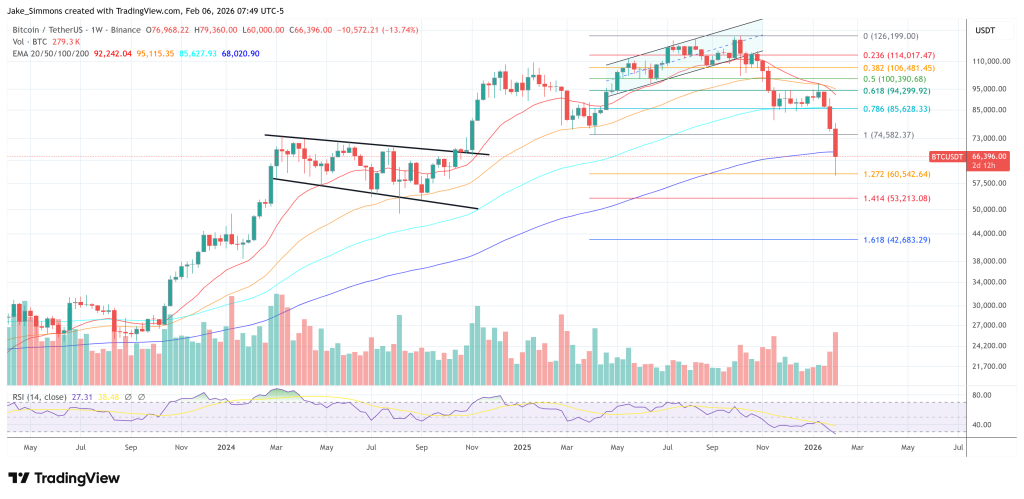
Bitcoin price chart
Market Opportunity
Notcoin Logo
Notcoin Price(NOT)
$0.0003987
$0.0003987$0.0003987
-2.32%
USD
Notcoin (NOT) Live Price Chart
Disclaimer: The articles reposted on this site are sourced from public platforms and are provided for informational purposes only. They do not necessarily reflect the views of MEXC. All rights remain with the original authors. If you believe any content infringes on third-party rights, please contact [email protected] for removal. MEXC makes no guarantees regarding the accuracy, completeness, or timeliness of the content and is not responsible for any actions taken based on the information provided. The content does not constitute financial, legal, or other professional advice, nor should it be considered a recommendation or endorsement by MEXC.

You May Also Like

HitPaw API is Integrated by Comfy for Professional Image and Video Enhancement to Global Creators

HitPaw API is Integrated by Comfy for Professional Image and Video Enhancement to Global Creators

SAN FRANCISCO, Feb. 7, 2026 /PRNewswire/ — HitPaw, a leader in AI-powered visual enhancement solutions, announced Comfy, a global content creation platform, is
Share
AI Journal2026/02/08 09:15
Journalist gives brutal review of Melania movie: 'Not a single person in the theater'

Journalist gives brutal review of Melania movie: 'Not a single person in the theater'

A Journalist gave a brutal review of the new Melania documentary, which has been criticized by those who say it won't make back the huge fees spent to make it,
Share
Rawstory2026/02/08 09:08
Facts Vs. Hype: Analyst Examines XRP Supply Shock Theory

Facts Vs. Hype: Analyst Examines XRP Supply Shock Theory

Prominent analyst Cheeky Crypto (203,000 followers on YouTube) set out to verify a fast-spreading claim that XRP’s circulating supply could “vanish overnight,” and his conclusion is more nuanced than the headline suggests: nothing in the ledger disappears, but the amount of XRP that is truly liquid could be far smaller than most dashboards imply—small enough, in his view, to set the stage for an abrupt liquidity squeeze if demand spikes. XRP Supply Shock? The video opens with the host acknowledging his own skepticism—“I woke up to a rumor that XRP supply could vanish overnight. Sounds crazy, right?”—before committing to test the thesis rather than dismiss it. He frames the exercise as an attempt to reconcile a long-standing critique (“XRP’s supply is too large for high prices”) with a rival view taking hold among prominent community voices: that much of the supply counted as “circulating” is effectively unavailable to trade. His first step is a straightforward data check. Pulling public figures, he finds CoinMarketCap showing roughly 59.6 billion XRP as circulating, while XRPScan reports about 64.7 billion. The divergence prompts what becomes the video’s key methodological point: different sources count “circulating” differently. Related Reading: Analyst Sounds Major XRP Warning: Last Chance To Get In As Accumulation Balloons As he explains it, the higher on-ledger number likely includes balances that aggregators exclude or treat as restricted, most notably Ripple’s programmatic escrow. He highlights that Ripple still “holds a chunk of XRP in escrow, about 35.3 billion XRP locked up across multiple wallets, with a nominal schedule of up to 1 billion released per month and unused portions commonly re-escrowed. Those coins exist and are accounted for on-ledger, but “they aren’t actually sitting on exchanges” and are not immediately available to buyers. In his words, “for all intents and purposes, that escrow stash is effectively off of the market.” From there, the analysis moves from headline “circulating supply” to the subtler concept of effective float. Beyond escrow, he argues that large strategic holders—banks, fintechs, or other whales—may sit on material balances without supplying order books. When you strip out escrow and these non-selling stashes, he says, “the effective circulating supply… is actually way smaller than the 59 or even 64 billion figure.” He cites community estimates in the “20 or 30 billion” range for what might be truly liquid at any given moment, while emphasizing that nobody has a precise number. That effective-float framing underpins the crux of his thesis: a potential supply shock if demand accelerates faster than fresh sell-side supply appears. “Price is a dance between supply and demand,” he says; if institutional or sovereign-scale users suddenly need XRP and “the market finds that there isn’t enough XRP readily available,” order books could thin out and prices could “shoot on up, sometimes violently.” His phrase “circulating supply could collapse overnight” is presented not as a claim that tokens are destroyed or removed from the ledger, but as a market-structure scenario in which available inventory to sell dries up quickly because holders won’t part with it. How Could The XRP Supply Shock Happen? On the demand side, he anchors the hypothetical to tokenization. He points to the “very early stages of something huge in finance”—on-chain tokenization of debt, stablecoins, CBDCs and even gold—and argues the XRP Ledger aims to be “the settlement layer” for those assets.He references Ripple CTO David Schwartz’s earlier comments about an XRPL pivot toward tokenized assets and notes that an institutional research shop (Bitwise) has framed XRP as a way to play the tokenization theme. In his construction, if “trillions of dollars in value” begin settling across XRPL rails, working inventories of XRP for bridging, liquidity and settlement could rise sharply, tightening effective float. Related Reading: XRP Bearish Signal: Whales Offload $486 Million In Asset To illustrate, he offers two analogies. First, the “concert tickets” model: you think there are 100,000 tickets (100B supply), but 50,000 are held by the promoter (escrow) and 30,000 by corporate buyers (whales), leaving only 20,000 for the public; if a million people want in, prices explode. Second, a comparison to Bitcoin’s halving: while XRP has no programmatic halving, he proposes that a sudden adoption wave could function like a de facto halving of available supply—“XRP’s version of a halving could actually be the adoption event.” He also updates the narrative context that long dogged XRP. Once derided for “too much supply,” he argues the script has “totally flipped.” He cites the current cycle’s optics—“XRP is sitting above $3 with a market cap north of around $180 billion”—as evidence that raw supply counts did not cap price as tightly as critics claimed, and as a backdrop for why a scarcity narrative is gaining traction. Still, he declines to publish targets or timelines, repeatedly stressing uncertainty and risk. “I’m not a financial adviser… cryptocurrencies are highly volatile,” he reminds viewers, adding that tokenization could take off “on some other platform,” unfold more slowly than enthusiasts expect, or fail to get to “sudden shock” scale. The verdict he offers is deliberately bound. The theory that “XRP supply could vanish overnight” is imprecise on its face; the ledger will not erase coins. But after examining dashboard methodologies, escrow mechanics and the behavior of large holders, he concludes that the effective float could be meaningfully smaller than headline supply figures, and that a fast-developing tokenization use case could, under the right conditions, stress that float. “Overnight is a dramatic way to put it,” he concedes. “The change could actually be very sudden when it comes.” At press time, XRP traded at $3.0198. Featured image created with DALL.E, chart from TradingView.com
Share
NewsBTC2025/09/18 11:00
