

Arizona Introduces Bill To Exempt Bitcoin and Crypto From Property Taxes
Bitcoin Magazine
Arizona Introduces Bill To Exempt Bitcoin and Crypto From Property Taxes
Arizona state Sen. Wendy Rogers has introduced a package of legislation aimed at reshaping how digital assets are treated under state and local tax law, renewing a broader push by some lawmakers to position Arizona as a jurisdiction with clearer and more favorable rules for cryptocurrencies and blockchain infrastructure.
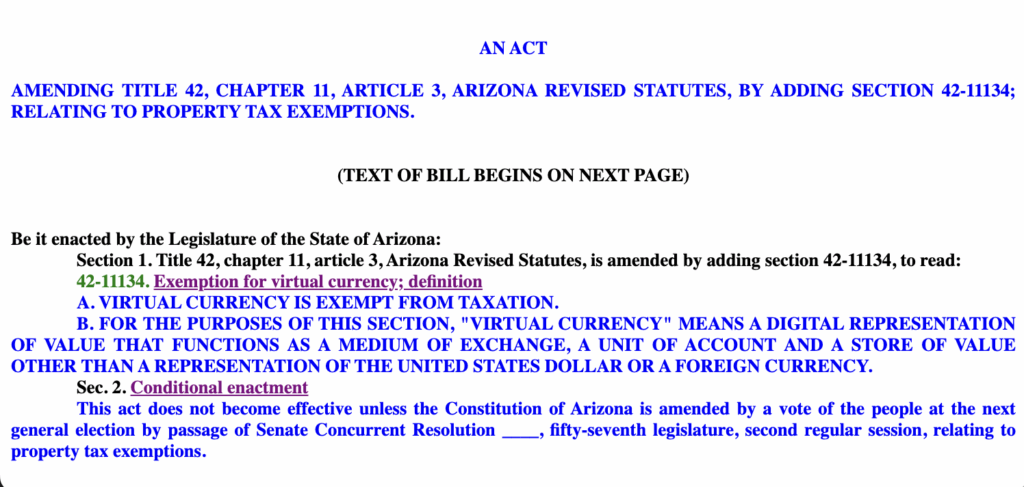
In bills prefiled with the Arizona Senate, Rogers proposed amending state statutes to exempt virtual currency from taxation (SB 1044), prohibiting counties, cities and towns from taxing or fining entities that operate blockchain nodes (SB 1045), and advancing a constitutional amendment to clarify how digital assets fit into Arizona’s property tax framework (SCR 1003).
The measures take different procedural paths. SB 1045, which focuses on protections for blockchain node operators, could move through the legislature and become law if approved by lawmakers and signed by the governor.
By contrast, SB 1044 and SCR 1003 are tied together and would ultimately require voter approval during the next general election in November 2026.
SCR 1003 proposes amending Arizona’s constitution to explicitly exclude virtual currency from property taxation. SB 1044 would mirror that change in state statutes, adding language that clarifies digital assets are not subject to property tax. Under Arizona law, changes to constitutional tax definitions must be approved by voters, making the ballot measure a central hurdle for the broader tax exemption effort.
SB 1045 addresses a narrower, but increasingly debated issue: the treatment of blockchain nodes at the local level. The bill would bar cities, towns and counties from imposing “a tax or fee on a person that runs a node on blockchain technology,” effectively preventing local governments from singling out node operators through taxes or penalties.
Arizona is one of many states embracing bitcoin and crypto
Arizona’s legislative activity around digital assets builds on earlier efforts that have already placed the state among a small group with crypto-specific laws on the books. Arizona is one of the few U.S. states that allows the government to take custody of digital assets deemed abandoned after three years.
That framework emerged from past attempts by crypto advocates to establish a state-level digital asset reserve and has since become part of a wider debate over how much authority states should have to hold or invest in cryptocurrencies such as bitcoin.
Rogers was previously a co-sponsor of a bitcoin reserve bill that was vetoed by Arizona Governor Katie Hobbs in May. Following the veto, Rogers criticized the decision and said she planned to refile similar legislation in a future session.
Arizona’s proposals arrive as states across the country experiment with different approaches to digital asset policy. New Hampshire and Texas have also enacted laws related to digital asset reserves, while other states have focused on narrower tax questions.
Ohio lawmakers advanced a bill that would exempt cryptocurrency transactions under $200 from capital gains taxes, though it has stalled since June.
In New York, a proposal to impose a 0.2% excise tax on digital asset transactions was referred to committee earlier this year and has not moved forward.
At the federal level, Sen. Cynthia Lummis of Wyoming introduced draft legislation proposing a de minimis exemption for digital asset transactions and capital gains of $300 or less.
Lummis announced on Friday that she plans to retire from the U.S. Senate in January 2027.
Bitcoin is trading at $87,341, down 3% over the past 24 hours. Its 24-hour trading volume is $46 B. The price is 3% below its 7-day high of $90,031 and 1% above its 7-day low of $86,806.
With a circulating supply of 19,966,021 BTC (out of a maximum 21 million), Bitcoin’s market cap stands at approximately $1.74 T, reflecting a 3% drop in the last 24 hours.
This post Arizona Introduces Bill To Exempt Bitcoin and Crypto From Property Taxes first appeared on Bitcoin Magazine and is written by Micah Zimmerman.
You May Also Like

Crypto Market Prediction: Is Shiba Inu (SHIB) Saved? XRP Can Enter New Year With Bull Run, Bitcoin (BTC): There's a Problem

Philippines Blocks Coinbase, Gemini Access; BTC Trading Faces Potential Disruptions
