Details the Q-Former architecture: a 12-layer BERT-based model using 32 learnable query embeddings. These queries use cross-attention to extract visual information for MLLM input.Details the Q-Former architecture: a 12-layer BERT-based model using 32 learnable query embeddings. These queries use cross-attention to extract visual information for MLLM input.

Visual Prompt Generation: Cross-Attention in Q-Former

Abstract and 1 Introduction

  1. Related Work

    2.1. Multimodal Learning

    2.2. Multiple Instance Learning

  2. Methodology

    3.1. Preliminaries and Notations

    3.2. Relations between Attention-based VPG and MIL

    3.3. MIVPG for Multiple Visual Inputs

    3.4. Unveiling Instance Correlation in MIVPG for Enhanced Multi-instance Scenarios

  3. Experiments and 4.1. General Setup

    4.2. Scenario 1: Samples with Single Image

    4.3. Scenario 2: Samples with Multiple Images, with Each Image as a General Embedding

    4.4. Scenario 3: Samples with Multiple Images, with Each Image Having Multiple Patches to be Considered and 4.5. Case Study

  4. Conclusion and References

\ Supplementary Material

A. Detailed Architecture of QFormer

B. Proof of Proposition

C. More Experiments

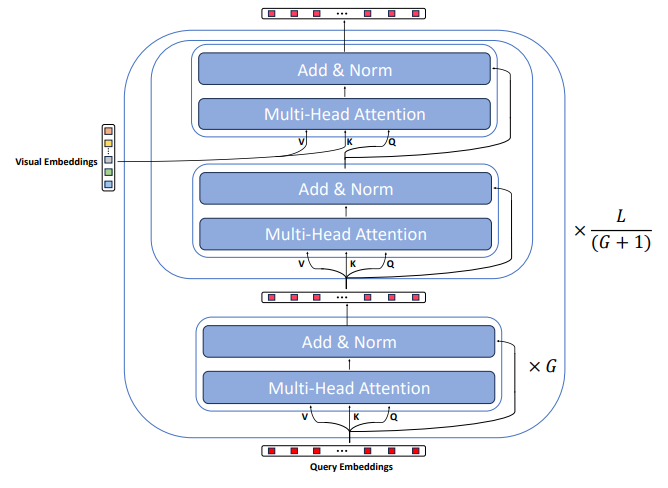
\ Figure 7. Overview of QFormer
A. Detailed Architecture of QFormer

The architecture overview is depicted in Figure 7. Specifically, QFormer is initialized as a BERT-based model[8] comprising a total of L = 12 layers. In contrast to typical BERT models that process textual inputs, QFormer takes R = 32 learnable query embeddings as inputs. These embeddings are utilized to extract visual information from the input visual data during Stage-1 pretraining in BLIP2[22]. Subsequently, they serve as visual prompt embeddings for the LLM inputs after projection.

\ Inside the QFormer, each layer includes a self-attention module composed of a Multi-Head Attention component and a Forward module (consisting of Linear, LayerNorm, and Residual Connection). The cross-attention module, initialized with random values, is inserted every G layers, where learnable query embeddings interact with visual embeddings. In the main paper, for the sake of conciseness, we condensed the representation of the multi-head attention and forward modules into self(cross) attention modules. Furthermore, we exclusively illustrated the modifications made to the cross-attention module in MIVPG, as the self-attention modules remain unchanged. The final QFormer output is represented by the last layer’s query embeddings.

\ For a more comprehensive understanding, readers are encouraged to refer to [22].

\

:::info Authors:

(1) Wenliang Zhong, The University of Texas at Arlington ([email protected]);

(2) Wenyi Wu, Amazon ([email protected]);

(3) Qi Li, Amazon ([email protected]);

(4) Rob Barton, Amazon ([email protected]);

(5) Boxin Du, Amazon ([email protected]);

(6) Shioulin Sam, Amazon ([email protected]);

(7) Karim Bouyarmane, Amazon ([email protected]);

(8) Ismail Tutar, Amazon ([email protected]);

(9) Junzhou Huang, The University of Texas at Arlington ([email protected]).

:::


:::info This paper is available on arxiv under CC by 4.0 Deed (Attribution 4.0 International) license.

:::

\

Market Opportunity
Prompt Logo
Prompt Price(PROMPT)
$0.04913
$0.04913$0.04913
+1.46%
USD
Prompt (PROMPT) Live Price Chart
Disclaimer: The articles reposted on this site are sourced from public platforms and are provided for informational purposes only. They do not necessarily reflect the views of MEXC. All rights remain with the original authors. If you believe any content infringes on third-party rights, please contact [email protected] for removal. MEXC makes no guarantees regarding the accuracy, completeness, or timeliness of the content and is not responsible for any actions taken based on the information provided. The content does not constitute financial, legal, or other professional advice, nor should it be considered a recommendation or endorsement by MEXC.

You May Also Like

The Rise of the Heli-Trek: How Fly-Out Adventures Are Redefining Everest Travel

The Rise of the Heli-Trek: How Fly-Out Adventures Are Redefining Everest Travel

Planning to embark on a Gokyo Ri Trek, Mera Peak, or Island Peak? Keep reading to know how the “Fly-Out” model is evolving Khumbu travel.  For a very long time,
Share
Techbullion2025/12/25 12:26
One Of Frank Sinatra’s Most Famous Albums Is Back In The Spotlight

One Of Frank Sinatra’s Most Famous Albums Is Back In The Spotlight

The post One Of Frank Sinatra’s Most Famous Albums Is Back In The Spotlight appeared on BitcoinEthereumNews.com. Frank Sinatra’s The World We Knew returns to the Jazz Albums and Traditional Jazz Albums charts, showing continued demand for his timeless music. Frank Sinatra performs on his TV special Frank Sinatra: A Man and his Music Bettmann Archive These days on the Billboard charts, Frank Sinatra’s music can always be found on the jazz-specific rankings. While the art he created when he was still working was pop at the time, and later classified as traditional pop, there is no such list for the latter format in America, and so his throwback projects and cuts appear on jazz lists instead. It’s on those charts where Sinatra rebounds this week, and one of his popular projects returns not to one, but two tallies at the same time, helping him increase the total amount of real estate he owns at the moment. Frank Sinatra’s The World We Knew Returns Sinatra’s The World We Knew is a top performer again, if only on the jazz lists. That set rebounds to No. 15 on the Traditional Jazz Albums chart and comes in at No. 20 on the all-encompassing Jazz Albums ranking after not appearing on either roster just last frame. The World We Knew’s All-Time Highs The World We Knew returns close to its all-time peak on both of those rosters. Sinatra’s classic has peaked at No. 11 on the Traditional Jazz Albums chart, just missing out on becoming another top 10 for the crooner. The set climbed all the way to No. 15 on the Jazz Albums tally and has now spent just under two months on the rosters. Frank Sinatra’s Album With Classic Hits Sinatra released The World We Knew in the summer of 1967. The title track, which on the album is actually known as “The World We Knew (Over and…
Share
BitcoinEthereumNews2025/09/18 00:02
Chris Burniske Forecasts Big Changes Coming to Cryptocurrency Market

Chris Burniske Forecasts Big Changes Coming to Cryptocurrency Market

TLDR Chris Burniske predicts that price flows will start driving crypto market narratives. Burniske foresees underperforming cryptocurrencies gaining more attention. Coinbase predicts growth in Q4 2025 driven by positive macroeconomic factors. Tom Lee suggests Bitcoin and Ethereum could benefit from potential Fed rate cuts. A major shift is looming in the cryptocurrency market, according to [...] The post Chris Burniske Forecasts Big Changes Coming to Cryptocurrency Market appeared first on CoinCentral.
Share
Coincentral2025/09/18 00:17
