

Bitcoin Holds As Gold Posts Worst Week Since 1983 Amid Iran War
Bitcoin quietly gained ground while gold crumbled. That contrast has become one of the more telling stories to emerge from weeks of escalating conflict in the Middle East, as the two assets — long compared as competing stores of value — have moved in sharply opposite directions since the US and Israel launched strikes on Iran in late February.
Bitcoin Climbs As Gold Bleeds
Since those first attacks, Bitcoin has risen more than 11% to around $70,650. Gold, meanwhile, has shed over 12% from its peak. Reports indicate the cryptocurrency has held up better than expected under the pressure of a widening war — a performance that has drawn attention in financial markets still trying to make sense of the conflict’s economic fallout.
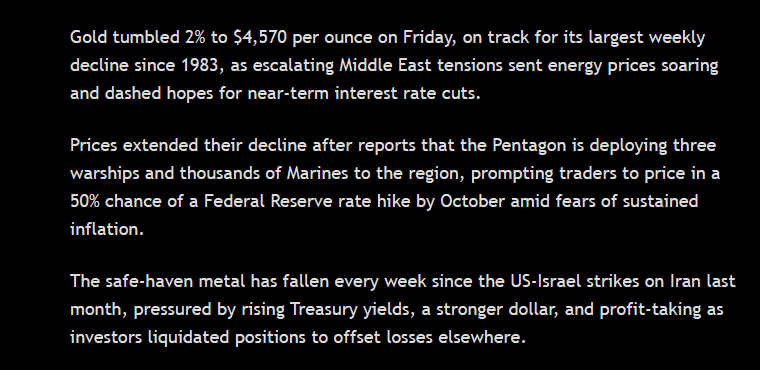
Gold’s losses accelerated this week. The metal dropped 3.4% on Friday alone, closing around $4,480 per ounce. For the full week of March 16-20, the decline reached 10% — the steepest weekly fall since 1983, according to data confirmed by TradingView.
It surpassed even the sharp drop seen in late January, when gold shed hundreds of dollars in a matter of days and wiped out more than $2 trillion in market value within weeks of hitting $5,500 per ounce.
That January plunge shocked investors. This one may have rattled them more.
Fed Signals No Rate Cuts, Adding Pressure On Gold
The Federal Reserve is adding to gold’s troubles. Fed Chair Jerome Powell said Wednesday that rising energy prices — driven in part by war-related disruptions in the Middle East — are expected to push inflation higher in the near term.
Traders have responded by pulling back expectations for rate cuts in 2025. Rates are now widely expected to hold steady through the year.
That shift matters for gold. When interest rates stay high, bonds and other yield-bearing instruments become more attractive by comparison.
Gold pays no interest. It earns nothing while it sits. Reports note that this dynamic has weighed on demand from institutional investors who might otherwise hold the metal as a hedge.
Trump Signals Possible Wind-Down Of Military PushThe Iran conflict has also disrupted oil flows through the Strait of Hormuz, one of the world’s most critical shipping corridors. That disruption has stoked fears of a prolonged energy crunch, adding more uncertainty to global markets already on edge.
US President Donald Trump said Friday he was considering pulling back from military operations in the region. At the same time, the US has deployed thousands of additional troops to the Middle East, and airstrikes have continued. The mixed signals have left markets guessing about what comes next.
Featured image from Unsplash, chart from TradingView
You May Also Like

Supported by hike speculation and PMIs – Danske Bank

The geopolitics of anti-corruption as global advisory firms face debarment in the Horn of Africa

BitGo wins BaFIN nod to offer regulated crypto trading in Europe
BitGo’s move creates further competition in a burgeoning European crypto market that is expected to generate $26 billion revenue this year, according to one estimate. BitGo, a digital asset infrastructure company with more than $100 billion in assets under custody, has received an extension of its license from Germany’s Federal Financial Supervisory Authority (BaFin), enabling it to offer crypto services to European investors. The company said its local subsidiary, BitGo Europe, can now provide custody, staking, transfer, and trading services. Institutional clients will also have access to an over-the-counter (OTC) trading desk and multiple liquidity venues.The extension builds on BitGo’s previous Markets-in-Crypto-Assets (MiCA) license, also issued by BaFIN, and adds trading to the existing custody, transfer and staking services. BitGo acquired its initial MiCA license in May 2025, which allowed it to offer certain services to traditional institutions and crypto native companies in the European Union.Read more
