Skale crypto price surged this week, reaching its highest level since February 1 after It Remains launched on its network.  Skale (SKL) token moved from a consolidation phase and surged by 170%, making it one of the best-performing coins this…Skale crypto price surged this week, reaching its highest level since February 1 after It Remains launched on its network.  Skale (SKL) token moved from a consolidation phase and surged by 170%, making it one of the best-performing coins this…

Here’s why the surging Skale crypto may crash 40% soon

2025/08/15 03:22

Skale crypto price surged this week, reaching its highest level since February 1 after It Remains launched on its network. 

Summary
  • Skale crypto price surged this week after the It Remains integration.
  • SKL has become highly overbought, pointing to a 40% plunge.

Skale (SKL) token moved from a consolidation phase and surged by 170%, making it one of the best-performing coins this week. The surge happened in a high-volume environment, with its 24-hour figure rising to $780 million, surpassing its market capitalization of $280 million. 

SKL price soared after It Remains, a popular Hollywood-level game launched on its network to take advantage of its gas-free transaction costs and fast speed. This launch will solidify Skale as one of the biggest chains in the crypto industry.

Data compiled by DappRadar shows that Skale has 129 games in its ecosystem. It had over 3.9 million unique active wallets in the last 30 days, a 23% increase. It also handled over 107 million transactions, higher than other top gaming chains like Sei and BSC. 

Why Skale crypto price may crash 

There are three main reasons why the soaring Skale may crash in the near term. First, sentiment in the crypto market has changed, with Bitcoin (BTC) and other top altcoins nosediving. The decline happened as liquidation jumped after the US published strong producer inflation data. A tumbling market often affects some of the best performers.

Second, SKL price will crash as the It Remains hype fades. In most cases, cryptocurrencies and stocks jump after a major event and then pull back as investors sell the news and look forward to the next big thing. 

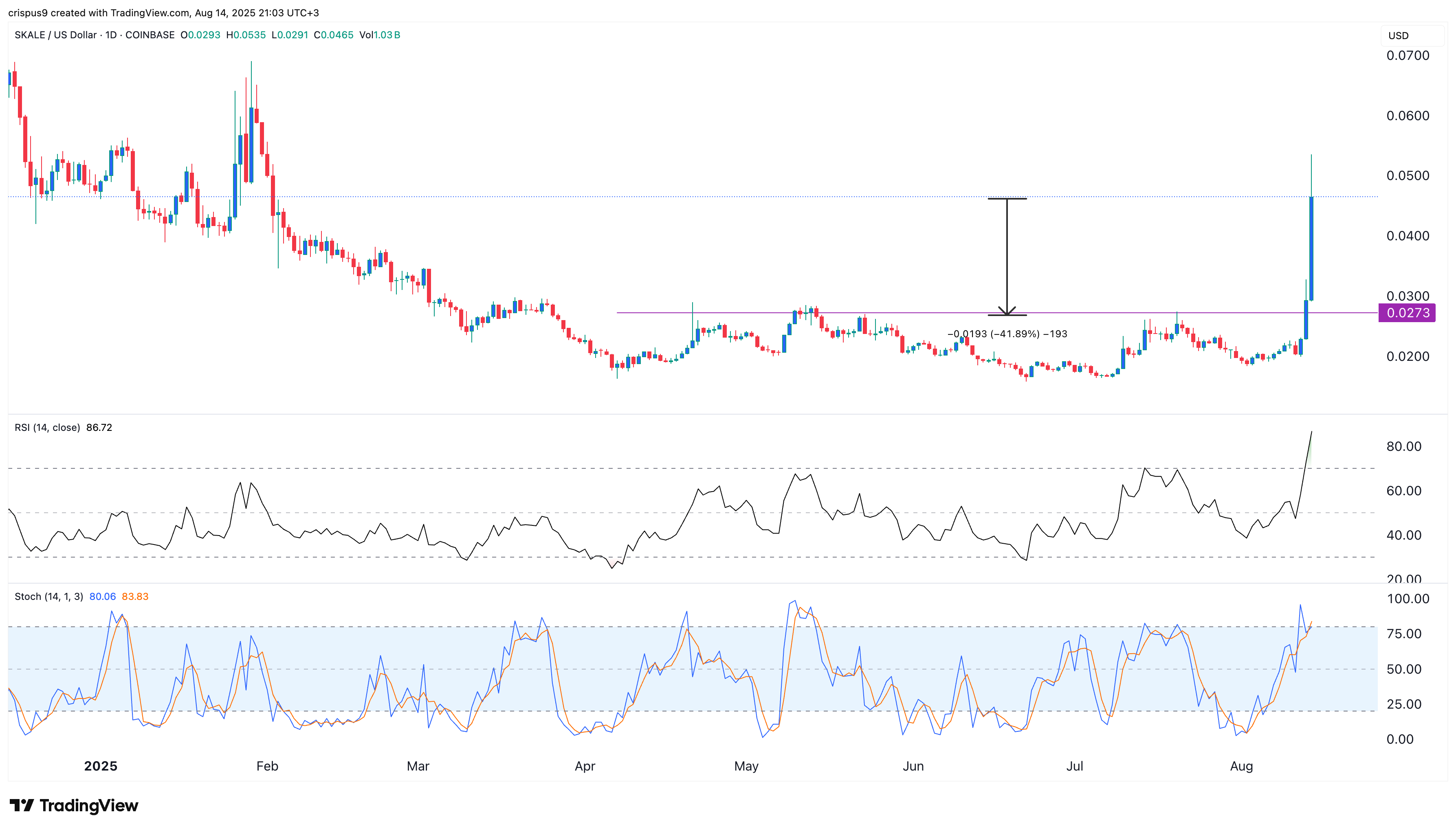
Third, technicals suggest that the price has become highly overbought. The Relative Strength Index jumped to the extreme overbought point at 86, while the Stochastic Oscillator moved to 83. A highly overbought asset tends to pull back as it loses momentum. 
Skale crypto price

Similarly, as the chart above shows, the token has moved higher than the 50-day and 100-day moving averages. As such, it could have a mean reversion, where it drops to get closer to these averages. If this happens, the potential target will be $0.027, its highest point in July and May, down by 40% from the current level. 

Disclaimer: The articles reposted on this site are sourced from public platforms and are provided for informational purposes only. They do not necessarily reflect the views of MEXC. All rights remain with the original authors. If you believe any content infringes on third-party rights, please contact [email protected] for removal. MEXC makes no guarantees regarding the accuracy, completeness, or timeliness of the content and is not responsible for any actions taken based on the information provided. The content does not constitute financial, legal, or other professional advice, nor should it be considered a recommendation or endorsement by MEXC.

You May Also Like

South Korea Revisits Crypto Exchange Liability Amid Hacking Risks

South Korea Revisits Crypto Exchange Liability Amid Hacking Risks

The post South Korea Revisits Crypto Exchange Liability Amid Hacking Risks appeared on BitcoinEthereumNews.com. Key Points: South Korea considers no-fault liability for virtual asset exchanges. Legislation aims to enhance operator accountability in cyber attacks. Pending fines could reach 3% of sales for hacking cases. South Korea’s Financial Services Commission is contemplating imposing no-fault liability on virtual asset operators for hacking-related damages, according to a Yonhap News Agency report on December 7. This potential legislation aligns virtual asset operators with financial institutions, impacting regulatory dynamics and market stability in South Korea’s evolving crypto sector. South Korea Targets Crypto Exchanges with 3% Sales Fines The Financial Services Commission (FSC) of South Korea is considering adding a clause to its draft legislation, imposing no-fault liability on virtual asset operators. This move follows a series of 20 computer incidents on top Korean won exchanges, emphasizing the need for enhanced security measures. The FSC aims to align virtual asset exchange liabilities with those of financial companies. South Korean lawmakers are debating stricter penalties, with proposed fines reaching 3% of sales revenue, paralleling measures in the Electronic Financial Transactions Act. Current maximum fines are capped at 5 billion won. This legislative shift reflects the government’s commitment to improving user protection and response strategies in the crypto sector. Industry reactions have been mixed. While there has been no official statement from major exchanges like Upbit and Bithumb, stakeholders are closely monitoring developments. Discussions on cryptocurrency forums and social media emphasize the potential impact on exchange compliance efforts and security enhancements. No-Fault Liability: Potential Game-Changer for Crypto Compliance Did you know? The concept of no-fault liability is already applied to South Korean banks for voice phishing cases, setting a precedent for proposed crypto exchange regulations. According to CoinMarketCap, Bitcoin (BTC), as of 06:31 UTC on December 7, 2025, has a market cap of $1.79 trillion. The 24-hour trading volume declined by 41.05%…
Share
BitcoinEthereumNews2025/12/07 14:37