

Here’s why the Illuvium’s ILV price is soaring
Illuvium token price surged for the third consecutive day, reaching its highest point since February 14 as the Pro League started.
- Illuvium price jumped after the developers released details of the Pro League.
- The event will run from August 3, with the main event ending in December.
- Technicals point to more upside, with the potential price target being at $41.
Illuvium (ILV) rose to a high of $23.65, up 160% from its lowest level this year. The surge came alongside a 3,200% spike in daily volume to $344 million, well above its $124 million market capitalization.
Illuvium Pro League kicks off
The ILV price spiked after the developers launched the 2025 edition of the Illuvium Pro League. The league will include three tournaments: IPL 250, IPL 500, and IPL 1000, with various qualification paths to the main event.
A two-point system will be in play: IPL points, earned from tournaments, and RLP, accumulated through the ranked ladder. The season begins August 16 and culminates in a world event in December.
IPL 250 will feature 32 players and a $2,000 prize pool. IPL 500 will host 64 players and offer $5,000, while the IPL 1000 will be an invite-only event with 64 players. Additional “last call” and “last chance” events will provide final opportunities to qualify.
The main event in December will involve 64 players, with 32 earning a payout from the total $250,000 prize pool.
ILV’s rally was also fueled by on-chain data showing increased accumulation by smart money investors. According to Nansen, these investors now hold over 91,000 ILV tokens, a significant rise from a month ago. Meanwhile, the ILV supply on exchanges has dropped from 2.81 million to 2.74 million.
Meanwhile, the supply of ILV tokens in exchanges has dropped to 2.74 million from last month’s high of 2.81 million.
ILV price surged after forming a double-bottom pattern
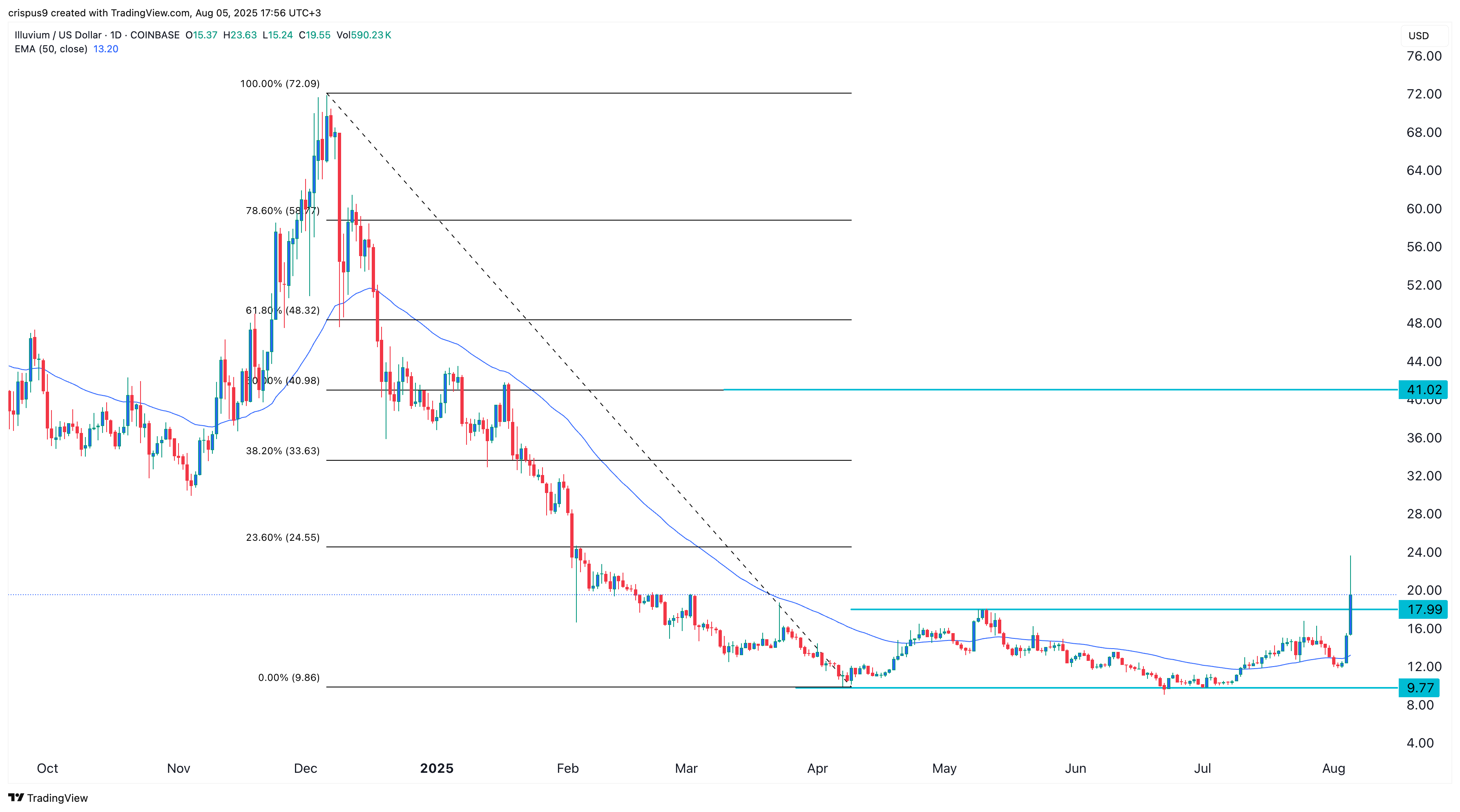
The daily chart shows that the ILV price dropped to a low of $9.7, where it formed a double-bottom pattern whose neckline was at $18, its highest point on May 10.
The token has since moved above its 50-day moving average and briefly crossed the 23.6% Fibonacci retracement level. The most likely scenario is continued upside leading into the tournament’s start, followed by a potential pullback.


You May Also Like

Gold Spot Volume on Binance Surges to $80M as Demand Extends Beyond Futures

WTI Oil eases to $87.50 amid a fragile US-Iran ceasefire




